
Autism & School
Understanding Autism in Education, School Support, Reasonable Adjustments, Attendance, EHCPs, Mental Health & Family Guidance
Autistic children and young people have the right to access education that is safe, inclusive and suited to their individual needs.
Every autistic learner is different, with their own strengths, interests, communication style and support needs. Schools, colleges and
education providers should work in partnership with families to
understand these needs and reduce barriers to learning.
An autism diagnosis is not required before a school can begin
providing appropriate SEND support or reasonable adjustments if needs have been identified.
This guide provides practical advice for children, parents, carers and professionals about autism in education, legal rights, evidence,
advocacy and support.
Understanding Autism in School
Autism is a lifelong neurodevelopmental difference that affects how a person experiences and interacts with the world. Every autistic child is unique.
Some autistic pupils may experience differences in:
- Communication
- Social interaction
- Sensory processing
- Emotional regulation
- Executive functioning (planning and organisation)
- Flexibility with routines
- Anxiety management
Many autistic children also have strengths such as:
- Excellent memory
- Strong attention to detail
- Creativity
- Honesty
- Deep interests and knowledge
- Logical thinking
- Problem-solving abilities
Schools should recognise both strengths and support needs.
Useful resources:
Autism and Learning
Autistic pupils may learn differently rather than being unable to learn.
Some learners may benefit from:
- Clear routines
- Visual timetables
- Step-by-step instructions
- Predictable classroom environments
- Extra processing time
- Quiet learning spaces
- Flexible teaching approaches
- Alternative communication methods
Teaching should be personalised to the individual rather than based on assumptions about autism.
School Support
Schools should identify needs early and provide appropriate support.
Support may include:
- SEN Support
- Individual learning plans
- Small group teaching
- Emotional regulation support
- Social communication support
- Safe spaces
- Sensory support
- Assistive technology
- Pastoral support
- Educational psychology input
Some children may require an Education, Health and Care Plan (EHCP) where SEN Support alone is not enough.
Reasonable Adjustments
Under the Equality Act 2010, schools have a duty to consider reasonable adjustments for disabled pupils, including many autistic children. These adjustments should reduce substantial disadvantages and help pupils access education fairly.
Possible adjustments include:
Sensory Support
- Quiet areas
- Ear defenders
- Reduced noise
- Alternative lighting
- Flexible seating
Communication Support
- Visual prompts
- Written instructions
- Extra thinking time
- Simplified language
Learning Support
- Chunked tasks
- Predictable routines
- Movement breaks
- Alternative methods of recording work
Social Support
- Safe adult
- Lunch clubs
- Structured breaktimes
- Peer mentoring
Assessment Support
- Extra time
- Rest breaks
- Separate room
- Access arrangements
Adjustments should reflect the child's individual needs rather than a standard autism checklist.
Sensory Differences
Many autistic pupils experience sensory differences.
They may be more sensitive or less sensitive to:
- Noise
- Light
- Smells
- Touch
- Temperature
- Crowds
Signs of sensory overload may include:
- Distress
- Withdrawal
- Difficulty communicating
- Covering ears
- Leaving situations
- Increased repetitive movements (stimming)
- Fatigue after school
Sensory overload is not the same as deliberate misbehaviour and should be understood within the context of the child's needs.
Anxiety and School Attendance
Many autistic pupils experience anxiety linked to:
- Sensory overload
- Unpredictable routines
- Social demands
- Bullying
- Academic pressure
- Change and transitions
This can contribute to:
- Distressed attendance
- Emotionally Based School Avoidance (EBSA)
- Reduced attendance
- School refusal
- Mental health difficulties
Support should focus on understanding the reasons behind attendance difficulties rather than relying solely on sanctions.
Useful resources:
Autism, Behaviour and Exclusions
Behaviour should always be considered in context.
Some behaviours may reflect:
- Anxiety
- Communication difficulties
- Sensory overload
- Unmet needs
- Distress
- Environmental pressures
Schools should consider whether appropriate support and reasonable adjustments have been provided before taking disciplinary action. Tribunal case law has reinforced the importance of considering reasonable adjustments for autistic pupils.
Useful resource:
Supporting Learning at Home
Parents and carers can help by:
- Using predictable routines
- Breaking homework into smaller steps
- Allowing movement breaks
- Using visual reminders
- Praising effort and progress
- Keeping communication positive
- Working with the school on shared strategies
Consistency is often more effective than perfection.
Autism and EHCPs
Some autistic children require an EHCP.
An EHCP may provide:
- Specialist teaching
- Therapy input
- Communication support
- Sensory provision
- Specialist placements
- Additional staffing
- Preparation for adulthood planning
Parents can request an Education, Health and Care needs assessment if they believe existing support is insufficient.
Useful resources:
Working with School
Positive partnership working often produces the best outcomes.
Parents may wish to:
- Share information about their child's needs
- Attend review meetings
- Keep written records
- Discuss adjustments
- Request regular communication
- Review support plans
- Raise concerns early
Schools should listen to the views of:
- The child
- Parents and carers
- Relevant professionals
Bullying
Autistic pupils may be at increased risk of bullying.
Schools should:
- Investigate concerns promptly
- Prevent disability-related bullying
- Support emotional wellbeing
- Make reasonable adjustments where appropriate
- Follow safeguarding procedures when necessary
Parents should report concerns in writing and keep copies of correspondence.
Mental Health and Wellbeing
Autistic children may experience:
- Anxiety
- Depression
- Burnout
- Low self-esteem
- Social isolation
Support may include:
- School counselling
- Mental health support
- CAMHS referrals where appropriate
- Safe spaces
- Wellbeing planning
- Family support
Useful resources:
Legal Rights
Autistic children may have rights under:
- Equality Act 2010
- Children and Families Act 2014
- SEND Code of Practice
- Human Rights Act 1998
- Education legislation
- Data protection legislation
These rights may include:
- Protection from disability discrimination
- Reasonable adjustments
- SEN Support
- EHCP assessments where appropriate
- Participation in decisions
- Accessible information
- Fair admissions
- Protection from unlawful exclusion
- Appeals and complaints
Useful resources:
Evidence Standards
Good evidence can support requests for adjustments, SEND support, EHCPs or complaints.
Useful evidence includes:
- School reports
- Attendance records
- Behaviour logs
- Parent diary
- Medical evidence
- Diagnostic reports (if available)
- Educational psychologist reports
- Emails
- Meeting notes
- Sensory assessments
- Examples of work
- Records of adjustments tried
Evidence should explain:
- What the difficulty is
- When it occurs
- Educational impact
- Support already provided
- Outcomes of previous interventions
- Adjustments requested
Accountability & Complaints
If concerns remain unresolved:
Step 1
Speak to:
- Class teacher
- Form tutor
- SENCO
- Pastoral lead
Step 2
Request written responses.
Step 3
Use the school's complaints procedure.
Step 4
Contact the local authority where appropriate.
Step 5
Appeal SEND decisions through the SEND Tribunal if applicable.
Step 6
Seek independent advice.
Useful organisations:
- Independent Provider of Special Education Advice (IPSEA)
- Contact
- Equality Advisory Support Service
- Local Government and Social Care Ombudsman
Advocacy & Independent Support
Families may find support from:
Quick Help Directory
Autism Information
SEND & Education
Legal Rights
Independent Advice
Mental Health
Key Message
Autistic children and young people have the right to an education that recognises their individual strengths, understands their differences and provides appropriate support. Schools should identify needs early, make reasonable adjustments where required, work collaboratively with families and create inclusive environments where autistic learners can participate safely and successfully. Families who have concerns should keep clear records, seek advice promptly and use review, complaint or appeal processes where necessary to ensure children receive the support they need.
Education, Health and Care Plans, Needs Assessments,
Reviews, Appeals, Rights, Evidence & Support
An Education, Health and Care Plan, known as an EHCP, is a legal document for children and young people aged 0 to 25 who need more support than is usually available through ordinary SEN Support.
An EHCP should describe a child or young person’s education, health and social care needs, the outcomes they are working towards, and the provision required to meet those needs.
1. What is an EHCP?
An EHCP is for children and young people with special educational needs or disabilities whose needs cannot reasonably be met through standard support in a nursery, school or college.
An EHCP may include:
- The child or young person’s views
- Parents’ or carers’ views
- Special educational needs
- Health needs linked to education
- Social care needs linked to education
- Outcomes
- Specific support required
- School, college or placement name
- Preparation for adulthood where appropriate
Useful links:
- EHCP overview: https://www.gov.uk/children-with-special-educational-needs/extra-SEN-help
- SEND guide for parents and carers: https://www.gov.uk/government/publications/send-guide-for-parents-and-carers
- SEND Code of Practice: https://www.gov.uk/government/publications/send-code-of-practice-0-to-25
2. Who Can Request an EHCP Needs Assessment?
An EHCP starts with an Education, Health and Care needs assessment.
A request can usually be made by:
- A parent or carer
- A young person aged 16 to 25
- A school or college
- A nursery or early years setting
- Professionals involved with the child
Parents and young people can request an assessment directly from the local authority.
Useful link:
- Find your local council: https://www.gov.uk/find-local-council
3. When to Request an EHCP Needs Assessment
A needs assessment may be appropriate when:
- The child is not making expected progress
- SEN Support is not enough
- Needs are complex or long-term
- The child needs specialist teaching
- The child needs therapy to access education
- Attendance is affected by unmet needs
- Behaviour may be linked to unmet SEND
- The child needs a specialist placement
- Several professionals are involved
- The child needs significant help to access learning safely
Evidence matters. The request should explain what support has already been tried, what remains difficult, and why an EHCP may be needed.
4. EHCP Needs Assessment Process
The local authority decides whether to assess.
If it agrees, it gathers advice and information from relevant people, which may include:
- Parents or carers
- Child or young person
- School, nursery or college
- Educational psychologist
- Health professionals
- Social care
- Speech and language therapy
- Occupational therapy
- Physiotherapy
- Specialist teachers
If the local authority refuses to assess, parents or young people may have the right to appeal.
Useful links:
- Appeal an EHCP decision: https://www.gov.uk/appeal-ehc-plan-decision
- SEND Tribunal: https://www.gov.uk/courts-tribunals/first-tier-tribunal-special-educational-needs-and-disability
5. Draft EHCP
If the local authority decides to issue an EHCP, it will send a draft plan.
Parents and young people should check whether the draft:
- Describes needs accurately
- Includes all professional advice
- Sets clear outcomes
- Specifies support clearly
- Names the right placement
- Includes health and social care needs where relevant
- Uses clear wording, not vague phrases
Avoid vague wording such as “access to,” “regular,” “as needed,” or “opportunities for” where specific provision is required.
6. Final EHCP
A final EHCP is legally binding.
The local authority must secure the special educational provision set out in the plan.
The named school or college must usually admit the child or young person, unless specific legal exceptions apply.
Keep a full copy of:
- Final EHCP
- Appendices
- Professional reports
- Decision letters
- Review documents
7. What Should an EHCP Include?
An EHCP is divided into sections.
Key sections include:
Section A: Views, Interests and Aspirations
The child, young person and family’s views.
Section B: Special Educational Needs
All identified special educational needs.
Section C: Health Needs
Health needs related to SEND.
Section D: Social Care Needs
Social care needs related to SEND.
Section E: Outcomes
What the child or young person is working towards.
Section F: Special Educational Provision
The support required. This should be specific and detailed.
Section G: Health Provision
Health support reasonably required by learning difficulties or disabilities.
Section H: Social Care Provision
Social care support.
Section I: Placement
The school, college or setting.
Section J: Personal Budget
Where applicable.
Section K: Advice and Information
Reports gathered during assessment.
8. EHCP Reviews
EHCPs must be kept up to date.
Reviews should consider:
- Progress
- Current needs
- Whether provision is working
- Whether outcomes need updating
- Whether the placement remains suitable
- Health and social care changes
- Preparation for adulthood
Parents and young people should receive paperwork in advance and be able to submit views.
9. EHCP Annual Reviews
An EHCP must normally be reviewed at least every 12 months.
Annual reviews should involve:
- School or college
- Parents or carers
- Child or young person
- Local authority
- Relevant professionals
Parents can prepare by:
- Reviewing the EHCP line by line
- Checking whether provision is being delivered
- Collecting evidence of progress or difficulties
- Submitting written views
- Asking for amendments
- Requesting updated professional advice if needed
10. EHCP Appeals
Parents and young people may appeal decisions such as:
- Refusal to assess
- Refusal to issue an EHCP
- Contents of the EHCP
- Named placement
- Ceasing to maintain an EHCP
Appeals go to the SEND Tribunal.
Useful links:
- Appeal an EHCP decision: https://www.gov.uk/appeal-ehc-plan-decision
- SEND Tribunal: https://www.gov.uk/courts-tribunals/first-tier-tribunal-special-educational-needs-and-disability
- IPSEA: https://www.ipsea.org.uk/
- SOS!SEN: https://www.sossen.org.uk/
11. Mediation
Before some SEND Tribunal appeals, families usually need to consider mediation.
Mediation can help resolve disputes about:
- Assessment decisions
- EHCP contents
- Provision
- Placement
Families do not have to reach agreement in mediation if they believe tribunal is necessary.
Useful link:
- Appeal an EHCP decision: https://www.gov.uk/appeal-ehc-plan-decision
12. EHCP and School Placement
An EHCP can name:
- Mainstream school
- Special school
- Specialist college
- Alternative provision
- Independent specialist placement where legally appropriate
Parents and young people can request a preferred placement.
The local authority must consider the request according to legal criteria.
Evidence should explain why the placement can meet needs.
13. EHCP and Home Education
Children with EHCPs can be home educated.
However, parents should understand how this may affect:
- Local authority duties
- Provision in the EHCP
- Annual reviews
- Specialist support
- Future school placement
Useful links:
- Home education: https://www.gov.uk/home-education
- Elective home education guidance: https://www.gov.uk/government/publications/elective-home-education
14. EHCP for Young People Aged 16 to 25
EHCPs may continue beyond school where the young person remains in education or training and legal criteria are met.
EHCPs can support:
- College
- Specialist college
- Supported internships
- Preparation for adulthood
- Independent living skills
- Employment pathways
- Community participation
Useful links:
- Supported internships: https://www.gov.uk/government/publications/supported-internships-for-young-people-with-learning-difficulties
- National Careers Service: https://nationalcareers.service.gov.uk/
15. Reasonable Adjustments and EHCPs
An EHCP does not replace disability rights.
A child or young person may also have rights to reasonable adjustments under equality law.
Examples include:
- Extra time
- Sensory adjustments
- Accessible materials
- Communication support
- Flexible routines
- Safe spaces
- Assistive technology
- Exam access arrangements
Useful links:
- Equality Act advice for schools: https://www.gov.uk/government/publications/equality-act-2010-advice-for-schools
- Equality Advisory Support Service: https://www.equalityadvisoryservice.com/
16. Legal Rights
EHCP rights may include:
- Right to request a needs assessment
- Right to receive a decision
- Right to be involved
- Right to appeal certain decisions
- Right to annual reviews
- Right to request amendments
- Right to request a placement
- Right to receive provision set out in the EHCP
- Protection from disability discrimination
- Right to accessible information where needed
Useful links:
- SEND Code of Practice: https://www.gov.uk/government/publications/send-code-of-practice-0-to-25
- SEND guide: https://www.gov.uk/government/publications/send-guide-for-parents-and-carers
- SEND Tribunal: https://www.gov.uk/courts-tribunals/first-tier-tribunal-special-educational-needs-and-disability
17. Evidence Standards
Strong evidence is important for EHCP requests, reviews and appeals.
Useful evidence includes:
- School reports
- SEN Support plans
- Progress data
- Attendance records
- Behaviour logs
- Medical reports
- Educational psychologist reports
- Speech and language therapy reports
- Occupational therapy reports
- CAMHS or mental health evidence
- Social care assessments
- Parent diary or timeline
- Child or young person’s views
- Emails showing concerns raised
- Evidence that support has not worked or is insufficient
A good evidence record should show:
- What the need is
- How it affects education
- What support has been tried
- What support is still needed
- What progress has or has not been made
- What outcome is being requested
18. Accountability and Complaints
If EHCP duties are not being met:
- Raise concerns with the school or college SENCO.
- Contact the local authority SEND team.
- Ask for written reasons or a written response.
- Keep all correspondence.
- Use the local authority complaints process where appropriate.
- Use SEND Tribunal for appealable decisions.
- Use the Local Government and Social Care Ombudsman for maladministration or delay where appropriate.
- Seek specialist advice.
Useful links:
- Complain about a school: https://www.gov.uk/complain-about-school
- Local Government and Social Care Ombudsman: https://www.lgo.org.uk/
- SEND Tribunal: https://www.gov.uk/courts-tribunals/first-tier-tribunal-special-educational-needs-and-disability
- IPSEA: https://www.ipsea.org.uk/
19. Advocacy and Support
Families can get help from:
- SENDIASS
- IPSEA
- SOS!SEN
- Contact
- Citizens Advice
- Disability Rights UK
- Local parent carer forums
Useful links:
- SENDIASS: https://councilfordisabledchildren.org.uk/information-advice-and-support-services-network
- IPSEA: https://www.ipsea.org.uk/
- SOS!SEN: https://www.sossen.org.uk/
- Contact: https://contact.org.uk/
- Citizens Advice: https://www.citizensadvice.org.uk/
- Disability Rights UK: https://www.disabilityrightsuk.org/
20. Quick Help Directory
EHCP information
https://www.gov.uk/children-with-special-educational-needs/extra-SEN-help
SEND guide
https://www.gov.uk/government/publications/send-guide-for-parents-and-carers
SEND Code of Practice
https://www.gov.uk/government/publications/send-code-of-practice-0-to-25
Find your local council
https://www.gov.uk/find-local-council
Appeal an EHCP decision
https://www.gov.uk/appeal-ehc-plan-decision
SEND Tribunal
https://www.gov.uk/courts-tribunals/first-tier-tribunal-special-educational-needs-and-disability
SENDIASS
https://councilfordisabledchildren.org.uk/information-advice-and-support-services-network
IPSEA
SOS!SEN
Contact
Ombudsman
Equality advice
https://www.equalityadvisoryservice.com/
Key Message
An EHCP is a legally important document designed to secure the right education, health and care support for a child or young person with significant SEND. Families should be involved at every stage, evidence should be clear and child-focused, and support should be specific, measurable and reviewed regularly. If decisions are delayed, unclear or unfair, parents and young people can seek advice, use complaints processes and appeal where the law allows.

Adult Learning
Adult Education, Returning to Learning, Digital Skills, Literacy, Numeracy, Community Learning, Skills Bootcamps & Free Courses
Adult learning can help people gain qualifications, improve
confidence, develop new skills, change careers, support family
learning, increase independence and improve employment
opportunities. Learning is available at all ages, whether you are
returning to education after many years, improving essential skills, seeking promotion, changing careers or learning for personal
development.
This guide provides information about adult education opportunities, financial support, legal rights, accessibility, evidence standards,
complaints procedures and accountability routes across the UK.
Understanding Adult Learning
Adult learning includes:
- Basic skills education
- Further Education
- Higher Education
- Professional qualifications
- Vocational training
- Apprenticeships
- Community learning
- Digital skills training
- Skills Bootcamps
- Distance learning
- Online learning
- Workplace training
Learning can take place through:
- Colleges
- Universities
- Adult education centres
- Community organisations
- Employers
- Online providers
- Local authorities
Adult Education
What is Adult Education?
Adult education refers to learning opportunities available after compulsory education, regardless of age.
Adult learners may study:
- English
- Mathematics
- Digital skills
- Vocational qualifications
- Access to Higher Education courses
- Professional qualifications
- Languages
- Health and wellbeing courses
- Creative subjects
Benefits may include:
- Improved employment prospects
- Increased confidence
- Career progression
- Personal development
- Better digital inclusion
- Greater independence
Useful Resources
Returning to Learning
Returning After Time Away from Education
Many adults return to education after:
- Raising a family
- Illness or disability
- Employment changes
- Redundancy
- Caring responsibilities
- Lack of previous opportunities
It is normal to feel nervous about returning to study.
Helpful steps include:
- Starting with short courses
- Speaking to an adviser
- Exploring funding options
- Identifying learning support needs
- Developing a study routine
Support Available
- Careers advice
- Learning support
- Disability support
- Financial assistance
- Study skills support
Useful Resources
Digital Skills
Why Digital Skills Matter
Digital skills are increasingly important for:
- Employment
- Education
- Accessing services
- Communication
- Online safety
- Financial management
Digital learning may cover:
- Online forms
- Word processing
- Spreadsheets
- Video calls
- Internet safety
- Artificial Intelligence awareness
- Online job applications
Useful Resources
- Essential Digital Skills
- Learn My Way
- Good Things Foundation
Literacy Support
English and Reading Support
Literacy support can help adults improve:
- Reading
- Writing
- Spelling
- Communication
- Workplace skills
- Confidence
Support may be available through:
- Colleges
- Community learning providers
- Adult education centres
- Online learning programmes
Useful Resources
Numeracy Support
Maths Skills for Everyday Life
Numeracy skills can help with:
- Budgeting
- Employment
- Qualifications
- Confidence
- Household finances
Support may include:
- Functional Skills Maths
- Community courses
- Online learning
- College programmes
Useful Resources
- Multiply Programme Information
- National Numeracy
Community Learning
Learning in the Community
Community learning provides flexible opportunities that may be:
- Free
- Low-cost
- Informal
- Local
Courses may include:
- English
- Maths
- Digital skills
- Health and wellbeing
- Arts and crafts
- Employability skills
- Family learning
Community learning can be particularly valuable for:
- Isolated adults
- Parents
- Older learners
- Disabled adults
- People rebuilding confidence
Useful Resources
Skills Bootcamps
What Are Skills Bootcamps?
Skills Bootcamps are flexible training programmes designed to help adults gain skills for employment and career progression.
Bootcamps may cover:
- Digital
- Construction
- Engineering
- Green skills
- Business
- Health and social care
- Leadership and management
Benefits may include:
- Free training for eligible learners
- Employer engagement
- Fast-track learning
- Job opportunities
Useful Resources
Free Courses
Free Learning Opportunities
Many adults may qualify for free education and training.
Opportunities may include:
- Free English courses
- Free maths courses
- Free digital skills courses
- Free Level 3 qualifications
- Skills Bootcamps
- Community learning
Eligibility depends on circumstances and location.
Useful Resources
Financial Support
Support may include:
- Advanced Learner Loans
- Student Finance
- Bursaries
- Hardship funds
- Disability support funding
- Travel support
Useful Resources
Disability & Accessibility Support
Adult learners may be entitled to:
- Reasonable adjustments
- Accessible learning materials
- Assistive technology
- Learning support
- Examination adjustments
- Disability-related funding
Useful Resources
Legal Rights
Adult learners may have rights relating to:
Equality Rights
Protection from discrimination under the Equality Act 2010.
Disability Rights
Access to reasonable adjustments and accessible learning.
Education Rights
Fair access to courses and support services.
Data Protection Rights
Access to personal records and educational information.
Consumer Rights
Clear information about courses, fees and services.
Useful Resources
Evidence Standards
If requesting support, funding, adjustments or making a complaint, useful evidence may include:
- Qualification records
- Learning assessments
- Medical evidence
- Disability evidence
- Funding applications
- Emails and correspondence
- Course information
- Attendance records
- Support plans
- Meeting notes
Keep copies of:
- Applications
- Decisions
- Appeals
- Complaints
- Supporting documentation
Evidence should be:
- Accurate
- Relevant
- Organised
- Dated
Accountability & Complaints
If concerns arise:
Step 1
Raise concerns with:
- Tutor
- Course provider
- Student support services
Step 2
Request written responses.
Step 3
Use the provider's complaints procedure.
Step 4
Seek independent advice.
Step 5
Escalate where appropriate.
Useful Resources
Advocacy & Independent Support
Useful organisations include:
- National Careers Service
- Citizens Advice
- Disability Rights UK
- Workers' Educational Association (WEA)
- AbilityNet
Quick Help Directory
Careers & Learning
Digital Skills
Literacy & Numeracy
Free Training
Financial Support
Accessibility Support
Key Message
It is never too late to learn. Adult education can help people gain qualifications, improve confidence, build skills, support employment and increase independence. Learners should have fair access to education, appropriate support, protection from discrimination and clear routes for raising concerns. Understanding your rights, keeping good records and seeking advice early can help you make the most of learning opportunities and achieve your personal, educational and career goals.
Safeguarding & Welfare
Education Welfare, Child Protection, Attendance Support, Early Help, Family Support, Safeguarding Leads & Multi-Agency Support
Safeguarding means protecting children and young people from harm and supporting their health, safety, development and wellbeing. Welfare support in education should help families access the right help early, reduce risks, improve attendance and ensure children can learn in a safe environment.
If a child is in immediate danger, call 999.
1. Education Welfare Services
Education Welfare Services usually support schools, children and families with attendance, welfare and barriers to education.
They may help with:
- Attendance concerns
- Persistent absence
- School refusal or EBSA
- Family difficulties affecting education
- Safeguarding concerns
- Children missing education
- Support planning
- Referrals to other services
Useful links:
- School attendance and absence: https://www.gov.uk/school-attendance-absence
- Working together to improve school attendance: https://www.gov.uk/government/publications/working-together-to-improve-school-attendance
- Find your local council: https://www.gov.uk/find-local-council
2. Child Protection
Child protection applies where a child may be suffering, or is likely to suffer, significant harm.
Concerns may include:
- Physical abuse
- Emotional abuse
- Sexual abuse
- Neglect
- Domestic abuse exposure
- Exploitation
- Online abuse
- Serious bullying
- Harmful sexual behaviour
- Radicalisation concerns
Useful links:
- Report child abuse to local council: https://www.gov.uk/report-child-abuse-to-local-council
- NSPCC: https://www.nspcc.org.uk/
- Childline: https://www.childline.org.uk/
3. Attendance Support
Attendance difficulties should be explored carefully. Absence may be linked to illness, SEND, disability, mental health, bullying, family crisis, transport problems, caring responsibilities or safeguarding issues.
Support may include:
- Attendance meetings
- Early help assessment
- Reintegration plans
- Reasonable adjustments
- SEND review
- Mental health referral
- Medical needs planning
- Alternative education where required
Useful links:
- School attendance: https://www.gov.uk/school-attendance-absence
- Mental health and attendance guidance: https://www.gov.uk/government/publications/mental-health-issues-affecting-a-pupils-attendance-guidance-for-schools
- Education for children with health needs: https://www.gov.uk/government/publications/education-for-children-with-health-needs-who-cannot-attend-school
4. Early Help
Early Help means support offered before problems become more serious. It is not about blame; it is about helping families at the right time.
Early Help may support:
- Parenting stress
- Attendance concerns
- Behaviour difficulties
- Mental health needs
- Housing or financial pressure
- Family conflict
- SEND-related difficulties
- Domestic abuse concerns
- Young carers
- Bereavement
Useful links:
- Find local council support: https://www.gov.uk/find-local-council
- Family Hubs and Start for Life: https://www.gov.uk/government/collections/family-hubs-and-start-for-life-programme
- Family Lives: https://www.familylives.org.uk/
5. Family Support
Family support services can help families manage practical, emotional and educational challenges.
Support may include:
- Family support workers
- Parenting programmes
- Youth services
- Housing and money advice
- SEND support
- Mental health support
- Domestic abuse support
- Food and welfare help
- Community groups
Useful links:
- Family Hubs: https://www.gov.uk/government/collections/family-hubs-and-start-for-life-programme
- Citizens Advice: https://www.citizensadvice.org.uk/
- Turn2us: https://www.turn2us.org.uk/
- NHS mental health: https://www.nhs.uk/mental-health/
6. School Safeguarding Leads
Schools and colleges should have a Designated Safeguarding Lead, often called a DSL. The DSL is responsible for safeguarding concerns, referrals, records and liaison with other agencies.
Parents and carers can ask:
- Who is the Designated Safeguarding Lead?
- What is the safeguarding policy?
- Has my concern been recorded?
- What action will be taken?
- Who will update me?
- What support is available for my child?
- What happens next?
Useful links:
- Keeping children safe in education: https://www.gov.uk/government/publications/keeping-children-safe-in-education--2
- School safeguarding guidance: https://www.gov.uk/topic/schools-colleges-childrens-services/safeguarding-children
7. Multi-Agency Support
Some children and families need joined-up support from more than one service.
Multi-agency support may involve:
- School
- Local authority
- Social care
- Health visitor
- GP
- CAMHS or mental health services
- Police
- Youth services
- SEND services
- Housing support
- Domestic abuse services
- Voluntary organisations
Good multi-agency working should be coordinated, respectful and focused on the child’s safety and wellbeing.
8. Legal Rights
Children and families may have rights relating to:
- Protection from harm
- Safe education
- Safeguarding referrals where needed
- Attendance support
- SEND support
- Reasonable adjustments
- Support for health needs
- Protection from discrimination
- Access to complaints procedures
- Data protection and access to records
Useful links:
- Keeping children safe in education: https://www.gov.uk/government/publications/keeping-children-safe-in-education--2
- SEND guide: https://www.gov.uk/government/publications/send-guide-for-parents-and-carers
- Equality Act school guidance: https://www.gov.uk/government/publications/equality-act-2010-advice-for-schools
- ICO data rights: https://ico.org.uk/for-the-public/
9. Evidence Standards
When raising safeguarding or welfare concerns, keep evidence clear and factual.
Useful evidence includes:
- Dates and times
- Names of people involved
- School emails
- Attendance records
- Behaviour logs
- Medical letters
- Photos of injuries or damage, where appropriate
- Screenshots of messages
- Incident reports
- Police reference numbers
- Social care reference numbers
- Meeting notes
- Copies of action plans
A strong concern report should include:
- What happened
- When it happened
- Who was involved
- Immediate safety concerns
- Impact on the child
- What help is needed
- What action has already been taken
Do not delay reporting urgent concerns while gathering evidence.
10. Accountability & Complaints
If safeguarding or welfare concerns are not handled properly:
- Contact the school Designated Safeguarding Lead.
- Escalate to the headteacher or principal.
- Use the school complaints procedure where appropriate.
- Contact children’s social care through the local council if a child may be at risk.
- Contact police if a crime or immediate danger is involved.
- Escalate to governors, academy trust or local authority where relevant.
- Contact Ofsted if the concern relates to wider safeguarding standards.
- Seek independent advice.
Useful links:
- Complain about a school: https://www.gov.uk/complain-about-school
- Report child abuse to local council: https://www.gov.uk/report-child-abuse-to-local-council
- Ofsted complaints: https://complain.ofsted.gov.uk/
- Local Government and Social Care Ombudsman: https://www.lgo.org.uk/
11. Quick Help Directory
Immediate danger
999
Report child abuse to local council
https://www.gov.uk/report-child-abuse-to-local-council
Keeping children safe in education
https://www.gov.uk/government/publications/keeping-children-safe-in-education--2
School attendance
https://www.gov.uk/school-attendance-absence
Education for health needs
Family Hubs
https://www.gov.uk/government/collections/family-hubs-and-start-for-life-programme
NSPCC
Childline
Citizens Advice
https://www.citizensadvice.org.uk/
School complaints
https://www.gov.uk/complain-about-school
Ombudsman
Key Message
Safeguarding and welfare support should protect children, reduce barriers to education and help families access the right support early. Concerns should be listened to, recorded and acted on appropriately. Families should report urgent risks immediately, keep clear evidence where possible and use escalation routes when support or protection is not adequate.
Parent & Family Support
Supporting Learning at Home, Parents' Evenings, School Meetings, Family Support, Separation, Additional Needs & Parent Advocacy
Parents, carers and families play a vital role in a child's education, wellbeing and future opportunities. Positive partnerships between families, schools, colleges and other services can help children and young people thrive academically, socially and emotionally.
This guide provides practical advice, legal rights information,
accessible support services, evidence standards, advocacy guidance and accountability routes for parents, carers and families across the UK.
Important: Families come in many forms, including single-parent
families, blended families, kinship carers, foster carers, adoptive
families, grandparents raising children and families with shared
parental responsibility. This guide is intended to support all families equally.
Supporting Learning at Home
Why Home Learning Support Matters
Children often benefit when families are actively involved in education.
Support does not require parents to be teachers. Small, consistent actions can make a significant difference.
Examples include:
- Encouraging reading
- Talking about learning
- Helping with routines
- Supporting homework where appropriate
- Encouraging attendance
- Promoting healthy sleep
- Supporting emotional wellbeing
- Celebrating effort and progress
Practical Tips
- Create a quiet learning space if possible.
- Establish routines.
- Encourage curiosity and questions.
- Focus on progress rather than perfection.
- Maintain regular communication with school.
Useful resources:
- BBC Bitesize:
https://www.bbc.co.uk/bitesize - Oak National Academy:
https://www.thenational.academy/ - National Literacy Trust:
https://literacytrust.org.uk/
Parents' Evenings
What Are Parents' Evenings?
Parents' evenings provide opportunities to discuss:
- Academic progress
- Attendance
- Behaviour
- Wellbeing
- SEND support
- Future goals
Parents should feel able to:
- Ask questions
- Request clarification
- Discuss concerns
- Share information about home circumstances
Questions You May Wish to Ask
- How is my child progressing?
- What are their strengths?
- Are there any concerns?
- What support is available?
- What can we do at home?
- How is attendance affecting progress?
- Are there wellbeing concerns?
Take notes during meetings where possible.
School Meetings
Understanding School Meetings
Schools may arrange meetings regarding:
- Progress reviews
- Attendance concerns
- SEND support
- Behaviour concerns
- EHCP reviews
- Safeguarding matters
- Transition planning
Preparing for Meetings
Before attending:
- Read any documents provided
- Write down questions
- Bring relevant evidence
- Consider bringing an advocate if appropriate
- Keep copies of correspondence
After meetings:
- Request written notes if available
- Record agreed actions
- Monitor progress
Education During Separation
Supporting Children During Family Changes
Parental separation can affect education, attendance, behaviour and wellbeing.
Children may experience:
- Anxiety
- Confusion
- Changes in routine
- Emotional distress
- Concentration difficulties
Schools should be informed of significant changes where appropriate.
Helpful Approaches
- Maintain consistent communication.
- Avoid involving children in adult disputes.
- Share relevant information with school.
- Focus on the child's needs.
- Encourage emotional support.
Useful resources:
- Citizens Advice:
https://www.citizensadvice.org.uk/ - Family Lives:
https://www.familylives.org.uk/ - Cafcass:
https://www.cafcass.gov.uk/
Supporting Additional Needs
Children with SEND or Disabilities
Families may need additional support when children have:
- Autism
- ADHD
- Dyslexia
- Dyspraxia
- Learning disabilities
- Physical disabilities
- Sensory impairments
- Mental health difficulties
Parents can:
- Work with the SENCO
- Request assessments
- Participate in reviews
- Keep records
- Seek independent advice
Useful links:
- SEND Guide:
https://www.gov.uk/government/publications/send-guide-for-parents-and-carers - SEND Code of Practice:
https://www.gov.uk/government/publications/send-code-of-practice-0-to-25 - Contact:
https://contact.org.uk/ - IPSEA:
https://www.ipsea.org.uk/
Family Support Services
Early Help & Family Support
Families may benefit from support when facing challenges relating to:
- Education
- Attendance
- SEND
- Mental health
- Housing
- Finances
- Parenting
- Family relationships
Services may include:
Early Help Services
Support before problems become more serious.
Family Hubs
Local support for families.
Parenting Programmes
Practical parenting support.
Youth Services
Support for young people.
Useful links:
- Family Hubs:
https://www.gov.uk/guidance/family-hubs-and-start-for-life-programme - Find Local Council:
https://www.gov.uk/find-local-council - Family Lives:
https://www.familylives.org.uk/
Parent Support Groups
Peer Support for Families
Many families find support through local or national groups.
Benefits may include:
- Shared experiences
- Emotional support
- Information sharing
- Advocacy advice
- Community connections
Support groups may focus on:
- SEND
- Autism
- ADHD
- Disability
- Mental health
- Home education
- School attendance
- Family wellbeing
Useful organisations:
Contact
National Autistic Society
ADHD UK
Mencap
Family Lives
https://www.familylives.org.uk/
Parent Rights in Education
Parents and carers may have rights to:
- Receive information from schools
- Participate in educational decisions
- Attend meetings
- Request records
- Raise concerns
- Access complaints procedures
- Request SEND assessments
- Challenge certain decisions
- Receive information in accessible formats
Useful links:
- Education Information:
https://www.gov.uk/browse/education - School Complaints:
https://www.gov.uk/complain-about-school
Family Wellbeing & Mental Health
Parents and carers also need support.
Family wellbeing can affect:
- Attendance
- Learning
- Behaviour
- Relationships
- Emotional health
Support may be available through:
- GPs
- NHS services
- Family support organisations
- Local authorities
- Charities
Useful links:
- NHS Mental Health:
https://www.nhs.uk/mental-health/ - Mind:
https://www.mind.org.uk/ - Family Lives:
https://www.familylives.org.uk/
Legal Rights
Parents and families may have rights relating to:
Education
- Participation in educational decisions
- Access to information
- School admissions processes
SEND
- Assessments
- EHCP processes
- Appeals
- Reviews
Equality
Protection from discrimination.
Data Protection
Access to personal information and educational records.
Useful links:
- Equality Act Guidance:
https://www.gov.uk/guidance/equality-act-2010-guidance - ICO:
https://ico.org.uk/for-the-public/ - SEND Tribunal:
https://www.gov.uk/courts-tribunals/first-tier-tribunal-special-educational-needs-and-disability
Evidence Standards
Good record-keeping can help families advocate effectively.
Useful records include:
- School reports
- Attendance records
- SEND documentation
- EHCP paperwork
- Meeting notes
- Emails
- Letters
- Medical evidence
- Behaviour records
- School communications
Good Evidence Practice
Keep:
- Dates
- Names
- Agreed actions
- Outcomes
- Copies of correspondence
Evidence should be:
- Accurate
- Relevant
- Organised
- Child-focused
Accountability & Escalation
If concerns are not resolved:
School Level
- Teacher
- Form Tutor
- SENCO
- Headteacher
Governance Level
- Governors
- Academy Trust
Local Authority
- Education Services
- SEND Teams
- Complaints Teams
Independent Routes
- Ombudsman
- SEND Tribunal
- Equality Advisory Support Service
Useful links:
- Complain About a School:
https://www.gov.uk/complain-about-school - Local Government and Social Care Ombudsman:
https://www.lgo.org.uk/ - Equality Advisory Support Service:
https://www.equalityadvisoryservice.com/
Advocacy & Independent Advice
Useful organisations include:
Citizens Advice
https://www.citizensadvice.org.uk/
Contact
IPSEA
Family Lives
https://www.familylives.org.uk/
SENDIASS
https://councilfordisabledchildren.org.uk/information-advice-and-support-services-network
Quick Help Directory
Family Hubs
https://www.gov.uk/guidance/family-hubs-and-start-for-life-programme
Family Lives
https://www.familylives.org.uk/
Contact
SEND Guide
https://www.gov.uk/government/publications/send-guide-for-parents-and-carers
SEND Code of Practice
https://www.gov.uk/government/publications/send-code-of-practice-0-to-25
IPSEA
NHS Mental Health
https://www.nhs.uk/mental-health/
School Complaints
https://www.gov.uk/complain-about-school
Citizens Advice
https://www.citizensadvice.org.uk/
Ombudsman
Equality Advice
https://www.equalityadvisoryservice.com/
Key Message
Parents, carers and families are important partners in education. Effective communication, early support, good record-keeping and understanding rights can help children and young people achieve positive educational outcomes. Families should feel empowered to ask questions, seek support, challenge decisions where necessary and work collaboratively with schools and services to meet a child's educational and wellbeing needs.
Funding & Financial Support
Student Finance, Free School Meals, School Transport, Bursaries, DSA, Childcare Support, Travel Assistance & Financial Help
Financial barriers should not prevent children, young people or
students from accessing education. Across the UK, there are grants, bursaries, loans, transport schemes, disability support funds and other forms of assistance that can help families and learners
participate fully in education.
This guide explains the main types of education-related financial
support, eligibility considerations, legal rights, evidence requirements, complaints procedures and accountability routes.
Important: Funding schemes vary across England, Scotland, Wales and Northern Ireland. Always check local authority, school, college, university and government guidance relevant to your area.
Understanding Education Funding
Financial support may be available for:
- School-aged children
- College students
- University students
- Apprentices
- Learners with disabilities
- Learners with SEND
- Families on low incomes
- Care-experienced young people
- Young carers
- Adult learners
Support can come from:
- Central government
- Local authorities
- Schools
- Colleges
- Universities
- Charities
- Employers
- Training providers
Student Finance
What is Student Finance?
Student Finance helps eligible higher education students pay for university and related costs.
Support may include:
Tuition Fee Loans
Help cover course tuition fees.
Maintenance Loans
Help with living costs.
Grants and Bursaries
Available in certain circumstances.
Disabled Students' Allowance (DSA)
Additional support for eligible disabled students.
Hardship Funds
Emergency or exceptional financial support.
Useful resources:
- Student Finance England:
https://www.gov.uk/student-finance - Student Finance Calculator:
https://www.gov.uk/student-finance-calculator - Student Finance Wales:
https://www.studentfinancewales.co.uk/ - Student Awards Agency Scotland:
https://www.saas.gov.uk/ - Student Finance Northern Ireland:
https://www.studentfinanceni.co.uk/
Free School Meals
What Are Free School Meals?
Free School Meals (FSM) help eligible children access nutritious meals during the school day.
Eligibility may depend on:
- Household income
- Certain benefits
- Universal Credit criteria
- Local authority rules
Benefits may include:
- Daily school meals
- Access to additional school support funding
- Holiday food programmes in some areas
Useful links:
- Free School Meals:
https://www.gov.uk/apply-free-school-meals - Find Local Council:
https://www.gov.uk/find-local-council
School Transport
School Travel Support
Local authorities may provide travel assistance where eligibility criteria are met.
Support may include:
- Free transport
- Travel passes
- Specialist transport
- SEND transport arrangements
- Travel assistance for disabilities
Eligibility may depend on:
- Distance from school
- Disability
- SEND
- Safety considerations
- Low-income criteria
Useful links:
- School Transport:
https://www.gov.uk/help-home-school-transport - Local Council Search:
https://www.gov.uk/find-local-council
Bursaries
Educational Bursaries
Bursaries can help learners meet educational costs.
They may help with:
- Travel
- Equipment
- Meals
- Books
- Uniform
- Course-related expenses
Sources may include:
- Colleges
- Universities
- Charitable trusts
- Professional organisations
Students should ask their institution about available support.
Disabled Students' Allowance (DSA)
What is DSA?
Disabled Students' Allowance helps eligible higher education students access education.
DSA may fund:
- Specialist equipment
- Assistive technology
- Non-medical helpers
- Study support
- Additional travel costs
DSA is usually non-repayable.
Useful links:
- Disabled Students' Allowance:
https://www.gov.uk/disabled-students-allowance-dsa - Student Finance:
https://www.gov.uk/student-finance
Apprenticeship Funding
Apprenticeship Financial Support
Apprenticeships combine work and learning.
Key points:
- Apprentices are paid employees
- Training is usually government-funded
- Apprentices receive wages
- Additional support may be available
Useful links:
- Apprenticeships:
https://www.gov.uk/apprenticeships-guide - Find an Apprenticeship:
https://www.gov.uk/apply-apprenticeship - Apprenticeship Funding:
https://www.gov.uk/guidance/apprenticeship-funding
Childcare Support
Support for Childcare Costs
Some families and learners may receive help with childcare costs.
Support may include:
Free Childcare Entitlements
For eligible children.
Tax-Free Childcare
Government childcare support scheme.
Childcare Support for Students
Available through some colleges and universities.
Care to Learn
Support for eligible young parents in education.
Useful links:
- Childcare Choices:
https://www.childcarechoices.gov.uk/ - Care to Learn:
https://www.gov.uk/care-to-learn - Childcare Support:
https://www.gov.uk/help-with-childcare-costs
Travel Assistance
Education Travel Costs
Support may be available for:
- School travel
- College travel
- University-related travel
- SEND-related travel
- Apprenticeship travel
Students should ask:
- Local authorities
- Colleges
- Universities
- Student services
Useful links:
- School Transport:
https://www.gov.uk/help-home-school-transport - National Rail Discounts:
https://www.16-25railcard.co.uk/
16–19 Bursary Fund
What Is the 16–19 Bursary Fund?
The 16–19 Bursary Fund helps eligible students continue in education.
Support may be available for:
- Travel costs
- Equipment
- Meals
- Educational materials
Some groups may qualify automatically for higher levels of support.
Useful links:
- 16–19 Bursary Fund:
https://www.gov.uk/1619-bursary-fund
Financial Support for SEND & Disabled Learners
Additional support may be available through:
- EHCP-related funding
- DSA
- Transport assistance
- College support funds
- Specialist equipment schemes
- Access to Work (post-education employment support)
Useful links:
- SEND Guide:
https://www.gov.uk/government/publications/send-guide-for-parents-and-carers - Access to Work:
https://www.gov.uk/access-to-work - Contact:
https://contact.org.uk/ - Disability Rights UK:
https://www.disabilityrightsuk.org/
Financial Hardship Support
If a family or student experiences financial hardship, support may be available through:
- Local welfare assistance
- School hardship funds
- College hardship funds
- University hardship funds
- Citizens Advice
- Charitable grants
Useful links:
- Citizens Advice:
https://www.citizensadvice.org.uk/ - Turn2Us:
https://www.turn2us.org.uk/ - Family Fund:
https://www.familyfund.org.uk/
Legal Rights
Learners and families may have rights relating to:
Education Access
Support should not be unlawfully withheld.
Equality Rights
Protection from discrimination.
Disability Rights
Reasonable adjustments and accessibility support.
SEND Rights
Access to assessments and support processes.
Consumer and Funding Rights
Fair treatment in funding decisions.
Useful links:
- Equality Act Guidance:
https://www.gov.uk/guidance/equality-act-2010-guidance - Equality Advisory Support Service:
https://www.equalityadvisoryservice.com/
Evidence Standards
Evidence is often important when applying for financial support.
Useful evidence may include:
- Benefit awards
- Income information
- Educational enrolment documents
- Attendance records
- Medical evidence
- Disability evidence
- EHCPs
- Financial hardship evidence
- Housing information
- Travel costs evidence
Keep copies of:
- Application forms
- Emails
- Letters
- Decisions
- Appeals
Evidence should be:
- Accurate
- Current
- Relevant
- Organised
Accountability & Appeals
If funding is refused or concerns arise:
Step 1
Request written reasons.
Step 2
Review eligibility criteria.
Step 3
Provide additional evidence.
Step 4
Use appeal or review procedures.
Step 5
Seek independent advice.
Useful organisations:
Citizens Advice
https://www.citizensadvice.org.uk/
Turn2Us
Contact
Disability Rights UK
https://www.disabilityrightsuk.org/
Equality Advisory Support Service
https://www.equalityadvisoryservice.com/
Advocacy & Independent Support
Useful support organisations include:
Citizens Advice
https://www.citizensadvice.org.uk/
Turn2Us
Contact
Family Fund
https://www.familyfund.org.uk/
Disability Rights UK
https://www.disabilityrightsuk.org/
Quick Help Directory
Student Finance
https://www.gov.uk/student-finance
Disabled Students' Allowance
https://www.gov.uk/disabled-students-allowance-dsa
Free School Meals
https://www.gov.uk/apply-free-school-meals
School Transport
https://www.gov.uk/help-home-school-transport
16–19 Bursary Fund
https://www.gov.uk/1619-bursary-fund
Apprenticeships
https://www.gov.uk/apprenticeships-guide
Childcare Choices
https://www.childcarechoices.gov.uk/
Care to Learn
https://www.gov.uk/care-to-learn
Access to Work
https://www.gov.uk/access-to-work
Citizens Advice
https://www.citizensadvice.org.uk/
Turn2Us
Family Fund
https://www.familyfund.org.uk/
Disability Rights UK
https://www.disabilityrightsuk.org/
Key Message
Financial circumstances should not prevent children, young people or adults from accessing education, training or skills development. A wide range of support exists to help with tuition, transport, meals, childcare, disability-related costs and educational participation. Understanding eligibility, keeping evidence, applying early and knowing how to challenge decisions can help families and learners access the support they need to achieve their educational goals.
Alternative Education
Complete Guide to Alternative Provision, Specialist Education, Rights, Support & Educational Pathways
Introduction
Most children and young people attend mainstream schools, but some may require alternative educational arrangements due to special educational needs and disabilities (SEND), medical conditions, mental health difficulties, safeguarding concerns, school exclusions, attendance difficulties, or other circumstances affecting their ability to access mainstream education.
Alternative education is not a lesser form of education. It is intended to ensure that children and young people can continue learning in environments that meet their individual needs, promote wellbeing, and support positive educational outcomes.
This guide explains:
- Alternative Provision (AP)
- Pupil Referral Units (PRUs)
- Specialist Schools
- Hospital Education
- Education Other Than At School (EOTAS)
- Managed Moves
- Reintegration Support
- Educational Rights
- Evidence Standards
- Complaints and Accountability
- Support Services
- Legal Rights and Responsibilities
This information is provided as general guidance and signposting only and should not be considered legal advice.
Understanding Alternative Education
Alternative education refers to educational arrangements outside a traditional mainstream school setting.
Alternative provision may be considered where a child or young person:
- has been excluded
- is at risk of exclusion
- cannot attend school due to illness
- has significant SEND needs
- experiences severe anxiety or EBSA (Emotionally Based School Avoidance)
- requires specialist support
- needs temporary educational arrangements
- requires safeguarding support
The aim should always be to provide suitable education that meets individual needs and promotes learning, wellbeing, safety, and future opportunities.
Alternative Provision (AP)
Alternative Provision refers to education arranged for children who cannot attend mainstream school for various reasons.
Examples include:
- Alternative Provision Academies
- Independent Alternative Providers
- Vocational Education Programmes
- Therapeutic Educational Settings
- Specialist Behaviour Support Provision
Alternative Provision may help support:
- engagement in learning
- attendance
- emotional wellbeing
- behaviour support
- transition back into education
Government Guidance:
https://www.gov.uk/government/publications/alternative-provision
Pupil Referral Units (PRUs)
PRUs are specialist educational settings providing education for children who are unable to attend mainstream school.
Reasons may include:
- exclusion
- behavioural difficulties
- mental health difficulties
- safeguarding concerns
- temporary educational placements
PRUs should:
- provide suitable education
- support personal development
- help improve outcomes
- prepare children for future educational opportunities
PRU placements should be reviewed regularly.
Government Information:
https://www.gov.uk/types-of-school/pupil-referral-units-prus
Specialist Schools
Some children and young people may require specialist educational settings.
Specialist schools may support:
- autism
- learning disabilities
- physical disabilities
- sensory impairments
- social, emotional and mental health needs
- complex medical conditions
Placements should be based on assessed needs and available evidence.
Parents and carers should be involved in decision-making wherever possible.
Hospital Education
Children who cannot attend school because of illness or medical treatment may still be entitled to education.
Support may be available through:
- hospital schools
- home tuition
- local authority arrangements
- online learning provision
Local authorities have responsibilities to ensure suitable education is available for children unable to attend school due to health needs.
Government Guidance:
https://www.gov.uk/government/publications/education-for-children-with-health-needs-who-cannot-attend-school
Education Other Than At School (EOTAS)
EOTAS refers to educational provision arranged outside a school setting.
EOTAS may be considered where:
- school attendance is unsuitable
- a child's needs cannot reasonably be met within a school environment
- specialist provision is required
Examples may include:
- home-based education packages
- therapeutic provision
- specialist tutors
- community learning programmes
EOTAS decisions usually require substantial evidence demonstrating why school attendance is unsuitable.
Managed Moves
A managed move is a voluntary agreement between schools to support a child moving from one school to another.
Managed moves may be considered:
- before exclusion
- where relationships have broken down
- where additional support may be available elsewhere
Managed moves should:
- be properly planned
- involve parents and carers
- prioritise the child's best interests
A managed move should not be used to avoid lawful exclusion procedures.
Reintegration Support
Some children may require support returning to education after:
- illness
- exclusion
- mental health difficulties
- safeguarding concerns
- alternative provision placements
- prolonged absence
Support may include:
- phased returns
- additional pastoral support
- SEND support
- mental health support
- attendance plans
Successful reintegration should focus on wellbeing and sustainable progress.
Alternative Pathways
Not every child follows the same educational route.
Alternative pathways may include:
- vocational learning
- apprenticeships
- supported internships
- college-based programmes
- specialist training providers
- community learning opportunities
The goal should be helping young people develop skills, confidence, qualifications, and future opportunities.
Educational Rights
Every child has the right to access suitable education.
Relevant legislation includes:
- Education Act 1996
- Children and Families Act 2014
- Equality Act 2010
- Human Rights Act 1998
Rights may include:
- access to education
- reasonable adjustments
- SEND support
- fair decision-making
- protection from discrimination
- access to complaints procedures
Government Education Information:
https://www.gov.uk/browse/education
SEND, EHCPs & Alternative Education
Children with SEND may require additional support.
This may include:
- SEN Support
- Education, Health and Care Plans (EHCPs)
- specialist provision
- alternative educational arrangements
Government SEND Information:
https://www.gov.uk/children-with-special-educational-needs
SEND Code of Practice:
https://www.gov.uk/government/publications/send-code-of-practice-0-to-25
Evidence Standards
Where educational decisions involve alternative provision, EOTAS, specialist placements, or disputes, evidence is often important.
Evidence may include:
- school records
- attendance data
- educational psychologist reports
- medical evidence
- SEND assessments
- occupational therapy reports
- speech and language reports
- CAMHS reports
- safeguarding records
Good evidence should be:
- relevant
- accurate
- professional
- up-to-date
- child-focused
Accountability & Decision-Making
Schools, local authorities, and educational bodies should make decisions that are:
- lawful
- evidence-based
- transparent
- proportionate
- child-centred
Parents and carers should be given opportunities to:
- participate in discussions
- understand decisions
- challenge decisions where appropriate
- access complaints procedures
Complaints & Challenging Decisions
Where concerns arise, individuals may consider:
Informal Resolution
- speaking with the school
- discussing concerns with SENCOs
- requesting meetings
Formal Complaints
- school complaints procedures
- academy trust complaints procedures
- local authority complaints
SEND Disputes
- mediation
- SEND Tribunal appeals
Government Information:
https://www.gov.uk/schools-admissions/appealing-a-schools-decision
SEND Tribunal Information:
https://www.gov.uk/courts-tribunals/first-tier-tribunal-special-educational-needs-and-disability
School Exclusions & Alternative Provision
Where exclusion occurs:
Parents and carers may have rights to:
- receive information
- challenge decisions
- attend review meetings
- seek independent advice
Government Exclusion Guidance:
https://www.gov.uk/government/publications/school-exclusion
Mental Health & Alternative Education
Some children accessing alternative education may experience:
- anxiety
- trauma
- depression
- school-related distress
- EBSA
- social difficulties
Educational planning should consider wellbeing alongside academic progress.
NHS Mental Health Services:
https://www.nhs.uk/mental-health/
YoungMinds:
https://www.youngminds.org.uk/
Advocacy & Independent Support
Independent organisations may help families understand:
- educational rights
- SEND processes
- complaints procedures
- EHCPs
- appeals
Support Organisations:
IPSEA:
https://www.ipsea.org.uk/
SENDIASS:
https://www.iassnetwork.org.uk/
Contact:
https://contact.org.uk/
National Autistic Society:
https://www.autism.org.uk/
Useful Government Information
Department for Education:
https://www.gov.uk/government/organisations/department-for-education
SEND Support:
https://www.gov.uk/children-with-special-educational-needs
Alternative Provision:
https://www.gov.uk/government/publications/alternative-provision
Education for Children with Health Needs:
https://www.gov.uk/government/publications/education-for-children-with-health-needs-who-cannot-attend-school
SEND Code of Practice:
https://www.gov.uk/government/publications/send-code-of-practice-0-to-25
Important Reminder
Every child and young person deserves access to suitable education that supports learning, wellbeing, inclusion, and future opportunities.
Alternative education should not be viewed as failure. For many children and families, alternative educational arrangements provide valuable support, specialist expertise, and pathways that better meet individual needs.
Parents, carers, children, and young people should feel empowered to ask questions, seek support, request evidence, challenge decisions where appropriate, and participate meaningfully in educational planning.
The best educational outcomes are often achieved when schools, families, local authorities, health professionals, and support services work together in the best interests of the child.
Disability & Accessibility
Disability Rights, Accessibility, Reasonable Adjustments, Disabled Students' Allowance, Assistive Technology & Inclusive Education
Every child, young person and student should have equal access to education regardless of disability, long-term health condition, learning difference or additional need. Schools, colleges, universities and
training providers have legal duties to promote inclusion, reduce
barriers and make reasonable adjustments where appropriate.
This guide explains disability rights, accessibility duties, support available, reasonable adjustments, assistive technology, complaints procedures, evidence standards and accountability routes across
education.
Important: Disability rights apply across all stages of education,
including early years, schools, colleges, apprenticeships, universities and adult learning.
1. Understanding Disability in Education
A disability may be:
- Physical
- Sensory
- Cognitive
- Neurological
- Developmental
- Mental health related
- Long-term medical condition
Examples include:
- Autism
- ADHD
- Dyslexia
- Dyspraxia
- Learning disabilities
- Visual impairment
- Hearing impairment
- Cerebral palsy
- Diabetes
- Epilepsy
- Chronic fatigue syndrome
- Anxiety disorders
- Mental health conditions
Not every disabled learner will need the same support.
Support should be based on individual needs.
Useful links:
- Equality Act guidance:
https://www.gov.uk/guidance/equality-act-2010-guidance - SEND Guide:
https://www.gov.uk/government/publications/send-guide-for-parents-and-carers
2. Disability Rights in Education
Disabled learners have legal protections against discrimination.
Education providers should not:
- Exclude unfairly
- Refuse access because of disability
- Treat disabled learners less favourably
- Fail to consider reasonable adjustments
- Allow disability-related harassment
Rights may apply in:
- Admissions
- Teaching
- Assessments
- School trips
- Activities
- Behaviour processes
- Exclusions
- Accommodation
- Apprenticeships
- University education
Useful links:
- Equality Act Advice for Schools:
https://www.gov.uk/government/publications/equality-act-2010-advice-for-schools - Equality and Human Rights Commission:
https://www.equalityhumanrights.com/
3. Accessibility Rights
Education providers should work to remove barriers affecting participation.
Accessibility includes:
Physical Accessibility
- Ramps
- Lifts
- Accessible toilets
- Adapted furniture
Curriculum Accessibility
- Alternative formats
- Accessible teaching materials
- Flexible learning methods
Communication Accessibility
- Sign language support
- Visual supports
- Plain language information
Digital Accessibility
- Screen reader compatibility
- Captioning
- Accessible online platforms
Useful links:
- Accessibility requirements:
https://www.gov.uk/guidance/accessibility-requirements-for-public-sector-websites-and-apps - Equality Act guidance:
https://www.gov.uk/guidance/equality-act-2010-guidance
4. Reasonable Adjustments
Reasonable adjustments help disabled learners access education fairly.
Examples include:
Classroom Adjustments
- Seating changes
- Rest breaks
- Movement breaks
- Quiet workspaces
Learning Adjustments
- Alternative formats
- Assistive technology
- Modified resources
Assessment Adjustments
- Extra time
- Reader support
- Scribe support
- Separate room arrangements
Attendance & Timetable Adjustments
- Flexible arrangements
- Medical support planning
Adjustments should be based on need and evidence.
Useful links:
- Equality Act Advice for Schools:
https://www.gov.uk/government/publications/equality-act-2010-advice-for-schools - JCQ Access Arrangements:
https://www.jcq.org.uk/exams-office/access-arrangements-and-special-consideration/
5. Disabled Students' Allowance (DSA)
Disabled Students' Allowance helps eligible higher education students access support.
DSA may help fund:
- Specialist equipment
- Assistive technology
- Non-medical helpers
- Study support
- Additional travel costs
DSA is separate from student loans and does not normally need to be repaid.
Useful links:
- Disabled Students' Allowance:
https://www.gov.uk/disabled-students-allowance-dsa - Student Finance:
https://www.gov.uk/student-finance
6. Assistive Technology
Assistive technology can help learners overcome barriers to learning and communication.
Examples include:
Reading Support
- Text-to-speech software
- Audiobooks
Writing Support
- Speech-to-text software
- Predictive text
Organisation Support
- Planning tools
- Reminder systems
Sensory Support
- Magnification software
- Screen readers
- Hearing support technology
Communication Support
- Augmentative and Alternative Communication (AAC)
Useful links:
- AbilityNet:
https://abilitynet.org.uk/ - RNIB:
https://www.rnib.org.uk/ - National Deaf Children's Society:
https://www.ndcs.org.uk/
7. Inclusive Education
Inclusive education means creating environments where all learners can participate and succeed.
Inclusive practice may include:
- Universal design for learning
- Differentiated teaching
- Accessible resources
- Positive behaviour support
- Anti-discrimination practices
- Flexible assessment approaches
- Student participation in decisions
Benefits include:
- Increased participation
- Better wellbeing
- Reduced barriers
- Improved outcomes
8. Accessibility Complaints
Concerns may arise where:
- Adjustments are not provided
- Facilities are inaccessible
- Learners experience discrimination
- Accessibility plans are not implemented
- Digital resources are inaccessible
Families should:
Step 1
Raise concerns informally.
Step 2
Request written responses.
Step 3
Use formal complaints procedures.
Step 4
Seek specialist advice.
Step 5
Use legal or tribunal routes where appropriate.
Useful links:
- Complain About a School:
https://www.gov.uk/complain-about-school - Equality Advisory Support Service:
https://www.equalityadvisoryservice.com/
9. SEND & Disability
Some disabled learners may also have SEND, but not all disabled learners have SEND and not all learners with SEND are disabled.
Possible support may include:
- SEN Support
- EHCPs
- Reasonable adjustments
- Accessibility plans
- Specialist services
Useful links:
- SEND Guide:
https://www.gov.uk/government/publications/send-guide-for-parents-and-carers - SEND Code of Practice:
https://www.gov.uk/government/publications/send-code-of-practice-0-to-25 - IPSEA:
https://www.ipsea.org.uk/
10. Mental Health & Disability
Mental health conditions can be disabilities where they have a substantial and long-term impact on daily life.
Learners may be entitled to:
- Reasonable adjustments
- Attendance support
- Assessment adjustments
- Wellbeing support
- Disability-related protections
Useful links:
- NHS Mental Health:
https://www.nhs.uk/mental-health/ - Mind:
https://www.mind.org.uk/ - YoungMinds:
https://www.youngminds.org.uk/
11. Legal Rights
Important legislation may include:
Equality Act 2010
Protection from disability discrimination.
Children and Families Act 2014
SEND support framework.
Human Rights Act 1998
Protection of fundamental rights.
Education Legislation
Rights relating to educational provision.
Data Protection Legislation
Access to educational information and records.
Useful links:
- Equality Act Guidance:
https://www.gov.uk/guidance/equality-act-2010-guidance - Legislation UK:
https://www.legislation.gov.uk/ - ICO:
https://ico.org.uk/for-the-public/
12. Evidence Standards
Evidence can be important when requesting support, adjustments or making complaints.
Useful evidence may include:
- Medical reports
- Diagnostic assessments
- Educational psychologist reports
- Therapy reports
- SEND documentation
- EHCPs
- Attendance records
- Exam arrangements
- Emails and correspondence
- Accessibility concerns
- Photographs of barriers
- Meeting notes
Evidence should show:
- Nature of need
- Impact on education
- Support requested
- Outcomes sought
Keep copies of all records.
13. Accountability & Escalation
If concerns remain unresolved:
School or College
- Teacher
- SENCO
- Support Team
- Headteacher
Governing Body
- Governors
- Academy Trust
Local Authority
- SEND Services
- Complaints Team
Independent Routes
- SEND Tribunal
- Equality Advisory Support Service
- Ombudsman
- Legal advice services
Useful links:
- SEND Tribunal:
https://www.gov.uk/courts-tribunals/first-tier-tribunal-special-educational-needs-and-disability - Local Government and Social Care Ombudsman:
https://www.lgo.org.uk/
14. Advocacy & Independent Support
Useful organisations include:
Equality Advisory Support Service
https://www.equalityadvisoryservice.com/
IPSEA
Contact
Disability Rights UK
https://www.disabilityrightsuk.org/
AbilityNet
Citizens Advice
https://www.citizensadvice.org.uk/
15. Quick Help Directory
Disability Rights
https://www.gov.uk/guidance/equality-act-2010-guidance
Equality Act Advice for Schools
https://www.gov.uk/government/publications/equality-act-2010-advice-for-schools
Disabled Students' Allowance
https://www.gov.uk/disabled-students-allowance-dsa
Student Finance
https://www.gov.uk/student-finance
SEND Support
https://www.gov.uk/government/publications/send-guide-for-parents-and-carers
SEND Code of Practice
https://www.gov.uk/government/publications/send-code-of-practice-0-to-25
Accessibility Guidance
https://www.gov.uk/guidance/accessibility-requirements-for-public-sector-websites-and-apps
Equality Advisory Support Service
https://www.equalityadvisoryservice.com/
Disability Rights UK
https://www.disabilityrightsuk.org/
AbilityNet
IPSEA
Contact
Ombudsman
Key Message
Disabled learners have the right to participate fully in education and should not be disadvantaged because of disability, health conditions or accessibility barriers. Schools, colleges, universities and training providers have legal duties to remove barriers, provide reasonable adjustments and promote inclusion. Understanding rights, keeping evidence, seeking support early and knowing how to challenge decisions can help ensure fair access to education and positive outcomes for every learner.
Careers & Skills
Career Planning, CV Writing, Interview Skills, Work Experience, Volunteering, Supported Employment & Skills Development
Careers education and skills development help people make informed decisions about their future. Whether you are a young person
choosing your next steps, a parent supporting a child, or an adult
considering a career change, understanding available opportunities can help build confidence and open pathways to employment, training and further education.
This guide provides practical information about career planning, work experience, employability skills, volunteering, supported employment, rights, support services and accountability.
1. Career Planning
Career planning is about understanding:
- Interests
- Strengths
- Skills
- Values
- Qualifications
- Future opportunities
Career pathways may include:
- Employment
- Apprenticeships
- Further Education
- Higher Education
- Vocational Training
- Supported Employment
- Self-employment
- Volunteering
Young people should be encouraged to explore a range of options and understand that career journeys are often flexible and change over time.
Useful links:
- National Careers Service:
https://nationalcareers.service.gov.uk/ - Explore Careers:
https://nationalcareers.service.gov.uk/explore-careers - Career Pilot:
https://www.careerpilot.org.uk/
2. Career Planning for Children & Young People
Career development starts long before employment.
Schools and colleges should help learners:
- Explore interests
- Understand workplaces
- Learn employability skills
- Meet employers
- Understand qualifications
- Consider future aspirations
Parents and carers can support by:
- Discussing interests
- Encouraging exploration
- Attending careers events
- Supporting work experience opportunities
- Promoting realistic but ambitious goals
Useful links:
- National Careers Service:
https://nationalcareers.service.gov.uk/ - Amazing Apprenticeships:
https://amazingapprenticeships.com/
3. CV Writing
A CV (Curriculum Vitae) helps employers understand a person's skills, experience and achievements.
A good CV should include:
Personal Details
- Name
- Contact information
Education
- Qualifications
- Current studies
Skills
- Communication
- Teamwork
- Organisation
- Digital skills
Experience
- Work experience
- Volunteering
- Community involvement
Achievements
- Awards
- Projects
- Responsibilities
References
Where appropriate.
Tips:
- Keep information accurate
- Tailor the CV to the role
- Use clear formatting
- Check spelling and grammar
Useful links:
- National Careers Service CV Advice:
https://nationalcareers.service.gov.uk/careers-advice/cv-sections
4. Interview Skills
Interviews allow employers and training providers to learn more about applicants.
Helpful preparation includes:
- Researching the organisation
- Practising common questions
- Preparing examples of skills
- Understanding the role
- Planning travel arrangements
- Dressing appropriately
- Arriving on time
Common interview topics include:
- Motivation
- Teamwork
- Problem solving
- Communication
- Career goals
Useful links:
- National Careers Service Interview Advice:
https://nationalcareers.service.gov.uk/careers-advice/interview-advice
5. Work Experience
Work experience helps young people understand workplaces and develop practical skills.
Benefits include:
- Confidence building
- Career exploration
- Employability skills
- Professional networking
- Understanding workplace expectations
Work experience may be available through:
- Schools
- Colleges
- Employers
- Community organisations
- Voluntary organisations
Students should understand:
- Health and safety rules
- Workplace expectations
- Professional behaviour
- Safeguarding procedures
Useful links:
- National Careers Service:
https://nationalcareers.service.gov.uk/
6. Career Changes
Career changes are increasingly common throughout life.
Reasons may include:
- New interests
- Health needs
- Redundancy
- Family responsibilities
- Better opportunities
- Disability or accessibility needs
Support may include:
- Careers advice
- Skills training
- Adult education
- Retraining programmes
- Apprenticeships
- Vocational qualifications
Useful links:
- National Careers Service:
https://nationalcareers.service.gov.uk/ - Skills for Careers:
https://www.gov.uk/guidance/free-courses-for-jobs
7. Supported Employment
Supported employment helps people with disabilities, learning disabilities, autism, mental health conditions and other support needs gain and maintain employment.
Support may include:
- Job coaching
- Workplace adjustments
- Employer support
- Skills development
- Travel training
- Ongoing employment support
Useful links:
- Access to Work:
https://www.gov.uk/access-to-work - Disability Rights UK:
https://www.disabilityrightsuk.org/ - Mencap Employment Support:
https://www.mencap.org.uk/
8. Volunteering
Volunteering can help develop:
- Confidence
- Experience
- Communication skills
- Teamwork
- Leadership
- Community engagement
Volunteering may support:
- University applications
- Job applications
- Personal development
- Career exploration
Useful links:
- NCVO Volunteering:
https://www.ncvo.org.uk/ - Do IT Volunteering:
https://doit.life/ - Volunteer Scotland:
https://volunteerscotland.net/
9. Skills Development
Employers increasingly value transferable skills.
Important skills include:
Communication
Listening, speaking and writing effectively.
Teamwork
Working collaboratively.
Problem Solving
Finding practical solutions.
Digital Skills
Using technology safely and effectively.
Time Management
Managing tasks and deadlines.
Resilience
Adapting to challenges.
Leadership
Supporting and motivating others.
Useful links:
- Essential Skills:
https://nationalcareers.service.gov.uk/skills-assessment - Skills Toolkit:
https://www.gov.uk/guidance/free-courses-for-jobs
10. Careers Support for SEND & Disabled Learners
Young people with SEND or disabilities may need additional support when preparing for employment.
Support may include:
- Supported internships
- Job coaching
- Reasonable adjustments
- Access to Work
- Specialist careers advice
- Supported employment programmes
Useful links:
- SEND Guide:
https://www.gov.uk/government/publications/send-guide-for-parents-and-carers - Access to Work:
https://www.gov.uk/access-to-work - Preparing for Adulthood:
https://www.preparingforadulthood.org.uk/ - Contact:
https://contact.org.uk/
11. Legal Rights
Learners, job applicants and employees may have rights relating to:
Equality
Protection from discrimination.
Disability Rights
Reasonable adjustments.
Employment Rights
Fair recruitment and treatment.
Education Rights
Access to careers guidance and support.
Relevant legislation may include:
- Equality Act 2010
- Employment Rights legislation
- Education legislation
- Data protection legislation
Useful links:
- Equality Advisory Support Service:
https://www.equalityadvisoryservice.com/ - ACAS:
https://www.acas.org.uk/ - Equality and Human Rights Commission:
https://www.equalityhumanrights.com/
12. Evidence Standards
Evidence can be important when:
- Requesting adjustments
- Applying for support
- Challenging decisions
- Making complaints
Useful evidence may include:
- Qualifications
- CVs
- Training certificates
- Medical evidence
- Disability evidence
- Employment records
- Assessment reports
- References
- Emails and correspondence
Keep records of:
- Applications
- Interviews
- Decisions
- Support requests
- Workplace adjustments
Evidence should be:
- Accurate
- Relevant
- Organised
- Dated
13. Accountability & Complaints
If concerns arise:
Education Settings
- Careers Adviser
- Tutor
- College Support Team
- School Leadership
Employment Settings
- Manager
- HR Department
- Training Provider
External Support
- ACAS
- Equality Advisory Support Service
- Citizens Advice
Useful links:
- ACAS:
https://www.acas.org.uk/ - Citizens Advice:
https://www.citizensadvice.org.uk/ - Equality Advisory Support Service:
https://www.equalityadvisoryservice.com/
14. Advocacy & Independent Advice
Useful support organisations include:
National Careers Service
https://nationalcareers.service.gov.uk/
Citizens Advice
https://www.citizensadvice.org.uk/
Disability Rights UK
https://www.disabilityrightsuk.org/
Contact
Preparing for Adulthood
https://www.preparingforadulthood.org.uk/
15. Quick Help Directory
National Careers Service
https://nationalcareers.service.gov.uk/
Career Planning
https://nationalcareers.service.gov.uk/explore-careers
CV Advice
https://nationalcareers.service.gov.uk/careers-advice/cv-sections
Interview Advice
https://nationalcareers.service.gov.uk/careers-advice/interview-advice
Apprenticeships
https://www.gov.uk/apply-apprenticeship
Access to Work
https://www.gov.uk/access-to-work
Supported Employment
Volunteering
https://doit.life/
https://www.ncvo.org.uk/
Free Skills Courses
https://www.gov.uk/guidance/free-courses-for-jobs
Equality Advice
https://www.equalityadvisoryservice.com/
ACAS
Citizens Advice
https://www.citizensadvice.org.uk/
Key Message
Career development is a lifelong journey. There is no single "right" path to success. Whether through education, apprenticeships, employment, volunteering or career changes, every person should have access to accurate information, fair opportunities and appropriate support. Understanding rights, building skills, gaining experience and seeking advice early can help children, young people and adults make informed decisions and achieve their goals.
Apprenticeships & Vocational Learning
Apprenticeships, Supported Internships, Traineeships, Funding, Wages, Rights & Employer Responsibilities
Apprenticeships and vocational learning provide practical pathways into employment, further education and professional careers. They combine learning with real-world experience and can be an excellent alternative or complement to traditional academic routes.
This guide provides information for young people, parents, carers and employers about apprenticeships, vocational learning, legal rights, support services, funding, wages, complaints and accountability.
Note: Apprenticeship schemes and funding arrangements may vary across England, Scotland, Wales and Northern Ireland.
1. What Are Apprenticeships?
An apprenticeship is a paid job that combines:
- Employment
- Practical workplace training
- Formal learning
- Qualifications
- Professional development
Apprentices work alongside experienced staff while gaining recognised qualifications.
Apprenticeships are available in many sectors including:
- Construction
- Engineering
- Healthcare
- Business
- Digital and IT
- Hospitality
- Education
- Creative industries
- Public services
Useful links:
- Apprenticeships:
https://www.gov.uk/apprenticeships-guide - Find an Apprenticeship:
https://www.gov.uk/apply-apprenticeship
2. Apprenticeship Levels
Apprenticeships are available at different levels.
Intermediate Apprenticeships (Level 2)
Comparable to GCSE level.
Advanced Apprenticeships (Level 3)
Comparable to A Levels.
Higher Apprenticeships (Levels 4–5)
Equivalent to higher education qualifications.
Degree Apprenticeships (Levels 6–7)
Combine university-level study with employment.
Useful links:
- Qualification Levels:
https://www.gov.uk/what-different-qualification-levels-mean
3. Apprenticeship Rights
Apprentices have employment rights and training rights.
These may include:
- A contract of employment
- Paid holidays
- Rest breaks
- National Minimum Wage entitlement
- Protection from discrimination
- Health and safety protections
- Training and assessment support
Apprentices should receive:
- Structured learning
- Support from their employer
- Support from their training provider
- Opportunities to complete their qualification
Useful links:
- Apprenticeship Rights:
https://www.gov.uk/employing-an-apprentice - Employment Rights:
https://www.gov.uk/employment-status/employee
4. Supported Internships
Supported Internships help young people aged 16–24 with Education, Health and Care Plans (EHCPs) move into employment.
Programmes usually include:
- Workplace experience
- Job coaching
- Employability skills
- Employer engagement
- Personal development
Supported Internships focus on helping young people gain sustainable employment.
Useful links:
- Supported Internships:
https://www.gov.uk/government/publications/supported-internships-for-young-people-with-learning-difficulties - SEND Guide:
https://www.gov.uk/government/publications/send-guide-for-parents-and-carers
5. Traineeships
While the previous national traineeship programme in England has largely been replaced by other education and employment pathways, learners may still access:
- Study programmes
- Skills bootcamps
- Supported internships
- Apprenticeships
- Further education courses
- Employment support schemes
Useful links:
- National Careers Service:
https://nationalcareers.service.gov.uk/ - Skills and Training:
https://www.gov.uk/improve-english-maths-it-skills
6. Apprenticeship Funding
Most apprenticeship training costs are funded through government apprenticeship funding arrangements.
For learners, apprenticeship training is generally funded and apprentices are paid employees.
Support may include:
- Training costs
- Assessment costs
- Additional learning support
- SEND support funding
- Travel support in some circumstances
Useful links:
- Apprenticeship Funding:
https://www.gov.uk/guidance/apprenticeship-funding - National Careers Service:
https://nationalcareers.service.gov.uk/
7. Apprenticeship Wages
Apprentices are entitled to be paid.
Wage rates may change annually and learners should always check the current government rates.
Useful links:
- National Minimum Wage:
https://www.gov.uk/national-minimum-wage-rates - Apprenticeship Pay:
https://www.gov.uk/apprenticeships-guide/pay-and-conditions
Apprentices should:
- Receive payslips
- Understand deductions
- Keep employment records
- Check wage entitlement regularly
8. Finding Apprenticeships
Young people can search for opportunities through:
GOV.UK
https://www.gov.uk/apply-apprenticeship
National Careers Service
https://nationalcareers.service.gov.uk/
Employers
Direct applications through employer websites.
Colleges & Schools
Many provide careers support and vacancy information.
Careers Advisers
Can help identify suitable pathways.
When applying:
- Tailor applications
- Prepare for interviews
- Research employers
- Understand course requirements
9. Employer Responsibilities
Employers providing apprenticeships should:
- Provide meaningful work
- Support learning
- Allow training time
- Ensure health and safety
- Prevent discrimination
- Follow employment law
- Pay wages correctly
- Work with training providers
Employers should create safe and inclusive workplaces.
Useful links:
- Employing Apprentices:
https://www.gov.uk/employing-an-apprentice - Health and Safety Executive:
https://www.hse.gov.uk/
10. SEND & Disability Support
Young people with SEND or disabilities may be entitled to additional support.
Support may include:
- Reasonable adjustments
- Accessible training materials
- Assistive technology
- Job coaching
- Flexible working arrangements
- Additional learning support
Useful links:
- SEND Guide:
https://www.gov.uk/government/publications/send-guide-for-parents-and-carers - Disability Rights UK:
https://www.disabilityrightsuk.org/ - Access to Work:
https://www.gov.uk/access-to-work
11. Mental Health & Wellbeing
Apprentices and vocational learners may experience:
- Workplace pressures
- Training demands
- Financial worries
- Exam stress
- Confidence issues
Support may be available through:
- Employers
- Training providers
- NHS services
- Employee assistance programmes
- Mental health charities
Useful links:
- NHS Mental Health:
https://www.nhs.uk/mental-health/ - Mind:
https://www.mind.org.uk/ - YoungMinds:
https://www.youngminds.org.uk/
12. Legal Rights
Apprentices and vocational learners may have rights relating to:
Employment Rights
- Fair pay
- Working hours protections
- Holiday entitlement
- Safe working environments
Equality Rights
Protection from discrimination based on:
- Disability
- Race
- Religion or belief
- Sex
- Gender reassignment
- Sexual orientation
Education Rights
- Access to training
- Assessment arrangements
- Support services
Useful links:
- Equality Act Guidance:
https://www.gov.uk/guidance/equality-act-2010-guidance - Equality Advisory Support Service:
https://www.equalityadvisoryservice.com/ - ACAS:
https://www.acas.org.uk/
13. Evidence Standards
If problems arise, keep records of:
- Employment contracts
- Apprenticeship agreements
- Payslips
- Training schedules
- Assessments
- Emails
- Meeting notes
- Workplace incidents
- Reasonable adjustment requests
- Complaints submitted
Evidence should be:
- Dated
- Accurate
- Organised
- Relevant
Keep copies of all important documents.
14. Accountability & Complaints
If concerns arise:
Step 1
Raise concerns with:
- Line manager
- Workplace mentor
- Training provider
Step 2
Request written responses.
Step 3
Use internal complaints procedures.
Step 4
Seek independent advice.
Step 5
Escalate where appropriate.
Useful organisations:
ACAS
Education and Skills Funding Agency
https://www.gov.uk/government/organisations/education-and-skills-funding-agency
Equality Advisory Support Service
https://www.equalityadvisoryservice.com/
Citizens Advice
https://www.citizensadvice.org.uk/
15. Advocacy & Independent Support
Useful organisations include:
National Careers Service
https://nationalcareers.service.gov.uk/
SENDIASS
https://councilfordisabledchildren.org.uk/information-advice-and-support-services-network
Disability Rights UK
https://www.disabilityrightsuk.org/
Citizens Advice
https://www.citizensadvice.org.uk/
ACAS
16. Quick Help Directory
Find an Apprenticeship
https://www.gov.uk/apply-apprenticeship
Apprenticeships Guide
https://www.gov.uk/apprenticeships-guide
Apprenticeship Funding
https://www.gov.uk/guidance/apprenticeship-funding
Apprenticeship Pay
https://www.gov.uk/apprenticeships-guide/pay-and-conditions
National Minimum Wage
https://www.gov.uk/national-minimum-wage-rates
National Careers Service
https://nationalcareers.service.gov.uk/
Supported Internships
Access to Work
https://www.gov.uk/access-to-work
ACAS
Equality Advisory Support Service
https://www.equalityadvisoryservice.com/
Citizens Advice
https://www.citizensadvice.org.uk/
NHS Mental Health
https://www.nhs.uk/mental-health/
Key Message
Apprenticeships and vocational learning provide valuable opportunities to gain qualifications, workplace experience and career skills. Learners should receive fair treatment, proper training, safe working conditions and appropriate support. Understanding rights, keeping good records, seeking advice early and knowing how to challenge unfair decisions can help ensure positive outcomes and successful progression into employment, further study or professional careers.
Higher Education
University Applications, UCAS, Student Finance, Accommodation, Mental Health, Disability Support, Student Rights & Appeals
Higher Education can include university degrees, foundation degrees, higher technical qualifications, degree apprenticeships and other
advanced study. This guide supports students, parents, carers and families with practical information, rights, support services and
complaints routes.
1. University Applications
Students should consider:
- Course content
- Entry requirements
- Location
- Teaching style
- Assessment methods
- Placement opportunities
- Graduate outcomes
- Disability support
- Accommodation
- Finance and living costs
- Wellbeing support
Useful links:
- UCAS: https://www.ucas.com/
- Discover Uni: https://discoveruni.gov.uk/
- National Careers Service: https://nationalcareers.service.gov.uk/
2. UCAS
UCAS is the main application service for undergraduate courses in the UK.
Applications usually include:
- Course choices
- Predicted grades
- Personal statement
- Reference
- Qualifications
- Offers and decisions
Useful links:
- UCAS undergraduate applications: https://www.ucas.com/undergraduate
- UCAS student advice: https://www.ucas.com/undergraduate/applying-university
- UCAS Clearing: https://www.ucas.com/clearing-launch
3. Student Finance
Student finance may include:
- Tuition fee loans
- Maintenance loans
- Grants or bursaries
- Disabled Students’ Allowance
- University hardship funds
- Scholarships
Useful links:
- Student finance: https://www.gov.uk/student-finance
- Student finance calculator: https://www.gov.uk/student-finance-calculator
- Disabled Students’ Allowance: https://www.gov.uk/disabled-students-allowance-dsa
- Repaying student loans: https://www.gov.uk/repaying-your-student-loan
4. University Accommodation
Accommodation options may include:
- University halls
- Private halls
- Shared rented housing
- Living at home
- Supported or accessible accommodation
Students should check:
- Contract length
- Deposit rules
- Bills
- Accessibility
- Safety
- Travel to campus
- Guarantor requirements
- Complaints process
Useful links:
- Shelter student housing advice: https://england.shelter.org.uk/housing_advice/private_renting/student_housing
- Citizens Advice renting: https://www.citizensadvice.org.uk/housing/renting-privately/
- GOV.UK private renting: https://www.gov.uk/private-renting
5. University Mental Health
University can bring academic pressure, social change, independence, financial stress and wellbeing challenges.
Support may include:
- University counselling
- Wellbeing advisers
- Disability support
- GP support
- NHS mental health services
- Student union advice
- Crisis support
Useful links:
- NHS mental health: https://www.nhs.uk/mental-health/
- Student Minds: https://www.studentminds.org.uk/
- Mind student mental health: https://www.mind.org.uk/information-support/tips-for-everyday-living/student-life/
- Samaritans: https://www.samaritans.org/
If there is immediate danger, call 999. For urgent NHS mental health help in England, call NHS 111 and choose the mental health option.
6. Disability Support
Disabled students may be entitled to reasonable adjustments and support.
Support may include:
- Accessible accommodation
- Lecture recordings
- Assistive technology
- Extra time
- Rest breaks
- Specialist mentoring
- Note-taking support
- Adapted materials
- Placement adjustments
- Disabled Students’ Allowance
Useful links:
- Disabled Students’ Allowance: https://www.gov.uk/disabled-students-allowance-dsa
- Equality Act guidance: https://www.gov.uk/guidance/equality-act-2010-guidance
- Disability Rights UK student advice: https://www.disabilityrightsuk.org/resources/education-skills-and-employment
- UCAS disabled students: https://www.ucas.com/undergraduate/applying-university/individual-needs/disabled-students
7. Student Rights
Students may have rights relating to:
- Fair admissions
- Clear course information
- Consumer protection
- Equality and disability support
- Reasonable adjustments
- Academic appeals
- Complaints
- Data protection
- Accommodation rights
- Safeguarding and harassment reporting
Useful links:
- Office for Students: https://www.officeforstudents.org.uk/for-students/
- Office of the Independent Adjudicator: https://www.oiahe.org.uk/students/
- Competition and Markets Authority student rights: https://www.gov.uk/government/publications/higher-education-consumer-law-advice-for-providers
- ICO data rights: https://ico.org.uk/for-the-public/
8. Academic Appeals
Academic appeals may involve concerns about:
- Exam results
- Coursework marks
- Procedural errors
- Mitigating circumstances
- Illness or disability impact
- Assessment irregularities
- Failure to apply reasonable adjustments
Students should:
- Read the university academic appeals policy
- Act before deadlines
- Gather evidence
- Keep communication in writing
- Ask the student union for advice
- Request reasonable adjustments if needed
Useful links:
- OIA student complaints and appeals: https://www.oiahe.org.uk/students/
- Citizens Advice: https://www.citizensadvice.org.uk/
- Equality Advisory Support Service: https://www.equalityadvisoryservice.com/
9. Student Wellbeing
Wellbeing support includes emotional, practical, financial and academic support.
Students can ask for:
- Study skills support
- Counselling
- Mental health mentoring
- Financial hardship support
- Disability adjustments
- Personal tutor support
- Accommodation advice
- Student union advice
- Safeguarding support
Helpful habits include:
- Registering with a GP
- Building routines
- Asking for help early
- Keeping evidence of problems
- Staying connected with trusted people
- Using university support services before crisis point
10. Legal Rights
Higher education rights may involve:
- Equality Act 2010
- Consumer law
- Contract law
- Data protection law
- Human rights principles
- Accommodation law
- Safeguarding responsibilities
Students should be given clear information about courses, costs, support, complaints and appeals.
Useful links:
- Equality Act guidance: https://www.gov.uk/guidance/equality-act-2010-guidance
- Office for Students: https://www.officeforstudents.org.uk/for-students/
- OIA: https://www.oiahe.org.uk/students/
- ICO: https://ico.org.uk/for-the-public/
11. Evidence Standards
Useful evidence includes:
- Emails
- Course handbooks
- Assessment briefs
- Medical letters
- Disability evidence
- DSA letters
- Reasonable adjustment plans
- Accommodation contracts
- Finance evidence
- Appeal forms
- Meeting notes
- Screenshots of online systems
- Deadlines and decision letters
A good evidence file should show:
- What happened
- When it happened
- Who was involved
- What policy applies
- What impact occurred
- What outcome is requested
12. Accountability & Complaints
Suggested route:
- Contact the relevant university department.
- Speak to the personal tutor, course leader or student support team.
- Ask the student union advice service for help.
- Use the university complaints or academic appeals procedure.
- Request a Completion of Procedures letter if unresolved.
- Take eligible complaints to the Office of the Independent Adjudicator.
Useful links:
- OIA student guidance: https://www.oiahe.org.uk/students/
- Office for Students: https://www.officeforstudents.org.uk/for-students/
- University complaints: check your university website
- Equality Advisory Support Service: https://www.equalityadvisoryservice.com/
13. Quick Help Directory
UCAS
Student Finance
https://www.gov.uk/student-finance
Disabled Students’ Allowance
https://www.gov.uk/disabled-students-allowance-dsa
Discover Uni
Student Mental Health
https://www.studentminds.org.uk/
https://www.nhs.uk/mental-health/
https://www.mind.org.uk/
Student Rights and Complaints
https://www.oiahe.org.uk/students/
https://www.officeforstudents.org.uk/for-students/
Accommodation
https://england.shelter.org.uk/housing_advice/private_renting/student_housing
https://www.gov.uk/private-renting
Data Protection
https://ico.org.uk/for-the-public/
Key Message
Higher Education should provide fair access, clear information, reasonable support and transparent complaints routes. Students should seek help early, keep evidence, understand deadlines and use university, student union and independent services where needed. Academic results matter, but wellbeing, safety, accessibility and long-term goals matter too.
Further Education
College Applications, BTECs, T Levels, Functional Skills, SEND Support, Student Wellbeing & Funding
Further Education (FE) helps young people and adult learners develop knowledge, skills and qualifications after compulsory secondary
education. Colleges offer academic, vocational, technical and
life-skills pathways that can lead to university, apprenticeships,
employment or independent living.
This guide provides practical information for students, parents, carers and professionals about Further Education, rights, support services, SEND provision, funding, complaints and accountability.
Note: Education arrangements differ across England, Scotland, Wales and Northern Ireland. Always check local guidance where appropriate.
1. What is Further Education?
Further Education generally refers to education after Year 11 and before higher education (university).
Further Education providers may include:
- Sixth Form Colleges
- Further Education Colleges
- Specialist Colleges
- Independent Training Providers
- Adult Learning Providers
- Specialist SEND Colleges
Courses may include:
- A Levels
- BTECs
- T Levels
- Functional Skills
- Vocational Qualifications
- Foundation Learning
- Supported Internships
- Apprenticeships
- Access to Higher Education Courses
Useful links:
- Further Education Courses:
https://nationalcareers.service.gov.uk/find-a-course - National Careers Service:
https://nationalcareers.service.gov.uk/
2. College Applications
Choosing the right college involves considering:
- Course availability
- Entry requirements
- SEND support
- Travel arrangements
- Student wellbeing services
- Accessibility
- Industry links
- Progression opportunities
Students should:
- Attend open days
- Ask questions about support services
- Discuss future goals
- Consider travel and practical arrangements
- Review admissions criteria
Useful links:
- National Careers Service:
https://nationalcareers.service.gov.uk/ - Find a Course:
https://nationalcareers.service.gov.uk/find-a-course
3. BTECs
What Are BTECs?
BTEC qualifications focus on practical learning and coursework-based assessment.
They are available across a wide range of subjects including:
- Business
- Health and Social Care
- Engineering
- Information Technology
- Sport
- Creative Arts
Benefits may include:
- Practical learning
- Continuous assessment
- Industry-relevant skills
- Progression to employment or university
Useful links:
- Pearson BTEC Information:
https://qualifications.pearson.com/
4. T Levels
What Are T Levels?
T Levels are technical qualifications designed in partnership with employers.
They combine:
- Classroom learning
- Industry placements
- Technical skills
T Levels aim to prepare students for:
- Skilled employment
- Apprenticeships
- Higher education
Useful links:
- T Levels:
https://www.tlevels.gov.uk/ - National Careers Service:
https://nationalcareers.service.gov.uk/
5. Functional Skills
What Are Functional Skills?
Functional Skills qualifications help learners develop practical skills needed for everyday life, work and study.
Subjects include:
- English
- Mathematics
- Digital Skills (where available)
Functional Skills can support:
- Employment opportunities
- Apprenticeships
- College progression
- Independent living
Useful links:
- Functional Skills:
https://www.gov.uk/government/collections/functional-skills-qualifications-requirements
6. College Mental Health Support
College can be an exciting but challenging transition. Students may experience:
- Anxiety
- Depression
- Exam stress
- Loneliness
- Financial worries
- Academic pressure
Many colleges provide:
- Counselling
- Wellbeing teams
- Safeguarding support
- Mental health advisers
- Student support services
- Referral pathways
Students should seek support early if they are struggling.
Useful links:
- NHS Mental Health:
https://www.nhs.uk/mental-health/ - YoungMinds:
https://www.youngminds.org.uk/ - Mind:
https://www.mind.org.uk/
7. SEND in College
Young people with SEND remain entitled to support in Further Education.
Support may include:
- Learning support assistants
- Specialist equipment
- Study skills support
- Assistive technology
- Communication support
- Exam access arrangements
- Transition planning
For some learners, EHCPs may continue up to age 25 where legal criteria are met.
Useful links:
- SEND Guide:
https://www.gov.uk/government/publications/send-guide-for-parents-and-carers - SEND Code of Practice:
https://www.gov.uk/government/publications/send-code-of-practice-0-to-25 - IPSEA:
https://www.ipsea.org.uk/ - Contact:
https://contact.org.uk/
8. Student Support Services
Most colleges provide support services to help students succeed.
Support may include:
Academic Support
- Study skills
- Learning support
- Literacy and numeracy support
Wellbeing Support
- Counselling
- Mental health support
- Welfare advice
Practical Support
- Travel advice
- Financial support
- Careers guidance
Safeguarding Support
- Designated safeguarding staff
- Reporting concerns
- Crisis support
Students should ask what services are available during enrolment.
9. College Funding
Financial support may be available depending on age, circumstances and course type.
Support may include:
16–19 Bursary Fund
For eligible students facing financial hardship.
Discretionary Learner Support
For adult learners.
Travel Support
Available in some areas.
SEND Support Funding
Additional support funding may be available where required.
Useful links:
- 16 to 19 Bursary Fund:
https://www.gov.uk/1619-bursary-fund - Student Finance:
https://www.gov.uk/student-finance - National Careers Service:
https://nationalcareers.service.gov.uk/
10. Legal Rights
Students may have rights relating to:
Education
- Access to suitable education
- Fair admissions processes
- Appropriate support
SEND
- SEN Support
- EHCP rights
- Reasonable adjustments
Equality
Protection from discrimination based on:
- Disability
- Race
- Religion or belief
- Sex
- Gender reassignment
- Sexual orientation
Safeguarding
Protection from abuse, bullying and exploitation.
Useful links:
- Equality Act Advice:
https://www.gov.uk/government/publications/equality-act-2010-advice-for-schools - Equality Advisory Support Service:
https://www.equalityadvisoryservice.com/ - SEND Tribunal:
https://www.gov.uk/courts-tribunals/first-tier-tribunal-special-educational-needs-and-disability
11. Evidence Standards
Good evidence is often important when requesting support, funding, adjustments or making complaints.
Useful evidence may include:
- Educational assessments
- SEND documentation
- EHCPs
- Medical evidence
- Mental health evidence
- Attendance records
- Progress reviews
- Professional reports
- Funding applications
- Meeting notes
Keep copies of:
- Emails
- Letters
- Support plans
- Review records
- Decisions made
Evidence should be:
- Factual
- Relevant
- Organised
- Dated
- Learner-focused
12. Accountability & Complaints
If concerns arise:
Step 1
Speak with:
- Tutor
- Learning support team
- Student services
- Safeguarding lead
Step 2
Request written responses.
Step 3
Use the college complaints procedure.
Step 4
Escalate to senior management.
Step 5
Seek specialist advice where necessary.
Useful links:
- Complain About a Further Education Provider:
https://www.gov.uk/complain-further-education-apprenticeship-provider - Education and Skills Funding Agency:
https://www.gov.uk/government/organisations/education-and-skills-funding-agency - Local Government and Social Care Ombudsman:
https://www.lgo.org.uk/
13. Advocacy & Independent Support
Students and families may benefit from independent advice and advocacy.
Useful organisations:
SENDIASS
https://councilfordisabledchildren.org.uk/information-advice-and-support-services-network
IPSEA
Contact
Citizens Advice
https://www.citizensadvice.org.uk/
National Careers Service
https://nationalcareers.service.gov.uk/
14. Quick Help Directory
Find a Course
https://nationalcareers.service.gov.uk/find-a-course
National Careers Service
https://nationalcareers.service.gov.uk/
T Levels
BTEC Qualifications
https://qualifications.pearson.com/
Functional Skills
https://www.gov.uk/government/collections/functional-skills-qualifications-requirements
College Funding
https://www.gov.uk/1619-bursary-fund
Student Finance
https://www.gov.uk/student-finance
SEND Support
https://www.gov.uk/government/publications/send-guide-for-parents-and-carers
IPSEA
Contact
Mental Health Support
https://www.nhs.uk/mental-health/
https://www.youngminds.org.uk/
College Complaints
https://www.gov.uk/complain-further-education-apprenticeship-provider
Ombudsman
Key Message
Further Education offers a wide range of pathways to support learning, employment, independence and future success. Students should have access to appropriate support, fair treatment and opportunities that meet their individual needs. Understanding rights, seeking help early, keeping evidence and knowing how to challenge decisions can help learners achieve positive outcomes and make informed choices about their future.
Exams & Qualifications
SATs, GCSEs, A Levels, T Levels, Functional Skills, Exam Support, Access Arrangements, Appeals & Reviews
Exams and qualifications can play an important role in education, training, employment and future opportunities. However, qualifications are only one part of a child's or young person's educational journey. Every learner has different strengths, abilities, interests and pathways.
This guide explains key qualifications, support available, exam rights, access arrangements, results services, appeals and where to find help.
Important: Qualification systems vary across England, Scotland, Wales and Northern Ireland. This guide focuses mainly on England, and learners should check local arrangements where appropriate.
SATs
What Are SATs?
SATs (Standard Assessment Tests) are national curriculum assessments taken by many pupils in England during primary education.
They are designed to assess progress in:
- Reading
- Grammar, punctuation and spelling
- Mathematics
SATs are generally taken at the end of Key Stage 2 (Year 6).
Schools use SATs alongside teacher assessment to help understand pupil progress.
Useful links:
- Primary assessments:
https://www.gov.uk/government/collections/national-curriculum-assessments-practice-materials - Information for parents:
https://www.gov.uk/government/publications/key-stage-2-national-curriculum-tests-information-for-parents
GCSEs
What Are GCSEs?
General Certificate of Secondary Education (GCSE) qualifications are normally taken by students aged 14–16.
Subjects commonly include:
- English Language
- English Literature
- Mathematics
- Sciences
- History
- Geography
- Languages
- Creative and technical subjects
GCSEs can help support progression to:
- Sixth Form
- College
- Apprenticeships
- T Levels
- Employment pathways
Useful links:
- GCSE information:
https://www.gov.uk/what-different-qualification-levels-mean - Ofqual:
https://www.gov.uk/government/organisations/ofqual
A Levels
What Are A Levels?
A Levels are advanced qualifications typically studied between ages 16–18.
Students usually study:
- Three or four subjects
A Levels are commonly used for:
- University applications
- Higher apprenticeships
- Employment opportunities
Useful links:
- UCAS:
https://www.ucas.com/ - National Careers Service:
https://nationalcareers.service.gov.uk/
T Levels
What Are T Levels?
T Levels are technical qualifications designed alongside employers.
They combine:
- Classroom learning
- Industry placements
- Practical skills
T Levels aim to prepare learners for:
- Skilled employment
- Apprenticeships
- Higher education
Useful links:
- T Levels:
https://www.tlevels.gov.uk/ - National Careers Service:
https://nationalcareers.service.gov.uk/
Functional Skills
What Are Functional Skills?
Functional Skills qualifications focus on practical skills needed for daily life, education and work.
Subjects include:
- English
- Mathematics
- Digital skills (where available)
Functional Skills can support:
- Employment
- Apprenticeships
- Further study
Useful links:
- Functional Skills:
https://www.gov.uk/government/collections/functional-skills-qualifications-requirements
Exam Stress
Understanding Exam Stress
Exam stress is common and can affect:
- Sleep
- Concentration
- Mood
- Appetite
- Confidence
- Attendance
- Mental health
Parents and carers can help by:
- Encouraging balanced routines
- Supporting healthy sleep
- Reducing unnecessary pressure
- Focusing on effort rather than perfection
- Encouraging breaks and exercise
Young people should remember:
- Exams do not define personal worth
- One result does not determine an entire future
- Support is available
Useful links:
- NHS exam stress support:
https://www.nhs.uk/mental-health/children-and-young-adults/advice-for-parents/help-your-child-beat-exam-stress/ - YoungMinds:
https://www.youngminds.org.uk/
Revision Techniques
Different learners benefit from different approaches.
Useful techniques may include:
Retrieval Practice
Testing memory regularly.
Flashcards
Short questions and answers.
Past Papers
Practising real exam questions.
Mind Maps
Visual summaries of topics.
Spaced Repetition
Revisiting topics over time.
Teaching Others
Explaining concepts aloud.
Revision Timetables
Structured planning with breaks.
Useful resources:
- BBC Bitesize:
https://www.bbc.co.uk/bitesize - Oak National Academy:
https://www.thenational.academy/
Exam Access Arrangements
What Are Access Arrangements?
Access arrangements help ensure disabled learners and learners with additional needs are not unfairly disadvantaged in exams.
Possible arrangements may include:
- Extra time
- Rest breaks
- Reader support
- Scribe support
- Modified papers
- Assistive technology
- Separate room arrangements
- Practical adjustments
Access arrangements should be based on evidence and assessed need.
Useful links:
- JCQ Access Arrangements:
https://www.jcq.org.uk/exams-office/access-arrangements-and-special-consideration/ - SEND Guide:
https://www.gov.uk/government/publications/send-guide-for-parents-and-carers
Results Day Support
Results day can be exciting, disappointing or stressful.
Young people should remember:
- There are often multiple pathways available
- Support is available even if results are unexpected
- Advice services can help explore options
Useful support:
National Careers Service
https://nationalcareers.service.gov.uk/
UCAS
Apprenticeships
https://www.gov.uk/apply-apprenticeship
Parents and carers can support by:
- Staying calm
- Listening
- Exploring options together
- Seeking professional advice if needed
Appeals & Reviews
Challenging Exam Results
Where concerns exist, learners may be able to request:
Clerical Check
Checking marks were recorded correctly.
Review of Marking
Checking marking processes.
Appeals
Formal challenge procedures.
Deadlines are often short, so action should be taken promptly.
Useful links:
- Ofqual:
https://www.gov.uk/government/organisations/ofqual - JCQ:
https://www.jcq.org.uk/ - Exam board websites
Students should speak with their school, college or exam centre as soon as possible.
Legal Rights
Learners may have rights relating to:
Equality
Protection from discrimination.
Disability Rights
Reasonable adjustments and access arrangements.
SEND Rights
Appropriate support and assessment.
Data Rights
Access to personal information and records.
Fair Assessment
Assessment procedures should be lawful and transparent.
Useful links:
- Equality Act advice for schools:
https://www.gov.uk/government/publications/equality-act-2010-advice-for-schools - Equality Advisory Support Service:
https://www.equalityadvisoryservice.com/ - ICO:
https://ico.org.uk/for-the-public/
Evidence Standards
Evidence is often important when requesting support, access arrangements or appealing decisions.
Useful evidence may include:
- Educational psychologist reports
- Medical evidence
- SEND plans
- EHCP documentation
- School assessments
- Attendance records
- Previous access arrangements
- Specialist reports
- Teacher evidence
Keep copies of:
- Emails
- Letters
- Meeting notes
- Exam documentation
- Results correspondence
A useful evidence record should show:
- Need identified
- Support requested
- Evidence provided
- Decision made
- Impact on learning
Accountability & Escalation
If concerns arise regarding examinations or qualifications:
Step 1
Speak to:
- Teacher
- SENCO
- Exams Officer
- Head of Year
Step 2
Request written explanations.
Step 3
Use school or college procedures.
Step 4
Contact the examination centre.
Step 5
Follow exam board review or appeal processes.
Step 6
Seek specialist advice where required.
Useful organisations:
- Ofqual:
https://www.gov.uk/government/organisations/ofqual - JCQ:
https://www.jcq.org.uk/ - Equality Advisory Support Service:
https://www.equalityadvisoryservice.com/
Quick Help Directory
SATs Information
https://www.gov.uk/government/collections/national-curriculum-assessments-practice-materials
GCSE Information
https://www.gov.uk/what-different-qualification-levels-mean
A Levels & Higher Education
T Levels
Functional Skills
https://www.gov.uk/government/collections/functional-skills-qualifications-requirements
Revision Support
https://www.bbc.co.uk/bitesize
https://www.thenational.academy/
Exam Stress Support
https://www.nhs.uk/mental-health/children-and-young-adults/advice-for-parents/help-your-child-beat-exam-stress/
https://www.youngminds.org.uk/
Access Arrangements
https://www.jcq.org.uk/exams-office/access-arrangements-and-special-consideration/
Careers Advice
https://nationalcareers.service.gov.uk/
Apprenticeships
https://www.gov.uk/apply-apprenticeship
Ofqual
https://www.gov.uk/government/organisations/ofqual
Equality Rights
https://www.equalityadvisoryservice.com/
Key Message
Qualifications can open doors to future opportunities, but they do not define a child's value, abilities or future success. Learners should receive fair access, reasonable adjustments where needed and appropriate support throughout the examination process. Understanding rights, maintaining evidence, seeking help early and knowing how to challenge decisions can help ensure that assessments are fair, inclusive and focused on enabling every learner to achieve their potential.
Online Safety & Digital Learning
Online Safety, Social Media, Gaming, Cyberbullying, Grooming, AI, Screen Time & Privacy
Digital technology can support learning, creativity,
friendships and future skills. It can also create risks,
including cyberbullying, grooming, harmful content, privacy problems, scams, sexual exploitation and overuse.
This guide gives neutral, practical information for children, young people, parents and carers about safe online
behaviour, digital learning, artificial intelligence, evidence standards, legal rights and where to get help.
If a child is in immediate danger, call 999.
1. Online Safety for Children
Online safety means helping children use digital spaces safely, confidently and responsibly.
Children should be supported to understand:
- Not everyone online is who they say they are
- Personal information should be protected
- Harmful content should be reported
- Private images should not be shared
- Bullying online is still bullying
- Pressure, threats or blackmail should be reported
- It is never too late to ask for help
Useful links:
- CEOP Safety Centre: https://www.ceop.police.uk/Safety-Centre/
- NSPCC online safety: https://www.nspcc.org.uk/keeping-children-safe/online-safety/
- UK Safer Internet Centre: https://saferinternet.org.uk/
- Childline online safety: https://www.childline.org.uk/info-advice/bullying-abuse-safety/online-mobile-safety/
2. Social Media Safety
Social media can help children connect, learn and express themselves, but it also carries risks.
Safety steps include:
- Use private accounts
- Avoid sharing school, address or location details
- Do not accept unknown contacts
- Block and report abusive users
- Think before posting
- Avoid sharing personal images
- Talk to a trusted adult if pressured or threatened
Parents and carers can:
- Talk regularly without blame
- Review privacy settings together
- Check platform age guidance
- Agree family rules
- Encourage children to report concerns early
Useful links:
- Internet Matters social media advice: https://www.internetmatters.org/resources/social-media-advice-hub/
- NSPCC social media: https://www.nspcc.org.uk/keeping-children-safe/online-safety/social-media/
- Childline online safety: https://www.childline.org.uk/info-advice/bullying-abuse-safety/online-mobile-safety/
3. Gaming Safety
Gaming can support problem-solving, teamwork and social connection, but risks may include contact with strangers, bullying, spending pressure, scams, inappropriate content and excessive use.
Safety tips:
- Check age ratings
- Use parental controls
- Limit in-game spending
- Disable unknown contact where needed
- Report abusive players
- Avoid voice chat with strangers
- Keep gaming in shared spaces for younger children
- Discuss healthy breaks and sleep
Useful links:
- Internet Matters gaming advice: https://www.internetmatters.org/resources/online-gaming-advice/
- NSPCC gaming safety: https://www.nspcc.org.uk/keeping-children-safe/online-safety/online-games/
- PEGI age ratings: https://pegi.info/
4. Cyberbullying
Cyberbullying includes online harassment, threats, exclusion, humiliation, fake accounts, abusive messages, image sharing or spreading rumours.
Children should:
- Not respond to abusive messages where possible
- Screenshot evidence
- Block and report the account
- Tell a trusted adult
- Report to school if pupils are involved
- Contact police if there are threats, stalking, hate crime or image abuse
Useful links:
- Report Harmful Content: https://reportharmfulcontent.com/
- Childline cyberbullying: https://www.childline.org.uk/info-advice/bullying-abuse-safety/types-bullying/online-bullying/
- Anti-Bullying Alliance: https://anti-bullyingalliance.org.uk/
5. Online Grooming
Online grooming is when someone builds trust with a child to exploit, abuse or manipulate them. Groomers may pretend to be young, offer gifts, request secrecy, ask for images, move conversations to private apps or threaten the child.
Warning signs may include:
- Secretive online behaviour
- Sudden gifts or money
- Older contacts
- Withdrawal from family
- Distress after being online
- Sexualised conversations
- Fear of consequences
- Pressure to send images
Report concerns immediately.
Useful links:
- CEOP Safety Centre: https://www.ceop.police.uk/Safety-Centre/
- NSPCC grooming guidance: https://www.nspcc.org.uk/what-is-child-abuse/types-of-abuse/grooming/
- Report child abuse to local council: https://www.gov.uk/report-child-abuse-to-local-council
6. Sexting Risks
“Sexting” often means sending or receiving sexual images, videos or messages. Children may be pressured, tricked, threatened or blackmailed into sharing images.
Important message for children:
- You are not to blame if someone pressures or threatens you.
- Do not send more images or money.
- Save evidence.
- Tell a trusted adult.
- Report it.
Useful links:
- Childline Report Remove: https://www.childline.org.uk/info-advice/bullying-abuse-safety/online-mobile-safety/report-remove/
- CEOP: https://www.ceop.police.uk/Safety-Centre/
- Internet Watch Foundation: https://www.iwf.org.uk/
7. Digital Learning
Digital learning can include:
- Online classrooms
- Homework platforms
- Revision websites
- Educational videos
- E-books
- Assistive technology
- Online tutoring
- Virtual school resources
Helpful learning resources:
- BBC Bitesize: https://www.bbc.co.uk/bitesize
- Oak National Academy: https://www.thenational.academy/
- National Careers Service: https://nationalcareers.service.gov.uk/
- Local libraries: https://www.gov.uk/local-library-services
For children with SEND, digital learning may support communication, reading, writing, organisation, sensory access and independence.
8. Artificial Intelligence (AI) in Education
AI tools can help with learning, planning, revision, accessibility and creativity, but they must be used safely and honestly.
AI may help learners:
- Break down difficult topics
- Create revision questions
- Practise explanations
- Summarise notes
- Plan essays
- Support spelling or structure
- Generate ideas
Risks include:
- Inaccurate information
- Overreliance
- Plagiarism
- Sharing personal data
- Biased content
- Inappropriate content
- Breaching school rules
Good practice:
- Check school AI policy
- Do not submit AI work as your own
- Verify facts using trusted sources
- Do not enter private information
- Use AI as support, not replacement learning
- Parents should supervise younger children
Useful links:
- Generative AI in education: https://www.gov.uk/government/publications/generative-artificial-intelligence-in-education
- Keeping children safe in education: https://www.gov.uk/government/publications/keeping-children-safe-in-education--2
- ICO children’s data guidance: https://ico.org.uk/for-organisations/uk-gdpr-guidance-and-resources/childrens-information/
9. Screen Time
Screen time is not only about the number of hours. The type of activity, content, sleep, mood, physical activity and family routines also matter.
Healthy screen habits include:
- Regular breaks
- No screens before sleep where possible
- Balance with outdoor activity
- Shared rules
- Age-appropriate content
- Device-free mealtimes
- Monitoring mood after online use
- Encouraging offline friendships and hobbies
Seek help if screen use affects sleep, school, mood, safety or family life.
Useful links:
- NHS children and young people mental health: https://www.nhs.uk/mental-health/children-and-young-adults/
- Internet Matters screen time advice: https://www.internetmatters.org/issues/screen-time/
10. Parental Controls
Parental controls can help manage:
- Content filtering
- Screen time
- App downloads
- In-app purchases
- Contact with strangers
- Location sharing
- Privacy settings
They should be used alongside conversation, trust and education.
Useful links:
- Internet Matters parental controls: https://www.internetmatters.org/parental-controls/
- UK Safer Internet Centre parental controls: https://saferinternet.org.uk/guide-and-resource/parental-controls-offered-by-your-home-internet-provider
- NSPCC parental controls: https://www.nspcc.org.uk/keeping-children-safe/online-safety/parental-controls/
11. Online Privacy
Children and young people should understand that online information can be copied, shared and difficult to remove.
Protect privacy by:
- Using strong passwords
- Turning off location sharing
- Keeping accounts private
- Avoiding personal details in usernames
- Not sharing school, address or phone number
- Thinking before posting images
- Checking app permissions
- Reporting impersonation or fake accounts
Useful links:
- ICO children and young people: https://ico.org.uk/for-the-public/children/
- ICO data protection rights: https://ico.org.uk/for-the-public/
- Get Safe Online: https://www.getsafeonline.org/
12. Legal Rights
Children and families may have rights relating to:
- Protection from abuse and exploitation
- Protection from bullying and harassment
- Safeguarding
- Data protection and privacy
- Equality and disability discrimination
- Reasonable adjustments for digital learning
- Safe use of school technology
- Complaints and accountability routes
Possible legal areas include:
- Safeguarding law
- Education law
- Equality Act 2010
- Data protection law
- Criminal law for threats, grooming, stalking, hate crime or image abuse
Useful links:
- Keeping children safe in education: https://www.gov.uk/government/publications/keeping-children-safe-in-education--2
- Equality Act advice for schools: https://www.gov.uk/government/publications/equality-act-2010-advice-for-schools
- ICO: https://ico.org.uk/for-the-public/
- Report harmful content: https://reportharmfulcontent.com/
13. Evidence Standards
If online harm occurs, keep evidence safely.
Useful evidence includes:
- Screenshots
- Usernames
- Profile links
- Dates and times
- Messages
- Images or videos, where lawful and safe to retain
- Platform reports
- School reports
- Police reference numbers
- Witness details
- Timeline of incidents
- Impact on attendance, wellbeing or learning
Do not forward illegal images. Seek advice from police, CEOP, Childline or NSPCC.
A good report should explain:
- What happened
- Where it happened
- Who was involved
- Whether the child is at immediate risk
- What evidence exists
- What action has already been taken
- What support is needed
14. Accountability & Complaints
If the issue involves school pupils, school devices, school platforms or education impact:
- Report to the school safeguarding lead.
- Provide evidence.
- Ask for the online safety or anti-bullying policy.
- Ask how the child will be protected.
- Request a written action plan.
- Use the school complaints policy if unresolved.
- Report criminal or safeguarding concerns to police, CEOP or children’s services.
- Escalate to governors, academy trust, local authority or Ofsted where appropriate.
Useful links:
- Complain about a school: https://www.gov.uk/complain-about-school
- Ofsted complaints: https://complain.ofsted.gov.uk/
- Report child abuse to local council: https://www.gov.uk/report-child-abuse-to-local-council
- CEOP Safety Centre: https://www.ceop.police.uk/Safety-Centre/
15. Quick Help Directory
Immediate danger
999
Online grooming or sexual abuse
https://www.ceop.police.uk/Safety-Centre/
Report harmful online content
https://reportharmfulcontent.com/
Remove nude images shared online
https://www.childline.org.uk/info-advice/bullying-abuse-safety/online-mobile-safety/report-remove/
Online safety advice
https://www.nspcc.org.uk/keeping-children-safe/online-safety/
https://saferinternet.org.uk/
https://www.internetmatters.org/
Cyberbullying
https://www.childline.org.uk/info-advice/bullying-abuse-safety/types-bullying/online-bullying/
https://anti-bullyingalliance.org.uk/
Parental controls
https://www.internetmatters.org/parental-controls/
https://www.nspcc.org.uk/keeping-children-safe/online-safety/parental-controls/
Privacy and data rights
https://ico.org.uk/for-the-public/children/
https://ico.org.uk/for-the-public/
Digital learning
https://www.bbc.co.uk/bitesize
https://www.thenational.academy/
https://www.gov.uk/local-library-services
AI in education
https://www.gov.uk/government/publications/generative-artificial-intelligence-in-education
Key Message
Digital learning and online life can be positive, creative and empowering when children are supported to stay safe, protect privacy and ask for help. Online harm should be taken seriously, evidence should be saved carefully, and safeguarding concerns should be reported quickly. Schools, families and services should work together to protect children while helping them build confidence, responsibility and digital skills.
Bullying, Safeguarding & Child Protection
Bullying, Disability Bullying, Racist Bullying, Cyberbullying, Peer-on-Peer Abuse, Online Safety & Reporting Concerns
Every child and young person has the right to feel safe,
respected and protected in education. Bullying, abuse,
discrimination and safeguarding concerns should always be taken seriously. This guide explains support, legal rights, evidence standards, reporting routes and accountability
options for children, young people, parents and carers.
If a child is in immediate danger, call 999.
1. Bullying
Bullying is repeated behaviour intended to hurt, intimidate, isolate or control another person. It can happen in school, outside school, online or through social groups.
Bullying may include:
- Name-calling
- Threats
- Physical harm
- Social exclusion
- Rumours
- Humiliation
- Harassment
- Damage to belongings
- Online abuse
- Discriminatory bullying
Useful links:
- Bullying at school: https://www.gov.uk/bullying-at-school
- Anti-Bullying Alliance: https://anti-bullyingalliance.org.uk/
- Childline bullying support: https://www.childline.org.uk/info-advice/bullying-abuse-safety/types-bullying/
2. Disability Bullying
Disability bullying may involve targeting a child because of disability, SEND, medical needs, neurodivergence, communication differences, mobility, sensory needs or learning differences.
Examples include:
- Mocking speech, movement or appearance
- Excluding a child because of support needs
- Taking advantage of vulnerability
- Damaging equipment
- Making jokes about disability
- Online harassment
- Refusing reasonable adjustments
Schools must consider equality duties and reasonable adjustments.
Useful links:
- Equality Act advice for schools: https://www.gov.uk/government/publications/equality-act-2010-advice-for-schools
- Disability discrimination complaints: https://www.gov.uk/complain-about-school/disability-discrimination
- Contact charity: https://contact.org.uk/
- IPSEA: https://www.ipsea.org.uk/
3. Racist Bullying
Racist bullying includes behaviour targeting a child’s race, ethnicity, nationality, language, culture, religion or perceived background.
It may include:
- Racist name-calling
- Stereotyping
- Exclusion
- Racist jokes
- Online hate
- Religious or cultural harassment
- Mocking language, hair, clothing or customs
Schools should record and respond to racist incidents seriously.
Useful links:
- Report hate crime: https://www.gov.uk/report-hate-crime
- True Vision hate crime reporting: https://www.report-it.org.uk/
- Equality Advisory Support Service: https://www.equalityadvisoryservice.com/
- Childline racism and discrimination: https://www.childline.org.uk/info-advice/bullying-abuse-safety/crime-law/racism-racial-bullying/
4. Cyberbullying
Cyberbullying happens through phones, messaging apps, gaming platforms, social media, emails or online groups.
It may include:
- Threats
- Abusive messages
- Sharing private images
- Impersonation
- Group exclusion
- Fake accounts
- Online rumours
- Harassment
- Pressure to share images
- Hate speech
Practical steps:
- Do not reply to abuse where possible
- Screenshot evidence
- Save usernames, dates and messages
- Block and report accounts
- Tell school if pupils are involved
- Report criminal threats or image abuse to police
Useful links:
- Childline online bullying: https://www.childline.org.uk/info-advice/bullying-abuse-safety/types-bullying/online-bullying/
- Internet Matters: https://www.internetmatters.org/
- UK Safer Internet Centre: https://saferinternet.org.uk/
- Report Harmful Content: https://reportharmfulcontent.com/
- CEOP safety centre: https://www.ceop.police.uk/Safety-Centre/
5. Peer-on-Peer Abuse
Peer-on-peer abuse means harm caused by another child or young person. It can include bullying, sexual harassment, physical abuse, coercion, exploitation, online abuse, intimidation or harmful sexual behaviour.
Schools should respond through safeguarding procedures, not treat serious abuse as ordinary behaviour.
Useful links:
- Keeping children safe in education: https://www.gov.uk/government/publications/keeping-children-safe-in-education--2
- NSPCC child protection: https://www.nspcc.org.uk/what-is-child-abuse/
- Report child abuse to local council: https://www.gov.uk/report-child-abuse-to-local-council
6. School Safeguarding
Schools must have safeguarding arrangements to protect children from harm.
Parents and carers can ask:
- Who is the Designated Safeguarding Lead?
- What is the safeguarding policy?
- What action has been taken?
- How will the child be kept safe?
- Has the concern been recorded?
- Has outside support been contacted?
- What is the review date?
Useful links:
- Keeping children safe in education: https://www.gov.uk/government/publications/keeping-children-safe-in-education--2
- Safeguarding children: https://www.gov.uk/topic/schools-colleges-childrens-services/safeguarding-children
- NSPCC: https://www.nspcc.org.uk/
7. Child Protection
Child protection is action taken when a child may be suffering, or likely to suffer, significant harm.
Concerns may include:
- Physical abuse
- Emotional abuse
- Sexual abuse
- Neglect
- Domestic abuse exposure
- Exploitation
- Online abuse
- Serious bullying
- Harmful sexual behaviour
- Radicalisation risk
If worried, contact children’s social care through the local council.
Useful links:
- Report child abuse to local council: https://www.gov.uk/report-child-abuse-to-local-council
- NSPCC Helpline: https://www.nspcc.org.uk/keeping-children-safe/reporting-abuse/nspcc-helpline/
- Childline: https://www.childline.org.uk/
8. Emotional Abuse
Emotional abuse includes persistent behaviour that harms a child’s emotional wellbeing, confidence, identity or sense of safety.
It may include:
- Humiliation
- Threats
- Intimidation
- Isolation
- Constant criticism
- Manipulation
- Exposure to domestic abuse
- Severe bullying
- Discrimination
- Coercive control
Children affected by emotional abuse may show anxiety, withdrawal, anger, sleep problems, school avoidance, low confidence or changes in behaviour.
Useful links:
- NSPCC emotional abuse: https://www.nspcc.org.uk/what-is-child-abuse/types-of-abuse/emotional-abuse/
- Childline emotional abuse: https://www.childline.org.uk/info-advice/bullying-abuse-safety/abuse-safety/emotional-abuse/
- NHS children’s mental health: https://www.nhs.uk/mental-health/children-and-young-adults/
9. Online Safety
Online safety includes protecting children from harm through phones, social media, gaming, websites, livestreaming and messaging apps.
Risks may include:
- Cyberbullying
- Grooming
- Sextortion
- Harmful content
- Image sharing
- Scams
- Online hate
- Radicalisation
- Exposure to sexual or violent material
Parents and carers can:
- Talk calmly and regularly
- Use privacy settings
- Agree screen-time boundaries
- Check age ratings
- Encourage reporting
- Avoid blaming the child
- Save evidence if harm occurs
Useful links:
- CEOP safety centre: https://www.ceop.police.uk/Safety-Centre/
- Internet Matters: https://www.internetmatters.org/
- UK Safer Internet Centre: https://saferinternet.org.uk/
- NSPCC online safety: https://www.nspcc.org.uk/keeping-children-safe/online-safety/
10. Reporting Concerns
Report concerns urgently if a child is unsafe.
Routes include:
- Call 999 for immediate danger
- Contact school safeguarding lead
- Contact local authority children’s services
- Contact police for crime, threats or sexual offences
- Contact NSPCC for advice
- Use CEOP for online sexual abuse or grooming concerns
Useful links:
- Report child abuse to local council: https://www.gov.uk/report-child-abuse-to-local-council
- NSPCC Helpline: https://www.nspcc.org.uk/keeping-children-safe/reporting-abuse/nspcc-helpline/
- CEOP: https://www.ceop.police.uk/Safety-Centre/
- Report hate crime: https://www.gov.uk/report-hate-crime
11. Anti-Bullying Support
Support may include:
- School anti-bullying policy
- Pastoral support
- Safeguarding referral
- Counselling
- SEND review
- Reasonable adjustments
- Restorative work where safe
- Behaviour plans
- Police involvement where criminal behaviour occurs
Useful links:
- Anti-Bullying Alliance: https://anti-bullyingalliance.org.uk/
- Kidscape: https://www.kidscape.org.uk/
- Bullying at school: https://www.gov.uk/bullying-at-school
- YoungMinds bullying support: https://www.youngminds.org.uk/young-person/coping-with-life/bullying/
12. Legal Rights
Children and young people may have rights relating to:
- Safe education
- Protection from bullying and harassment
- Protection from discrimination
- Reasonable adjustments for disability
- Safeguarding and child protection
- Protection from online abuse
- Support for mental health impact
- SEND support where bullying affects learning
- Complaints and accountability routes
Relevant legal areas may include:
- Equality Act 2010
- Children Act safeguarding duties
- Education law
- Human rights law
- Data protection law
- Criminal law where threats, assault, hate crime or image abuse occur
Useful links:
- Equality Act advice for schools: https://www.gov.uk/government/publications/equality-act-2010-advice-for-schools
- Complain about a school: https://www.gov.uk/complain-about-school
- ICO data protection rights: https://ico.org.uk/for-the-public/
- Child Law Advice: https://childlawadvice.org.uk/
13. Evidence Standards
Good evidence helps schools and agencies act quickly.
Keep:
- Dates and times
- Names of people involved
- Witness details
- Screenshots
- Messages
- Photos of injuries or damaged belongings
- Medical notes
- School emails
- Behaviour records
- Incident reports
- Police reference numbers
- Safeguarding records where shared
- Timeline of concerns
- Impact on attendance, learning and wellbeing
A good report should explain:
- What happened
- When it happened
- Who was involved
- Whether it has happened before
- What evidence exists
- Impact on the child
- What protection is needed
- What outcome is requested
Do not delete online evidence before saving copies.
14. Accountability & Complaints
If the school response is not adequate:
- Report the concern in writing.
- Ask for the anti-bullying or safeguarding policy.
- Ask what action will be taken to keep the child safe.
- Ask for a named staff contact.
- Keep a timeline.
- Escalate to the headteacher.
- Use the school complaints policy.
- Escalate to governors, academy trust or local authority.
- Contact Ofsted only where concerns relate to wider safeguarding or school standards.
- Seek legal or specialist advice for discrimination, SEND, safeguarding or serious harm.
Useful links:
- Complain about a school: https://www.gov.uk/complain-about-school
- Ofsted complaints: https://complain.ofsted.gov.uk/
- Local Government and Social Care Ombudsman: https://www.lgo.org.uk/
- Equality Advisory Support Service: https://www.equalityadvisoryservice.com/
15. Quick Help Directory
Immediate Danger
999
Report Child Abuse to Local Council
https://www.gov.uk/report-child-abuse-to-local-council
Bullying at School
https://www.gov.uk/bullying-at-school
School Complaints
https://www.gov.uk/complain-about-school
Keeping Children Safe in Education
https://www.gov.uk/government/publications/keeping-children-safe-in-education--2
NSPCC
Childline
CEOP Online Safety
https://www.ceop.police.uk/Safety-Centre/
Report Harmful Content
https://reportharmfulcontent.com/
Anti-Bullying Alliance
https://anti-bullyingalliance.org.uk/
Kidscape
Report Hate Crime
https://www.gov.uk/report-hate-crime
Equality Advisory Support Service
https://www.equalityadvisoryservice.com/
SEND Support
https://www.gov.uk/government/publications/send-guide-for-parents-and-carers
https://www.ipsea.org.uk/
https://contact.org.uk/
Key Message
Bullying, abuse and safeguarding concerns should never be dismissed as “normal school life.” Children and young people deserve safety, dignity and protection. Families should report concerns early, keep clear evidence, ask for written action plans and escalate where necessary. Schools and agencies should act in a child-focused, lawful and transparent way to prevent harm and support recovery.
Education Rights, Advocacy & Complaints
Education Rights, SEND Rights, Disability Rights, Appeals, Tribunals, Advocacy & Accountability
Every child and young person has the right to access
education, participate in decisions that affect them, and
receive fair treatment within the education system. Parents, carers and young people also have rights to challenge
decisions, make complaints and seek independent support when educational needs are not being met.
This guide explains education rights, legal protections,
complaints processes, appeals, advocacy services, tribunals, mediation and accountability routes across the UK.
Important: Education laws and procedures vary between England, Scotland, Wales and Northern Ireland. This guide primarily references England, and families should check local arrangements where appropriate.
1. Education Rights
Children and young people have rights to:
- Access suitable education
- Attend school free of charge in the state sector
- Learn in a safe environment
- Be protected from discrimination
- Be safeguarded from harm
- Receive support for additional needs
- Have their views listened to where appropriate
- Access complaints and appeal processes
Parents and carers have rights to:
- Receive information from schools
- Participate in educational decisions
- Request assessments and support
- Challenge decisions
- Access records and reports
- Make complaints
Useful links:
- Education and Learning:
https://www.gov.uk/browse/education - Children's Rights:
https://www.unicef.org.uk/what-we-do/un-convention-child-rights/
2. SEND Rights
Children and young people with SEND may have additional rights under:
- Children and Families Act 2014
- SEND Code of Practice
- Equality Act 2010
SEND rights may include:
- SEN Support
- Reasonable adjustments
- Education, Health and Care Needs Assessments
- Education, Health and Care Plans (EHCPs)
- Annual Reviews
- SEND Tribunal Appeals
Useful links:
- SEND Guide for Parents:
https://www.gov.uk/government/publications/send-guide-for-parents-and-carers - SEND Code of Practice:
https://www.gov.uk/government/publications/send-code-of-practice-0-to-25 - IPSEA:
https://www.ipsea.org.uk/
3. Disability Rights
Disabled pupils are protected under the Equality Act 2010.
Schools, colleges and local authorities should not discriminate because of disability.
Protection may include:
- Equal access to education
- Reasonable adjustments
- Accessibility improvements
- Protection from harassment
- Protection from victimisation
Examples of reasonable adjustments may include:
- Additional time
- Adapted resources
- Communication support
- Physical access arrangements
- Flexible timetables
- Specialist equipment
Useful links:
- Equality Act Advice for Schools:
https://www.gov.uk/government/publications/equality-act-2010-advice-for-schools - Equality Advisory Support Service:
https://www.equalityadvisoryservice.com/
4. Human Rights in Education
Human rights principles can be relevant to education decisions.
These may include:
- Respect for private and family life
- Freedom of thought, belief and religion
- Protection from discrimination
- Access to education
- Participation in decisions affecting children
Children's views should be considered appropriately according to age and understanding.
Useful links:
- Equality and Human Rights Commission:
https://www.equalityhumanrights.com/ - UNICEF UK:
https://www.unicef.org.uk/
5. School Complaints
If concerns arise, most issues should first be raised directly with the school.
Typical complaint areas include:
- Bullying
- Attendance support
- Behaviour management
- Safeguarding concerns
- Communication issues
- Failure to provide support
- Poor administration
Suggested escalation:
Step 1
Speak to:
- Teacher
- Form tutor
- SENCO
- Pastoral lead
Step 2
Contact:
- Headteacher
Step 3
Use the school's formal complaints procedure.
Step 4
Escalate to:
- Governors
- Academy Trust
- Local authority where appropriate
Useful link:
- Complain About a School:
https://www.gov.uk/complain-about-school
6. SEND Complaints
SEND concerns may involve:
- Delayed support
- Failure to assess needs
- EHCP issues
- Provision not being delivered
- Lack of reasonable adjustments
Families should:
- Keep records
- Request written responses
- Ask for review meetings
- Escalate concerns where necessary
Useful support:
- IPSEA:
https://www.ipsea.org.uk/ - SENDIASS:
https://councilfordisabledchildren.org.uk/information-advice-and-support-services-network - Contact:
https://contact.org.uk/
7. SEND Appeals
Parents and young people may challenge decisions relating to:
- Refusal to assess
- Refusal to issue an EHCP
- Contents of an EHCP
- School placement
- Ceasing an EHCP
Appeals generally involve:
- Evidence gathering
- Mediation consideration
- Tribunal application
Useful links:
- Appeal an EHCP Decision:
https://www.gov.uk/appeal-ehc-plan-decision - SEND Tribunal:
https://www.gov.uk/courts-tribunals/first-tier-tribunal-special-educational-needs-and-disability
8. Education Tribunals
Tribunals provide an independent legal route to challenge certain education decisions.
Common tribunal issues include:
- SEND disputes
- Disability discrimination
- EHCP decisions
Tribunals consider:
- Legal duties
- Evidence
- Professional reports
- Child's needs
- Educational impact
Good evidence is often critical.
9. Exclusion Appeals
Where a child has been suspended or permanently excluded, families should receive information about review rights and challenge processes.
Parents can request:
- Reasons for exclusion
- Behaviour evidence
- Meeting records
- Governing body review
Useful links:
- School Discipline and Exclusions:
https://www.gov.uk/school-discipline-exclusions - Child Law Advice:
https://childlawadvice.org.uk/
10. Advocacy Services
Advocates help children, young people and families understand rights and navigate complex systems.
Advocacy can include:
- Explaining legal rights
- Attending meetings
- Preparing complaints
- Supporting appeals
- Helping gather evidence
Useful services:
SENDIASS
https://councilfordisabledchildren.org.uk/information-advice-and-support-services-network
IPSEA
SOS!SEN
Contact
Citizens Advice
https://www.citizensadvice.org.uk/
11. Mediation Services
Mediation helps resolve disputes without immediately proceeding to tribunal.
Mediation may be used for:
- EHCP disagreements
- Placement disputes
- Provision concerns
Benefits may include:
- Faster resolutions
- Reduced conflict
- Improved communication
Mediation is often discussed before SEND Tribunal appeals.
Useful link:
- SEND Mediation:
https://www.gov.uk/appeal-ehc-plan-decision
12. Ombudsman Services
Ombudsman services investigate complaints about maladministration and service failures.
The Local Government and Social Care Ombudsman may investigate complaints relating to:
- Local authority SEND services
- Education administration
- Delays
- Failure to follow procedures
Useful link:
- Local Government and Social Care Ombudsman:
https://www.lgo.org.uk/
For academy complaints, different routes may apply depending on the issue.
13. Challenging School Decisions
Parents and young people may challenge decisions relating to:
- Admissions
- Exclusions
- Attendance issues
- SEND provision
- Disability discrimination
- Safeguarding concerns
- Educational support
Before challenging decisions:
Gather Evidence
Collect:
- Emails
- Letters
- Reports
- Assessments
- Meeting notes
- Policies
- Attendance records
- Behaviour records
Request Written Reasons
Ask decision-makers to explain:
- Why the decision was made
- What evidence was considered
- What policies were applied
Follow Correct Procedures
Use:
- Complaints procedures
- Appeals processes
- Mediation
- Tribunal routes where necessary
14. Legal Rights Framework
Important legislation may include:
Children and Families Act 2014
Provides the legal framework for SEND support and EHCPs.
Equality Act 2010
Protects against discrimination.
Education Acts
Establish duties relating to education provision.
Human Rights Act 1998
Protects fundamental rights and freedoms.
Data Protection Law
Provides rights relating to educational records and personal information.
Useful links:
- ICO:
https://ico.org.uk/for-the-public/ - Legislation.gov.uk:
https://www.legislation.gov.uk/
15. Evidence Standards
Strong evidence often determines the success of complaints and appeals.
Useful evidence includes:
- School reports
- Attendance records
- Behaviour logs
- SEND support plans
- EHCP documents
- Medical reports
- Educational psychologist reports
- Emails and correspondence
- Meeting notes
- Exclusion paperwork
- Assessment results
Good Evidence Practice
Keep:
- Dates
- Names
- Actions taken
- Decisions made
- Impact on the child
- Outcomes sought
Evidence should be:
- Accurate
- Organised
- Relevant
- Child-focused
- Factual
16. Accountability & Escalation Pathway
School Level
- Teacher
- SENCO
- Pastoral Lead
- Headteacher
Governance Level
- Governors
- Academy Trust
Local Authority
- Education Department
- SEND Services
- Complaints Team
Independent Oversight
- Mediation
- SEND Tribunal
- Ombudsman
- Equality Advisory Support Service
Escalate gradually and maintain written records throughout.
17. Quick Help Directory
Education Rights
https://www.gov.uk/browse/education
SEND Rights
https://www.gov.uk/government/publications/send-guide-for-parents-and-carers
SEND Code of Practice
https://www.gov.uk/government/publications/send-code-of-practice-0-to-25
SEND Appeals
https://www.gov.uk/appeal-ehc-plan-decision
SEND Tribunal
https://www.gov.uk/courts-tribunals/first-tier-tribunal-special-educational-needs-and-disability
School Complaints
https://www.gov.uk/complain-about-school
School Exclusions
https://www.gov.uk/school-discipline-exclusions
SENDIASS
https://councilfordisabledchildren.org.uk/information-advice-and-support-services-network
IPSEA
SOS!SEN
Contact
Equality Advisory Support Service
https://www.equalityadvisoryservice.com/
Ombudsman
Child Law Advice
https://childlawadvice.org.uk/
Key Message
Children, young people, parents and carers have important legal rights within the education system. Understanding those rights, keeping clear evidence, seeking independent advice and using the correct complaints, mediation and appeal routes can help ensure that educational decisions are lawful, fair, transparent and focused on the child's best interests. Advocacy and accountability are important tools for securing appropriate support, challenging poor decisions and improving educational outcomes.
Home Education
Elective Home Education, Parental Rights, Local Authority Responsibilities, Learning Support, Exams & Returning to School
Home education can provide a flexible and personalised
approach to learning. Many families choose home education for educational, health, special educational needs, wellbeing, lifestyle, philosophical, cultural or religious reasons. Others may consider home education when a child is struggling within a school environment.
This guide provides neutral information for parents, carers, children and young people about Elective Home Education (EHE), legal rights and responsibilities, local authority
involvement, learning resources, examinations, evidence standards and support services.
Important: Home education laws and guidance differ across England, Scotland, Wales and Northern Ireland. Families should check guidance relevant to their nation and local authority.
1. What is Elective Home Education (EHE)?
Elective Home Education (EHE) means parents choose to provide education themselves rather than send their child to school.
Home education does not have to follow the National Curriculum and does not need to mirror school learning.
Education can take many forms including:
- Structured learning
- Project-based learning
- Online learning
- Outdoor learning
- Practical life skills
- Vocational learning
- Child-led learning
- Community learning
- Educational visits
The law generally requires that education is:
- Suitable
- Efficient
- Appropriate to the child's age
- Appropriate to ability
- Appropriate to aptitude
- Appropriate to any special educational needs
Useful links:
- Elective Home Education:
https://www.gov.uk/home-education - Elective Home Education Guidance:
https://www.gov.uk/government/publications/elective-home-education
2. Parents' Responsibilities
Parents who choose home education take responsibility for providing suitable education.
This may include:
- Planning learning opportunities
- Monitoring progress
- Accessing resources
- Arranging social opportunities
- Supporting wellbeing
- Preparing for future education or employment pathways
Parents do not normally need:
- Qualified teacher status
- A school-style timetable
- Formal classroom teaching
- National Curriculum delivery
However, education should be demonstrably suitable if requested by the local authority.
3. Home Education Rights
Parents generally have the right to:
Choose Home Education
Parents can decide to educate their child at home.
Choose Learning Approaches
Families may use:
- Formal curriculum models
- Flexible approaches
- Alternative educational philosophies
Adapt Education
Learning can be adapted to:
- SEND
- Disability
- Health needs
- Learning style
- Interests
- Pace of development
Access Public Services
Home educated children remain entitled to:
- NHS healthcare
- Safeguarding protections
- SEND support processes
- EHCP assessments where appropriate
Useful links:
- Home Education:
https://www.gov.uk/home-education - SEND Guide:
https://www.gov.uk/government/publications/send-guide-for-parents-and-carers
4. Local Authority Involvement
Local authorities have duties relating to children receiving suitable education.
Authorities may:
- Make enquiries where education suitability is unclear
- Request information about provision
- Offer support or advice
- Maintain contact with families
Parents are not normally required to:
- Accept home visits
- Follow the National Curriculum
- Recreate school environments
However, parents should be prepared to demonstrate that suitable education is taking place.
Useful links:
- Elective Home Education Guidance:
https://www.gov.uk/government/publications/elective-home-education - Find Your Local Council:
https://www.gov.uk/find-local-council
5. Learning Resources
Home educating families often use a mixture of resources.
Free Learning Resources
- BBC Bitesize:
https://www.bbc.co.uk/bitesize - Oak National Academy:
https://www.thenational.academy/ - National Geographic Kids:
https://kids.nationalgeographic.com/ - British Library Learning:
https://www.bl.uk/learning
Libraries
Public libraries provide:
- Books
- Digital resources
- Learning activities
- Study spaces
Find your local library:
https://www.gov.uk/local-library-services
Museums & Educational Visits
Many museums and heritage organisations provide educational materials and workshops.
6. Home Education Curriculum Ideas
There is no legal requirement to follow the National Curriculum.
Many families create programmes covering:
English
- Reading
- Writing
- Communication
- Literature
Mathematics
- Numeracy
- Problem solving
- Financial skills
Science
- Biology
- Chemistry
- Physics
- Practical investigations
Humanities
- History
- Geography
- Citizenship
Creative Subjects
- Art
- Music
- Drama
- Photography
Life Skills
- Cooking
- Budgeting
- Communication
- Independent living
Physical Education
- Sports
- Walking
- Outdoor activities
Digital Skills
- Computing
- Online safety
- Technology
For children with SEND, learning should be adapted to individual needs and strengths.
7. Exams for Home Educated Children
Home educated children can take:
- GCSEs
- IGCSEs
- Functional Skills Qualifications
- A Levels
- Vocational qualifications
Parents are usually responsible for:
- Finding examination centres
- Registering candidates
- Paying examination fees
Useful links:
- GCSE Information:
https://www.gov.uk/what-different-qualification-levels-mean - National Careers Service:
https://nationalcareers.service.gov.uk/
Exam Planning Tips
Start planning early because:
- Deadlines may be many months before exams
- Centres may have limited places
- Access arrangements may need evidence
8. Home Education & SEND
Children with SEND can be home educated.
Parents may:
- Request EHCP assessments
- Continue EHCP support processes
- Participate in annual reviews
An EHCP remains legally important even where education is delivered at home.
Useful links:
- SEND Guide:
https://www.gov.uk/government/publications/send-guide-for-parents-and-carers - IPSEA:
https://www.ipsea.org.uk/ - Contact:
https://contact.org.uk/
9. Returning to School
Some families later decide that a return to school is appropriate.
Reasons may include:
- Academic needs
- Social opportunities
- Examination access
- Health improvements
- Family circumstances
Parents should:
- Contact the local authority
- Research schools
- Consider transition planning
- Discuss support needs
- Share relevant educational information
For children with SEND, transition planning may be particularly important.
Useful links:
- School Admissions:
https://www.gov.uk/schools-admissions - Apply for a School Place:
https://www.gov.uk/schools-admissions
10. Home Education Support Groups
Many families find support through local and national home education communities.
Support groups may provide:
- Learning activities
- Social opportunities
- Educational trips
- Peer support
- Exam advice
- SEND support
Useful organisations:
Education Otherwise
https://www.educationotherwise.org/
Home Education UK
https://home-education.org.uk/
National Home Education Network
Parents should assess information critically and seek professional advice where necessary.
11. Legal Rights
Home educating families may have rights under:
Education Law
- Right to choose home education
- Right to provide suitable education
SEND Law
- EHCP assessments
- SEND support processes
- Tribunal rights
Equality Law
Protection from discrimination relating to disability and other protected characteristics.
Human Rights
Respect for family life, religious beliefs and philosophical convictions, subject to lawful educational requirements.
Useful links:
- Home Education:
https://www.gov.uk/home-education - SEND Tribunal:
https://www.gov.uk/courts-tribunals/first-tier-tribunal-special-educational-needs-and-disability - Equality Advisory Support Service:
https://www.equalityadvisoryservice.com/
12. Evidence Standards
Keeping records can help demonstrate educational provision.
Useful evidence may include:
- Learning journals
- Educational plans
- Reading records
- Project work
- Photographs of activities
- Progress notes
- Educational visits
- Online learning records
- Exam entries
- Assessments
- SEND documentation
Evidence does not need to replicate school reports but should demonstrate learning and educational opportunities.
Useful Record-Keeping
Keep:
- Dates
- Activities
- Resources used
- Skills developed
- Progress observed
Clear records may help if the local authority requests information.
13. Accountability & Complaints
If disputes arise:
Step 1
Communicate with the local authority.
Step 2
Request written explanations.
Step 3
Keep copies of correspondence.
Step 4
Seek independent advice.
Step 5
Use formal complaints procedures if necessary.
Useful organisations:
- Local Government and Social Care Ombudsman:
https://www.lgo.org.uk/ - Child Law Advice:
https://childlawadvice.org.uk/ - Citizens Advice:
https://www.citizensadvice.org.uk/ - IPSEA (for SEND-related issues):
https://www.ipsea.org.uk/
14. Quick Help Directory
Home Education Guidance
https://www.gov.uk/home-education
Elective Home Education Guidance
https://www.gov.uk/government/publications/elective-home-education
Local Council
https://www.gov.uk/find-local-council
BBC Bitesize
https://www.bbc.co.uk/bitesize
Oak National Academy
https://www.thenational.academy/
National Careers Service
https://nationalcareers.service.gov.uk/
SEND Support
https://www.gov.uk/government/publications/send-guide-for-parents-and-carers
IPSEA
Contact
Education Otherwise
https://www.educationotherwise.org/
Home Education UK
https://home-education.org.uk/
Child Law Advice
https://childlawadvice.org.uk/
Ombudsman
Key Message
Home education can provide a flexible and personalised learning experience when it is suitable, efficient and responsive to a child's individual needs. Parents have important rights and responsibilities, while local authorities have duties to ensure children receive an appropriate education. Understanding the legal framework, maintaining good records, accessing support and knowing where to seek advice can help families make informed decisions and support positive educational outcomes.
School Attendance & Absence
School Attendance, Illness, Persistent Absence, EBSA, Attendance Concerns, Fines & Home Education
School attendance is important for educational achievement, wellbeing, social development and future opportunities. However, attendance difficulties can arise for many reasons, including illness, disability, special educational needs, mental health difficulties, bullying, family circumstances, trauma, safeguarding concerns and emotionally based school
avoidance.
This guide provides practical information for children, young people, parents and carers about attendance rights,
responsibilities, support available, evidence standards,
appeals, accountability and official support services.
Important: Attendance should be approached with a focus on understanding barriers and providing support, rather than blame. Every child's circumstances are unique and should be considered fairly.
1. School Attendance Rules
In England, parents have a legal responsibility to ensure that children of compulsory school age receive a suitable full-time education.
Most children attend school, but education may also be provided through:
- Elective Home Education (EHE)
- Alternative Provision
- Specialist placements
- Education arranged because of health needs
Schools and local authorities also have legal duties relating to:
- Safeguarding
- Attendance support
- SEND support
- Equality duties
- Alternative education arrangements where required
Useful links:
- School Attendance and Absence:
https://www.gov.uk/school-attendance-absence - Working Together to Improve School Attendance:
https://www.gov.uk/government/publications/working-together-to-improve-school-attendance
2. Illness & Absence
Children should not normally attend school when they are too unwell to participate safely or effectively.
Common reasons for authorised illness absence may include:
- Physical illness
- Hospital appointments
- Infectious diseases
- Recovery after medical treatment
- Mental health difficulties
- Severe anxiety
- Specialist assessments
Parents should:
- Inform the school as soon as possible
- Follow school reporting procedures
- Keep records of absences
- Provide medical evidence if requested
- Maintain communication with the school
Useful links:
- NHS Health Information:
https://www.nhs.uk/ - School Attendance and Illness:
https://www.gov.uk/school-attendance-absence
3. Persistent Absence
A child may be identified as persistently absent when attendance falls significantly below expected levels.
Persistent absence may be linked to:
- SEND
- Autism
- ADHD
- Anxiety
- Bullying
- Health conditions
- Bereavement
- Family difficulties
- Transport issues
- Safeguarding concerns
Parents should ask:
- Why attendance has reduced
- What barriers exist
- What support can be offered
- Whether SEND needs are being met
- Whether mental health support is required
Early intervention is usually more effective than waiting until attendance becomes critical.
4. School Refusal
The term "school refusal" is often used when a child experiences severe distress about attending school.
In many cases, difficulties are not simply a refusal to attend but may reflect:
- Anxiety
- Trauma
- Bullying
- Unmet SEND needs
- Sensory difficulties
- Mental health concerns
- Safeguarding issues
Good practice focuses on understanding causes and developing supportive solutions rather than punishment.
Useful support:
- YoungMinds:
https://www.youngminds.org.uk/ - NHS Mental Health:
https://www.nhs.uk/mental-health/
5. Emotionally Based School Avoidance (EBSA)
Emotionally Based School Avoidance (EBSA) describes attendance difficulties caused by emotional distress.
EBSA may involve:
- Panic attacks
- Extreme anxiety
- Physical symptoms
- Distress before school
- Withdrawal
- Emotional exhaustion
Helpful support may include:
- Gradual reintegration plans
- Reduced demands
- Safe spaces
- Trusted adults
- Flexible arrangements
- SEND assessments
- Mental health referrals
- Multi-agency support
Useful guidance:
- Mental Health Issues Affecting Attendance:
https://www.gov.uk/government/publications/mental-health-issues-affecting-a-pupils-attendance-guidance-for-schools - YoungMinds:
https://www.youngminds.org.uk/
6. Attendance Concerns
Where attendance becomes a concern, schools should normally work collaboratively with families.
Support may include:
- Attendance meetings
- Early help support
- Pastoral support
- SEND reviews
- Mental health referrals
- Family support services
- Attendance plans
Parents should request:
- Written records of meetings
- Action plans
- Review dates
- Copies of attendance records
Keep communication factual, respectful and child-focused.
7. School Attendance Fines
Local authorities may issue penalty notices in certain circumstances where attendance concerns are not resolved.
Before enforcement action, authorities should normally consider:
- Support already provided
- Barriers to attendance
- SEND needs
- Disability
- Medical conditions
- Safeguarding concerns
- Family circumstances
Parents who receive attendance-related notices should:
- Read all documents carefully
- Keep copies
- Seek advice promptly
- Provide supporting evidence where relevant
Useful links:
- School Attendance:
https://www.gov.uk/school-attendance-absence - Citizens Advice:
https://www.citizensadvice.org.uk/
8. Medical Needs & Attendance
Some children cannot attend school because of physical or mental health needs.
This may include:
- Long-term illness
- Chronic medical conditions
- Cancer treatment
- Mental health conditions
- Recovery following surgery
- Severe anxiety or other diagnosed conditions
Government guidance states that local authorities have duties to arrange suitable education for children who cannot attend school because of health needs. (England)
Useful links:
- Education for Children with Health Needs:
https://www.gov.uk/government/publications/education-for-children-with-health-needs-who-cannot-attend-school - NHS:
https://www.nhs.uk/
Parents may wish to request:
- Medical support plans
- Reduced timetables where appropriate
- Alternative provision
- SEND assessment
- EHCP review
9. Attendance Appeals & Challenging Decisions
Parents may wish to challenge decisions relating to:
- Attendance enforcement
- Failure to provide support
- Lack of reasonable adjustments
- Disability discrimination
- Failure to meet SEND duties
- Alternative provision concerns
Useful steps:
Step 1
Request written reasons.
Step 2
Gather evidence.
Step 3
Use school complaints procedures.
Step 4
Escalate to the local authority.
Step 5
Seek specialist legal advice where necessary.
Useful organisations:
- IPSEA:
https://www.ipsea.org.uk/ - Child Law Advice:
https://childlawadvice.org.uk/ - Equality Advisory Support Service:
https://www.equalityadvisoryservice.com/
10. Elective Home Education (EHE)
Parents have the right to educate their children at home if they choose to do so.
Home education must generally be:
- Suitable
- Efficient
- Appropriate to age, ability and needs
Parents considering home education should understand:
- Educational responsibilities
- Curriculum flexibility
- SEND implications
- Examination arrangements
- Future education pathways
Useful links:
- Elective Home Education:
https://www.gov.uk/home-education - Elective Home Education Guidance:
https://www.gov.uk/government/publications/elective-home-education - Find Your Local Council:
https://www.gov.uk/find-local-council
11. Legal Rights
Children, young people and families may have rights relating to:
Education
- Access to suitable education
- Alternative education where appropriate
- Attendance support
SEND
- SEN Support
- EHCP assessments
- Reasonable adjustments
- SEND appeals
Equality
Protection from discrimination relating to:
- Disability
- Race
- Religion or belief
- Sex
- Gender reassignment
- Sexual orientation
Health
- Support where health affects education
- Appropriate educational provision during absence
Useful links:
- SEND Guide:
https://www.gov.uk/government/publications/send-guide-for-parents-and-carers - Equality Act Advice for Schools:
https://www.gov.uk/government/publications/equality-act-2010-advice-for-schools - School Attendance:
https://www.gov.uk/school-attendance-absence
12. Evidence Standards
Good evidence is often essential when discussing attendance concerns.
Useful evidence includes:
- Attendance records
- Medical letters
- GP reports
- Hospital records
- Mental health evidence
- School emails
- SEND documentation
- EHCP paperwork
- Meeting notes
- Behaviour records
- Bullying reports
- Professional assessments
Create a clear timeline recording:
- Dates
- Attendance concerns
- Barriers identified
- Support requested
- School responses
- Impact on the child
Evidence should be factual, organised and focused on the child's needs.
13. Accountability & Escalation
If concerns remain unresolved:
School Level
- Teacher
- Form tutor
- Attendance officer
- SENCO
- Headteacher
Governing Level
- Governors
- Academy Trust
Local Authority
- Attendance team
- SEND services
- Education welfare services
Independent Routes
- Ombudsman
- SEND Tribunal
- Legal advice services
Useful links:
- Complain About a School:
https://www.gov.uk/complain-about-school - Local Government and Social Care Ombudsman:
https://www.lgo.org.uk/ - SEND Tribunal:
https://www.gov.uk/courts-tribunals/first-tier-tribunal-special-educational-needs-and-disability
14. Quick Help Directory
Attendance Rules
https://www.gov.uk/school-attendance-absence
Attendance Guidance
https://www.gov.uk/government/publications/working-together-to-improve-school-attendance
Mental Health & Attendance
Medical Needs & Education
Elective Home Education
https://www.gov.uk/home-education
SEND Support
https://www.gov.uk/government/publications/send-guide-for-parents-and-carers
SEND Legal Advice
Child Law Advice
https://childlawadvice.org.uk/
Mental Health Support
https://www.nhs.uk/mental-health/
https://www.youngminds.org.uk/
School Complaints
https://www.gov.uk/complain-about-school
Ombudsman
Key Message
Attendance concerns should always be approached by understanding the reasons behind the absence rather than focusing solely on attendance figures. Early support, effective communication, reasonable adjustments, appropriate evidence and awareness of legal rights can help children and young people access education safely and successfully. Where attendance difficulties are linked to health, SEND, anxiety or safeguarding concerns, schools and local authorities should work collaboratively with families to identify barriers and provide appropriate support.
Mental Health & Wellbeing in Education
Mental Health, Attendance, EBSA, Exam Stress, Bullying, Confidence & Support
Mental health and emotional wellbeing are central to learning, attendance, friendships, behaviour and future opportunities. This guide is for children, young people, parents, carers and education professionals.
If someone is in immediate danger, call 999. For urgent mental health help in England, call NHS 111 and choose the mental health option. NHS guidance says urgent expert help is available for a mental health crisis or emergency. (NHS)
1. Mental Health in Education
Schools and colleges should promote wellbeing, identify concerns early and help learners access support. GOV.UK guidance supports schools and colleges to promote mental health and wellbeing, including where mental health affects behaviour or attendance. (GOV.UK)
Mental health concerns may affect:
- Attendance
- Concentration
- Sleep
- Friendships
- Behaviour
- Confidence
- Learning progress
- Physical health
- Exam performance
Support should be calm, non-blaming, child-focused and evidence-based.
2. Anxiety & School Attendance
Anxiety can make school feel unsafe or overwhelming. It may be linked to bullying, SEND, friendship issues, academic pressure, trauma, separation anxiety, sensory overload or unmet needs.
Parents and carers can ask school for:
- A meeting with pastoral staff
- A written attendance support plan
- Reasonable adjustments
- SEND review
- Reduced stress at key transition times
- Safe space or trusted adult
- Gradual reintegration plan
- Mental health referral where needed
GOV.UK has specific guidance for schools where mental health affects attendance. (GOV.UK)
3. School Refusal / EBSA
Emotionally Based School Avoidance, often called EBSA, describes severe difficulty attending school because of emotional distress. It should not be treated simply as defiance.
Good support may include:
- Understanding the cause
- Listening to the child
- Avoiding shame or punishment
- Building a trusted relationship
- Agreeing small, realistic steps
- Reducing overwhelming demands
- Supporting parents and carers
- Reviewing SEND, bullying or safeguarding concerns
YoungMinds has parent guidance on school anxiety and refusal. (YoungMinds)
4. Exam Stress & School Stress
Exam stress is common, but support is needed when anxiety affects sleep, eating, mood, safety, attendance or daily functioning.
Helpful support includes:
- Revision timetable
- Past papers
- Rest breaks
- Sleep routine
- Exercise and fresh air
- Reduced pressure at home
- Speaking to teachers early
- Access arrangements if eligible
- Counselling or pastoral support
NHS advice says good sleep helps thinking and concentration, and most teenagers need 8 to 10 hours’ sleep a night. (NHS)
Useful links:
- BBC Bitesize: https://www.bbc.co.uk/bitesize
- Oak National Academy: https://www.thenational.academy/
- Exam stress NHS advice: https://www.nhs.uk/mental-health/children-and-young-adults/advice-for-parents/help-your-child-beat-exam-stress/
5. Bullying & Mental Health
Bullying can seriously affect attendance, confidence, learning and mental health. It can include physical, verbal, social, sexual, racist, disability-related, homophobic, transphobic or online bullying.
Parents and carers should:
- Keep dated records
- Save screenshots
- Report concerns in writing
- Ask for the anti-bullying policy
- Ask what action will be taken
- Ask how the child will be kept safe
- Request review dates
Useful links:
- Anti-Bullying Alliance: https://anti-bullyingalliance.org.uk/
- Childline bullying support: https://www.childline.org.uk/info-advice/bullying-abuse-safety/types-bullying/
- Report abuse to local council: https://www.gov.uk/report-child-abuse-to-local-council
6. Neurodiversity & Wellbeing
Neurodivergent learners, including autistic pupils, ADHD pupils, dyslexic pupils and others, may experience stress due to sensory overload, transitions, communication demands, masking, executive functioning difficulties or misunderstanding.
Helpful adjustments may include:
- Visual timetable
- Movement breaks
- Quiet space
- Reduced sensory demands
- Clear instructions
- Extra processing time
- Flexible homework expectations
- Reasonable adjustments
- SEND support plan
- EHCP assessment where needed
Useful links:
- SEND guide: https://www.gov.uk/government/publications/send-guide-for-parents-and-carers
- National Autistic Society: https://www.autism.org.uk/
- ADHD UK: https://adhduk.co.uk/
- British Dyslexia Association: https://www.bdadyslexia.org.uk/
7. Self-Esteem & Confidence
Children and young people may lose confidence because of bullying, low attainment, repeated sanctions, friendship problems, family stress, discrimination or unmet SEND needs.
Support can include:
- Strength-based feedback
- Realistic goals
- Safe relationships with adults
- Peer support
- Mentoring
- Counselling
- Celebrating progress
- Reducing public shame
- Encouraging hobbies and interests
8. Counselling Support
Schools may offer counselling, pastoral support, wellbeing teams or referrals to external services. Parents can ask:
- What support is available in school?
- Is consent needed?
- Is support confidential?
- How long is the waiting list?
- Can the child access support during school hours?
- Can the school refer to NHS or local services?
Useful links:
- NHS children and young people mental health: https://www.nhs.uk/mental-health/children-and-young-adults/
- YoungMinds: https://www.youngminds.org.uk/
- Mind: https://www.mind.org.uk/
9. Mental Health Services
Support may come from:
- GP
- NHS 111 mental health option
- CAMHS / children and young people’s mental health services
- School mental health team
- Counsellor
- Educational psychologist
- Local authority early help
- Voluntary sector services
Useful links:
- NHS urgent mental health help: https://www.nhs.uk/nhs-services/mental-health-services/where-to-get-urgent-help-for-mental-health/
- Find NHS mental health services: https://www.nhs.uk/service-search/mental-health/find-an-NHS-talking-therapies-service/
- Every Mind Matters: https://www.nhs.uk/every-mind-matters/
10. Suicide Prevention Awareness
Suicide prevention should be handled sensitively, without blame, stigma or sensational language. Warning signs may include talking about wanting to die, self-harm, withdrawal, giving things away, hopelessness, sudden mood changes or feeling like a burden.
Take immediate action if a child or young person may be at risk:
- Call 999 if there is immediate danger
- Call NHS 111 and choose the mental health option for urgent mental health help in England
- Contact GP, CAMHS crisis team or local crisis service
- Stay with the young person where safe
- Remove immediate risks where possible
- Do not promise secrecy
The government’s suicide prevention strategy for England identifies children and young people as a priority group for support. (GOV.UK)
Support links:
- NHS urgent mental health help: https://www.nhs.uk/nhs-services/mental-health-services/where-to-get-urgent-help-for-mental-health/
- Samaritans: https://www.samaritans.org/
- Papyrus HOPELINEUK: https://www.papyrus-uk.org/
- Childline: https://www.childline.org.uk/
11. Legal Rights
Children and young people may have rights relating to:
- Suitable education
- Attendance support
- Education if unable to attend due to health needs
- SEND support
- Reasonable adjustments
- Protection from discrimination
- Safeguarding
- Anti-bullying action
- Access to complaints procedures
- Data protection and access to records
Where a child cannot attend school because of physical or mental health needs, statutory guidance says local authorities must arrange suitable education where required. (GOV.UK)
Useful links:
- School attendance: https://www.gov.uk/school-attendance-absence
- Children with health needs who cannot attend school: https://www.gov.uk/government/publications/education-for-children-with-health-needs-who-cannot-attend-school
- Equality Act advice for schools: https://www.gov.uk/government/publications/equality-act-2010-advice-for-schools
- SEND guide: https://www.gov.uk/government/publications/send-guide-for-parents-and-carers
- Complain about a school: https://www.gov.uk/complain-about-school
12. Evidence Standards
Keep records that are factual, dated and child-focused.
Useful evidence includes:
- Attendance records
- Medical letters
- GP or CAMHS notes
- Counselling records where available
- School emails
- Behaviour logs
- Bullying reports
- SEND plans
- EHCP documents
- Meeting notes
- Screenshots of online bullying
- Timeline of incidents
- Notes of support requested and responses received
A useful evidence note includes:
- Date
- What happened
- Impact on the child
- Who was told
- What support was requested
- What response was given
- What outcome is needed
13. Accountability & Complaints
Suggested route:
- Speak to form tutor, class teacher or pastoral lead.
- Ask for a written support plan.
- Involve the SENCO if SEND, disability or neurodiversity is relevant.
- Ask for attendance, mental health or reintegration planning.
- Use the school complaints policy if support is not provided.
- Escalate to governors, academy trust or local authority where relevant.
- Use SEND Tribunal, Ombudsman or discrimination routes where appropriate.
Useful links:
- Complain about a school: https://www.gov.uk/complain-about-school
- Local Government and Social Care Ombudsman: https://www.lgo.org.uk/
- SEND Tribunal: https://www.gov.uk/courts-tribunals/first-tier-tribunal-special-educational-needs-and-disability
- Equality Advisory Support Service: https://www.equalityadvisoryservice.com/
14. Quick Help Directory
Immediate danger
999
Urgent mental health help
https://www.nhs.uk/nhs-services/mental-health-services/where-to-get-urgent-help-for-mental-health/
School anxiety / EBSA
https://www.youngminds.org.uk/parent/parents-a-z-mental-health-guide/school-anxiety-and-refusal/
https://www.gov.uk/government/publications/mental-health-issues-affecting-a-pupils-attendance-guidance-for-schools
Exam stress
Bullying
https://anti-bullyingalliance.org.uk/
https://www.childline.org.uk/
SEND and neurodiversity
https://www.gov.uk/government/publications/send-guide-for-parents-and-carers
https://www.ipsea.org.uk/
https://contact.org.uk/
Suicide prevention
https://www.samaritans.org/
https://www.papyrus-uk.org/
https://www.childline.org.uk/
Complaints
https://www.gov.uk/complain-about-school
https://www.lgo.org.uk/
Key Message
Mental health and education are closely connected. Children and young people should be listened to, supported early and treated with dignity. Schools, families, health services and local authorities should work together to reduce barriers, protect safety, support attendance and help every learner feel valued, included and able to progress.
Special Educational Needs & Disabilities (SEND)
Understanding SEND, EHCPs, Legal Rights, Advocacy, Support & Accountability
Every child and young person deserves access to education that supports their individual needs, abilities and aspirations. Special Educational Needs and Disabilities (SEND) support exists to help children and young people overcome barriers to learning and participate fully in education and wider life.
This guide provides practical information about SEND rights, support available in schools and colleges, Education, Health and Care Plans (EHCPs), appeals, advocacy, evidence
gathering, complaints processes and specialist support
services across the UK.
Understanding SEND
A child or young person may have Special Educational Needs (SEN) if they have a learning difficulty or disability that requires special educational provision beyond what is normally available.
The SEND Code of Practice identifies four broad areas of need:
Communication and Interaction
Including:
- Autism Spectrum Condition (ASC)
- Speech and Language Difficulties
- Social Communication Difficulties
Cognition and Learning
Including:
- Dyslexia
- Learning Disabilities
- Moderate Learning Difficulties
- Severe Learning Difficulties
Social, Emotional & Mental Health
Including:
- ADHD
- Anxiety
- Trauma-related difficulties
- Behaviour linked to unmet needs
Sensory and Physical Needs
Including:
- Hearing Impairment
- Visual Impairment
- Multi-sensory Impairment
- Physical Disabilities
- Medical Conditions
Useful links:
- SEND Code of Practice:
https://www.gov.uk/government/publications/send-code-of-practice-0-to-25 - SEND Guide for Parents:
https://www.gov.uk/government/publications/send-guide-for-parents-and-carers
SEN Support
Most children with SEND receive support through SEN Support without needing an EHCP.
Schools should follow the:
Assess
Identify needs.
Plan
Agree support and outcomes.
Do
Provide interventions and support.
Review
Monitor progress and update support.
Parents and young people should be involved throughout this process.
Support may include:
- Additional teaching support
- Small group work
- Specialist interventions
- Assistive technology
- Communication support
- Emotional wellbeing support
- Reasonable adjustments
SEND Support Plans
Schools often create support plans outlining:
- Identified needs
- Support provided
- Targets and outcomes
- Review dates
- Responsible staff
Parents should request copies of plans and review notes.
Useful evidence includes:
- Progress reports
- Assessment results
- Attendance data
- Behaviour records
- Professional reports
- Medical evidence
Education, Health & Care Plans (EHCPs)
An EHCP is a legal document for children and young people aged 0–25 whose needs cannot be met through ordinary SEN Support.
An EHCP may include:
Education Needs
- Learning support
- Specialist teaching
- Therapy support
Health Needs
- Medical support
- Therapy provision
Social Care Needs
- Family support
- Short breaks
- Personal care support
EHCPs are legally enforceable.
Local authorities must secure the educational provision specified in Section F of an EHCP.
Useful links:
- EHCP Information:
https://www.gov.uk/children-with-special-educational-needs/extra-SEN-help - SEND Guide:
https://www.gov.uk/government/publications/send-guide-for-parents-and-carers
EHCP Needs Assessments
Parents, schools or young people over compulsory school age can request an Education, Health and Care Needs Assessment.
An assessment may be appropriate where:
- Progress remains limited despite support
- Needs are complex
- Specialist provision is required
- Multiple professionals are involved
Evidence often includes:
- School reports
- Educational psychologist assessments
- Medical evidence
- Therapy reports
- Attendance records
- SEND support documentation
Parents can request assessments directly from their local authority.
Find your local authority:
https://www.gov.uk/find-local-council
EHCP Reviews
EHCPs should remain accurate and reflect current needs.
Reviews should consider:
- Educational progress
- Health needs
- Social care needs
- Placement suitability
- Outcomes achieved
- Additional support required
Parents and young people should receive review paperwork before meetings and have opportunities to contribute.
EHCP Annual Reviews
By law, EHCPs must normally be reviewed at least once every 12 months.
Annual Reviews should:
- Assess progress
- Consider professional advice
- Update outcomes
- Review provision
- Consider placement suitability
Parents should:
- Submit written views
- Review evidence carefully
- Request amendments where needed
- Keep copies of all documents
EHCP Appeals
Parents and young people may appeal decisions relating to:
- Refusal to assess
- Refusal to issue an EHCP
- Contents of the EHCP
- School placement
- Ceasing an EHCP
Useful links:
- Appeal an EHCP Decision:
https://www.gov.uk/appeal-ehc-plan-decision - SEND Tribunal:
https://www.gov.uk/courts-tribunals/first-tier-tribunal-special-educational-needs-and-disability
SEND Tribunal Process
The SEND Tribunal is independent from local authorities.
Appeals commonly involve:
- Refusal to assess
- Refusal to issue plans
- Provision disputes
- Placement disputes
Good evidence includes:
- Professional reports
- Educational assessments
- Medical evidence
- School records
- Expert witness reports
- Parent evidence
Tribunal decisions are legally binding.
Useful support:
- IPSEA:
https://www.ipsea.org.uk/ - SOS!SEN:
https://www.sossen.org.uk/
Autism & School
Autistic children may need support with:
- Communication
- Sensory processing
- Predictability
- Social interaction
- Anxiety management
Helpful adjustments may include:
- Visual timetables
- Quiet spaces
- Structured routines
- Sensory accommodations
- Reduced transitions
Useful links:
- National Autistic Society:
https://www.autism.org.uk/
ADHD & School
Children with ADHD may experience difficulties with:
- Attention
- Organisation
- Impulse control
- Emotional regulation
Support may include:
- Movement breaks
- Seating adjustments
- Task chunking
- Visual reminders
- Flexible approaches to learning
Useful links:
- ADHD UK:
https://adhduk.co.uk/
Dyslexia Support
Dyslexia may affect:
- Reading
- Spelling
- Writing
- Processing speed
Support may include:
- Phonics interventions
- Assistive technology
- Extra exam arrangements
- Alternative learning methods
Useful links:
- British Dyslexia Association:
https://www.bdadyslexia.org.uk/
Dyspraxia Support
Dyspraxia may affect:
- Coordination
- Organisation
- Handwriting
- Planning tasks
Support may include:
- Occupational therapy
- Adapted equipment
- Alternative recording methods
Useful links:
- Dyspraxia Foundation:
https://dyspraxiafoundation.org.uk/
Learning Disabilities
Children with learning disabilities may require:
- Specialist teaching
- Adapted curriculum
- Additional support staff
- Personalised learning plans
Useful links:
- Mencap:
https://www.mencap.org.uk/
Sensory Impairments
Children with hearing or visual impairments may need:
- Specialist equipment
- Communication support
- Adapted resources
- Qualified specialist teachers
Useful links:
- RNIB:
https://www.rnib.org.uk/ - National Deaf Children's Society:
https://www.ndcs.org.uk/
Physical Disabilities
Schools should work to remove barriers to participation.
Support may include:
- Accessible classrooms
- Mobility support
- Personal care arrangements
- Adapted equipment
- Specialist transport
Useful links:
School Accessibility
Schools must plan to improve accessibility for disabled pupils.
Accessibility may include:
- Physical access
- Curriculum access
- Communication access
- Information in alternative formats
Useful links:
- Equality Act School Guidance:
https://www.gov.uk/government/publications/equality-act-2010-advice-for-schools
Reasonable Adjustments
Under equality law, schools have duties to make reasonable adjustments for disabled pupils.
Examples include:
- Extra time
- Rest breaks
- Adapted materials
- Flexible timetables
- Specialist equipment
- Communication support
Adjustments should be individual and evidence-based.
SEND Complaints
Concerns should usually be raised through:
Step 1
School SENCO.
Step 2
Headteacher.
Step 3
School complaints process.
Step 4
Governors or Academy Trust.
Step 5
Local Authority.
Step 6
Tribunal or Ombudsman where appropriate.
Useful links:
- Complain About a School:
https://www.gov.uk/complain-about-school - Local Government Ombudsman:
https://www.lgo.org.uk/
SEND Advocacy
Advocacy helps families understand and exercise their rights.
Advocates can:
- Attend meetings
- Explain processes
- Help prepare evidence
- Support appeals
- Challenge unlawful decisions
Useful services:
SENDIASS
Independent Information, Advice and Support Services:
https://councilfordisabledchildren.org.uk/information-advice-and-support-services-network
IPSEA
SOS!SEN
Contact
Legal Rights
Children, young people and families may have rights under:
- Children and Families Act 2014
- Equality Act 2010
- SEND Regulations
- Human Rights Act 1998
- Education Acts
- Data Protection legislation
Rights may include:
- Appropriate educational provision
- Participation in decisions
- Access to assessments
- Appeals and complaints
- Freedom from discrimination
- Reasonable adjustments
- Access to information
Evidence Standards
Strong evidence is often essential.
Keep:
- School reports
- EHCP documents
- Emails
- Attendance records
- Behaviour records
- Medical evidence
- Therapy reports
- Professional assessments
- Meeting notes
- Review paperwork
Create a timeline showing:
- Dates
- Concerns raised
- Support requested
- Responses received
- Impact on the child
- Outcomes sought
Evidence should be factual, organised and child-focused.
Accountability & Escalation
If support is not being provided:
- Raise concerns with the school.
- Request written responses.
- Escalate through complaints procedures.
- Contact SENDIASS.
- Seek specialist advice.
- Use mediation where available.
- Appeal to the SEND Tribunal where appropriate.
- Escalate to Ombudsman services when relevant.
Always keep copies of correspondence and decisions.
Quick Help Directory
SEND Information
https://www.gov.uk/government/publications/send-guide-for-parents-and-carers
SEND Code of Practice
https://www.gov.uk/government/publications/send-code-of-practice-0-to-25
EHCP Information
https://www.gov.uk/children-with-special-educational-needs/extra-SEN-help
EHCP Appeals
https://www.gov.uk/appeal-ehc-plan-decision
SEND Tribunal
https://www.gov.uk/courts-tribunals/first-tier-tribunal-special-educational-needs-and-disability
SENDIASS
https://councilfordisabledchildren.org.uk/information-advice-and-support-services-network
IPSEA
SOS!SEN
Contact
Equality Rights
https://www.gov.uk/government/publications/equality-act-2010-advice-for-schools
School Complaints
https://www.gov.uk/complain-about-school
Ombudsman
Key Message
SEND support should be based on the child's individual needs, strengths and aspirations. Children, young people and families have important legal rights, including the right to participate in decisions, challenge unlawful decisions, access support and seek accountability when educational needs are not being met. Early intervention, strong evidence, informed advocacy and understanding of legal rights can significantly improve outcomes for children and young people with SEND.
Secondary School Education
Choosing a Secondary School, Admissions, Attendance, GCSEs, Behaviour & Support for Teenagers
Secondary school is an important stage in a young person's
education, personal development and future opportunities. It is often a time of increased independence, academic expectations, friendships, identity development and preparation for further education, training or employment.
This guide provides neutral, practical information for young people, parents, carers and families across the UK, including rights,
responsibilities, support services, evidence standards and
accountability routes.
Note: Education laws and procedures may differ between England, Scotland, Wales and Northern Ireland. Always check local authority and devolved government guidance where applicable.
1. Choosing a Secondary School
Choosing the right secondary school involves more than academic performance. Every child has different strengths, interests, learning styles and support needs.
Things to consider:
- School ethos and values
- Academic performance
- SEND support
- Safeguarding arrangements
- Behaviour and anti-bullying policies
- Attendance support
- Pastoral care and wellbeing support
- School size and environment
- Travel arrangements
- Extracurricular activities
- Accessibility for disabled pupils
- Careers guidance and future pathways
Useful resources:
- GOV.UK School Admissions:
https://www.gov.uk/schools-admissions - School Performance Tables:
https://www.gov.uk/school-performance-tables - Ofsted School Reports:
https://reports.ofsted.gov.uk/ - Find Your Local Council:
https://www.gov.uk/find-local-council
2. Secondary School Admissions
Parents and carers usually apply for secondary school places through their local authority.
Admission decisions are normally based on:
- Catchment areas
- Sibling policies
- Distance from school
- Faith criteria (where applicable)
- Special educational needs arrangements
If a place is refused, parents generally have the right to appeal.
Useful links:
- Apply for a Secondary School Place:
https://www.gov.uk/apply-for-secondary-school-place - School Admissions:
https://www.gov.uk/schools-admissions - School Admission Appeals:
https://www.gov.uk/schools-admissions/appealing-a-schools-decision
Admission Appeal Evidence
Useful evidence may include:
- Medical evidence
- SEND documentation
- Professional reports
- Travel concerns
- Child welfare considerations
- Social or emotional support needs
Keep evidence factual, relevant and dated.
3. School Attendance
Regular attendance supports educational achievement, wellbeing and social development.
Schools should work with families where attendance difficulties occur.
Attendance concerns may be linked to:
- Illness
- Mental health difficulties
- Anxiety-based school avoidance
- Bullying
- SEND needs
- Family difficulties
- Bereavement
- Safeguarding concerns
- Transport difficulties
Useful links:
- School Attendance and Absence:
https://www.gov.uk/school-attendance-absence - Mental Health Support:
https://www.gov.uk/guidance/promoting-and-supporting-mental-health-and-wellbeing-in-schools-and-colleges - NHS Mental Health Support:
https://www.nhs.uk/mental-health/
If Attendance Becomes a Problem
Parents can:
- Contact school early
- Request support meetings
- Ask for attendance plans
- Request SEND reviews
- Seek mental health support
- Keep written records of concerns
Schools should consider individual circumstances and barriers to attendance.
4. Behaviour Policies
All schools should have clear behaviour policies explaining:
- Expectations
- Rewards
- Consequences
- Suspensions
- Permanent exclusions
- Anti-bullying procedures
- Safeguarding processes
Behaviour should be managed fairly, consistently and proportionately.
Schools should also consider:
- Disability
- SEND
- Mental health
- Communication difficulties
- Trauma
- Safeguarding concerns
Useful links:
- School Discipline and Exclusions:
https://www.gov.uk/school-discipline-exclusions - Behaviour in Schools Guidance:
https://www.gov.uk/government/publications/behaviour-in-schools--2 - Anti-Bullying Alliance:
https://anti-bullyingalliance.org.uk/
5. School Expectations
Secondary school often involves:
- Independent learning
- Homework responsibilities
- Organisation skills
- Respectful behaviour
- Attendance expectations
- Digital safety awareness
- Participation in learning
Students should understand:
- School rules
- Uniform requirements
- Online behaviour expectations
- Safeguarding policies
- Reporting concerns
Parents should receive access to key school policies.
6. GCSE Preparation
GCSEs are important qualifications that can influence future education and career opportunities.
Preparation works best when started gradually rather than leaving revision until the final months.
Helpful strategies include:
- Revision timetables
- Regular practice questions
- Past papers
- Flashcards
- Topic summaries
- Teacher feedback
- Revision groups
- Healthy sleep routines
- Balanced study and relaxation
Students should avoid comparing themselves unfairly to others.
7. Revision Support
Every learner revises differently.
Useful resources:
- BBC Bitesize:
https://www.bbc.co.uk/bitesize - Oak National Academy:
https://www.thenational.academy/ - National Careers Service:
https://nationalcareers.service.gov.uk/
Helpful revision habits:
- Short focused sessions
- Break tasks into manageable steps
- Practice retrieval and recall
- Regular breaks
- Healthy eating and hydration
- Good sleep
Exam Stress Support
Young people experiencing exam anxiety may benefit from:
- School wellbeing services
- Pastoral teams
- School counsellors
- GP support
- NHS mental health services
- YoungMinds
Useful links:
- YoungMinds:
https://www.youngminds.org.uk/ - NHS Mental Health:
https://www.nhs.uk/mental-health/
8. Transition to Secondary School
Moving from primary to secondary school is a major life change.
Young people may worry about:
- Making friends
- Getting lost
- Homework
- Teachers
- Bullying
- Academic expectations
Parents can support by:
- Encouraging questions
- Visiting the school
- Practising routes
- Establishing routines
- Encouraging independence
Schools often provide:
- Transition days
- Orientation events
- Tutor support
- Pastoral support
- SEND transition planning
Additional support may be needed for children with:
- SEND
- Autism
- Anxiety
- Disability
- Health conditions
- Social communication needs
9. Parent Support During Teen Years
Teenagers often experience significant emotional, social and physical changes.
Parents and carers can support by:
- Maintaining communication
- Listening without judgement
- Encouraging healthy routines
- Supporting education without excessive pressure
- Monitoring online safety
- Encouraging positive friendships
- Seeking help early when concerns arise
Common issues include:
- Exam stress
- Friendship difficulties
- Mental health concerns
- Online risks
- Bullying
- Self-esteem challenges
Useful support:
- Family Lives:
https://www.familylives.org.uk/ - YoungMinds:
https://www.youngminds.org.uk/ - NSPCC:
https://www.nspcc.org.uk/ - Childline:
https://www.childline.org.uk/
10. Legal Rights
Young people and parents may have rights relating to:
Education Rights
- Access to suitable education
- Fair admissions processes
- Attendance support
- Access to examinations
- Careers guidance
SEND Rights
- SEN Support
- Education, Health and Care Plans (EHCPs)
- Reasonable adjustments
- SEND Tribunal appeals
Equality Rights
Protection from discrimination based on:
- Disability
- Race
- Religion or belief
- Sex
- Gender reassignment
- Sexual orientation
- Pregnancy and maternity
Useful links:
- Equality Act Advice for Schools:
https://www.gov.uk/government/publications/equality-act-2010-advice-for-schools - SEND Guide:
https://www.gov.uk/government/publications/send-guide-for-parents-and-carers - IPSEA:
https://www.ipsea.org.uk/ - Equality Advisory Support Service:
https://www.equalityadvisoryservice.com/
11. Evidence Standards
Good evidence is often essential when raising concerns.
Keep records of:
- Emails
- Letters
- Attendance records
- Behaviour reports
- Bullying reports
- School meeting notes
- SEND reviews
- Medical evidence
- Mental health evidence
- Assessment reports
- Exclusion notices
A useful evidence log should include:
- Date
- Event
- People involved
- Impact on the child
- Action requested
- School response
- Outcome
Focus on facts rather than assumptions.
12. Accountability & Complaints
If concerns cannot be resolved informally:
Step 1
Speak with:
- Subject teacher
- Form tutor
- Head of Year
- SENCO
- Pastoral lead
Step 2
Request:
- Written action plans
- Meeting notes
- Review dates
Step 3
Use the school's complaints procedure.
Step 4
Escalate where necessary to:
- Governing body
- Academy trust
- Local authority
- Department for Education
- SEND Tribunal
- Ombudsman
Useful links:
- Complain About a School:
https://www.gov.uk/complain-about-school - Department for Education:
https://www.gov.uk/government/organisations/department-for-education - SEND Tribunal:
https://www.gov.uk/courts-tribunals/first-tier-tribunal-special-educational-needs-and-disability - Local Government and Social Care Ombudsman:
https://www.lgo.org.uk/ - Ofsted:
https://www.gov.uk/government/organisations/ofsted
13. Quick Help Directory
Secondary School Admissions
https://www.gov.uk/apply-for-secondary-school-place
Admissions Appeals
https://www.gov.uk/schools-admissions/appealing-a-schools-decision
Attendance
https://www.gov.uk/school-attendance-absence
GCSE Revision
https://www.bbc.co.uk/bitesize
https://www.thenational.academy/
Careers Advice
https://nationalcareers.service.gov.uk/
SEND Support
https://www.gov.uk/government/publications/send-guide-for-parents-and-carers
https://www.ipsea.org.uk/
https://contact.org.uk/
Mental Health Support
https://www.nhs.uk/mental-health/
https://www.youngminds.org.uk/
Bullying Support
https://anti-bullyingalliance.org.uk/
https://www.childline.org.uk/
School Complaints
https://www.gov.uk/complain-about-school
Safeguarding Concerns
Emergency: 999
Report concerns to your local authority:
https://www.gov.uk/report-child-abuse-to-local-council
NSPCC:
https://www.nspcc.org.uk/
Key Message
Secondary school should provide a safe, inclusive and supportive environment where young people can learn, develop independence and prepare for adulthood. When concerns arise, early communication, accurate evidence, understanding legal rights and using appropriate accountability routes can help secure the right support and outcomes for every child.
Primary School Education
Starting School, Admissions, Attendance, Learning Support
& Behaviour
Primary school should help children feel safe, included and ready to learn. This guide gives neutral, practical information for children, parents and carers about choosing a school,
admissions, attendance, uniform support, homework,
reading, communication, transitions and behaviour policies.
1. Starting School
Children usually start Reception in the school year after their 4th birthday. Parents and carers can prepare by:
- Visiting schools and reading Ofsted reports
- Asking about settling-in arrangements
- Sharing medical, allergy, SEND or safeguarding information
- Helping children practise routines such as dressing, eating, toileting and asking for help
- Reading stories about starting school
- Talking positively but honestly about change
Useful links:
- Apply for a primary school place: https://www.gov.uk/apply-for-primary-school-place
- Find schools and performance information: https://www.gov.uk/school-performance-tables
- Ofsted reports: https://reports.ofsted.gov.uk/
2. Choosing a School
When choosing a school, consider:
- Distance and transport
- Admissions criteria
- Safeguarding and pastoral support
- SEND support
- Behaviour approach
- Attendance support
- Communication with parents
- Breakfast clubs and after-school clubs
- Uniform cost
- Accessibility for disabled children and parents
- School culture and inclusion
You can ask the school for its policies on admissions, SEND, behaviour, bullying, attendance, complaints and uniform.
3. School Admissions
If a child is refused a school place, parents and carers can usually appeal. GOV.UK says the decision letter should explain how to appeal, and each rejection must be appealed separately.
Useful links:
- School admissions: https://www.gov.uk/schools-admissions
- Appeal a school decision: https://www.gov.uk/schools-admissions/appealing-a-schools-decision
- Find your local council: https://www.gov.uk/find-local-council
For Reception, Year 1 and Year 2, infant class size rules usually limit classes to 30 pupils, so appeals can be harder unless there has been a mistake or unreasonable decision.
4. School Uniform Support
Schools in England must follow statutory guidance on uniform cost. GOV.UK says uniform cost should not be a barrier to applying for or attending a school, and schools should limit branded items.
Parents can ask about:
- Second-hand uniform schemes
- Local council grants
- Hardship support
- PTA or community support
- Flexibility for disability, sensory needs, faith, weather or cost
- Reasonable adjustments
Useful links:
- School uniform guidance: https://www.gov.uk/school-uniform
- Cost of school uniforms: https://www.gov.uk/government/publications/cost-of-school-uniforms/cost-of-school-uniforms
- Find your local council: https://www.gov.uk/find-local-council
5. School Attendance
Parents are responsible for ensuring children receive suitable education. GOV.UK states children can usually miss school only if they are too ill to attend or have advance permission from the school.
If attendance is affected by anxiety, bullying, illness, SEND, disability, transport, poverty, family crisis or unmet support needs, parents should ask the school and local authority for help early.
Useful links:
- School attendance and absence: https://www.gov.uk/school-attendance-absence
- Education for children with health needs who cannot attend school: https://www.gov.uk/government/publications/education-for-children-with-health-needs-who-cannot-attend-school
- Mental health support in schools: https://www.gov.uk/guidance/promoting-and-supporting-mental-health-and-wellbeing-in-schools-and-colleges
6. Homework Support
Homework should support learning, not create distress or family conflict. Parents can ask the school:
- How much homework is expected
- What to do if the child does not understand it
- Whether adjustments can be made for SEND, disability or health needs
- Whether reading, spelling or maths support is available
- Whether homework clubs are offered
Helpful support:
- BBC Bitesize: https://www.bbc.co.uk/bitesize/primary
- National Numeracy: https://www.nationalnumeracy.org.uk/
- Libraries: https://www.gov.uk/local-library-services
7. Reading & Learning Support
Children learn at different speeds. Concerns should be raised early, especially where a child is struggling with reading, writing, speech, attention, memory, confidence or emotional regulation.
Parents can ask for:
- A meeting with the teacher
- Reading assessment
- Phonics support
- SENCO involvement
- Speech and language advice
- Dyslexia screening or support where appropriate
- A written support plan
- Reasonable adjustments
Useful links:
- SEND guide for parents and carers: https://www.gov.uk/government/publications/send-guide-for-parents-and-carers
- Speech and Language UK: https://speechandlanguage.org.uk/
- British Dyslexia Association: https://www.bdadyslexia.org.uk/
- BookTrust: https://www.booktrust.org.uk/
8. Parent & School Communication
Good communication should be respectful, timely and child-focused.
Parents can:
- Keep emails factual and dated
- Ask for meetings when concerns continue
- Request written summaries of actions agreed
- Ask who is responsible for each action
- Ask for review dates
- Keep copies of letters, reports and school responses
If communication breaks down, use the school complaints policy. GOV.UK provides a route for complaints about state schools, private schools, SEND and disability discrimination.
Useful link:
- Complain about a school: https://www.gov.uk/complain-about-school
9. School Transitions
Transitions include starting Reception, moving year group, changing school, moving from infant to junior school, or preparing for secondary school.
Children may need extra support if they have:
- SEND
- Disability
- Anxiety
- Trauma or bereavement
- Medical needs
- Communication needs
- Bullying concerns
- Attendance difficulties
Parents can ask for:
- Transition meetings
- Extra visits
- Visual timetables
- Social stories
- A named trusted adult
- SEND transition plan
- Information sharing between schools
- Reasonable adjustments
10. School Behaviour Policies
Schools should have a behaviour policy explaining rules, rewards, sanctions, exclusions, bullying responses and support. Behaviour should be managed fairly and consistently, but schools should also consider unmet needs, SEND, disability, trauma, communication needs and safeguarding concerns.
Parents can ask:
- What behaviour policy applies?
- What evidence was recorded?
- Was the child able to explain what happened?
- Were SEND or disability needs considered?
- What support will prevent repeat incidents?
- Was the sanction proportionate?
- Is there a written behaviour or pastoral plan?
Useful links:
- School discipline and exclusions: https://www.gov.uk/school-discipline-exclusions
- Behaviour in schools guidance: https://www.gov.uk/government/publications/behaviour-in-schools--2
- Anti-Bullying Alliance: https://anti-bullyingalliance.org.uk/
11. Legal Rights
Children and parents may have rights relating to:
- Suitable education
- Fair admissions and appeals
- Attendance support
- SEND support
- Reasonable adjustments for disability
- Protection from discrimination
- Safeguarding
- Fair behaviour and exclusion processes
- Access to school complaints procedures
- Data protection and access to records
Useful links:
- Equality Act advice for schools: https://www.gov.uk/government/publications/equality-act-2010-advice-for-schools
- Disability discrimination complaints: https://www.gov.uk/complain-about-school/disability-discrimination
- SEND guide: https://www.gov.uk/government/publications/send-guide-for-parents-and-carers
- ICO data rights: https://ico.org.uk/for-the-public/
- Child Law Advice: https://childlawadvice.org.uk/
- IPSEA SEND legal advice: https://www.ipsea.org.uk/
12. Evidence Standards
When raising concerns, keep evidence clear and organised.
Useful evidence includes:
- Emails and letters
- Attendance records
- Behaviour logs
- Homework concerns
- Reading records
- Medical letters
- SEND plans
- Meeting notes
- Incident reports
- Exclusion or suspension letters
- Photos of relevant documents
- A dated timeline
- Notes of what support was requested and what response was given
A good evidence note should include:
- Date
- What happened
- Who was involved
- Impact on the child
- What action was requested
- What response was given
- What outcome is needed
13. Accountability & Complaints
Suggested route:
- Speak to the class teacher.
- Contact the year lead, SENCO or pastoral lead if needed.
- Ask for a written action plan.
- Use the school complaints policy.
- Escalate to governors or academy trust.
- Contact the local authority where relevant.
- Use a specialist route for admissions, exclusions, SEND or disability discrimination.
- Contact Ofsted only where the concern relates to wider school standards or safeguarding.
Useful links:
- Complain about a school: https://www.gov.uk/complain-about-school
- Ofsted Parent View: https://parentview.ofsted.gov.uk/
- Ofsted complaints: https://complain.ofsted.gov.uk/
- Local Government and Social Care Ombudsman: https://www.lgo.org.uk/
- Contact the Department for Education: https://form.education.gov.uk/service/Contact_the_Department_for_Education
14. Quick Help Directory
Apply for primary school
https://www.gov.uk/apply-for-primary-school-place
Admissions appeal
https://www.gov.uk/schools-admissions/appealing-a-schools-decision
Attendance
https://www.gov.uk/school-attendance-absence
Uniform support
https://www.gov.uk/school-uniform
https://www.gov.uk/find-local-council
SEND support
https://www.gov.uk/government/publications/send-guide-for-parents-and-carers
https://www.ipsea.org.uk/
https://contact.org.uk/
Bullying
https://anti-bullyingalliance.org.uk/
https://www.childline.org.uk/
Complaints
https://www.gov.uk/complain-about-school
https://complain.ofsted.gov.uk/
Safeguarding
Emergency: 999
Report child abuse to local council: https://www.gov.uk/report-child-abuse-to-local-council
NSPCC: https://www.nspcc.org.uk/
Key Message
Primary education works best when children, parents, carers and schools communicate early, keep clear records and focus on safe, fair and practical support. Concerns should be handled calmly, evidence should be recorded, and children should be supported according to their needs, rights and best interests.
Early Years & Child Development
Early Years Education, Child Development, Nursery, Preschool & Family Support
Early years support helps children build the foundations for learning, communication, confidence, wellbeing and positive future outcomes. This guide is for parents, carers, families and professionals looking for neutral, practical information about early education, childcare rights, child development, school readiness and support when concerns arise.
1. Early Years Education
Early years education covers learning and care from birth to age 5. In England, registered early years providers must follow the Early Years Foundation Stage, known as the EYFS. This sets standards for learning, development, assessment, safeguarding and welfare.
Early learning usually includes:
- Communication and language
- Personal, social and emotional development
- Physical development
- Literacy
- Mathematics
- Understanding the world
- Expressive arts and design
Good early years education should be safe, inclusive, age-appropriate and based on play, relationships, routine and individual development.
Useful links:
- EYFS statutory framework: https://www.gov.uk/government/publications/early-years-foundation-stage-framework--2
- GOV.UK education and childcare: https://www.gov.uk/browse/education
- Ofsted childcare reports: https://reports.ofsted.gov.uk/
- Find childcare: https://www.gov.uk/find-childcare
2. Child Development
Children develop at different speeds. Development is usually looked at across:
- Speech, language and communication
- Movement and physical skills
- Social and emotional development
- Play and learning
- Behaviour and self-regulation
- Independence skills
- Hearing, vision and sensory needs
Parents and carers should not feel blamed if a child develops differently. Early concerns should be taken seriously, because early support can make a major difference.
Useful links:
- NHS baby development: https://www.nhs.uk/baby/babys-development/
- Help your baby learn to talk: https://www.nhs.uk/baby/babys-development/play-and-learning/help-your-baby-learn-to-talk/
- Speech and Language UK ages and stages: https://speechandlanguage.org.uk/help-for-families/ages-and-stages/
3. Nursery Education & Preschool Learning
Nurseries, preschools and childminders should provide safe care, learning opportunities and development support. Parents and carers can ask providers about:
- Staff qualifications
- Safeguarding arrangements
- SEND support
- Key person arrangements
- Daily routines
- Behaviour support
- Meals and allergies
- Toileting support
- Communication with parents
- Fees and funded hours
- Complaints procedure
Children should be supported with kindness, consistency and respect. Concerns about safety, discrimination, neglect, poor supervision or unmet needs should be raised promptly.
4. School Readiness
School readiness does not mean every child must read, write or count before school. It means children are helped to build confidence, communication, independence and emotional security.
Helpful areas include:
- Listening and following simple routines
- Playing alongside or with others
- Using words, gestures or communication aids
- Managing separation from parents or carers
- Toileting support where developmentally appropriate
- Eating, drinking and asking for help
- Curiosity about books, stories, songs and play
- Confidence in safe movement and physical play
Children with SEND, disability, developmental delay, trauma, illness or family challenges may need extra transition support.
Parents can ask for:
- A nursery-to-school transition meeting
- A written transition plan
- SEND support before starting school
- Reasonable adjustments
- Health visitor or speech and language input
- A phased or supported transition where appropriate
5. Starting Nursery
Before starting nursery, parents and carers may want to:
- Visit the setting
- Read the Ofsted report
- Ask about settling-in sessions
- Share medical, allergy or SEND information
- Explain communication needs
- Ask who the key person will be
- Check fees, funded hours and optional charges
- Ask how concerns are recorded and shared
- Ask for the complaints policy
A child should not be unfairly excluded or treated negatively because of disability, developmental needs, toileting, speech delay, behaviour linked to unmet needs, or family background.
6. Free Childcare Entitlements
In England, childcare support includes funded childcare for eligible families. All 3 and 4-year-olds are entitled to 15 hours of free early education or childcare per week, and some 2-year-olds may qualify if the child or family receives extra support.
Working parents in England may be able to get up to 30 hours of funded childcare from the term after their child turns 9 months until school age, depending on eligibility.
Useful links:
- Free childcare for working parents: https://www.gov.uk/free-childcare-if-working
- Find free early education and childcare: https://www.gov.uk/find-free-early-education
- Childcare Choices: https://www.childcarechoices.gov.uk/
- Tax-Free Childcare: https://www.gov.uk/tax-free-childcare
- Universal Credit childcare costs: https://www.gov.uk/help-with-childcare-costs/universal-credit
- Find your local council: https://www.gov.uk/find-local-council
Rules differ in Scotland, Wales and Northern Ireland, so families should check their national or local authority scheme.
7. Speech & Language Development
Speech and language development includes listening, understanding, gestures, sounds, words, interaction and confidence communicating.
Ways to support communication include:
- Talking during everyday routines
- Reading picture books
- Singing songs and rhymes
- Giving children time to respond
- Reducing background noise
- Getting down to the child’s level
- Naming objects and feelings
- Using simple repeated language
- Playing turn-taking games
- Responding to gestures, sounds and attempts to communicate
If a parent or carer is worried, NHS guidance says they can speak to a GP or health visitor, who may refer to speech and language therapy. Some areas also allow self-referral.
Useful links:
- NHS help your baby learn to talk: https://www.nhs.uk/baby/babys-development/play-and-learning/help-your-baby-learn-to-talk/
- Speech and Language UK: https://speechandlanguage.org.uk/
- I CAN / Speech and Language UK support: https://speechandlanguage.org.uk/help-for-families/
8. Developmental Delays
A developmental delay means a child is developing more slowly than expected in one or more areas. This may involve speech, movement, play, learning, social interaction, feeding, toileting, behaviour or emotional regulation.
Parents and carers should seek advice if they notice:
- Loss of skills
- Limited response to sound or name
- No babbling, gestures or words at expected stages
- Difficulty walking, sitting or using hands
- Very limited eye contact or social interaction
- Feeding or swallowing concerns
- Extreme distress, sensory needs or sleep difficulties
- Behaviour that may show unmet communication or health needs
Support may come from:
- Health visitor
- GP
- Nursery SENCO
- Speech and language therapist
- Paediatrician
- Occupational therapist
- Physiotherapist
- Portage service
- Local authority early years SEND team
- Family hub or children’s centre
9. Early Intervention Support
Early intervention means getting help as soon as concerns appear, rather than waiting for crisis.
Support may include:
- Health visitor review
- Two-year development review
- Speech and language support
- Parenting support
- Early years SEND support
- Portage home learning support
- Family support worker
- Child development clinic
- Early help assessment
- Specialist nursery placement
- Education, Health and Care needs assessment where appropriate
Useful links:
- Find your local council: https://www.gov.uk/find-local-council
- SEND guide for parents and carers: https://www.gov.uk/government/publications/send-guide-for-parents-and-carers
- Request an EHC needs assessment: https://www.gov.uk/children-with-special-educational-needs/extra-SEN-help
- Family hubs and Start for Life: https://www.gov.uk/government/collections/family-hubs-and-start-for-life-programme
10. Family Support Services
Family support can help with parenting, child development, mental health, routines, finances, housing, domestic abuse, disability support, SEND and safeguarding concerns.
Family hubs aim to join up support so families can access services more easily. GOV.UK describes the Family Hubs and Start for Life programme as joining up services so parents and carers can access support when they need it.
Useful links:
- Family hubs and Start for Life: https://www.gov.uk/government/collections/family-hubs-and-start-for-life-programme
- Find local council support: https://www.gov.uk/find-local-council
- Family Lives: https://www.familylives.org.uk/
- Citizens Advice family and education: https://www.citizensadvice.org.uk/family/education/
- NSPCC: https://www.nspcc.org.uk/
- Childline: https://www.childline.org.uk/
11. Legal Rights
Families may have rights under education, childcare, equality, SEND, safeguarding and data protection law.
Key rights can include:
- Access to suitable early education and childcare where eligible
- Safe care from registered providers
- Protection from discrimination
- Reasonable adjustments for disabled children
- SEND support in early years settings
- The right to request an EHC needs assessment
- Safeguarding protection where a child is at risk
- Access to complaints procedures
- Access to personal records, subject to data protection rules
Useful links:
- Equality Act advice for schools: https://www.gov.uk/government/publications/equality-act-2010-advice-for-schools
- Disability discrimination: https://www.gov.uk/complain-about-school/disability-discrimination
- SEND guide: https://www.gov.uk/government/publications/send-guide-for-parents-and-carers
- ICO data protection rights: https://ico.org.uk/for-the-public/
- Child Law Advice: https://childlawadvice.org.uk/
- IPSEA SEND legal advice: https://www.ipsea.org.uk/
12. Evidence Standards
When asking for help or making a complaint, keep evidence factual, dated and organised.
Useful evidence includes:
- Nursery reports
- Development checks
- Health visitor records
- GP letters
- Speech and language reports
- SEND plans
- Emails and messages
- Incident forms
- Safeguarding concerns
- Photos of relevant documents
- Attendance records
- Fee invoices
- Notes from meetings
- A timeline of concerns
- Records of what support was requested
A strong evidence note should include:
- Date
- What happened
- Who was involved
- What was said or agreed
- Impact on the child
- What support is needed
- What response was given
- Next steps and deadline
Use calm, factual wording. Avoid blame where possible and focus on the child’s needs, safety, development and rights.
13. Accountability & Complaints
If there is a concern about nursery, childcare or early years support:
- Speak to the key person, room leader or manager.
- Ask for the concern and response in writing.
- Request a meeting and written action plan.
- Use the provider’s complaints policy.
- Contact the local authority early years team if funded childcare, SEND or safeguarding duties are involved.
- Contact Ofsted if the concern relates to registered childcare safety, welfare or standards.
- Seek legal or specialist advice for discrimination, SEND or safeguarding issues.
Useful links:
- Complain about childcare: https://www.gov.uk/complain-about-childcare
- Ofsted: https://www.gov.uk/government/organisations/ofsted
- Report child abuse to local council: https://www.gov.uk/report-child-abuse-to-local-council
- Local Government and Social Care Ombudsman: https://www.lgo.org.uk/
- Equality Advisory Support Service: https://www.equalityadvisoryservice.com/
14. Quick Help Directory
Find childcare
https://www.gov.uk/find-childcare
Free childcare
https://www.gov.uk/find-free-early-education
https://www.gov.uk/free-childcare-if-working
https://www.childcarechoices.gov.uk/
Child development
https://www.nhs.uk/baby/babys-development/
Speech and language
https://www.nhs.uk/baby/babys-development/play-and-learning/help-your-baby-learn-to-talk/
https://speechandlanguage.org.uk/
SEND support
https://www.gov.uk/government/publications/send-guide-for-parents-and-carers
https://www.ipsea.org.uk/
https://contact.org.uk/
Family support
https://www.gov.uk/find-local-council
https://www.familylives.org.uk/
https://www.nspcc.org.uk/
Safeguarding
Emergency: 999
Report child abuse to local council: https://www.gov.uk/report-child-abuse-to-local-council
NSPCC: https://www.nspcc.org.uk/
Complaints
Childcare complaints: https://www.gov.uk/complain-about-childcare
Ofsted: https://www.gov.uk/government/organisations/ofsted
Local Government Ombudsman: https://www.lgo.org.uk/
Key Message
Every child deserves a safe, supportive and inclusive start in life. Parents and carers should be listened to, concerns should be taken seriously, and support should be based on the child’s needs, evidence and best interests. Early help is not about blame; it is about giving children the best chance to develop, learn and thrive.
Education Hub
Supporting Learning, Opportunity & Positive Futures
Education should help every learner build skills, confidence, safety, wellbeing and future opportunities. This page gives clear,
guidance for learners, parents, carers and professionals across the UK, with practical support links, rights information and steps to take when something goes wrong.
Important: Education law and processes can differ across England, Scotland, Wales and Northern Ireland. Where a link is England-
specific, check your local council, devolved government or education authority for local rules.
1. Understanding the Education System
Education can include:
- Early years and childcare
- Primary and secondary school
- Further education, sixth form and college
- Apprenticeships and traineeships
- Higher education and university
- Adult learning and skills
- Home education
- Special educational needs and disabilities support
- Alternative provision where a learner cannot attend mainstream education
Useful official starting points:
- GOV.UK Education and learning: https://www.gov.uk/browse/education
- The Education Hub: https://educationhub.blog.gov.uk/
- Find your local council: https://www.gov.uk/find-local-council
- School performance and information: https://www.gov.uk/school-performance-tables
- Ofsted reports: https://reports.ofsted.gov.uk/
2. Education Rights & Responsibilities
Every child of compulsory school age has the right to receive a suitable full-time education, either at school or otherwise, such as elective home education.
Parents and carers are responsible for making sure children receive suitable education. Schools and local authorities also have duties to support attendance, safeguarding, equality, SEND needs, admissions, exclusions and suitable learning provision.
Key rights may include:
- Access to suitable education
- Fair treatment without discrimination
- Safeguarding and protection from harm
- Support for special educational needs and disabilities
- Reasonable adjustments for disabled learners
- Fair admissions and appeal processes
- Fair exclusion and suspension procedures
- Access to complaints and accountability routes
- Support where illness, mental health or other needs affect education
3. Equality, Inclusion & Disability Rights
Education providers must not discriminate against learners because of protected characteristics such as disability, sex, race, religion or belief, pregnancy or maternity, sexual orientation, gender reassignment, age where applicable, or marriage and civil partnership where applicable.
Disabled learners may have the right to reasonable adjustments so they can access education fairly.
Support links:
- Equality Act guidance for schools: https://www.gov.uk/government/publications/equality-act-2010-advice-for-schools
- Disability discrimination complaints: https://www.gov.uk/complain-about-school/disability-discrimination
- Equality Advisory Support Service: https://www.equalityadvisoryservice.com/
- Citizens Advice discrimination in education: https://www.citizensadvice.org.uk/family/education/taking-action-about-discrimination-in-education/
4. SEND, Additional Needs & EHCP Support
Special educational needs and disabilities support should focus on the learner’s needs, evidence, outcomes and participation.
Support may include:
- SEN support in school or college
- Reasonable adjustments
- Individual support plans
- Education, Health and Care needs assessment
- Education, Health and Care Plan
- Specialist teaching or therapy input
- Alternative provision where appropriate
- Transport support in some circumstances
Useful links:
- SEND guide for parents and carers: https://www.gov.uk/government/publications/send-guide-for-parents-and-carers
- Appeal an EHC plan decision: https://www.gov.uk/appeal-ehc-plan-decision
- SEND Tribunal: https://www.gov.uk/courts-tribunals/first-tier-tribunal-special-educational-needs-and-disability
- IPSEA legal SEND advice: https://www.ipsea.org.uk/
- Contact charity: https://contact.org.uk/
- Council local SEND offer: use https://www.gov.uk/find-local-council
5. Attendance, Absence & Barriers to Learning
Attendance matters, but barriers should be understood fairly. These may include illness, anxiety, bullying, SEND needs, caring responsibilities, poverty, transport, trauma, family crisis or unmet support needs.
Good practice is to:
- Speak to the school early
- Ask for a meeting
- Keep records of concerns
- Provide medical or professional evidence where available
- Ask what support can be put in place
- Request reasonable adjustments if disability is involved
- Ask the local authority for help if the child cannot attend because of health needs
Useful links:
- School attendance and absence: https://www.gov.uk/school-attendance-absence
- Education for children who cannot attend because of health needs: https://www.gov.uk/government/publications/education-for-children-with-health-needs-who-cannot-attend-school
- Mental health support in schools and colleges: https://www.gov.uk/guidance/promoting-and-supporting-mental-health-and-wellbeing-in-schools-and-colleges
6. Admissions, Exclusions & School Problems
If a school place is refused, parents and carers usually have the right to appeal.
If a learner is suspended or permanently excluded, the school must follow the correct process. Families should ask for written reasons, evidence, minutes and details of review rights.
Useful links:
- School admissions: https://www.gov.uk/schools-admissions
- Appeal a school admission decision: https://www.gov.uk/schools-admissions/appealing-a-schools-decision
- School suspensions and exclusions: https://www.gov.uk/school-discipline-exclusions/exclusions
- Child Law Advice education pages: https://childlawadvice.org.uk/information-pages/
- School Exclusion Project: https://schoolexclusionproject.com/
7. Evidence Standards: What to Keep
When raising education concerns, keep evidence clear, factual and dated.
Useful evidence may include:
- Emails and letters
- Attendance records
- Behaviour logs
- Exclusion letters
- Medical letters
- SEND reports
- EHCP documents
- Meeting notes
- Timelines of events
- Photos of relevant documents
- Screenshots of messages
- Copies of complaints
- Names of people spoken to
- Records of requested support and responses
A good evidence record should answer:
- What happened?
- When did it happen?
- Who was involved?
- What impact did it have?
- What support was requested?
- What response was given?
- What outcome is needed?
Avoid personal attacks. Focus on facts, impact, rights, duties and practical solutions.
8. Accountability: What to Do When Things Go Wrong
Step-by-step route:
- Speak to the class teacher, tutor, SENCO, pastoral lead or relevant staff member.
- Ask for a written plan and timescale.
- Keep a written record.
- Use the school or college complaints policy.
- Escalate to governors, trustees or the responsible body if unresolved.
- Contact the local authority where it has responsibility.
- Use specialist appeal routes where available, such as admissions appeals or SEND Tribunal.
- Contact Ofsted only where the concern is about the school as a whole, not just an individual dispute.
- Seek independent advice where discrimination, safeguarding, exclusion or SEND rights are involved.
Useful links:
- Complain about a school: https://www.gov.uk/complain-about-school
- Contact the Department for Education: https://form.education.gov.uk/service/Contact_the_Department_for_Education
- Ofsted complaints: https://complain.ofsted.gov.uk/
- Ofsted Parent View: https://parentview.ofsted.gov.uk/
- Local Government and Social Care Ombudsman: https://www.lgo.org.uk/
- Parliamentary and Health Service Ombudsman: https://www.ombudsman.org.uk/
9. Support for Parents, Carers & Learners
You do not have to manage education concerns alone. Support may be available from:
- School pastoral teams
- SENCOs
- Local authority education teams
- SENDIASS services
- Youth services
- Mental health services
- Citizens Advice
- Child Law Advice
- Specialist charities
- Legal advice services
- Local safeguarding teams
- Community and family support organisations
Support links:
- Citizens Advice education: https://www.citizensadvice.org.uk/family/education/
- Child Law Advice: https://childlawadvice.org.uk/
- Family Lives: https://www.familylives.org.uk/
- YoungMinds: https://www.youngminds.org.uk/
- NSPCC: https://www.nspcc.org.uk/
- Childline: https://www.childline.org.uk/
- National Careers Service: https://nationalcareers.service.gov.uk/
- Apprenticeships: https://www.gov.uk/apply-apprenticeship
- Student finance: https://www.gov.uk/student-finance
10. Quick Help Directory
Urgent safeguarding concern
- Call 999 if someone is in immediate danger.
- Contact your local council children’s services: https://www.gov.uk/report-child-abuse-to-local-council
- NSPCC: https://www.nspcc.org.uk/
Bullying
- Anti-Bullying Alliance: https://anti-bullyingalliance.org.uk/
- Childline bullying support: https://www.childline.org.uk/info-advice/bullying-abuse-safety/types-bullying/
Mental health
- NHS mental health services: https://www.nhs.uk/mental-health/
- YoungMinds: https://www.youngminds.org.uk/
- Samaritans: https://www.samaritans.org/
SEND and disability
- SEND guide: https://www.gov.uk/government/publications/send-guide-for-parents-and-carers
- IPSEA: https://www.ipsea.org.uk/
- Contact: https://contact.org.uk/
School complaint
- Complain about a school: https://www.gov.uk/complain-about-school
- Ofsted complaints: https://complain.ofsted.gov.uk/
Admissions appeal
- Appeal a school place decision: https://www.gov.uk/schools-admissions/appealing-a-schools-decision
Exclusion or suspension
- School discipline and exclusions: https://www.gov.uk/school-discipline-exclusions
- School Exclusion Project: https://schoolexclusionproject.com/
Careers, training and future options
- National Careers Service: https://nationalcareers.service.gov.uk/
- Apprenticeships: https://www.gov.uk/apply-apprenticeship
- Find a course: https://nationalcareers.service.gov.uk/find-a-course
11. Key Message
Education support should be fair, evidence-based, inclusive and focused on positive futures. Learners, parents, carers, schools, colleges, local authorities and support services all have a role in building safe, respectful and effective learning pathways.
When concerns arise, the best approach is to act early, keep records, ask for reasonable support, use the correct complaints or appeal route, and seek independent advice where needed.
Education, Learning & Skills Support
Information & Guidance Hub
Education, Learning & Skills Guidance provides friendly,
balanced, and compassionate
information to help children, young people, parents, carers, students, educators, and families better
understand education
systems, school life, SEND support, educational rights, attendance, safeguarding, mental health, further education, higher education,
apprenticeships, careers, lifelong learning, and the services available to
support learning and development throughout life.
Our aim is to make information easier to understand, helping people feel more informed, supported, and better prepared to navigate
education pathways, school
concerns, additional needs, examinations,
transitions, educational challenges, funding opportunities, and the
services that support learning and achievement. We encourage
inclusion, accessibility, positive communication, informed
decision-making, equal
opportunities, and supportive
learning environments for all
children, young people, and adults.
The information on this website is provided as general guidance and signposting only. Education, Learning & Skills Guidance is not a school, college, university, legal
service, advocacy organisation, educational
psychologist service, or regulated advice provider. We do not make educational decisions, determine school placements, provide legal representation, guarantee
admissions, or make decisions
regarding Education, Health and Care Plans (EHCPs), exclusions, funding, or educational
entitlements. If you
require specialist educational
advice, legal advice, advocacy
support, or professional
assessment, you should
contact an appropriate education professional, local authority, school, college, university, legal adviser, or specialist support organisation.
The wellbeing, safety, development, inclusion, educational opportunities, rights, and future potential of
children, young people, students, families, carers, and adult learners remain at the heart of everything we promote.
Learning Matters
Education helps build confidence, independence, life skills,
opportunities, and brighter futures.
How to Make a Subject Access Request (SAR) to HMCTS for Family Court Administrative Records
If you have been involved in Family Court proceedings, you have the right to ask HM Courts & Tribunals Service (HMCTS) for copies of the personal data they hold about you.
This is known as a Subject Access Request (SAR) and is a legal right under Article 15 of the UK General Data Protection Regulation (UK GDPR) and the Data Protection Act 2018.
A SAR can help you understand what administrative information HMCTS holds, how your data has been processed, and who has had access to it.
HM Courts & Tribunals Service (HMCTS): You can submit an SAR for personal data held on court administrative files by emailing data.access@justice.gov.uk or by writing to the Disclosure Team (Post point 10.25, 102 Petty France, London, SW1H 9AJ). However, this will not yield full transcripts or judicial records due to exemptions.
What Can You Request?
You can ask HMCTS for all personal data relating to you that is held on Family Court administrative systems.
This may include:
- Family Court administrative files.
- Case management records.
- Court office records.
- Electronic and paper records.
- Administrative correspondence.
- Internal emails that contain your personal data.
- Microsoft Teams or other internal messages containing your personal data.
- Telephone attendance notes.
- Administrative file notes.
- Workflow records.
- Audit logs.
- Case progression records.
- Complaint records.
- Administrative decision records.
- Metadata showing when records were created or amended.
- Records shared between HMCTS departments where they contain your personal data.
Can You Ask for Internal Notes?
Yes.
If an internal note contains your personal data, it falls within the scope of a Subject Access Request unless a lawful exemption applies.
Examples include:
- Administrative notes.
- Caseworker notes.
- File annotations.
- Internal comments.
- Supervisor notes.
- Processing notes.
- Telephone logs.
- Internal emails discussing you.
- Diary entries.
- Workflow comments.
Can HMCTS Refuse to Disclose Information?
Sometimes.
A Subject Access Request gives you the right to receive your personal data, but it does not automatically entitle you to receive every document held on a file.
HMCTS may lawfully withhold or redact information where an exemption applies, for example:
- Personal data belonging to another individual.
- Information protected by legal professional privilege.
- Judicial deliberations or material relating to judicial decision-making.
- Information where disclosure would prejudice the administration of justice or another lawful exemption under the Data Protection Act 2018 applies.
If information is withheld, HMCTS should explain the exemption being relied upon unless doing so would itself be unlawful.
How Far Back Can You Request Records?
You can ask for records covering a specific period.
For example:
"Please provide all personal data held about me from 1 January 2020 to 3 July 2026."
If you are unsure of the dates, you can simply ask for all records held.
Information You Can Specifically Request
Your request can include:
- All personal data held about you.
- Copies of documents containing your personal data.
- Internal administrative notes.
- Internal emails.
- Call logs.
- Audit trails.
- Access logs showing who viewed your records.
- Record amendment history.
- Metadata.
- Complaint records.
- Escalation records.
- Administrative correspondence.
You can also ask HMCTS to explain:
- Why your personal data is being processed.
- The categories of personal data held.
- Who your data has been shared with.
- Where the information came from if it was not obtained directly from you.
- How long the information will be retained.
- Whether automated decision-making has been used.
How Long Does HMCTS Have to Respond?
In most cases, HMCTS must respond within one calendar month of receiving your request.
The time limit may be extended by up to two further months if the request is particularly complex or involves a large volume of data. If an extension is needed, HMCTS should inform you within the first month and explain why.
Do You Need to Explain Why You Want the Information?
No.
You do not have to justify or explain your reasons for making a Subject Access Request.
Your legal right exists regardless of why you want the information.
What If HMCTS Does Not Respond Properly?
If you believe HMCTS has:
- failed to respond within the legal time limit,
- withheld personal data without proper justification,
- failed to carry out reasonable searches, or
- otherwise failed to comply with UK data protection law,
you can first ask HMCTS to review its response. If the issue remains unresolved, you can make a complaint to the Information Commissioner's Office (ICO), which regulates data protection compliance in the UK.
Practical Tips
- Be clear about the date range you want searched.
- Include your full name, date of birth, contact details, and any known court or case reference numbers.
- Ask for the information in electronic, searchable PDF format where possible.
- Keep a copy of your request and any correspondence.
- If information appears to be missing, ask HMCTS to explain what searches were carried out and why certain records were not located.
A well-written Subject Access Request is often more effective than a very broad one because it helps HMCTS identify the records you are seeking while ensuring your legal rights are protected.
Template (SARS) request
Subject;
Subject Access Request (Article 15 UK GDPR & Data Protection Act 2018)
To: Data Protection Officer / HM Courts & Tribunals Service (HMCTS)
I am making a formal Subject Access Request under Article 15 of the UK General Data Protection Regulation and the Data Protection Act 2018.
Please provide copies of all personal data held about me by HM Courts & Tribunals Service, including all Family Court administrative records, whether held electronically,
digitally, manually, archived, or within any case management or administrative systems.
Time Period Requested
Please search all records from 1 January 2020 to 3 July 2026.
This request includes all data held within Family Court administrative files regardless of whether the information was placed before the court or formed part of the official court bundle.
Scope of the Request
Please disclose all personal data relating to me including, but not limited to:
- Family Court administrative files.
- Administrative case files.
- Court office records.
- Case management systems.
- Electronic and paper files.
- Archived records.
- Records held by regional court offices.
- Central HMCTS records.
- Digital case management platforms.
- Scanned documents.
- Metadata associated with documents and records.
Internal Communications
Please provide copies of all personal data contained within:
- Internal emails.
- Email chains.
- Draft emails.
- Microsoft Teams messages.
- Instant messaging communications.
- Internal memoranda.
- Briefings.
- File notes.
- Telephone attendance notes.
- Call logs.
- Internal correspondence.
- Escalation records.
- Discussions between court staff concerning me.
- Communications with managers or legal advisers where my personal data appears.
Internal Notes
Please include every internal note containing my personal data, including:
- Caseworker notes.
- Administrative notes.
- Margin notes.
- Handwritten notes.
- Notebook entries.
- Sticky notes.
- Case annotations.
- Decision logs.
- Action logs.
- Diary entries.
- Workflow notes.
- Processing notes.
- Supervisor comments.
- Internal observations.
- Case summaries.
- Administrative assessments.
- Internal recommendations.
Audit and System Records
Please provide:
- Audit logs.
- Access logs.
- Viewing history.
- User activity logs.
- Record amendment history.
- Metadata showing creation, amendment, deletion or movement of records.
- User IDs associated with actions on my records.
- Date and time stamps.
- Workflow history.
- Case progression logs.
Correspondence
Please provide copies of all correspondence involving my personal data, including correspondence:
- Sent to me.
- Received from me.
- Sent about me.
- Between HMCTS staff.
- Between HMCTS and judges' clerks where disclosure is permitted by law.
- Between HMCTS and external agencies where my personal data appears.
- Between HMCTS and legal representatives.
- Between HMCTS and Cafcass where my personal data is processed administratively.
Documents
Please provide copies of all documents containing my personal data, including:
- Draft documents.
- Superseded versions.
- Working copies.
- Administrative forms.
- Complaint records.
- Incident reports.
- Safeguarding referrals.
- Risk assessments.
- File reviews.
- Complaint handling records.
- Quality assurance records.
- Escalation documents.
- Freedom of Information records where my personal data appears.
- Data protection correspondence relating to me.
Search Terms
Please search using all identifiers associated with me, including:
- My full legal name.
- Any previous names held.
- My date of birth.
- My addresses.
- My email addresses.
- My telephone numbers.
- Any HMCTS reference numbers.
- Any Family Court case numbers connected with me.
Information Required Under Article 15
In addition to copies of my personal data, please provide:
- The purposes of processing.
- The categories of personal data processed.
- The categories or identities of recipients with whom my personal data has been shared.
- Details of any transfers outside the United Kingdom.
- The source of any personal data not obtained directly from me.
- The retention periods applicable to each category of data.
- Details of any automated decision-making or profiling.
- Information about my rights relating to rectification, erasure, restriction, objection and complaint.
Redactions
If any information is withheld, please:
- Identify the specific document or category of document withheld.
- State the statutory exemption relied upon.
- Explain why that exemption applies.
- Disclose all remaining personal data capable of being released after appropriate redaction.
Format
Please provide the information electronically in searchable PDF format wherever possible. If files are too large, please provide them in logical batches.
If you require any further information to identify my records, please let me know as soon as possible. Otherwise, I expect this request to be processed within the statutory time limits.
Yours faithfully,
[Your Full Name]
[Date of Birth]
[Current Address]
[Email Address]
[Telephone Number]
[Any Family Court case numbers]
Guide to Laws Governing Family Courts
1. Constitutional Principles
Rule of Law
Every Family Court must:
- Apply the law fairly.
- Give each party an equal opportunity to present their case.
- Base decisions on evidence.
- Explain the reasons for decisions.
A judge cannot simply decide what they think is "best" without applying the law.
Human Rights Act 1998
The court is a public authority under section 6 of the Act and must act compatibly with the European Convention on Human Rights.
Article 6 – Right to a Fair Trial
Everyone has the right to:
- a fair hearing
- an independent judge
- sufficient time to prepare
- disclose evidence
- challenge evidence
- legal equality
The judge must ensure procedural fairness throughout.
Article 8 – Right to Family Life
The court must respect:
- relationships between parents and children
- grandparents
- siblings
- wider family where appropriate
Interference with family life must be:
- lawful
- necessary
- proportionate
Article 3
Protection against:
- degrading treatment
- inhuman treatment
Relevant where abuse allegations exist.
Article 14
Protection against discrimination because of:
- disability
- race
- religion
- sex
- age
- other protected characteristics
2. Children Act 1989
The Children Act is the main law governing children.
Paramountcy Principle
Section 1(1)
The child's welfare shall be the court's paramount consideration.
Everything must focus on the child's welfare.
Welfare Checklist
Section 1(3)
The judge must consider:
- wishes and feelings of the child
- age
- maturity
- emotional needs
- educational needs
- physical needs
- likely effect of change
- harm suffered
- risk of future harm
- capability of each parent
- available court powers
A judge should show in the judgment how these factors were considered.
No Order Principle
Section 1(5)
No order should be made unless making one is better for the child than making no order.
Delay Principle
Section 1(2)
Delay is likely to prejudice the welfare of the child.
Parental Responsibility
Sections 2–4 explain:
- who has parental responsibility
- how it is acquired
- responsibilities of parents
Child Arrangements Orders
Section 8
Can determine:
- where a child lives
- time with each parent
- communication
- holidays
- indirect contact
Prohibited Steps Orders
Prevent a parent from:
- removing a child
- changing schools
- changing names
- taking a child abroad
Specific Issue Orders
Resolve disputes such as:
- schooling
- medical treatment
- religion
- passports
3. Children and Families Act 2014
Introduced major reforms.
Presumption of Parental Involvement
Section 11
The court should presume both parents should be involved unless involvement would put the child at risk.
Child Arrangements Orders
Replaced:
- Residence Orders
- Contact Orders
Child's Voice
Greater emphasis on hearing children's wishes where appropriate.
4. Family Law Act 1996
Provides protection against domestic abuse.
Orders include:
- Non-Molestation Orders
- Occupation Orders
The court must assess:
- violence
- harassment
- intimidation
- coercive behaviour
5. Domestic Abuse Act 2021
Expanded the legal definition of abuse.
Includes:
- physical abuse
- emotional abuse
- financial abuse
- coercive control
- psychological abuse
- technological abuse
The court should consider all forms of abuse, not just physical violence.
6. Equality Act 2010
The court must not discriminate because of:
- disability
- autism
- ADHD
- learning disability
- race
- religion
- sex
- age
- sexual orientation
Reasonable adjustments should be made where needed, such as allowing extra time or adapting procedures.
7. Mental Capacity Act 2005
Applies where a party lacks capacity.
The court should:
- presume capacity unless proven otherwise
- provide support to make decisions
- appoint representation if necessary
8. Adoption and Children Act 2002
Governs:
- adoption
- placement orders
- contact after adoption
Adoption is generally treated as a last resort.
9. Divorce, Dissolution and Separation Act 2020
Introduced "no-fault divorce."
Removes the need to prove:
- adultery
- unreasonable behaviour
- desertion
10. Family Procedure Rules 2010 (FPR)
These are the rules every Family Court must follow.
They cover:
- filing documents
- evidence
- hearings
- expert witnesses
- disclosure
- appeals
- enforcement
Failure to follow the FPR can affect the fairness of proceedings.
11. Practice Directions
Practice Directions supplement the FPR.
PD12J
Domestic abuse.
Requires the court to:
- identify abuse
- assess risk
- consider fact-finding hearings
- prioritise child safety
PD3AA
Vulnerable witnesses.
Requires adjustments where a person is vulnerable because of disability, trauma, or fear.
PD27A
Court bundles.
Sets standards for the preparation and use of hearing bundles.
PD12B
Child Arrangements Programme.
Guides how private law children cases progress.
12. Evidence
Evidence should be:
- relevant
- reliable
- proportionate
- tested where disputed
The court may consider:
- witness statements
- school reports
- medical records
- police disclosure
- CAFCASS reports
- expert evidence
- photographs
- emails
- text messages
- recordings (subject to admissibility)
13. Perjury Act 1911
Giving false evidence under oath is a criminal offence.
Knowingly making a false statement in court can amount to perjury.
14. Contempt of Court Act 1981
Examples include:
- refusing to obey court orders
- disrupting proceedings
- breaching reporting restrictions
- publishing protected information
15. Data Protection Act 2018 and UK GDPR
Family courts must protect personal data.
This includes:
- children's records
- medical records
- school records
- confidential information
16. CAFCASS
The Children and Family Court Advisory and Support Service (CAFCASS) is independent of the parties and advises the court.
Its officers may:
- interview parents
- speak with children
- assess risk
- prepare reports
- make recommendations
The court is not bound by those recommendations but should explain if it departs from them.
17. Welfare Principles
The court should always consider:
- the child's safety
- emotional wellbeing
- educational stability
- relationship with both parents where safe
- identity and cultural background
- long-term welfare
18. Standard of Proof
Family courts usually apply the balance of probabilities.
This means the judge decides whether something is more likely than not to have happened (i.e., over 50%), rather than the criminal standard of "beyond reasonable doubt."
19. Burden of Proof
Generally, the person making an allegation must prove it on the balance of probabilities.
20. Judicial Duties
A judge should:
- remain impartial
- allow each side to be heard
- explain decisions
- consider all relevant evidence
- ignore irrelevant matters
- avoid bias or the appearance of bias
- comply with the Human Rights Act 1998
- apply the Children Act 1989 correctly
- follow the Family Procedure Rules and applicable Practice Directions
- follow binding decisions from higher courts
21. Appeals
An appeal is not simply because a party disagrees with the outcome. Common grounds include:
- the judge applied the wrong law
- the judge misunderstood or ignored important evidence
- there was procedural unfairness
- the decision was plainly wrong
- there was a serious procedural irregularity
Permission to appeal is often required.
22. Key Principles to Remember
Every Family Court should ensure that:
- the child's welfare is the paramount consideration where required by law;
- both parties receive a fair hearing;
- decisions are evidence-based;
- family life is respected unless interference is lawful, necessary, and proportionate;
- domestic abuse allegations are addressed in line with the law and Practice Direction 12J;
- discrimination is avoided and reasonable adjustments are made where required; and
- court orders are clear, lawful, proportionate, and enforceable.
Practical Tip
If you are representing yourself, it is often helpful to refer to the specific section of an Act or Practice Direction rather than citing only the name of the legislation. For example, citing section 1 of the Children Act 1989 (welfare principle) or Practice Direction 12J (domestic abuse) allows you to explain exactly which legal duty you say the court should have applied and why.
1st 2nd and 3rdr hearings
In private law children proceedings (for example, applications for Child Arrangements Orders under the Children Act 1989), the hearings usually follow this sequence. Not every case has every hearing, and some cases are resolved early.
1st Hearing – FHDRA
First Hearing Dispute Resolution Appointment (FHDRA)
This is the initial hearing where the court aims to:
- identify the issues in dispute;
- consider any safeguarding concerns raised by Children and Family Court Advisory and Support Service (CAFCASS);
- encourage agreement where appropriate;
- decide whether more evidence or reports are needed; and
- make interim arrangements if necessary.
Possible outcomes include:
- agreement reached and a final order made;
- directions for further evidence; or
- the case listed for a later hearing.
2nd Hearing – DRA or Fact-Finding Hearing
The second hearing depends on the issues in the case.
Dispute Resolution Appointment (DRA)
- Reviews compliance with previous directions.
- Considers reports (such as a CAFCASS section 7 report).
- Encourages settlement.
- Determines whether the case is ready for a final hearing.
Or, if there are disputed allegations:
Fact-Finding Hearing
- The judge hears evidence about allegations such as domestic abuse, coercive control, or other significant factual disputes.
- The judge decides whether those allegations are proved on the balance of probabilities.
- If findings are made, they may influence the later welfare decision.
3rd Hearing – Final Hearing
At the final hearing:
- all remaining evidence is heard;
- witnesses may give evidence and be questioned;
- the judge applies the welfare principle under section 1 of the Children Act 1989;
- the judge makes a final decision and usually gives reasons.
The court may make orders such as:
- Child Arrangements Order;
- Specific Issue Order;
- Prohibited Steps Order; or
- No Order, if that is in the child's best interests.
Typical Timeline
Hearing & Purpose
1st First Hearing Dispute Resolution Appointment (FHDRA) – identify issues, review safeguarding, encourage agreement, give directions.
2nd Dispute Resolution Appointment (DRA) or Fact-Finding Hearing (if allegations need to be determined).
3rd Final Hearing – hear the evidence and make a final order.
Other Hearings That May Occur
Depending on the case, there may also be:
- Directions Hearing – to manage the case and give procedural directions.
- Review Hearing – to check progress or compliance with earlier directions.
- Interim Hearing – to decide temporary arrangements before the final decision.
- Enforcement Hearing – if someone is alleged to have breached a court order.
- Appeal Hearing – if a party challenges the judge's decision on legal grounds.
Cases involving complex issues or multiple allegations may have more than three
hearings before reaching a final decision.
Immigration & Family Courts – Full Guidance
This guide covers:
UK immigration categories
Visas and settlement
Spouse/partner routes
Parent and child visas
Domestic abuse immigration protections
Deportation and appeals
Human rights claims
Family courts and immigration overlap
Children cases involving immigration
International child relocation
Key forms, tribunals, courts and official links
Main official source:
UK Visas and Immigration (UKVI)
1. Main UK Immigration Categories
Work Visas
Examples:
- Skilled Worker
- Health and Care Worker
- Global Talent
- Temporary Worker
Official guidance:
Work Visas
Family Visas
Examples:
- Spouse visa
- Civil partner visa
- Unmarried partner visa
- Parent visa
- Child visa
Official guidance:
Family Visas
Study Visas
Examples:
- Student visa
- Child Student visa
Official guidance:
Study Visas
Settlement & Citizenship
Examples:
- Indefinite Leave to Remain (ILR)
- British citizenship
- Naturalisation
Official guidance:
Settlement and Citizenship
2. Spouse & Partner Visas
A British citizen or settled person can sponsor:
- Husband/wife
- Civil partner
- Unmarried partner
- Fiancé(e)
Main route:
Appendix FM
Official guidance:
Family Visa Partner Guidance
Main Requirements
Usually:
- Genuine relationship
- Financial requirement
- English language requirement
- Accommodation requirement
Financial Requirement
Rules can change, but generally involve:
- Minimum income thresholds
- Savings alternatives
- Combined income evidence
Official financial guidance:
Family Visa Financial Requirement
3. Parent Visas
A parent may apply if:
- Child is British or settled
- Parent has active role in upbringing
Official guidance:
Parent Visa Guidance
4. Child Visas
Children may apply:
- As dependants
- Under family routes
- Through adoption/special guardianship
Official guidance:
Child Family Visa Guidance
5. Immigration & Family Courts
Family courts and immigration law frequently overlap.
Common situations:
- Child contact disputes involving visas
- Parent deportation
- International relocation
- Abduction concerns
- Domestic abuse
- Immigration status disputes
Main family law legislation:
Children Act 1989
6. Family Court Orders Affecting Immigration
Family court orders may affect:
- Visa applications
- Parent rights
- Human rights claims
- Deportation appeals
Examples:
- Child Arrangements Orders
- Specific Issue Orders
- Prohibited Steps Orders
- Special Guardianship Orders
Official family court guidance:
Family Court Applications Involving Children
7. Immigration Status & Child Welfare
Courts prioritise:
The child’s welfare
A parent’s immigration status does not automatically remove parental rights.
Courts assess:
- Stability
- Safety
- Emotional welfare
- Relationship with both parents
8. Deportation & Family Life Rights
Under:
Article 8 ECHR
(Right to Family and Private Life)
Deportation may be challenged if:
- A genuine parental relationship exists
- Removal harms child welfare
- Exceptional circumstances apply
Official human rights guidance:
Article 8 Immigration Guidance
9. Immigration Appeals
Appeals often go to:
First-tier Tribunal (Immigration and Asylum Chamber)
Then possibly:
- Upper Tribunal
- Court of Appeal
- Supreme Court
Official tribunal guidance:
Immigration and Asylum Tribunal Guidance
10. Immigration Appeal Forms
IAFT Forms
Used for tribunal appeals.
Official forms list:
Immigration Tribunal Forms
Judicial Review Form
Form N461
Used for immigration judicial review.
N461 Judicial Review Form
11. Domestic Abuse & Immigration
Victims on spouse visas may still apply to remain.
Possible routes:
- Domestic Violence ILR route
- Destitution Domestic Violence Concession
Official guidance:
Victims of Domestic Abuse Immigration Guidance
Domestic Violence Indefinite Leave to Remain
Available where:
- Relationship broke down due to abuse
- Applicant held qualifying partner visa
Official application guidance:
Domestic Violence Settlement Route
12. Children & Immigration
Courts consider:
- Citizenship
- Schooling
- Stability
- Cultural ties
- Welfare impact
- Relationship with parents
Children may have:
- British citizenship rights
- Human rights protections
13. International Relocation Cases
A parent cannot usually permanently remove a child from England & Wales without:
- Consent of everyone with parental responsibility
OR - Court permission
These are:
Relocation Applications
International Child Abduction
Governed by:
Hague Convention 1980
Official guidance:
International Child Abduction Guidance
ICACU
International Child Abduction and Contact Unit
14. Asylum & Refugee Claims
People may claim asylum if fearing:
- Persecution
- Violence
- Political/religious harm
Official asylum guidance:
Claim Asylum in the UK
15. No Recourse to Public Funds (NRPF)
Some migrants cannot access:
- Benefits
- Housing assistance
However exceptions may exist involving:
- Children
- Human rights
- Domestic abuse
Official NRPF guidance:
NRPF Guidance
16. Family Court & Cafcass
Children and Family Court Advisory and Support Service (Cafcass) may investigate:
- Safeguarding
- Child welfare
- International concerns
- Domestic abuse allegations
Official site:
Cafcass
17. Social Services & Immigration
Local authorities may become involved where:
- Child welfare concerns exist
- Homelessness occurs
- Safeguarding concerns arise
Main safeguarding guidance:
Working Together to Safeguard Children
18. Human Rights Claims
Immigration cases may involve:
- Article 8 family life
- Child welfare
- Medical issues
- Exceptional circumstances
19. Immigration Detention
People may be detained:
- Pending removal
- During immigration investigations
Rights include:
- Bail applications
- Legal advice
- Judicial review
Official detention guidance:
Immigration Detention Guidance
20. Legal Aid
Legal aid may be available for:
- Asylum
- Domestic abuse
- Child protection
- Some family cases
- Immigration detention
Official checker:
Check Legal Aid Eligibility
Find solicitor:
Find a Legal Aid Adviser
21. Key Immigration Forms
FL401
Domestic abuse injunctions.
FL401 Form
C100
Child arrangements applications.
C100 Form
N161
Appeals.
N161 Appellant Notice
Immigration Appeal Forms
Immigration Appeal Forms Collection
22. Important Courts & Tribunals
Court/Tribunal
Handles
Family Court
Children/family disputes
First-tier Immigration Tribunal
Immigration appeals
Upper Tribunal
Immigration appeals
High Court
Judicial review
Court of Appeal
Higher appeals
Supreme Court
Final appeals
23. Important Contacts
UK Visas & Immigration
Citizens Advice
Citizens Advice Immigration Help
Refugee Council
Shelter
Housing and homelessness support.
24. Common Immigration & Family Court Problems
- One parent threatening deportation
- Child passport disputes
- International relocation disputes
- Immigration abuse/coercive control
- Visa expiry during proceedings
- False allegations affecting immigration
- Contact blocked due to status
- Child abduction fears
25. Important Practical Advice
Keep Evidence
Save:
- Immigration letters
- Visas
- Child evidence
- Financial evidence
- Relationship evidence
Avoid Missing Deadlines
Immigration deadlines are strict.
Get Specialist Advice
Immigration + family law overlap can become highly complex.
26. Key Official Resources
- UKVI Main Site
- Family Visas
- Immigration Appeal Forms
- Children Act 1989
- International Child Abduction Guidance
- Check Legal Aid Eligibility
- Find a Legal Aid Adviser
Parents, Children & School Support Guide
Early Years, Primary, Secondary & College
This guide is for parents, carers, children, young people, schools, nurseries, colleges and family support services. It covers children who are struggling with attendance, anxiety, bullying, SEND, disability, mental health, illness, family stress, behaviour, trauma, learning needs or school refusal.
Useful links:
- NHS child mental health: https://www.nhs.uk/mental-health/children-and-young-adults/
- GOV.UK SEND support: https://www.gov.uk/children-with-special-educational-needs
- GOV.UK school attendance guidance: https://www.gov.uk/government/publications/working-together-to-improve-school-attendance
- GOV.UK mental health and attendance guidance: https://www.gov.uk/government/publications/mental-health-issues-affecting-a-pupils-attendance-guidance-for-schools
- Find your local council: https://www.gov.uk/find-local-council
- Childline: https://www.childline.org.uk
- YoungMinds parents guide: https://www.youngminds.org.uk/parent/
Understanding Why a Child May Struggle With School
Some children want to go to school but feel unable to cope. Others may avoid school because something feels unsafe, overwhelming, confusing or embarrassing.
Children may struggle because of:
- Anxiety
- Separation anxiety
- Bullying
- Friendship problems
- Sensory overload
- Autism or ADHD
- Dyslexia, dyspraxia or learning needs
- Speech and language difficulties
- Trauma or bereavement
- Domestic abuse or family stress
- Poverty, uniform or transport issues
- Chronic illness or pain
- Tiredness or sleep problems
- Fear of teachers or punishments
- Feeling behind with learning
- Exams or pressure
- Toileting issues
- Eating difficulties
- Mental health problems
- Disability or mobility needs
- Care responsibilities at home
- Racism, discrimination or identity-based bullying
- School not making reasonable adjustments
The Department for Education has guidance for schools and parents where mental health affects attendance, including planning support and adjustments.
Early Years Support: Nursery, Childminders & Reception
Early years support matters because problems can appear before school age.
Children may struggle with:
- Speech delay
- Separation anxiety
- Toileting
- Sensory needs
- Eating
- Sleep
- Behaviour
- Social communication
- Developmental delay
- Medical needs
- Autism signs
- Hearing or vision problems
What parents can do
- Speak to the nursery, childminder or reception teacher early.
- Ask what they notice compared with other children.
- Keep a diary of worries, behaviours, sleep, eating and triggers.
- Ask for a health visitor review.
- Speak to the GP if development, hearing, speech or behaviour is a concern.
- Ask about speech and language support.
- Ask the setting about SEN support.
- Use short, predictable routines at drop-off.
- Use pictures or visual timetables.
- Practise nursery routines at home through play.
- Give comfort items if allowed.
- Use simple language: “You are safe. I will come back after lunch.”
Useful links:
- Best Start in Life: https://beststartinlife.gov.uk
- NHS child development: https://www.nhs.uk/conditions/baby/babys-development/
- GOV.UK early years SEND research and support information: https://www.gov.uk/government/publications/early-years-provision-for-children-with-send-and-in-deprived-areas
- Find local council SEND Local Offer: https://www.gov.uk/find-local-council
Primary School Support
Primary children may show distress through behaviour, tears, tummy aches, refusing to get dressed, anger, clinginess, silence or meltdowns.
Common reasons
- Separation anxiety
- Bullying
- Friendship issues
- Learning difficulties
- Sensory overload
- Fear of getting things wrong
- Toileting worries
- Teacher changes
- Family separation
- Sleep problems
- Autism, ADHD or dyslexia
- Feeling unsafe at break or lunch
NHS guidance explains that anxiety in children is common at different ages and can show in different ways.
What parents can do
- Stay calm and avoid shouting where possible.
- Ask gentle questions at quiet times.
- Use “I wonder” questions: “I wonder if lunch feels too noisy?”
- Ask school for a meeting with the class teacher and SENCO.
- Ask for a simple support plan.
- Agree one safe adult in school.
- Ask for morning check-ins.
- Ask for a quiet space or sensory breaks.
- Break the day into smaller steps.
- Praise effort, not just attendance.
- Create a visual morning routine.
- Prepare uniform and bag the night before.
- Use a feelings chart.
- Ask school to monitor bullying, playground issues and lunch times.
Secondary School Support
Secondary school can be harder because of bigger buildings, different teachers, pressure, social media, exams and friendships.
Young people may struggle with:
- Anxiety
- Panic attacks
- Bullying or online bullying
- Friendship groups
- Body image
- Identity worries
- Exam stress
- ADHD or autism demands
- Sensory overload
- Depression
- Self-harm
- School trauma
- Feeling judged
- Getting lost or being late
- Homework overload
- Behaviour sanctions
- Masking all day then meltdowns at home
What parents can do
- Ask for a meeting with the head of year, SENCO or pastoral lead.
- Ask for a named trusted adult.
- Request reasonable adjustments.
- Ask for a reduced timetable only if it is properly planned, reviewed and lawful.
- Ask for help with transitions between lessons.
- Ask for a time-out card.
- Ask for toilet access support if needed.
- Ask school to reduce homework pressure temporarily.
- Ask for bullying to be recorded and investigated.
- Ask for exam access arrangements where appropriate.
- Ask for CAMHS or mental health support if needed.
Useful links:
- NHS mental health for children and young people: https://www.nhs.uk/mental-health/children-and-young-adults/
- YoungMinds school anxiety and refusal: https://www.youngminds.org.uk/parent/parents-a-z-mental-health-guide/school-anxiety-and-refusal/
- Childline school support: https://www.childline.org.uk
College, Sixth Form & Post-16 Support
Young people in college or sixth form may need support with independence, anxiety, disability, travel, learning support, exams, mental health or social confidence.
Support may include:
- Learning support team
- SEN support
- EHCP support up to age 25 where eligible
- Disabled Students’ Allowance for higher education
- Exam access arrangements
- Travel training
- Mentoring
- Counselling
- Reasonable adjustments
- Supported internships
- Apprenticeship support
GOV.UK explains that EHC plans can support children and young people up to age 25 when they need more support than normally available through SEN support.
Useful links:
- GOV.UK SEND support: https://www.gov.uk/children-with-special-educational-needs
- Disabled Students’ Allowance: https://www.gov.uk/disabled-students-allowance-dsa
- Apprenticeships: https://www.apprenticeships.gov.uk
- Access to Work: https://www.gov.uk/access-to-work
- National Careers Service: https://nationalcareers.service.gov.uk
School Refusal, School Anxiety & Emotionally Based School Avoidance
Some children cannot attend school because their distress becomes too high. This is sometimes called school refusal, school anxiety or emotionally based school avoidance.
This is not always “bad behaviour.” It can be a sign that something is wrong or unsupported.
Signs include:
- Crying before school
- Panic attacks
- Feeling sick
- Stomach pain or headaches
- Meltdowns
- Freezing or shutting down
- Refusing uniform
- Hiding
- Anger before school
- Begging not to go
- Sleeping problems
- Attending some lessons but not others
- Going in late
- Leaving early
- Feeling exhausted after school
YoungMinds notes that school anxiety can be exhausting for both the child and parent, and parents can feel overwhelmed by pressure to get their child into school.
Helpful parent steps
- Do not assume the child is being difficult.
- Ask: “What feels hardest about school?”
- Separate the child from the problem: “You are not the problem; we need to understand what is hard.”
- Keep communication open with school.
- Ask for a support plan in writing.
- Build attendance back gradually where needed.
- Focus on safety and trust first.
- Avoid sudden punishment if anxiety is severe.
- Keep routines gentle and predictable.
- Ask for mental health, SEND or medical support if needed.
SEND Support and EHCPs
SEND means Special Educational Needs and Disabilities.
A child may need SEND support if they have difficulties with:
- Learning
- Reading or writing
- Speech and language
- Communication
- Social interaction
- Sensory needs
- Physical disability
- Mental health
- Behaviour linked to unmet needs
- Medical conditions
- Autism or ADHD
- Dyslexia or dyspraxia
Schools should identify needs, plan support, put support in place, and review it.
An EHCP is for children and young people up to 25 who need more support than is available through ordinary SEN support.
Useful links:
- GOV.UK SEND support: https://www.gov.uk/children-with-special-educational-needs
- IPSEA: https://www.ipsea.org.uk
- SOS!SEN: https://www.sossen.org.uk
- Council SEND Local Offer: https://www.gov.uk/find-local-council
- SEND Tribunal: https://www.gov.uk/courts-tribunals/first-tier-tribunal-special-educational-needs-and-disability
Reasonable Adjustments at School
Disabled pupils may need reasonable adjustments under equality law.
Examples include:
- Extra time
- Quiet space
- Visual timetable
- Reduced sensory demands
- Movement breaks
- Time-out card
- Alternative uniform arrangements
- Accessible toilets
- Lift access
- Larger print
- Hearing support
- Seating plan changes
- Support during transitions
- Modified homework
- Reduced copying from board
- Safe adult check-ins
- Flexible start to the day
- Exam access arrangements
The Department for Education’s attendance and mental health guidance refers to support planning and reasonable adjustments where mental health affects attendance.
Bullying, Discrimination and Safety
Children may avoid school because they feel unsafe.
Bullying may be:
- Physical
- Verbal
- Online
- Racist
- Disability-related
- Homophobic or transphobic
- Sexual harassment
- Linked to poverty, clothing, family or appearance
What parents can do:
- Keep a written record.
- Screenshot online abuse.
- Report to class teacher, head of year or safeguarding lead.
- Ask for the school anti-bullying policy.
- Ask what action will be taken.
- Ask how your child will be kept safe.
- Contact police if threats, assault, harassment or hate crime are involved.
Useful links:
- Anti-Bullying Alliance: https://anti-bullyingalliance.org.uk
- Childline bullying support: https://www.childline.org.uk/info-advice/bullying-abuse-safety/types-bullying/
- Report hate crime: https://www.report-it.org.uk
- Equality Advisory Support Service: https://www.equalityadvisoryservice.com
Mental Health Support
Children and young people may struggle with:
- Anxiety
- Depression
- Self-harm
- Eating difficulties
- Trauma
- Panic attacks
- Low confidence
- Suicidal thoughts
- OCD
- Bereavement
- Stress
- Anger
- Emotional overwhelm
Get urgent help if a child may harm themselves or someone else.
Support:
- GP
- School pastoral team
- School nurse
- CAMHS
- NHS Talking Therapies where age appropriate
- Local mental health support teams in schools
- YoungMinds
- Childline
- Kooth where available locally
Useful links:
- NHS children and young people mental health: https://www.nhs.uk/mental-health/children-and-young-adults/
- NHS anxiety in children: https://www.nhs.uk/mental-health/children-and-young-adults/advice-for-parents/anxiety-in-children/
- YoungMinds parent support: https://www.youngminds.org.uk/parent/
- Childline: https://www.childline.org.uk
- Kooth: https://www.kooth.com
- Samaritans: https://www.samaritans.org
Attendance: Working With School
Parents are expected to make sure children receive education, but schools and councils should also work with families where there are barriers.
The Department for Education says support should be considered where mental health affects attendance.
Ask school for:
- Attendance meeting
- Pastoral support plan
- SENCO involvement
- Early help referral
- Reduced anxiety plan
- Medical needs plan
- Bullying investigation
- Reasonable adjustments
- Reintegration plan
- Alternative provision discussion if needed
- Written record of agreed actions
If your child is ill, the Children’s Commissioner parent guide explains that if a child is too ill to attend, parents should tell school as soon as possible and schools must record illness absence appropriately.
Practical Things Parents Can Try at Home
Morning routine support
- Prepare clothes, bag and lunch the night before.
- Use a visual checklist.
- Keep mornings calm and predictable.
- Use simple choices: “jumper first or shoes first?”
- Avoid long arguments at the door.
- Use reassurance but keep it short.
- Plan a calming activity before leaving.
Anxiety support
- Use breathing exercises.
- Use grounding: name 5 things you can see, 4 you can feel, 3 you can hear.
- Make a worry box.
- Write worries down and sort them into “today”, “later”, “school can help”.
- Practise the journey when school is closed.
- Arrange a meet-and-greet with a safe adult.
Confidence support
- Praise small steps.
- Celebrate trying.
- Avoid comparing siblings or classmates.
- Give responsibilities at home.
- Help the child notice strengths.
- Break tasks into smaller steps.
Sensory support
- Try ear defenders if noise is a problem.
- Cut labels out of clothes.
- Ask school about uniform adjustments.
- Use fidget tools if helpful.
- Build in quiet time after school.
- Reduce after-school demands.
Learning support
- Read together in short sessions.
- Use audiobooks.
- Use coloured overlays if helpful.
- Practise homework in short chunks.
- Ask school for differentiated homework.
- Ask for dyslexia or learning screening.
What Schools Can Do
Schools can help by:
- Listening without blaming
- Meeting parents early
- Involving the child
- Checking for bullying
- Checking SEND needs
- Creating an attendance support plan
- Offering a safe adult
- Adjusting homework
- Providing sensory breaks
- Supporting transitions
- Using nurture or pastoral support
- Making reasonable adjustments
- Recording concerns properly
- Referring to early help, school nurse or CAMHS where needed
Medical Needs in School
Children with medical conditions may need an Individual Healthcare Plan.
This may include:
- Medication
- Emergency instructions
- Allergies
- Diabetes care
- Epilepsy care
- Asthma plan
- Mobility support
- Fatigue support
- Pain support
- Toileting support
- Hospital appointment planning
Useful links:
- NHS conditions A-Z: https://www.nhs.uk/conditions/
- GOV.UK supporting pupils with medical conditions: https://www.gov.uk/government/publications/supporting-pupils-at-school-with-medical-conditions--3
Family Support and Early Help
Families may need extra support because of:
- Housing problems
- Poverty
- Domestic abuse
- Parental mental health
- Separation
- Bereavement
- Caring responsibilities
- Disability
- Debt
- Food insecurity
- Transport problems
Early Help can support families before problems become worse.
Ask school, health visitor, GP, council or family hub about:
- Early Help assessment
- Family support worker
- Parenting support
- Young carers support
- Domestic abuse support
- Food or uniform support
- Mental health support
- SEND advice
- Housing help
Useful links:
- Find your local council: https://www.gov.uk/find-local-council
- Family Hubs: https://www.gov.uk/government/collections/family-hubs-and-start-for-life-programme
- Citizens Advice: https://www.citizensadvice.org.uk
- Gingerbread single parent support: https://www.gingerbread.org.uk
- Family Lives: https://www.familylives.org.uk
Family Lives helpline:
- 0808 800 2222
When to Ask for More Help
Ask for extra help if:
- Your child is missing school regularly.
- They are crying, panicking or shutting down.
- They talk about self-harm or not wanting to live.
- Bullying is not stopping.
- They are falling behind.
- They have repeated exclusions or behaviour sanctions.
- You suspect autism, ADHD, dyslexia or learning needs.
- They have ongoing medical symptoms.
- School says “nothing is wrong” but home is in crisis.
- You feel blamed instead of supported.
Complaints and Appeals
If support is not happening:
- Ask for a meeting and written plan.
- Put concerns in writing.
- Ask for the school complaints policy.
- Contact the local authority SEND team if SEND is involved.
- Contact SENDIASS locally.
- Get advice from IPSEA or SOS!SEN.
- Consider SEND Tribunal where legally appropriate.
Useful links:
- SEND support GOV.UK: https://www.gov.uk/children-with-special-educational-needs
- SEND Tribunal: https://www.gov.uk/courts-tribunals/first-tier-tribunal-special-educational-needs-and-disability
- Local Government and Social Care Ombudsman: https://www.lgo.org.uk
- IPSEA: https://www.ipsea.org.uk
- SOS!SEN: https://www.sossen.org.uk
Support Links Directory
Government and NHS
- NHS 111: https://111.nhs.uk
- NHS children’s mental health: https://www.nhs.uk/mental-health/children-and-young-adults/
- NHS anxiety in children: https://www.nhs.uk/mental-health/children-and-young-adults/advice-for-parents/anxiety-in-children/
- GOV.UK SEND: https://www.gov.uk/children-with-special-educational-needs
- GOV.UK school attendance: https://www.gov.uk/government/publications/working-together-to-improve-school-attendance
- GOV.UK mental health and attendance: https://www.gov.uk/government/publications/mental-health-issues-affecting-a-pupils-attendance-guidance-for-schools
- GOV.UK medical conditions in school: https://www.gov.uk/government/publications/supporting-pupils-at-school-with-medical-conditions--3
- Find local council: https://www.gov.uk/find-local-council
- Family Hubs: https://www.gov.uk/government/collections/family-hubs-and-start-for-life-programme
Children and young people
- Childline: https://www.childline.org.uk — 0800 1111
- YoungMinds: https://www.youngminds.org.uk — Parent helpline 0808 802 5544
- Kooth: https://www.kooth.com
- The Mix: https://www.themix.org.uk
- Anna Freud: https://www.annafreud.org
SEND and education rights
- IPSEA: https://www.ipsea.org.uk
- SOS!SEN: https://www.sossen.org.uk
- Contact: https://contact.org.uk
- Council for Disabled Children: https://councilfordisabledchildren.org.uk
- SENDIASS: search your council SEND Local Offer
Parenting and family support
- Family Lives: https://www.familylives.org.uk — 0808 800 2222
- NSPCC: https://www.nspcc.org.uk — 0808 800 5000
- Citizens Advice: https://www.citizensadvice.org.uk — 0800 144 8848
- Gingerbread: https://www.gingerbread.org.uk
- Carers UK: https://www.carersuk.org — 0808 808 7777
Bullying and safety
- Anti-Bullying Alliance: https://anti-bullyingalliance.org.uk
- Childline bullying help: https://www.childline.org.uk/info-advice/bullying-abuse-safety/types-bullying/
- Report hate crime: https://www.report-it.org.uk
- CEOP online safety: https://www.ceop.police.uk/Safety-Centre/
Quick Parent Checklist
✓ Speak to school early
✓ Ask for SENCO or pastoral support
✓ Keep a diary of symptoms, worries and absence
✓ Ask what happens at break, lunch and transitions
✓ Ask for a written support plan
✓ Ask about SEND support or EHCP if needed
✓ Ask for reasonable adjustments
✓ Check bullying and safety
✓ Speak to GP if anxiety, illness or mental health is affecting school
✓ Contact SENDIASS, IPSEA, YoungMinds or Citizens Advice if you feel stuck
Domestic Abuse & Safeguarding in England & Wales – Full Guidance
If you are in immediate danger:
Call 999
If you cannot speak, press 55 on a mobile after dialing 999 (“Silent Solution”)
Official emergency guidance:
GOV.UK Domestic Abuse Help
1. What Is Domestic Abuse?
Under the Domestic Abuse Act 2021, domestic abuse includes behaviour between people aged 16+ who are personally connected. Abuse can be a single incident or a pattern of behaviour.
Domestic abuse includes:
- Physical abuse
- Emotional abuse
- Psychological abuse
- Sexual abuse
- Financial/economic abuse
- Coercive control
- Stalking and harassment
- Digital/online abuse
- “Honour”-based abuse
- Forced marriage
- Immigration-related abuse
Official legislation:
Domestic Abuse Act 2021
2. What Is Safeguarding?
Safeguarding means protecting:
- Children
- Vulnerable adults
- Victims of abuse
- People at risk of harm
It involves:
- Prevention
- Early intervention
- Risk assessment
- Multi-agency support
Key safeguarding guidance:
Working Together to Safeguard Children 2026
3. Types of Domestic Abuse
Physical Abuse
- Assault
- Hitting
- Strangulation
- Restraining
Emotional/Psychological Abuse
- Threats
- Humiliation
- Isolation
- Intimidation
Coercive & Controlling Behaviour
A pattern of domination or control.
Examples:
- Monitoring phones
- Restricting movement
- Financial control
- Isolation from family
- Threats involving children
Economic Abuse
Economic abuse is legally recognised.
Examples:
- Controlling wages
- Blocking employment
- Debt coercion
- Taking benefits
- Destroying credit ratings
Support organisation:
Surviving Economic Abuse
Digital Abuse
- GPS tracking
- Password control
- Spyware
- Social media monitoring
- Threats online
Post-Separation Abuse
Abuse often continues after relationships end through:
- Family court manipulation
- Stalking
- Harassment
- Child contact abuse
- Financial abuse
4. Men and Women Can Both Be Victims
Domestic abuse affects:
- Women
- Men
- LGBTQ+ people
- Elderly people
- Disabled people
Recent UK data estimated:
- 2.2 million women
- 1.5 million men
experienced domestic abuse in a year.
5. Domestic Abuse Support for Women
National Domestic Abuse Helpline
Run by Refuge
- 24/7 support
- Refuge accommodation
- Safety planning
Official site:
National Domestic Abuse Helpline
Telephone:
- 0808 2000 247
Women’s Aid
Women’s Aid
Provides:
- Refuge support
- Legal guidance
- Safety advice
- Survivor support
Official site:
Women’s Aid
Refuge
Refuge
Official site:
Refuge
6. Domestic Abuse Support for Men
Men’s Advice Line
Men's Advice Line
Support for:
- Male victims
- Fathers
- LGBTQ+ victims
- Non-binary victims
Official site:
Men’s Advice Line
Telephone:
- 0808 801 0327
Email:
- info@mensadviceline.org.uk
Mankind Initiative
Official site:
ManKind Initiative
Telephone:
- 01823 334244
7. LGBTQ+ Domestic Abuse Support
Galop
Galop
Supports:
- LGBT+ victims
- Hate crime victims
- Domestic abuse victims
Official site:
Galop
8. Child Safeguarding & Domestic Abuse
Children exposed to abuse are considered victims in their own right under the Domestic Abuse Act 2021.
Children may experience:
- Trauma
- Anxiety
- Behavioural issues
- Educational problems
- Long-term emotional harm
Official safeguarding guidance:
NSPCC Domestic Abuse Guidance
9. Safeguarding Agencies
Social Services
Can:
- Investigate risks
- Support families
- Initiate child protection plans
Police
Police may:
- Arrest perpetrators
- Issue bail conditions
- Apply for Domestic Violence Protection Orders
Cafcass
Children and Family Court Advisory and Support Service
In family court, Cafcass investigates:
- Child safety
- Welfare concerns
- Domestic abuse allegations
Official site:
Cafcass
10. MARAC (Multi-Agency Risk Assessment Conference)
MARAC handles high-risk domestic abuse cases.
Agencies involved:
- Police
- Social services
- Health services
- Domestic abuse specialists
Purpose:
- Share intelligence
- Create protection plans
- Reduce homicide risk
11. Court Protection Orders
Non-Molestation Order
Protects against:
- Harassment
- Threats
- Violence
- Intimidation
Breach is a criminal offence.
Apply using:
- Form FL401
Official form:
FL401 Form
Occupation Order
Can regulate:
- Who lives in the family home
- Exclusion zones
- Home access
Usually applied for with FL401.
Domestic Violence Protection Order (DVPO)
Police/emergency court protection.
Restraining Orders
Usually made in criminal proceedings.
12. Evidence in Domestic Abuse Cases
Useful evidence includes:
- Text messages
- Police reports
- Photos of injuries
- Medical records
- Witness statements
- Social media
- CCTV
- Call logs
Courts consider:
- Patterns of behaviour
- Credibility
- Risk
- Child welfare
13. Family Court & Domestic Abuse
Family courts follow:
Practice Direction 12J
This governs:
- Child contact where abuse alleged
- Risk assessment
- Fact-finding hearings
Official guidance:
Practice Direction 12J
14. Clare’s Law
Officially:
Domestic Violence Disclosure Scheme
Allows someone to ask police if a partner has violent history.
Official guidance:
Clare’s Law Guidance
15. Safeguarding for Migrants & Immigration Victims
Abusers may use:
- Immigration status
- Passport confiscation
- Deportation threats
- Visa control
Guidance for migrant victims:
Victims of Domestic Abuse Immigration Guidance
16. Honour-Based Abuse & Forced Marriage
Includes:
- Family coercion
- Threats
- Violence
- Spiritual abuse
- Marriage abandonment
Recent CPS guidance expanded protections around:
- Dowry abuse
- Spiritual abuse
- Immigration exploitation
Forced Marriage Unit:
Forced Marriage Unit
17. Workplace Safeguarding
Employers increasingly provide:
- Domestic abuse policies
- Workplace safety planning
- Flexible leave
- Confidential HR support
Example guidance:
Domestic Abuse Guidance for Staff
18. NHS & Health Safeguarding
Healthcare professionals may:
- Make safeguarding referrals
- Record injuries
- Assess risk
- Refer to specialist support
The NHS plays a major safeguarding role.
19. Refuge & Safe Accommodation
Victims may access:
- Emergency refuge accommodation
- Safe houses
- Sanctuary schemes
London support information:
London Domestic Abuse Safe Accommodation Support
20. Key Emergency Contacts
Service
Contact
Emergency Police
999
Silent Solution
Press 55
National Domestic Abuse Helpline
0808 2000 247
Men’s Advice Line
0808 801 0327
Samaritans
116 123
NSPCC
0808 800 5000
Childline
0800 1111
21. Important Official Resources
- GOV.UK Domestic Abuse Help
- Domestic Abuse Act 2021
- Working Together to Safeguard Children 2026
- Cafcass
- NSPCC Domestic Abuse Guidance
- Women’s Aid
- Men’s Advice Line
- Galop
Grandparents & Kinship Care in England & Wales – Full Guidance
Kinship care happens when a child is raised by:
Grandparents
Aunts/uncles
Older siblings
Family friends
Connected persons
instead of their parents.
This area overlaps with:
Family law
Social services
Safeguarding
Child arrangements
Special guardianship
Adoption
Benefits and housing
The main law is:
Children Act 1989
1. What Is Kinship Care?
Kinship care means a child lives with someone they already know because their parents cannot safely care for them.
Examples:
- Parent illness
- Domestic abuse
- Addiction
- Prison
- Death
- Neglect
- Safeguarding concerns
Official kinship information:
Kinship UK
2. Grandparents’ Legal Rights
Grandparents do not automatically have legal rights to see grandchildren in England & Wales.
However, grandparents can:
- Apply for contact
- Apply for children to live with them
- Seek parental responsibility
- Become special guardians
- Become foster carers
- Apply for adoption in some situations
Official parliamentary guidance:
Grandparents’ Rights Guidance
3. Types of Kinship Care Arrangements
A. Informal Family Arrangement
No court order.
Grandparents/family simply care for child informally.
Parents usually retain:
- Parental responsibility
- Legal decision-making powers
This can create problems with:
- Schools
- Medical consent
- Benefits
- Passports
B. Child Arrangements Order (CAO)
A Family Court order stating:
- Child lives with grandparent/relative
This gives the carer:
Parental Responsibility
while the order remains active.
Official form:
C100 Child Arrangements Form
C. Special Guardianship Order (SGO)
One of the most important kinship orders.
A Special Guardianship Order:
- Gives long-term stability
- Gives enhanced parental responsibility
- Usually lasts until child is 18
The special guardian can make most decisions without needing parental agreement.
Official guidance:
Become a Special Guardian
Detailed support guidance:
Special Guardianship Guidance (Kinship)
4. Who Can Apply for a Special Guardianship Order?
You must:
- Be over 18
- Not be the child’s parent
Grandparents commonly apply.
Official eligibility rules:
Who Can Apply for SGO
5. How Special Guardianship Works
Special guardians receive:
- Parental responsibility
- Decision-making authority
- Long-term care rights
Parents usually:
- Keep parental responsibility
- Lose primary control
Special guardians generally have the “final say” on most day-to-day issues.
6. Special Guardianship vs Adoption
Birth parents keep PR
Usually yes Special Guardianship
No Adoption
Child legally remains in birth family
Yes Special Guardianship
No
Long-term stability
Yes Special Guardianship
Yes Adoption
Child’s surname changes automatically
No Special Guardianship
Often Adoption
Usually used for relatives
Commonly Special Guardianship
Less common Adoption
Official guidance:
Cafcass Special Guardianship Orders
7. Family Court Process
Most applications go through:
Family Court
Common forms:
- C100
- C1A (harm/domestic abuse allegations)
- Special Guardianship applications
8. Social Services & Kinship Care
Local authorities may:
- Assess grandparents
- Support kinship placements
- Conduct safeguarding investigations
- Recommend Special Guardianship
Assessments usually consider:
- Safety
- Housing
- Financial stability
- Child welfare
- Criminal checks
9. Kinship Foster Care
Some grandparents become:
Family & Friends Foster Carers
This usually occurs when:
- Child is looked after by local authority
- Care proceedings are ongoing
Kinship foster carers may receive:
- Financial support
- Training
- Allowances
Official guidance:
Family and Friends Care Statutory Guidance
10. Financial Support for Kinship Carers
Possible support includes:
- Child Benefit
- Universal Credit
- Guardian’s Allowance
- Special Guardianship support
- Local authority allowances
Recent government pilots expanded kinship financial support in some areas.
Official benefits guidance:
Benefits for Kinship Carers
11. Guardian’s Allowance
May apply if:
- Parent died
- Child lives with relative
Official guidance:
Guardian’s Allowance
12. Housing & Kinship Care
Kinship carers may need:
- Larger housing
- Housing benefit help
- Council rehousing support
Housing support:
Shelter UK
13. Schools & Medical Decisions
Without parental responsibility, grandparents may struggle with:
- School admissions
- Medical consent
- Passports
- Education decisions
Court orders help formalise authority.
14. Cafcass & Kinship Care
Children and Family Court Advisory and Support Service may:
- Interview family members
- Assess child welfare
- Recommend placements
- Investigate safeguarding issues
Official site:
Cafcass
15. Safeguarding & Kinship Care
Courts and social services prioritise:
Child welfare
Main concerns include:
- Domestic abuse
- Neglect
- Substance misuse
- Mental health
- Stability
- Emotional harm
Main safeguarding guidance:
Working Together to Safeguard Children
16. Emergency Situations
Grandparents may need urgent orders if:
- Parent disappears
- Child abandoned
- Child at immediate risk
- Police/social services involved
Possible emergency applications:
- Emergency Child Arrangements Order
- Prohibited Steps Order
- Recovery Order
- Interim Care Arrangements
17. Contact Between Child & Parents
Courts often encourage:
- Safe ongoing family contact
- Supervised contact if necessary
However courts can:
- Restrict contact
- Supervise contact
- Stop contact if unsafe
18. Kinship Care During Care Proceedings
If social services begin:
Care Proceedings
grandparents/family members may be assessed as:
- Connected persons
- Potential special guardians
- Alternative carers
Official court guidance:
Care Proceedings Guidance
19. Evidence Grandparents Should Keep
Useful evidence includes:
- School records
- Medical records
- Contact logs
- Financial records
- Social services communications
- Police references
- Child care history
Chronologies are especially important.
20. Can Parents Remove the Child Later?
Depends on the arrangement.
Informal Arrangement
Parents may usually reclaim care.
Child Arrangements Order
Court involvement required.
Special Guardianship
Much harder to reverse. Courts require strong reasons.
21. Legal Aid
Legal aid may sometimes be available for:
- Care proceedings
- Domestic abuse
- Special guardianship advice
- Child protection cases
Official checker:
Check Legal Aid Eligibility
Find solicitor:
Find a Legal Aid Adviser
22. Main Forms
C100
Child arrangements applications.
C100 Form
C1A
Domestic abuse/harm allegations.
C1A Form
Special Guardianship Guidance
Special Guardianship Official Guidance
23. Important Organisations
Kinship
Major UK kinship care charity.
Family Rights Group
Supports relatives and kinship carers.
Grandparents Plus / Kinship
Now merged into Kinship.
Citizens Advice
Citizens Advice Family Guidance
24. Common Problems Kinship Carers Face
- Lack of financial support
- Delayed assessments
- Conflict with parents
- School/medical authority issues
- Housing shortages
- Court costs
- Emotional stress
- Trauma in children
25. Important Practical Advice
Keep Everything Documented
Save:
- Emails
- School communications
- Medical evidence
- Social worker records
Ask for Written Support Plans
Especially for:
- Special Guardianship
- Financial support
- Therapy support
Focus on Child Welfare
Courts prioritise:
- Stability
- Safety
- Emotional wellbeing
26. Key Official Resources
UK Social Services – Full Guidance
Social services in the UK support children, adults, older people, carers, people with disabilities, and vulnerable individuals. In England, adult social care is mainly governed by the Care Act 2014. Different systems apply in Scotland, Wales, and Northern Ireland.
1. Main Areas of Social Services
Adult Social Care
Support for:
- Older people
- Disabled adults
- Mental health support
- Home care
- Residential care
- Carers
- Safeguarding vulnerable adults
Official guidance:
The Care Act places duties on local councils to assess needs, promote wellbeing, provide safeguarding, and support carers.
Children’s Social Services
Support includes:
- Child protection
- Foster care
- Adoption
- Family support
- Children in need services
- Safeguarding
Official guidance:
Safeguarding Adults
Safeguarding protects adults at risk from:
- Abuse
- Neglect
- Financial exploitation
- Domestic abuse
- Modern slavery
- Self-neglect
Key safeguarding guidance:
- SCIE Safeguarding Adults Guidance
- NHS Safeguarding Framework
- Office of the Public Guardian Safeguarding Policy
Local authorities must investigate safeguarding concerns under Section 42 of the Care Act.
2. How to Access Social Services
Through Your Local Council
Every local authority has a social services department.
Find your council:
You can request:
- Care needs assessment
- Carer’s assessment
- Child safeguarding help
- Housing support
- Mental health services
- Emergency support
3. Care Needs Assessment
Under the Care Act, adults can request a free assessment.
Assessment covers:
- Daily living needs
- Mobility
- Mental health
- Safety
- Independence
- Carer support
Official information:
4. Carer Support
Unpaid carers have legal rights to assessment and support.
You may qualify for:
- Respite care
- Financial support
- Emotional support
- Training
- Practical help
Links:
- Carer’s Assessment (NHS)
- Carers UK
5. Financial Help & Benefits
Main UK Benefits
- Universal Credit
- Personal Independence Payment (PIP)
- Attendance Allowance
- Carer’s Allowance
- Disability Living Allowance (DLA)
- Housing Benefit
Official benefits portal:
Benefit calculators:
6. Mental Health Social Services
Support may include:
- Community mental health teams
- Crisis support
- Supported accommodation
- Social workers
- Care coordinators
Resources:
7. Domestic Abuse & Emergency Protection
Emergency contacts:
- Police: 999
- Non-emergency: 101
Support:
8. Homelessness & Housing Support
If at risk of homelessness:
- Your council must provide advice and support
- Emergency accommodation may be available
Guidance:
9. Legal Rights & Advocacy
You may have rights to:
- Independent advocacy
- Complaints procedures
- Appeals
- Human rights protections
Useful links:
- Citizens Advice
- Local Government Ombudsman
- Advocacy Support Finder
10. Safeguarding Reporting
If someone is at immediate risk:
- Call 999
Otherwise contact:
- Local council safeguarding team
- NHS safeguarding lead
- Police (101)
Guidance:
- Adult Safeguarding Guidance
11. Key Government & NHS Resources
Service
Link
Adult Social Care
Care Act Guidance
Benefits
Mental Health
Child Protection
Carers Support
Housing Help
The UK social care framework focuses on wellbeing, independence, safeguarding, and protecting vulnerable adults and children. Local councils are legally responsible for assessments and safeguarding duties under the Care Act 2014.
CAFCASS – Full Guidance (UK)
What is CAFCASS?
Cafcass stands for the Children and Family Court Advisory and Support Service.
It is an independent organisation in England that:
- Represents children in family court cases
- Advises family courts on children’s welfare
- Helps judges decide what is in a child’s best interests
- Works with families during court proceedings
Official website:
Government information:
CAFCASS is independent from social services and the courts, although it works closely with both.
1. What Does CAFCASS Do?
CAFCASS helps family courts make decisions about:
- Child arrangements
- Where children should live
- Contact with parents
- Safety concerns
- Domestic abuse allegations
- Care proceedings
- Adoption
- Public law proceedings
Their main duty is:
To protect and promote the welfare of children in family court proceedings.
2. Types of Cases CAFCASS Handles
Private Law Cases
Usually disputes between parents or carers, such as:
- Child arrangements
- Contact disputes
- Relocation
- Specific issue orders
Examples:
- Divorce/separation disputes
- One parent stopping contact
- School disagreements
Guidance:
- Private Law Guidance
Public Law Cases
Cases involving local authorities/social services.
Examples:
- Care orders
- Supervision orders
- Adoption proceedings
- Child protection concerns
Guidance:
- Public Law Guidance
3. Role of a CAFCASS Officer
A CAFCASS officer may be called:
- Family Court Adviser (FCA)
- Children’s Guardian
They:
- Speak with parents
- Speak with children
- Review police/social services records
- Prepare reports for court
- Make recommendations to judges
Official role explanation:
4. What Happens After a Court Application?
Step 1 – Safeguarding Checks
CAFCASS performs:
- Police checks
- Social services checks
- Risk assessments
This is called a:
- Safeguarding Letter
The safeguarding letter is sent to the court before the first hearing.
Step 2 – Safeguarding Telephone Interview
You may receive a call discussing:
- Domestic abuse
- Child safety
- Mental health
- Substance misuse
- Parenting concerns
Be:
- Calm
- Honest
- Child-focused
Step 3 – First Hearing (FHDRA)
The first court hearing is often called:
- FHDRA
- First Hearing Dispute Resolution Appointment
CAFCASS may:
- Attend court
- Recommend mediation
- Suggest further reports
- Recommend interim arrangements
Step 4 – Section 7 Report
The court may order:
- A Section 7 report
This report includes:
- Child’s wishes and feelings
- Parenting assessment
- Welfare concerns
- Recommendations
The court often gives significant weight to Section 7 reports.
5. The Welfare Checklist
Judges and CAFCASS use the Children Act welfare checklist.
Main factors:
- Child’s wishes and feelings
- Emotional needs
- Educational needs
- Harm suffered/risk of harm
- Capability of each parent
- Stability
Law:
6. Child Wishes and Feelings
CAFCASS officers may:
- Speak privately with children
- Ask children about feelings and wishes
- Use forms/letters for children
Official practice guidance:
CAFCASS says children’s views should be considered carefully but balanced against welfare and safety concerns.
7. Domestic Abuse and Safeguarding
CAFCASS assesses:
- Physical abuse
- Emotional abuse
- Coercive control
- Harmful conflict
- Alienating behaviours
Guidance:
- Domestic Abuse Guidance (CAFCASS)
8. Preparing for a CAFCASS Interview
Good practice:
- Stay child-focused
- Avoid attacking the other parent
- Be factual
- Provide evidence where possible
- Explain concerns calmly
- Show willingness to co-parent safely
Helpful guide:
Key advice from professionals:
- Courts focus heavily on:
- Child welfare
- Stability
- Cooperation
- Safety
- Emotional wellbeing
9. Common CAFCASS Reports
Report Type
Purpose
Safeguarding Letter
Initial risk summary
Section 7 Report
Welfare assessment
Child Impact Report
Child-focused analysis
Rule 16.4 Guardian Report
Complex/high-risk cases
Position Statement
Hearing recommendations
10. If You Disagree With a CAFCASS Report
You can:
- Challenge inaccuracies
- Submit evidence
- Cross-examine the officer in court
- Ask for clarification
- Request corrections
You may need:
- A solicitor
- Barrister
- McKenzie Friend
Legal help:
11. Complaints About CAFCASS
Official complaints process:
You can complain about:
- Professional conduct
- Delays
- Communication
- Factual inaccuracies
You generally cannot complain simply because you disagree with recommendations.
12. CAFCASS Contact Information
Main contact:
- Telephone: 0300 456 4000
Official contacts:
13. Important Related Services
Service
Link
Family Mediation Council
Citizens Advice
Rights of Women
Rights of Women
Families Need Fathers
Gingerbread (single parents)
NSPCC
14. Key Things to Remember
- CAFCASS works for the child’s welfare, not either parent
- Judges often rely heavily on CAFCASS recommendations
- Being child-focused is critical
- Evidence matters more than accusations
- Cooperation and safeguarding are major factors
- The child’s voice may influence decisions depending on age and maturity
CAFCASS aims to ensure:
“Decisions are taken in children’s best interests.”
Safeguarding Processes Guide
Protecting Children, Supporting Families & Promoting Safety
Safeguarding is the process of protecting children, young people, and vulnerable individuals from harm, abuse, neglect, exploitation, and unsafe environments.
Everyone has a role in safeguarding children, including:
- Parents and carers
- Schools and education services
- Health professionals
- Social services
- Police and safeguarding agencies
- Community organisations
The main priority of safeguarding is always:
The safety, wellbeing, and best interests of the child.
What Is Safeguarding?
Safeguarding involves:
- Protecting children from abuse or neglect
- Preventing harm
- Supporting safe family environments
- Promoting children’s wellbeing
- Responding to concerns appropriately
- Ensuring children grow up safely and supported
Safeguarding is not only about responding to serious harm. Early support and intervention can help prevent situations from escalating further.
Types of Abuse & Harm
Children may experience different forms of harm, including:
Physical Abuse
Causing physical harm through hitting, shaking, burning, or other violence.
Emotional Abuse
Persistent behaviour that harms a child’s emotional wellbeing, confidence, or development.
Sexual Abuse
Involving children in sexual activity, exploitation, or inappropriate behaviour.
Neglect
Failing to meet a child’s basic needs such as:
- Food
- Shelter
- Supervision
- Medical care
- Emotional support
Abuse
Children can be affected directly or indirectly by:
- Violence
- Coercive control
- Threats
- Emotional abuse within the home
Online Harm
Including:
- Grooming
- Exploitation
- Cyberbullying
- Exposure to harmful content
Signs a Child May Need Support
Signs may include:
- Sudden behavioural changes
- Anxiety or withdrawal
- Fearfulness
- Aggressive behaviour
- Poor attendance at school
- Unexplained injuries
- Neglect of hygiene or health
- Emotional distress
- Changes in eating or sleeping patterns
A single sign does not always mean abuse is occurring, but concerns should never be ignored.
Early Help & Family Support
Sometimes families need additional support before concerns become more serious.
Early help services may support families with:
- Parenting difficulties
- Mental health struggles
- Housing or financial pressures
- School attendance concerns
- Behavioural difficulties
- Family conflict
- Substance misuse
- Emotional wellbeing
Early support aims to strengthen families and improve outcomes for children.
What Happens if a Safeguarding Concern Is Raised?
If someone is worried about a child’s safety or wellbeing, concerns may be reported to:
- Children’s social care
- Schools or safeguarding leads
- Police
- Health professionals
- NSPCC or safeguarding organisations
Professionals may:
- Gather information
- Speak with parents or carers
- Assess risks and needs
- Decide whether support or intervention is required
Safeguarding processes aim to protect children while supporting families wherever possible.
Child Protection Processes
Where serious concerns exist, children’s services may begin formal child protection procedures.
This can include:
- Child in Need assessments
- Strategy discussions
- Child protection conferences
- Safety planning
- Social worker involvement
- Multi-agency safeguarding meetings
The purpose is to assess risks and ensure children are protected from harm.
Working Together With Professionals
Parents and carers are encouraged to:
- Engage positively with support services
- Attend meetings and appointments
- Communicate openly
- Focus on the child’s needs
- Seek support when struggling
Working cooperatively with professionals can help improve outcomes for children and families.
Safeguarding & Family Court
Safeguarding concerns may also arise during:
- Child arrangement proceedings
- Family court cases
- Separation disputes
- Domestic abuse proceedings
The family court may request safeguarding information from:
- CAFCASS
- Social services
- Police
- Schools or health professionals
The court’s main concern remains:
The best interests and safety of the child.
Abuse & Safeguarding
Children can be emotionally harmed by witnessing domestic abuse, even if they are not physically harmed directly.
Abuse may involve:
- Physical violence
- Coercive control
- Emotional abuse
- Financial abuse
- Threats or intimidation
No child or adult should remain in unsafe or abusive situations.
If you or your children are in immediate danger, call 999.
Online Safeguarding
Parents and carers should also consider:
- Online safety
- Social media risks
- Gaming communication
- Cyberbullying
- Online grooming
- Sharing personal information
Children should feel able to speak openly to trusted adults about online concerns.
Support & Safeguarding Services
Safeguarding & Child Protection
Family Support Services
Family Court & Mediation Support
Final Message
Safeguarding is about protecting children, supporting families, and ensuring every child has the opportunity to grow up safely, securely, and free from harm.
Early support, positive communication, and working together with professionals can help families overcome difficulties and improve outcomes for children.
Court Appeals in England & Wales – Full Guidance
Appeals are not a “retrial.”
An appeal asks a higher court to review whether:
The law was applied incorrectly
The procedure was unfair
The judge made a serious error
The decision was unreasonable
Important evidence was wrongly excluded or misunderstood
Different rules apply for:
Civil cases
Family cases
Criminal cases
Tribunals
Magistrates’ courts
Crown Court cases
High Court appeals
Supreme Court appeals
1. Main Appeal Courts Structure
Civil & Family
Original Court
Appeal Court
County Court
High Court or Court of Appeal
Family Court
High Court or Court of Appeal
High Court
Court of Appeal
Court of Appeal
Supreme Court
Criminal
Original Court
Appeal Court
Magistrates’ Court
Crown Court or High Court
Crown Court
Court of Appeal (Criminal Division)
Court of Appeal
Supreme Court
2. Key Appeal Principles
Appeals are usually based on:
- Error of law
- Procedural unfairness
- Serious factual mistake
- Decision outside reasonable discretion
Appeals are not usually allowed simply because:
- You disagree with the outcome
- You lost
- You want another hearing
Official Civil Appeal Rules:
Civil Procedure Rules Part 52
Official Family Appeal Rules:
Family Procedure Rules Part 30
3. Permission to Appeal
Most appeals require:
Permission to Appeal
Permission may be granted if:
- The appeal has a real prospect of success
OR - There is another compelling reason
Permission may be requested:
- At the original hearing
- Later from the appeal court
4. Civil Appeals (County Court / High Court)
Main guidance:
Appeal a Civil Court Decision (EX340)
Detailed appeal guide:
How to Appeal a Civil Decision
Main Civil Appeal Forms
N161 – Appellant’s Notice
Main appeal form for most civil/family appeals.
Form N161
N161A – Guidance Notes
N161A Guidance Notes
N164 – Small Claims Appeals
Form N164
N162 – Respondent’s Notice
Form N162
N244 – Application Notice
Used for extensions, stays, relief, procedural applications.
Practice Direction forms list:
Practice Direction 5A – Forms
5. Family Court Appeals
Official guidance:
Appeal a Decision in a Family Law Case
Common Family Appeal Situations
Appeals involving:
- Child arrangements
- Non-molestation orders
- Financial remedies
- Care proceedings
- Fact-finding decisions
- Relocation orders
Main Family Appeal Forms
N161 – Family Appeals
Form N161
N161D – Guidance Notes
N161D Guidance Notes
N162 – Respondent’s Notice
Form N162
6. Magistrates’ Court Appeals
Official overview:
Appeal a Magistrates’ Court Decision
Types of Magistrates Appeals
A. Appeal to Crown Court
Usually against:
- Conviction
- Sentence
- Both
B. Case Stated Appeal to High Court
Used when:
- Magistrates applied law incorrectly
C. Judicial Review
For procedural unfairness/public law errors.
Magistrates Appeal Forms
Appeal Against Conviction or Sentence
Sentence Only Appeal
7. Crown Court Criminal Appeals
Official guidance:
Appeal a Crown Court Decision
Time Limits
Usually:
- 28 days from conviction
OR - 28 days from sentencing
Late appeals require:
Extension of Time
Criminal Appeal Forms
Form NG – Appeal Against Conviction
Criminal Procedure Forms
Criminal Procedure Rules Forms
Court of Appeal Criminal Forms
8. Judicial Review Appeals
Judicial review challenges:
- Public authority decisions
- Government decisions
- Tribunal/public body errors
Usually heard in:
Administrative Court
Main forms:
- N461 Judicial Review Claim Form
Form N461 – Judicial Review Claim Form
9. Tribunal Appeals
Common tribunals:
- Immigration
- Employment
- Benefits
- Tax
- SEND
- Mental health
Appeals often move:
- First-tier Tribunal → Upper Tribunal
- Upper Tribunal → Court of Appeal
Employment Tribunal Appeals
Appeals go to:
Employment Appeal Tribunal (EAT)
Official guidance:
Employment Appeal Tribunal
Appeal form:
EAT Notice of Appeal Form
10. Court of Appeal (Civil Division)
Official guidance:
Appeal to the Court of Appeal Civil Division
Common Time Limits
Usually:
- 21 days for County Court/High Court appeals
- 28 days for Upper Tribunal appeals
11. Court of Appeal (Criminal Division)
Handles:
- Conviction appeals
- Sentence appeals
- Confiscation orders
Official CPS guidance:
Appeals to the Court of Appeal
12. Supreme Court Appeals
The highest UK appeal court.
Usually only hears:
- Important legal principle cases
- Public importance issues
Permission is almost always required.
Official guidance:
UK Supreme Court Practice Directions
Supreme Court forms:
UK Supreme Court Forms
13. Criminal Cases Review Commission (CCRC)
For alleged miscarriages of justice.
The CCRC can refer cases back to the Court of Appeal.
Official guidance:
CCRC Applications
Application form:
CCRC Application Form
14. Important Appeal Documents
Skeleton Argument
Short legal summary.
Grounds of Appeal
Explains:
- Errors made
- Why decision was wrong
Appeal Bundle
Contains:
- Orders
- Evidence
- Transcripts
- Judgments
Transcript
Often essential.
Official transcript request form:
EX107 Transcript Request Form
15. Stays Pending Appeal
You can ask court to:
Stay Enforcement
This temporarily pauses:
- Evictions
- Financial enforcement
- Orders
- Warrants
Usually requested using:
N244
16. Costs Risks in Appeals
Appeals can involve:
- Court fees
- Opponent’s legal costs
- Security for costs
Weak appeals may result in:
- Costs orders
- Strike out
- Permission refusal
17. Common Reasons Appeals Fail
- Mere disagreement with judge
- No legal error
- Missing deadlines
- Poor grounds
- No transcript
- Rearguing original case
- Incomplete evidence
18. Appeals Based on New Evidence
Fresh evidence may be allowed if:
- It was unavailable earlier
- It is credible
- It could affect outcome
Civil courts follow:
Ladd v Marshall principles
19. Time Limits Summary
Civil appeals
21 days Family appeals
Usually 21 days
Crown Court criminal appeals
28 days Magistrates appeals
21 days
Supreme Court permission
28 days
20. Official Master Lists of Forms
Criminal Procedure Forms
Criminal Procedure Rules Forms
Court of Appeal Forms
21. Key Courts & Organisations
- HM Courts & Tribunals Service
- Court of Appeal of England and Wales
- Supreme Court of the United Kingdom
- Criminal Cases Review Commission
- Employment Appeal Tribunal
Evidence Guidance (England & Wales) – Family Court
In family court cases involving children, the quality and organisation of your evidence can strongly affect the outcome. Courts focus on:
The child’s welfare
Credibility
Reliability
Safety
Evidence over emotion
The main law is the Children Act 1989, and family procedure rules are governed by the Family Procedure Rules 2010.
1. What Counts as Evidence in Family Court?
Evidence is anything used to prove or disprove facts.
Common forms include:
- Text messages
- WhatsApp messages
- Emails
- Photos
- Videos/audio recordings
- Police reports
- Medical records
- School reports
- Witness statements
- Social services records
- Financial records
- Contact logs
- Diaries/journals
- CCTV
- Call logs
- Court orders
- Cafcass reports
Official family court procedure rules:
Family Procedure Rules 2010
2. The Standard of Proof
Family courts usually use:
“Balance of probabilities”
This means:
Is it more likely than not that something happened?
This is lower than criminal court’s:
“Beyond reasonable doubt”
So evidence does not need to prove something absolutely — only that it is more likely true than false.
3. Best Types of Evidence
Strong Evidence
Courts usually give significant weight to:
- Independent evidence
- Contemporaneous records (made at the time)
- Police/social worker reports
- Medical records
- Neutral third-party evidence
- School attendance records
- Clear communications
Weaker Evidence
Courts may give less weight to:
- Hearsay
- Unsupported accusations
- Edited screenshots
- Emotional allegations without proof
- Evidence gathered maliciously
4. Text Messages & WhatsApp Evidence
Messages are commonly used in family court.
Useful evidence includes:
- Threats
- Admission of behaviour
- Refusal of contact
- Harassment
- Parenting arrangements
- Financial discussions
Important
Do not:
- Edit messages
- Crop misleadingly
- Delete context
Courts dislike manipulated evidence.
Best practice:
- Export conversations
- Keep dates visible
- Use chronological order
5. Audio Recordings
In England & Wales, you can often legally record conversations you are part of.
Family courts sometimes allow recordings if relevant.
However:
- Secret recordings involving children can backfire
- Excessive recording may be viewed negatively
- Editing recordings can damage credibility
Courts focus on:
- Relevance
- Authenticity
- Welfare impact
6. Social Media Evidence
Facebook, Instagram, TikTok, Snapchat and other platforms are frequently used as evidence.
Examples:
- Abuse/threats
- Contradictory claims
- Substance misuse
- Parenting behaviour
- Breaches of court orders
Take:
- Screenshots
- URLs
- Dates/timestamps
7. Witness Statements
A witness statement is one of the most important documents.
It should include:
- Facts
- Dates
- Events
- Evidence references
- Clear chronology
Avoid:
- Insults
- Rants
- Legal arguments
- Excessive emotion
Good statements are:
- Calm
- Structured
- Specific
- Evidence-based
Official guidance:
Witness statements guidance (Justice.gov.uk)
8. The Importance of Chronology
Judges value timelines heavily.
A chronology should include:
Date
Event
Evidence
12 Jan 2026
Missed contact
WhatsApp screenshot
15 Jan 2026
Police called
CAD reference
20 Jan 2026
School incident
School email
Chronologies help judges understand patterns quickly.
9. Cafcass Evidence
Children and Family Court Advisory and Support Service (Cafcass) officers investigate children cases.
They may:
- Interview parents
- Speak to children
- Review police checks
- Contact schools/social services
Their reports carry major weight in court.
Official site:
Cafcass
10. Police Evidence
Relevant evidence may include:
- Crime reference numbers
- Domestic abuse reports
- Bail conditions
- Statements
- Convictions
- Police callouts
Even if no criminal conviction exists, family courts can still consider allegations under the balance of probabilities standard.
11. Medical Evidence
Courts often consider:
- GP records
- Mental health records
- Injury photographs
- Hospital notes
- Therapy records
- Drug/alcohol treatment evidence
Medical evidence is usually stronger when:
- Dated close to events
- Professionally recorded
- Independent
12. School Evidence
Schools can provide:
- Attendance records
- Behaviour reports
- Safeguarding concerns
- Teacher observations
- Emails
Courts often see schools as relatively neutral sources.
13. Domestic Abuse Evidence
Evidence may include:
- Police incidents
- Injuries/photos
- Refuge records
- Witnesses
- Threatening communications
- Medical notes
- MARAC involvement
- Non-molestation orders
Family courts follow:
Practice Direction 12J
Official guidance:
Practice Direction 12J
14. False Allegations
Courts take false allegations seriously.
Judges may look at:
- Inconsistencies
- Missing evidence
- Motive
- Contradictions
- Behaviour patterns
If allegations appear fabricated, it can damage credibility significantly.
15. How to Organise Evidence Properly
Best Practice Bundle Structure
Section A – Applications/Orders
- Court orders
- Applications
Section B – Statements
- Witness statements
- Position statements
Section C – Communications
- Texts
- Emails
Section D – Professional Evidence
- Police
- Medical
- School
- Cafcass
Section E – Photos/Other Evidence
- Images
- Logs
- Diaries
16. What Judges Dislike
Judges often react negatively to:
- Massive irrelevant evidence dumps
- Personal attacks
- Name-calling
- Excessive emotional language
- Social media campaigns
- Coaching children
- Manipulated screenshots
- Repeated allegations without evidence
Credibility matters enormously.
17. Position Statements
A position statement is a short summary before hearings.
It should cover:
- What orders you seek
- Key concerns
- Main evidence
- Proposed outcome
Usually:
- 1–3 pages
- Concise
- Neutral tone
18. McKenzie Friends
A litigant in person may use a:
McKenzie Friend
They can:
- Take notes
- Organise papers
- Quietly advise
They usually cannot:
- Speak for you
- Act as a lawyer
Official guidance:
McKenzie Friends Guidance
19. Evidence About Contact Denial
Useful evidence includes:
- Missed contact logs
- Refusal messages
- Calendar records
- Travel receipts
- Communication attempts
- Witness evidence
Patterns matter more than isolated incidents.
20. Child Evidence
Children rarely directly testify in family court.
Instead:
- Cafcass may speak to them
- Wishes/feelings may be reported
- Age and maturity matter
Courts try to protect children from direct conflict.
21. Electronic Evidence Tips
Preserve Everything
- Backup messages
- Save PDFs
- Keep originals
Use PDFs
Courts prefer:
- Paginated
- Organised
- Searchable documents
Label Clearly
Example:
- “Exhibit DM1”
- “Screenshot 14 Feb 2026”
22. Without Prejudice Messages
Messages marked:
“Without Prejudice”
are usually protected from being shown to the judge if they are genuine settlement discussions.
However there are exceptions.
23. Evidence in Emergency Applications
Emergency applications often require:
- Immediate risk evidence
- Police involvement
- Injuries
- Threats
- Urgency proof
Courts may act quickly if harm risk is credible.
24. Perjury & Dishonesty
Lying in witness statements can have serious consequences.
Statements include:
“Statement of Truth”
Knowingly false evidence may:
- Damage your case
- Lead to costs consequences
- Affect future hearings
25. Self-Representing (Litigant in Person) Tips
Focus On:
- Facts
- Evidence
- Child welfare
- Calm presentation
Avoid:
- Emotional arguments
- Long narratives
- Irrelevant history
- Attacking the judge/opponent
Judges generally appreciate:
- Clear chronology
- Good organisation
- Concise submissions
26. Key Official Resources
- Family Procedure Rules
- Cafcass
- Practice Direction 12J
- GOV.UK Family Court Guidance
- Citizens Advice – Family Court
Family Court FAQs (England & Wales)
This guide answers common questions about the UK family court system, especially around:
Child arrangements
CAFCASS
Social services
Domestic abuse
Court orders
Mediation
Evidence
Enforcement
Official family court information:
1. What does the family court do?
The family court deals with:
- Child arrangements
- Divorce/separation issues
- Domestic abuse orders
- Care proceedings
- Adoption
- Parental disputes
- Financial matters after separation
Main court guidance:
- Family Court and High Court Information
2. What is a Child Arrangements Order?
A Child Arrangements Order decides:
- Where a child lives
- Who they spend time with
- How contact happens
Legal basis:
3. What is CAFCASS?
CAFCASS helps the court make decisions about children’s welfare.
They may:
- Speak to parents
- Speak to children
- Conduct safeguarding checks
- Write reports for the court
Official guidance:
4. What is a Section 7 report?
A Section 7 report is a welfare report ordered by the court.
It may include:
- Child’s wishes and feelings
- Parenting assessments
- Welfare concerns
- Recommendations
Guidance:
5. Will the judge always follow CAFCASS recommendations?
Not always.
However:
- Judges often give significant weight to CAFCASS recommendations
- The judge makes the final decision
- Evidence can challenge recommendations
6. What does “best interests of the child” mean?
The court focuses on:
- Safety
- Emotional wellbeing
- Stability
- Educational needs
- Relationships
- Protection from harm
This is called the:
- Welfare Principle
Law:
7. What happens at the first hearing (FHDRA)?
FHDRA means:
- First Hearing Dispute Resolution Appointment
The court may:
- Explore agreements
- Consider safeguarding concerns
- Order reports
- Make temporary arrangements
Official process guide:
8. Can children choose who they live with?
Children do not make the final decision.
However:
- Older/mature children’s wishes may carry weight
- The court considers age and understanding
- Welfare remains the priority
9. What if the other parent lies in court?
The court considers:
- Evidence
- Documents
- Witnesses
- Consistency
- Professional reports
Useful evidence:
- Messages/emails
- Police records
- Medical evidence
- School reports
- Photos/videos
- Witness statements
False allegations can damage credibility.
10. What if domestic abuse is alleged?
The court takes allegations seriously.
Possible outcomes:
- Supervised contact
- Fact-finding hearing
- No direct contact
- Protective orders
Guidance:
- Domestic Abuse and Family Court Guidance
11. What is a fact-finding hearing?
A fact-finding hearing decides whether alleged incidents happened.
The judge may hear:
- Witness evidence
- Cross-examination
- Documents
- Police/social services evidence
The findings can affect final child arrangements.
12. Do I need a solicitor?
Not always.
You can represent yourself as a:
- Litigant in Person
However, legal advice can be very helpful in complex cases.
Find legal help:
13. Can grandparents apply for contact?
Yes, but grandparents often need court permission first.
Guidance:
- Grandparents and Family Court Guidance
14. What is mediation?
Mediation helps parents try to resolve disputes without court.
Most applicants must attend:
- MIAM (Mediation Information & Assessment Meeting)
Official mediation guidance:
15. Can social services remove my child?
Not without legal authority unless:
- Emergency police protection exists
- There is immediate danger
Usually the local authority needs:
- A court order
- Or parental consent
Guidance:
- Care Proceedings Guidance
16. What is parental responsibility?
Parental responsibility means legal rights and responsibilities for a child.
Usually held by:
- Mothers automatically
- Fathers in certain circumstances
- Guardians/adoptive parents
Official guidance:
17. Can the police enforce a Child Arrangements Order?
Usually enforcement goes through family court first.
Police may become involved if:
- Child abduction is alleged
- Breach involves criminal behaviour
- There is immediate risk
18. What happens if a court order is breached?
You can apply back to court.
Possible consequences:
- Enforcement orders
- Compensation
- Fines
- Changes to arrangements
Guidance:
19. Can I record meetings or calls?
This is legally sensitive.
Secret recordings:
- May sometimes be admitted
- Can also damage trust/credibility
- Should be discussed with legal advice
Guidance:
20. How long do family court cases take?
It depends on:
- Complexity
- Safeguarding issues
- Court delays
- Expert reports
Some cases:
- Resolve in weeks
- Others take many months or longer
21. What is supervised contact?
Contact supervised by:
- A contact centre
- Family member
- Professional supervisor
Usually used where:
- Safety concerns exist
- Relationships need rebuilding
Find centres:
22. Can I appeal a family court decision?
Yes, but:
- Appeals are difficult
- You usually need legal grounds
- Deadlines apply
Guidance:
- Appealing a Court Decision
23. What should I avoid doing in family court?
Avoid:
- Aggressive communication
- Speaking badly about the other parent to the child
- Breaching orders
- Emotional outbursts in court
- Posting about the case online
- Ignoring court directions
Courts value:
- Child-focused behaviour
- Cooperation
- Calm communication
- Reliability
24. What evidence is most persuasive?
Strong evidence includes:
- Independent records
- Police reports
- Medical evidence
- School records
- Professional assessments
- Consistent communications
The court usually gives more weight to:
- Objective evidence
than accusations alone.
25. Where can I get free help?
Useful organisations:
General legal/help guidance
Child/family law information
Families Need Fathers (Both Parents Matter)
Parenting/contact support
Housing/homelessness help
Key Things to Remember
- The child’s welfare is always the court’s priority
- CAFCASS recommendations are influential but not final
- Evidence matters more than allegations
- Courts encourage cooperation where safe
- Mediation is encouraged before court
- Court orders are legally binding
- Staying child-focused is extremely important
Family courts aim to protect children while supporting safe and healthy relationships wherever possible.
Family Court Forms (England & Wales)
The main official collection is the HMCTS Family law forms page and the Divorce and civil partnership dissolution forms collection. These cover children, finances, divorce, domestic abuse, enforcement, and emergency applications
CHILDREN CASES
Form C100
Child arrangements / contact / school disputes
Used to apply for:
- Child Arrangements Order (where child lives / time with parent)
- Specific Issue Order (example: school, passport, medical decisions)
- Prohibited Steps Order (stopping something happening)
This is the main form for private children disputes between parents.
Form C79
Enforcement of child arrangements order
Used when the other parent is breaching an existing child arrangements order.
Official forms page: Family Procedure Rules forms
Form C2
General application during an existing case
Used to ask the court for directions, urgent hearings, or additional orders during ongoing proceedings.
Official forms page: Family Procedure Rules forms
Form C1A
Domestic abuse / harm allegations in child cases
Used alongside C100 to explain:
- domestic abuse
- coercive control
- violence
- safeguarding concerns
- risks to children
Usually filed with C100.
DOMESTIC ABUSE / EMERGENCY PROTECTION
Form FL401
Non-molestation order / Occupation order
Used to apply for:
- Non-molestation order (protection from abuse/harassment)
- Occupation order (who stays in the home)
There is no court fee for this application.
Form FL403
Vary or discharge FL401 orders
Used to change or end an existing non-molestation or occupation order.
Official forms page: Family law forms
Form C110A
Care order / supervision order / Emergency Protection Order
Usually used by local authorities where serious child protection concerns exist.
DIVORCE / DISSOLUTION
Form D8
Apply for divorce
Main divorce application form.
Usually completed online now through the official service:
Apply for divorce service
Form D8B
Respond to divorce application
Used to answer/respond to divorce proceedings.
https://www.gov.uk/government/collections/divorce-and-civil-partnership-dissolution-forms?utm_source=chatgpt.com
Form D8S
Judicial separation
Used when parties want legal separation without divorce.
https://www.gov.uk/government/collections/divorce-and-civil-partnership-dissolution-forms?utm_source=chatgpt.com
FINANCIAL ORDERS / MONEY / PROPERTY
Form A
Start a financial remedy case
Financial order application guidance
Used when asking the court to decide:
- money division
- property
- pensions
- spousal maintenance
- lump sums
This starts financial remedy proceedings.
Form E
Full financial disclosure
Used for:
- income
- bank accounts
- pensions
- debts
- assets
- property
- business interests
This is the major financial disclosure form in divorce finances.
Form D81
Consent order financial statement
Used when both parties agree finances and want the judge to approve a consent order.
Helps the judge decide whether the agreement is fair.
Draft Consent Order
Financial settlement approval
Sent with D81 when both parties have agreed the settlement.
Guidance: Consent order guidance
FEES / HELP WITH FEES
Form EX160
Help with court fees
Used if you're on:
- low income
- benefits
- financial hardship
Can reduce or remove court fees.
OTHER IMPORTANT FORMS
Form FM1 / FM2
Mediation forms
Used for:
- MIAM (Mediation Information and Assessment Meeting)
- proof of mediation attendance/exemption
Often required before C100 applications.
Form H
Costs estimate
Used in financial remedy proceedings for estimated legal costs.
Form H1
Statement of costs
Used for updated legal costs in financial proceedings.
Fastest Shortcut to ALL Forms
Official master page:
HMCTS Family Law Forms Collection
and
These contain nearly every family court form used in England and Wales.
Most Common Forms People Actually Use
Usually the top 5 are:
- C100
- FL401
- Form A
- Form E
- D81
These are the forms most people dealing with children, abuse, divorce, or finances usually need first.
Parenting Rights in the UK (England & Wales) – Full Guidance
In the UK, “parenting rights” are usually referred to as parental responsibility and child arrangements. The law focuses on the child’s best interests, not automatic rights of either parent.
The main law is the Children Act 1989.
1. What Is Parental Responsibility?
Parental responsibility means the legal rights, duties, powers and responsibilities a parent has for a child.
This includes decisions about:
- Education and schools
- Medical treatment
- Religion
- Child’s name
- Passport applications
- Where the child lives
- Discipline and welfare
Official GOV.UK guidance:
GOV.UK – Parental rights and responsibilities
2. Who Automatically Has Parental Responsibility?
Mother
A birth mother automatically has parental responsibility.
Father
A father usually has parental responsibility if:
- He was married to the mother when the child was born
- He is named on the birth certificate (after 1 Dec 2003 in England/Wales)
- He later marries the mother
- He gets a court order
3. Unmarried Fathers’ Rights
If an unmarried father is not on the birth certificate, he does not automatically have parental responsibility.
He can get it by:
- Signing a parental responsibility agreement
- Being added to the birth certificate
- Applying to court for a parental responsibility order
- Getting a Child Arrangements Order stating the child lives with him
Official process:
Apply for parental responsibility – GOV.UK
4. What Rights Does a Parent Have?
If you have parental responsibility, you usually have the right to:
- Be involved in major decisions
- Access school information
- Access medical information
- Attend parents’ evenings
- Be consulted on serious medical treatment
- Apply for passports
- Object to adoption
- Apply to court regarding contact or residence
However:
- One parent cannot usually completely exclude the other parent without a court order.
- Everyday decisions can usually be made by the parent caring for the child at that time.
5. Child Arrangements Orders (CAO)
A Child Arrangements Order decides:
- Who the child lives with
- When the child spends time with another parent
- How contact happens (visits, phone, video calls etc.)
This replaced the old terms:
- “Custody”
- “Residence”
- “Access”
- “Contact”
Official guidance:
Child arrangements guidance – Cafcass
6. Does the UK Favour Mothers?
Legally, courts should not favour mothers or fathers. The court’s concern is the child’s welfare.
Courts often encourage:
- Shared parenting
- Meaningful contact with both parents
- Stability for the child
But outcomes depend on:
- Safety
- Domestic abuse allegations
- Child’s wishes (depending on age)
- Practical arrangements
- Parenting history
7. Fathers’ Rights in the UK
Fathers do not automatically get equal time with a child.
But fathers with parental responsibility can:
- Apply for contact
- Apply for shared care
- Seek overnight stays
- Oppose relocation
- Access school/medical information
- Request enforcement if contact is blocked
8. Can a Parent Stop Contact?
A parent should not stop contact without good reason.
Valid reasons may include:
- Abuse
- Neglect
- Addiction
- Serious safety concerns
If there is no valid reason, the other parent can apply to court for:
- Contact enforcement
- Variation of arrangements
- Emergency orders
9. Domestic Abuse and Parenting Cases
If domestic abuse is alleged, courts follow special rules under Practice Direction 12J.
The court may:
- Order fact-finding hearings
- Limit contact
- Require supervised contact
- Refuse overnight contact in severe cases
But allegations must usually be assessed carefully.
10. Taking a Child Abroad
Normally:
- You need consent from everyone with parental responsibility to permanently move abroad.
- Holidays are usually allowed if arrangements permit it.
If a Child Arrangements Order says the child “lives with” one parent, that parent can normally take the child abroad for up to 1 month unless restricted by the order.
11. Mediation Before Court
Before applying to family court, most parents must attend a:
MIAM
(Mediation Information and Assessment Meeting)
Exceptions include:
- Domestic abuse
- Urgent risk
- Child protection concerns
12. Going to Family Court
You can apply for:
- Child Arrangements Order
- Specific Issue Order
- Prohibited Steps Order
- Parental Responsibility Order
The main form is:
Form C100 or C1
Court fees usually apply.
Official court guidance:
Family court applications involving children – GOV.UK
13. Grandparents’ Rights
Grandparents do not automatically have legal rights to see grandchildren.
But they can:
- Apply for permission to seek contact
- Apply for Child Arrangements Orders
Courts often support ongoing grandparent relationships where beneficial for the child.
14. Step-Parents’ Rights
Step-parents do not automatically get parental responsibility.
They can gain it through:
- Agreement with parents
- Court order
- Adoption
- Child Arrangements Order
15. What Courts Consider Most Important
The court uses the “welfare checklist,” including:
- Child’s wishes and feelings
- Physical/emotional needs
- Risk of harm
- Stability
- Parenting capability
- Effect of changes
The child’s welfare is always the court’s top priority.
16. Common Misunderstandings
“Mothers always win”
Not legally true.
“Fathers have no rights”
Fathers with parental responsibility have significant legal rights.
“50/50 custody is automatic”
Not automatic; courts decide based on the child’s welfare.
“Child support affects contact”
Child maintenance and contact are legally separate issues.
17. Useful Official Resources
- GOV.UK – Parental Responsibility
- Who has parental responsibility – GOV.UK
- Apply for parental responsibility – GOV.UK
- Cafcass – Parenting plans and child arrangements
- Citizens Advice – Child arrangements
Parental Alienation & Family Relationship Difficulties Guide
Supporting Children, Reducing Conflict & Promoting Healthy Family Relationships
Family separation and conflict can sometimes affect the relationship between children and one or both parents. In some situations, children may become resistant, fearful, or unwilling to spend time with a parent due to a range of emotional, relational, safeguarding, or family factors.
Concerns sometimes described as “parental alienation” can be highly complex and emotionally difficult for children and families. Every situation is different and should be approached carefully, fairly, and with a focus on the child’s wellbeing, safety, and emotional needs.
This guide provides general information, support resources, and guidance for families experiencing high conflict, communication difficulties, or concerns about damaged parent-child relationships.
Understanding Family Relationship Difficulties
Children may become reluctant to spend time with a parent for many different reasons, including:
- Ongoing parental conflict
- Exposure to adult disputes
- Communication difficulties
- Emotional pressure or loyalty conflicts
- Safeguarding concerns
- Domestic abuse
- Trauma or anxiety
- Changes following separation
- Breakdown in trust or relationships
- Influence from adults or wider family members
It is important not to make assumptions without properly understanding the child’s experiences, emotional wellbeing, and family circumstances.
What Is Meant by “Parental Alienation”?
The term “parental alienation” is sometimes used to describe situations where:
- A child strongly rejects or resists a parent
- One parent may influence the child negatively against the other parent
- Family conflict affects the child’s relationship with a parent
Family courts and professionals increasingly recognise that:
- Children can be emotionally affected by ongoing adult conflict
- Harmful behaviours from adults may damage parent-child relationships
- False allegations and unsafe behaviour must both be carefully assessed
- Safeguarding and child welfare must always remain the priority
Not all situations involving rejected parents are the result of alienation. Some children may avoid a parent due to:
- Fear
- Trauma
- Unsafe experiences
- Poor parenting experiences
- Exposure to abuse or harmful behaviour
Every case requires careful assessment based on evidence, safeguarding, and the child’s best interests.
Impact on Children
High conflict family situations can affect children emotionally and psychologically.
Children may experience:
- Anxiety or stress
- Loyalty conflicts
- Confusion and emotional pressure
- Fear of upsetting one parent
- Emotional withdrawal
- Difficulty expressing feelings openly
- Low confidence or emotional distress
Children benefit most when:
- Adult conflict is reduced
- They feel emotionally safe
- They are not pressured to take sides
- Their voices are heard appropriately
- Relationships remain healthy and supportive where safe
Healthy Co-Parenting & Communication
Parents are encouraged to:
- Keep communication child-focused
- Avoid negative comments about the other parent
- Avoid involving children in adult disputes
- Support healthy relationships where safe
- Communicate calmly and respectfully
- Focus on long-term emotional wellbeing
Children should never:
- Carry messages between parents
- Be pressured to choose sides
- Hear hostile or abusive comments about either parent
- Feel responsible for adult conflict
Reducing conflict can significantly improve outcomes for children.
Safeguarding & Abuse Considerations
Concerns about Abuse, coercive control, safeguarding, or harmful behaviour must always be taken seriously.
Abuse may include:
- Physical violence
- Emotional abuse
- Coercive control
- Financial abuse
- Threats or intimidation
- Manipulation through children
No child or adult should be pressured into unsafe contact arrangements.
Safeguarding professionals and courts should carefully assess:
- Risks to children
- Emotional wellbeing
- Family dynamics
- Evidence and professional reports
- Child protection concerns
The safety and welfare of the child must always come first.
If there is immediate danger, call 999.
Family Court & CAFCASS
Where parents cannot agree arrangements, family court proceedings may occur.
The family court may consider:
- The child’s wishes and feelings
- Safeguarding concerns
- Emotional harm
- Communication between parents
- Professional assessments
- Child welfare and best interests
CAFCASS (Children and Family Court Advisory and Support Service) may:
- Speak with parents and children
- Assess safeguarding concerns
- Provide recommendations to the court
- Promote child-focused arrangements
The court’s primary concern is:
The welfare and best interests of the child.
Rebuilding Parent-Child Relationships
In some cases, rebuilding damaged family relationships may take time and support.
Families may benefit from:
- Family therapy
- Child counselling
- Parenting support
- Mediation services
- Emotional wellbeing support
- Conflict reduction work
- Structured communication support
Children should never feel emotionally pressured during this process.
Emotional Support for Parents
Family conflict and rejected relationships can affect:
- Mental health
- Stress levels
- Emotional wellbeing
- Parenting confidence
- Family stability
Seeking support can help parents:
- Communicate more effectively
- Manage emotions calmly
- Reduce conflict
- Focus on children’s needs
- Improve long-term family relationships
Support & Guidance Services
Family Support & Parenting Guidance
- https://www.papaorg.co.uk/
- Family Lives
- Relate UK
- NSPCC Parenting Support
Family Court & CAFCASS Information
- CAFCASS
- GOV.UK – Family Court Guidance
- Support Through Court
Mediation & Communication Support
Mental Health & Emotional Wellbeing
Our Message
Family relationship difficulties can be emotionally challenging for children and parents alike. Every family situation is different and should be approached carefully, fairly, and with safeguarding and child wellbeing at the centre of decision making.
Children benefit most when adults reduce conflict, communicate respectfully, and focus on creating safe, stable, and emotionally supportive environments.
More information:
Understanding Parental Alienation
Information, Awareness & Child-Focused Guidance
Parental alienation is a term sometimes used to describe situations where a child becomes resistant, fearful, hostile, or unwilling to spend time with one parent, and where this may be influenced by the behaviour, attitudes, or actions of another parent or adult.
These situations can be highly complex and emotionally difficult for everyone involved, especially children. Concerns around alienation should always be approached carefully, fairly, and with safeguarding and child wellbeing as the priority.
What Can Alienation Look Like?
In some situations, a child may:
- Suddenly reject one parent without clear explanation
- Repeat adult language or accusations they may not fully understand
- Show intense anger or hostility towards one parent
- Refuse contact or communication
- Feel pressured to choose sides
- Become emotionally conflicted or anxious around family relationships
Alienation concerns may arise where one parent or adult:
- Repeatedly speaks negatively about the other parent
- Blames the other parent for family problems
- Interferes with communication or contact
- Encourages fear, distrust, or hostility
- Pressures the child to reject the other parent
- Involves children in adult disputes or legal matters
- Uses children to carry messages or information
- Rewards rejection or hostility towards the other parent
Children are emotionally vulnerable during conflict and may absorb the emotions, fears, or views of adults around them.
Important Safeguarding Considerations
It is important to understand that:
Not every child refusing contact is experiencing alienation.
Children may also resist contact because of:
- Domestic abuse
- Fear or trauma
- Neglect or harmful parenting
- Emotional or physical safety concerns
- Poor past experiences
- Mental health difficulties
- High conflict between adults
This is why safeguarding assessments and careful professional involvement are important.
Family courts and professionals should carefully examine:
- The child’s experiences
- Safeguarding concerns
- Evidence from both parents
- Emotional wellbeing
- Family dynamics
- Risk factors
The welfare and safety of the child must always come first.
Emotional Impact on Children
Children caught in ongoing conflict may experience:
- Anxiety and emotional stress
- Loyalty conflicts
- Fear of upsetting one parent
- Confusion or emotional pressure
- Loss of confidence
- Emotional withdrawal
- Difficulty trusting relationships
Children may feel they must “choose” one parent to avoid conflict or emotional consequences.
Long-term exposure to conflict can affect:
- Emotional wellbeing
- Mental health
- Relationships later in life
- Confidence and identity
- School and social development
Why Reducing Conflict Matters
Children benefit most when adults:
- Reduce hostility and conflict
- Avoid negative comments about each other
- Support safe relationships with both parents where appropriate
- Communicate respectfully
- Keep children away from legal or adult disputes
- Focus on emotional stability and reassurance
Children should never:
- Be asked to take sides
- Carry messages between parents
- Be pressured to reject a parent
- Hear repeated criticism about either parent
- Feel responsible for adult problems
Final Message
Children should never be placed in the middle of adult conflict. Family relationship difficulties require careful, balanced, and child-focused approaches that prioritise emotional wellbeing, safeguarding, and stability.
Reducing conflict, improving communication, and seeking support early can help families protect children and promote healthier long-term relationships.
Child Arrangements – Full Guidance (UK)
A Child Arrangements Order (CAO) is a family court order that decides:
Where a child lives
Who the child spends time with
How contact takes place
When and how often arrangements happen
Child Arrangements Orders replaced the old:
Residence Orders
Contact Orders
Official CAFCASS guidance:
CAFCASS Private Law Proceedings Guidance
Gov.uk Child Arrangements Guidance
A Child Arrangements Order sets out “where a child lives and who they spend time with.”
1. What Is a Child Arrangements Order?
A Child Arrangements Order can decide:
- Which parent the child lives with
- Shared care arrangements
- Overnight stays
- Holiday arrangements
- Phone/video contact
- School collection arrangements
- Indirect contact (letters/messages)
Official definition:
The court’s main concern is always:
The child’s welfare and best interests.
2. Types of Child Arrangements
Living Arrangements
Determines:
- Who the child mainly lives with
- Shared care schedules
- Alternate weeks/weekends
- Split living arrangements
Spending Time Arrangements
Determines:
- Visits
- Overnight stays
- Holiday contact
- Supervised contact
- Telephone/video communication
3. Who Can Apply?
People who can usually apply without permission:
- Parents
- Guardians
- Special guardians
- Anyone with parental responsibility
Others who may apply:
- Grandparents
- Step-parents
- Relatives
- Family friends
Some may first need court permission.
Official guidance:
Grandparents often need permission before applying.
4. Before Going to Court – Mediation (MIAM)
Most applicants must attend a:
- MIAM (Mediation Information & Assessment Meeting)
Purpose:
- Encourage agreement without court
- Reduce conflict
- Focus on child welfare
Official mediation guidance:
The courts generally expect mediation to be considered before court proceedings.
5. Applying to Court
Applications are usually made using:
- Form C100
Official form:
- C100 Application Form
Court process guidance:
You may also apply for:
- Specific Issue Orders
- Prohibited Steps Orders
6. CAFCASS Involvement
In most private family cases, CAFCASS becomes involved.
Official CAFCASS website:
CAFCASS may:
- Conduct safeguarding checks
- Speak to parents
- Speak to children
- Review police/social services information
- Write reports for court
CAFCASS usually carries out police and local authority safeguarding checks before the first hearing.
7. Safeguarding Checks
CAFCASS checks for:
- Domestic abuse
- Violence
- Substance misuse
- Mental health concerns
- Child protection risks
A safeguarding letter is usually sent to the court before the first hearing.
8. The First Hearing (FHDRA)
The first hearing is called:
- FHDRA
- First Hearing Dispute Resolution Appointment
At this hearing:
- The judge explores agreements
- Safety concerns are considered
- CAFCASS may advise the court
- Further reports may be ordered
Official process guide:
9. Section 7 Reports
The court may order:
- A Section 7 welfare report
This includes:
- Child’s wishes and feelings
- Parenting assessment
- Welfare analysis
- Recommendations
Official guidance:
Section 7 reports advise the court about what is in the child’s best interests.
10. What the Court Considers
The court uses the:
- Welfare Checklist (Children Act 1989)
Factors include:
- Child’s wishes and feelings
- Emotional needs
- Educational needs
- Safety concerns
- Effect of changes
- Parenting capability
- Child’s background
Official law:
Judges must put children’s welfare first.
11. Shared Care / 50-50 Arrangements
Shared care means:
- Both parents share significant care responsibilities
This does NOT always mean exact 50/50 time.
Courts focus on:
- Stability
- Practicality
- Child’s routine
- Welfare
- Schooling
- Emotional wellbeing
12. Domestic Abuse Allegations
The court takes allegations seriously.
Possible outcomes:
- Supervised contact
- Indirect contact only
- Fact-finding hearings
- Protective orders
Guidance:
- Domestic Abuse in Family Proceedings
13. Child Wishes and Feelings
Depending on age and maturity:
- CAFCASS may speak directly with the child
- The child’s wishes may influence decisions
Official guidance:
14. Parenting Plans
Parents are encouraged to create:
- Parenting Plans / “Our Child’s Plan”
This can include:
- Routines
- Holidays
- Education
- Communication rules
- Medical decisions
Official tool:
CAFCASS says parenting plans can help avoid court proceedings.
15. Enforcement of Orders
If someone breaches the order:
- Try mediation first if safe
- You can apply back to court
Possible consequences:
- Enforcement orders
- Fines
- Unpaid work requirements
- Changes to arrangements
Official enforcement guidance:
Child Arrangements Orders are legally binding.
16. Emergency Orders
Urgent applications may be made where:
- A child is at immediate risk
- Abduction is feared
- Serious safeguarding concerns exist
Possible emergency applications:
- Prohibited Steps Orders
- Recovery Orders
- Emergency Child Arrangements Orders
If immediate danger exists:
- Call 999
17. Costs & Legal Aid
Court fees usually apply unless:
- You qualify for fee remission
- You receive certain benefits
Legal aid is limited but may be available for:
- Domestic abuse cases
- Child protection concerns
Helpful links:
18. Helpful Support Organisations
Organisation
Link
CAFCASS
Citizens Advice
Family Mediation Council
Child Law Advice
Resolution
Resolution Family Law Guidance
NSPCC
19. Key Things to Remember
- The child’s welfare is always the court’s priority
- Courts prefer parents to agree arrangements where possible
- CAFCASS often plays a major role
- Evidence matters more than accusations
- Child-focused behaviour is important
- Parenting plans and mediation are encouraged
- Orders are legally enforceable
The family court aims to make arrangements that best support:
- Stability
- Safety
- Emotional wellbeing
- Healthy relationships
- Long-term child welfare
Separated Parents Support
Supporting Families Through Change With Stability, Respect, and Care
Separation can be one of the most emotional and challenging times in family life.
It brings change, uncertainty, and difficult decisions—but it also brings the opportunity to create a new kind of stability built around what matters most:
Your children.
This support pack is designed to help separated parents move forward with confidence, understanding, and support.
It focuses on:
- putting children first
- creating stability across two homes
- protecting emotional wellbeing
- managing finances fairly
- reducing conflict
- improving communication
- understanding support available
- helping families rebuild with dignity
Because separation should never mean children lose security.
Children need love, consistency, and peace—not conflict.
Our Core Principle
Children First
Stability First
Respect First
Children do not need perfect parents.
They need safe, supportive, and emotionally stable parents.
They need both parents focused on their wellbeing.
They need peace more than conflict.
They need support more than blame.
This information Helps With
Healthy Co-Parenting
Building respectful communication and reducing unnecessary conflict
Shared Care and Parenting Stability
Helping children feel secure across both homes
Child Maintenance and Financial Fairness
Understanding responsibilities without turning children into financial disputes
Family Court and Parenting Agreements
Keeping focus on the child—not the argument
Housing and Stability
Protecting safe homes and routine for children
Emotional Wellbeing
Helping both parents and children adjust to change
Safeguarding and Protection
Ensuring children remain safe, supported, and protected
Work, Finances and Family Balance
Helping parents stay stable during difficult transitions
A Message to Parents
You do not have to “win.”
You need to protect your child.
You do not need more conflict.
You need more stability.
You do not need blame.
You need solutions.
Children remember how they felt.
They remember safety.
They remember peace.
They remember who protected them.
That matters most.
What Children Need Most
Children need:
- emotional security
- routine and consistency
- love from both parents where safe
- protection from adult conflict
- stability across both homes
- honesty without adult burden
- support at school and home
- reassurance that separation is not their fault
- support from both parents
Children should never carry adult problems.
They should only carry childhood.
Our Goal
To help parents make calmer decisions.
To reduce avoidable conflict.
To protect family stability.
To support fair parenting.
To help children feel safe during change.
Because the best outcome is not one parent winning.
It is the child feeling secure.
Final Message
Separated parents do not need more pressure.
They need better support.
Better information.
Better understanding.
Better systems.
And a constant reminder of what matters most:
The child.
Always the child.
Because when children are protected, families have a chance to heal.
And when stability comes first, the future becomes stronger.
Support. Stability. Children First.
A Practical and Positive Guide for Separated Parents Across the UK
Separated Parents Information
Support, Stability, and Putting Children First
UK Help and Guidance for Families
Separation is never easy.
It brings emotional change, financial pressure, parenting decisions, and often difficult conversations.
This guide is here to help parents focus on what matters most:
Protecting children.
Creating stability.
Reducing conflict.
Building a better future.
This is practical information with trusted support links across the UK to help separated parents move forward with confidence.
1. Healthy Co-Parenting
Building Respectful Communication and Reducing Conflict
Children benefit most when parents reduce conflict and work respectfully—even when they disagree.
Healthy co-parenting means:
- keeping communication calm and respectful
- focusing on the child, not past relationship issues
- avoiding conflict in front of children
- creating clear routines and consistency
- not using children as messengers
- making decisions based on child wellbeing
Helpful support:
Relate UK – Family Relationship Support
Children need peace more than they need parents to be “right.”
2. Shared Care and Parenting Stability
Helping Children Feel Secure Across Two Homes
Shared care should create stability—not confusion.
Children need:
- routine
- consistency
- emotional reassurance
- safe homes
- both parents supporting stability where appropriate
Shared care works best when:
- parenting arrangements are clear
- school and health routines are consistent
- both homes feel safe and stable
Useful guidance:
CAFCASS – Parenting Together
Children live in two homes.
They should feel secure in both.
3. Child Maintenance and Financial Fairness
Understanding Responsibilities Without Turning Children Into Financial Disputes
Child maintenance should support children—not create conflict.
Common issues include:
- false arrears
- shared care ignored
- unfair calculations
- Deduction from Earnings Orders (DEO)
- financial stress between parents
Helpful steps:
- keep payment records
- request written breakdowns
- challenge incorrect arrears early
- focus on fairness and child welfare
Useful support:
Children should never become financial tools.
4. Family Court and Parenting Agreements
Keeping Focus on the Child—Not the Argument
Family court should always focus on child welfare.
Helpful principles:
- keep communication factual
- protect children from adult conflict
- focus on long-term stability
- record safeguarding concerns clearly
- avoid unnecessary escalation
Useful support:
CAFCASS
GOV.UK Family Mediation
The best outcome is not winning.
It is the child feeling safe.
5. Housing and Stability
Protecting Safe Homes and Routine for Children
Separation often affects housing security.
Helpful steps:
- contact your local council early
- ask for homelessness prevention support
- protect rent and priority bills
- seek tenancy and housing advice
- keep income evidence ready
Useful support:
A false debt can cost a home.
A stable home protects a child.
6. Emotional Wellbeing
Helping Both Parents and Children Adjust to Change
Separation affects mental health for everyone.
Children may show:
- anxiety
- behaviour changes
- school difficulties
- emotional withdrawal
- confusion or blame
Parents may experience:
- stress
- depression
- exhaustion
- loneliness
- financial anxiety
Support matters.
Useful help:
Mind UK
YoungMinds
NHS Mental Health Support
Children remember how they felt.
Emotional safety matters.
7. Safeguarding and Protection
Ensuring Children Remain Safe, Supported, and Protected
If separation involves:
- domestic abuse
- coercive control
- financial abuse
- safeguarding concerns
- child protection issues
Safety must come first.
If immediate danger exists:
Call 999
Useful support:
Refuge Domestic Abuse Support
Mankind Initiative (Male Victims)
NSPCC
Protection comes before paperwork.
Always.
8. Work, Finances and Family Balance
Helping Parents Stay Stable During Difficult Transitions
Separation often affects:
- work attendance
- finances
- benefits
- childcare
- housing costs
- emotional wellbeing
Helpful actions:
- ask employers about flexible working
- request confidential HR support
- seek benefits advice
- protect priority bills first
- ask for hardship support early
Useful support:
ACAS
Citizens Advice
Benefits Information
Support early prevents bigger problems later.
Final Message
Separated parents do not need more pressure.
They need better support.
Better information.
Better systems.
And a constant reminder of what matters most:
The child.
Always the child.
Because when children are protected, families have the best chance to heal.
And when stability comes first, the future becomes stronger.
Support. Stability. Children First.
A Practical Guide for Separated Parents Across the UK

Children First
Helping Children Through Separation With Safety, Stability, and Emotional Security
When parents separate, children can feel confused, worried, frightened, or responsible for problems that are not theirs.
Separation itself does not automatically harm a child.
What causes the greatest harm is often:
- ongoing parental conflict
- being forced to take sides
- sudden loss of contact with one parent
- instability in home, school, or routines
- financial stress affecting the home
- exposure to arguments, hostility, or adult problems
- unsafe caregiving or safeguarding concerns
- emotional insecurity and uncertainty
Children need protection from conflict—not involvement in it.
Parental Separation and Adverse Childhood Experiences (ACEs)
Parental separation can count as an Adverse Childhood Experience (ACE), especially when it disrupts a child’s sense of safety, stability, attachment, or emotional security.
ACEs are potentially traumatic childhood experiences that affect emotional wellbeing, trust, relationships, education, and long-term mental health.
Separation becomes more harmful when children experience:
- repeated conflict
- emotional neglect
- instability
- loss of safe attachment
- fear or unpredictability
- being used in adult disputes
- financial hardship and housing insecurity
- domestic abuse or safeguarding failures
The separation itself is not always the trauma.
The instability around it often is.
A Simple Trauma-Informed Understanding
Children with separated parents may experience parental separation as an adverse childhood experience when it disrupts their sense of safety, stability, attachment, or emotional security.
The impact can be reduced when caregivers:
- maintain consistent routines
- minimise conflict
- reassure the child
- protect emotional wellbeing
- support safe, loving relationships with both parents where appropriate
Children remember how safe they felt.
That matters most.
What Children Need Most
Children need:
- routine
- emotional reassurance
- honesty without adult burden
- stable homes
- school consistency
- safe relationships
- freedom from adult conflict
- permission to love both parents
- support from trusted adults
- clear reassurance that separation is not their fault
Children should never carry adult pain.
They should carry childhood.
What Both Parents Can Do
Even when relationships break down, parenting must remain focused on the child.
Both parents should aim to:
Keep Communication Respectful
Children should not hear blame, insults, or hostility.
Speak about the other parent with care.
Children see themselves in both parents.
Criticising the other parent often hurts the child too.
Never Use Children as Messengers
Do not ask children to:
- carry messages
- report on the other parent
- choose sides
- hold adult secrets
- manage emotional conflict
Children are not mediators.
They are children.
Protect Routine and Stability
Consistency helps children feel safe.
Try to protect:
- school routines
- bedtime routines
- meal times
- activities and friendships
- important family traditions
- emotional availability
Routine creates emotional security.
Reassure Without Oversharing
Children need honesty—but not adult burdens.
Tell them:
“This is not your fault.”
“We both love you.”
“You are safe.”
“We will work this out.”
They do not need details of adult conflict.
They need reassurance.
Support Safe Relationships With Both Parents
Where safe and appropriate, children benefit from loving relationships with both parents.
Children should not feel guilty for loving both parents.
Love should never feel like betrayal.
Watch for Emotional Signs
Children may show stress through:
- anger
- withdrawal
- sleep problems
- anxiety
- clinginess
- school difficulties
- behaviour changes
- emotional shutdown
Sometimes behaviour is communication.
Listen carefully.
CAFCASS Guidance
CAFCASS supports the principle that children need stability, reduced conflict, and child-focused parenting after separation.
Their guidance encourages parents to:
- focus on the child’s needs
- work together where possible
- avoid exposing children to conflict
- build parenting arrangements around stability and safety
Helpful support:
CAFCASS Parenting Together
School and Trusted Adult Support
Children often cope better when they have trusted adults around them.
This may include:
- teachers
- grandparents
- family friends
- youth workers
- counsellors
- mentors
- safe extended family
Sometimes one trusted adult changes everything.
Children need safe places to speak.
When Extra Help Is Needed
If a child is showing signs of serious distress, support may be needed through:
- school safeguarding teams
- GP support
- counselling services
- CAMHS referrals
- family support services
- safeguarding professionals
If abuse or immediate risk exists:
Call 999
Protection always comes first.
What Parents Should Never Forget
Children do not remember court paperwork.
They remember:
who made them feel safe
who protected them
who reduced fear
who gave them peace
who put them first
That is what stays.
Final Message
The goal is not to win against the other parent.
The goal is to protect the child.
Children do not need perfect parents.
They need safe parents.
Calm parents.
Present parents.
Protective parents.
Because when children feel safe, families have the best chance to heal.
And when children come first, everything else becomes clearer.
Children First. Always.
Stability. Safety. Emotional Security.
Mediation & Dispute Resolution Guide
Supporting Families to Resolve Conflict Positively
Family disputes can be emotionally challenging for parents and children. Mediation and dispute resolution services aim to help families communicate more effectively, reduce conflict, and find practical solutions without unnecessary court proceedings wherever possible.
The focus should always remain on:
- The wellbeing of children
- Safe communication
- Reducing conflict
- Finding workable long-term arrangements
- Encouraging respectful co-parenting
What Is Family Mediation?
Family mediation is a voluntary process where an independent, professionally trained mediator helps parents or family members discuss disagreements and work towards agreements together.
A mediator is neutral and does not take sides or make decisions for either person.
Mediation can help families discuss:
- Child arrangements
- Parenting plans
- Communication difficulties
- Holidays and routines
- Financial arrangements
- Housing concerns
- Separation issues
- Co-parenting after separation
Mediation may help families avoid lengthy, stressful, and costly court proceedings.
Benefits of Mediation
Mediation can provide:
- A calmer and more structured environment
- Better communication between parents
- Faster resolutions than court proceedings
- Reduced stress for children
- More flexible agreements
- Lower financial costs
- Greater privacy and confidentiality
- Improved co-parenting relationships
- Child-focused decision making
Where safe and appropriate, mediation encourages parents to work together respectfully and focus on long-term stability for children.
When Mediation May Not Be Suitable
Mediation may not be appropriate where there is:
- Domestic abuse
- Coercive or controlling behaviour
- Serious safeguarding concerns
- Significant power imbalance
- Fear or intimidation
- Ongoing unsafe behaviour
- Risks to children or adults
In these situations, specialist support, safeguarding services, or court intervention may be necessary.
The safety and wellbeing of children and adults must always come first.
What Is a MIAM?
Before making many applications to family court in England and Wales, parents are usually expected to attend a:
Mediation Information & Assessment Meeting (MIAM)
A MIAM is a meeting with a trained mediator to:
- Explain how mediation works
- Assess whether mediation is suitable
- Discuss family circumstances safely
- Explore alternatives to court where appropriate
A MIAM does not mean parents must continue with mediation.
Child-Focused Dispute Resolution
When resolving family disputes, parents are encouraged to:
- Keep children away from adult conflict
- Avoid negative comments about the other parent
- Maintain routines and stability
- Encourage healthy relationships where safe
- Communicate calmly and respectfully
- Focus on long-term wellbeing rather than “winning”
Children benefit most when adults reduce conflict and work together positively.
Going to Family Court
Sometimes court proceedings may still become necessary, particularly where:
- Agreements cannot be reached
- Safeguarding concerns exist
- Domestic abuse allegations are involved
- One parent refuses communication
- Child welfare concerns arise
The family court’s primary concern is always:
The best interests of the child
Court proceedings can be stressful, lengthy, and emotionally difficult for families. Mediation and dispute resolution are encouraged wherever safe and appropriate before court action is taken.
Parenting After Separation
Even after separation, many parents can successfully co-parent by:
- Creating consistent routines
- Sharing important information
- Respecting boundaries
- Attending school or health appointments cooperatively
- Communicating child-focused decisions calmly
- Supporting children emotionally through change
Children often cope better with separation when conflict between parents is reduced.
Mediation & Family Support Services
Family Mediation Services
- Family Mediation Council
- National Family Mediation
- GOV.UK – Family Mediation
Family Court & Legal Information
- GOV.UK – Represent Yourself in Family Court
- Support Through Court
- Citizens Advice – Family Problems
Parenting & Relationship Support
Domestic Abuse & Safety
No parent or child should feel pressured into mediation where there is abuse or fear.
Domestic abuse can include:
- Physical violence
- Emotional abuse
- Coercive control
- Financial abuse
- Threats and intimidation
- Isolation
- Harassment or stalking
If you or your children are in immediate danger, call 999.
Domestic Abuse Support
Final Message
Family disputes can be difficult, but many families are able to move forward positively with the right support, communication, and guidance. Mediation and dispute resolution can help reduce conflict, improve co-parenting, and support better outcomes for children wherever it is safe and appropriate to do so.
Every child deserves stability, safety, and the opportunity to maintain healthy family relationships free from ongoing conflict.
Improving Communication Within Families
Building Healthier Relationships, Reducing Conflict & Supporting Children
Good communication is one of the most important parts of healthy family relationships. When parents and family members communicate calmly, respectfully, and openly, it can help reduce conflict, strengthen trust, and create a more stable environment for children.
Every family experiences disagreements and stress at times. Improving communication does not mean families never argue — it means learning healthier ways to listen, speak, and work through difficulties together.
Why Communication Matters
Healthy communication can help families:
- Reduce misunderstandings
- Resolve disagreements more calmly
- Build trust and respect
- Support children emotionally
- Strengthen relationships
- Create more stable home environments
- Improve co-parenting after separation
- Reduce stress and tension within the household
Children are often affected by the way adults communicate around them. Calm, respectful communication can help children feel safer, more secure, and emotionally supported.
Common Communication Difficulties
Families may struggle with communication due to:
- Stress and financial pressure
- Parenting disagreements
- Work or life pressures
- Relationship breakdowns
- Mental health difficulties
- Anger or frustration
- Past unresolved conflict
- Different parenting styles
- Poor listening habits
- Lack of time together
Recognising communication difficulties early can help prevent conflict from escalating.
Healthy Communication Skills
Listening Properly
Good communication starts with listening. Try to:
- Allow the other person to speak fully
- Avoid interrupting
- Listen to understand, not just respond
- Stay calm during difficult conversations
- Acknowledge feelings respectfully
People are more likely to communicate positively when they feel heard and understood.
Speaking Calmly & Respectfully
During disagreements:
- Avoid shouting or insults
- Focus on the issue, not personal attacks
- Use calm and clear language
- Avoid blame or humiliation
- Take breaks if emotions become overwhelming
Respectful communication can help reduce defensiveness and improve problem solving.
Using “I” Statements
Instead of accusations such as:
- “You never listen.”
Try:
- “I feel unheard when conversations are interrupted.”
This can help reduce conflict and encourage healthier discussion.
Understanding Reactive Communication
Many family arguments happen not because people do not care, but because conversations take place when emotions are already high.
People are more likely to react negatively when they are:
- Tired or exhausted
- Stressed from work or finances
- Angry or frustrated
- Feeling ignored or unheard
- Overwhelmed emotionally
- Hungry, anxious, or under pressure
- Carrying unresolved issues from earlier disagreements
Reactive communication can quickly escalate small disagreements into larger conflicts.
Choosing the Right Time to Talk
Important conversations are often more productive when both people are calm and emotionally regulated.
Before discussing difficult topics, it can help to ask:
- Is this the right time?
- Are we both calm enough to talk properly?
- Are children present?
- Are emotions too high right now?
- Would a short break help first?
Sometimes delaying a conversation for a calmer moment can prevent unnecessary conflict.
For example:
- Avoid serious discussions late at night when exhausted
- Avoid arguments during stressful moments
- Avoid discussing sensitive issues in front of children
- Take time to cool down before responding when upset
Choosing the right moment to speak can improve understanding and reduce reactive behaviour.
Taking Time to Calm Down
If emotions become overwhelming:
- Pause the conversation respectfully
- Take time to breathe and regulate emotions
- Agree to return to the discussion later
- Avoid storming out or escalating conflict
- Focus on solving the issue, not “winning”
It is okay to say:
- “I want to talk about this properly when we are both calmer.”
- “Can we continue this conversation later?”
- “I need a few minutes to calm down before we continue.”
This can help create safer and more productive communication.
Emotional Awareness
Understanding emotional triggers can help improve family communication.
Try to recognise:
- What situations cause stress or frustration
- When emotions begin escalating
- Patterns of reactive behaviour
- How tone of voice affects conversations
- When either person needs space or support
Emotional awareness can help parents respond more thoughtfully rather than reacting impulsively.
Protecting Children from Adult Conflict
Children can be deeply affected by repeated arguments, shouting, or emotional tension within the home.
Parents should try to:
- Keep disagreements private where possible
- Avoid heated discussions especially around children
- Reassure children they are safe and loved
- Never involve children in adult disputes
- Avoid using children as messengers between parents
Even when adults disagree, children benefit from calm, stable, and respectful parenting.
When Communication Needs Additional Support
Some families may benefit from:
- Relationship counselling
- Parenting support
- Family mediation
- Anger management support
- Mental health support
- Conflict resolution guidance
Seeking support is not a sign of failure — it can be a positive step towards healthier family relationships.
Managing Conflict Around Children
Children should not be exposed to ongoing adult conflict.
Parents should try to:
- Avoid arguing in front of children
- Never ask children to take sides
- Avoid negative comments about the other parent
- Reassure children they are loved and safe
- Keep adult disagreements away from children
Children benefit most when adults manage conflict calmly and responsibly.
Working Together as Parents
Good communication remains important if there is separation, especially where children are involved.
Healthy co-parenting communication may include:
- Keeping discussions child-focused
- Sharing important information calmly
- Respecting boundaries
- Using written communication if needed
- Avoiding hostile or aggressive messages
- Being consistent with routines and arrangements
Parents do not need to be close friends to co-parent successfully, but respectful communication can help reduce stress for children.
Digital Communication & Social Media
Conflict can often worsen through text messages or social media.
Try to:
- Avoid sending messages when angry
- Think before responding
- Keep communication polite and factual
- Avoid posting family disputes online
- Protect children’s privacy
Written communication may later be used in legal or family court proceedings.
If Communication Becomes Unsafe
Communication should never involve:
- Threats or intimidation
- Coercive control
- Harassment
- Emotional abuse
- Manipulation through children
- Physical violence
- Constant fear or monitoring
If communication becomes abusive or unsafe, specialist support should be sought.
No parent or child should feel pressured to remain in harmful situations.
If you or your children are in immediate danger, call 999.
Ways to Improve Family Communication
Families may benefit from:
- Relationship counselling
- Parenting support programmes
- Family mediation
- Mental health support
- Anger management support
- Conflict resolution guidance
- Family therapy
- Structured co-parenting support
Seeking help early can often prevent problems from escalating further.
Communication Support & Guidance Services
Family & Relationship Support
Mediation & Conflict Resolution
Mental Health & Emotional Support
Domestic Abuse & Safety Support
- Women’s Aid
- Refuge
- ManKind Initiative
- Men’s Advice Line
- Respect Phoneline
Final Message
Healthy communication is not about being perfect — it is about creating safer, calmer, and more respectful ways to support one another and resolve difficulties.
Improving communication within families can help reduce conflict, strengthen relationships, support children emotionally, and create healthier futures for everyone involved.
Resolving Conflict Calmly Guide
Reducing Conflict, Improving Communication & Supporting Family Wellbeing
Disagreements and conflict can happen in all families and relationships. Stress, emotions, parenting pressures, financial difficulties, separation, and misunderstandings can all lead to tension between adults.
Resolving conflict calmly does not mean avoiding disagreements completely. It means learning healthier ways to communicate, manage emotions, and work through problems safely and respectfully.
Children are often deeply affected by ongoing conflict between adults. Reducing conflict and improving communication can help create safer, calmer, and more stable environments for everyone involved.
Why Calm Conflict Resolution Matters
Ongoing unresolved conflict can affect:
- Emotional wellbeing
- Mental health
- Family relationships
- Parenting
- Children’s confidence and security
- Communication between parents
- Home stability
Calm conflict resolution can help:
- Reduce stress and tension
- Improve understanding
- Prevent situations escalating
- Protect children from emotional harm
- Strengthen healthier communication
- Support better co-parenting relationships
- Encourage practical problem solving
Understanding Reactive Conflict
Many arguments escalate because conversations happen when emotions are already high.
People may react more negatively when they are:
- Tired or exhausted
- Angry or frustrated
- Stressed financially or emotionally
- Feeling unheard or ignored
- Overwhelmed
- Under pressure from work or parenting
- Carrying unresolved emotions from previous disagreements
Reactive communication can quickly turn small issues into larger conflicts.
Choosing the Right Time to Talk
Difficult conversations are often more productive when both people are calm and emotionally regulated.
Before discussing important issues, it may help to ask:
- Is this the right time to talk?
- Are emotions too high right now?
- Are children nearby?
- Would a short break help first?
- Are we both able to listen properly?
Avoid discussing sensitive issues:
- Late at night when exhausted
- During highly emotional moments
- In front of children
- During stressful situations or arguments
Sometimes pausing and returning to a conversation later can prevent unnecessary escalation.
Taking Time to Calm Down
If emotions become overwhelming:
- Pause the conversation respectfully
- Take time to regulate emotions
- Avoid shouting or insults
- Agree to continue the discussion later
- Focus on resolving the issue, not “winning”
It is okay to say:
- “Can we continue this when we are calmer?”
- “I need a few minutes before we talk further.”
- “I want us to discuss this properly without arguing.”
Taking space safely can help prevent harmful reactions and improve communication.
Listening & Understanding
Healthy conflict resolution involves listening as well as speaking.
Try to:
- Listen without interrupting
- Focus on understanding rather than attacking
- Acknowledge feelings respectfully
- Avoid assumptions
- Stay focused on the issue rather than bringing up unrelated past arguments
People are more likely to communicate calmly when they feel heard and respected.
Using Respectful Communication
During disagreements:
- Avoid shouting, insults, or threats
- Avoid blame or humiliation
- Use calm language
- Speak clearly and respectfully
- Avoid aggressive body language
- Stay child-focused where parenting issues are involved
Using “I” statements may help reduce defensiveness:
Instead of:
- “You never listen.”
Try:
- “I feel frustrated when I don’t feel heard.”
Managing Conflict Around Children
Children should not be exposed to ongoing adult conflict.
Parents should try to:
- Avoid arguments in front of children
- Never ask children to take sides
- Avoid negative comments about the other parent
- Reassure children they are loved and safe
- Keep adult disagreements private where possible
Children often cope better when adults communicate calmly and reduce conflict around them.
If Conflict After Separation
Conflict may continue after separation, especially around:
- Child arrangements
- Communication
- Finances
- New relationships
- Parenting disagreements
Parents do not need to agree on everything to co-parent effectively. Respectful communication and child-focused decision making can help reduce stress for children.
Some families may benefit from:
- Family mediation
- Parenting support
- Counselling
- Co-parenting guidance
If Conflict Becomes Unsafe
Conflict should never involve:
- Domestic abuse
- Threats or intimidation
- Coercive control
- Harassment
- Physical violence
- Fear or manipulation
- Emotional abuse
If conflict becomes abusive or unsafe, specialist support and safeguarding may be necessary.
No adult or child should remain in situations where they feel unsafe or at risk of harm.
If there is immediate danger, call 999.
Ways to Get Support
Seeking support early can help prevent problems from escalating further.
Families may benefit from:
- Relationship counselling
- Family mediation
- Parenting programmes
- Mental health support
- Anger management support
- Conflict resolution guidance
Asking for support is a positive step towards improving family wellbeing and communication.
Support & Guidance Services
Family & Relationship Support
Mediation & Conflict Resolution
Mental Health & Emotional Support
Domestic Abuse & Safety Support
Support for Women
- Women’s Aid
- Refuge
Support for Men
- ManKind Initiative
- Men’s Advice Line
- Respect Phoneline
Final Message
Resolving conflict calmly is not about never disagreeing — it is about learning safer, healthier, and more respectful ways to communicate and solve problems together.
Reducing conflict can improve emotional wellbeing, strengthen relationships, support children, and create calmer and more stable family environments.
Family Conflict in the UK — Full Practical Guidance
Family conflict can involve:
Separation/divorce
Child arrangements disputes
Financial disagreements
Domestic abuse
Conflict with in-laws or extended family
Parental alienation concerns
Inheritance/family property disputes
Communication breakdowns
In the UK, there are legal, mediation, safeguarding, counselling, and emergency support systems available depending on the situation.
1. Immediate Safety First
If there is:
- Violence
- Threats
- Coercive control
- Harassment
- Stalking
- Child safeguarding concerns
contact emergency services immediately.
Emergency Help
- Emergency: 999
- Non-emergency police: 101
Domestic abuse support:
2. Understanding Common Types of Family Conflict
Separation and Divorce
Common issues:
- Child contact
- Finances
- Property
- Communication breakdown
- Emotional stress
Official divorce guidance:
Divorce and Separation (Gov.uk)
Child Arrangement Disputes
Disputes may involve:
- Where children live
- Overnight stays
- Schooling
- Holidays
- Medical decisions
- Relocation
The court focuses on:
“The best interests of the child.”
Official guidance:
Child Arrangements Orders
Financial Conflict
Typical disputes:
- Mortgage responsibility
- Hidden assets
- Maintenance
- Debt
- Property ownership
Financial remedy guidance:
Financial Orders After Divorce
Extended Family Conflict
May involve:
- Grandparent access
- Inheritance
- Care responsibilities
- Cultural/religious disagreements
- Family business/property disputes
Grandparents and child contact:
Support Through Court
3. Family Mediation (Strongly Recommended)
What Mediation Is
Family mediation helps people:
- Resolve disputes calmly
- Avoid court where possible
- Agree parenting arrangements
- Discuss finances
A neutral mediator helps both sides communicate.
Benefits
- Cheaper than court
- Faster
- Less stressful for children
- Private/confidential
- Flexible arrangements
Mediation Information and Assessment Meeting (MIAM)
Before many family court applications, you usually must attend a MIAM.
Official guidance:
Family Mediation Council
Find mediators:
Find a Family Mediator
4. Domestic Abuse and Coercive Control
Conflict is not always “mutual.” Sometimes abuse is present.
Signs of Coercive Control
- Financial control
- Isolation
- Monitoring phone/social media
- Threats involving children
- Intimidation
- Emotional manipulation
Coercive control is a criminal offence in the UK.
Guidance:
Coercive Control (CPS)
5. Protecting Children During Conflict
Children are often deeply affected by ongoing family disputes.
Helpful Approaches
- Avoid arguing in front of children
- Keep routines stable
- Avoid making children “choose sides”
- Never use children as messengers
- Focus on consistency
Child Mental Health Support
Support resources:
6. Going to Family Court
If agreements fail, court may be necessary.
Family Court Can Handle
- Child arrangements
- Prohibited steps orders
- Specific issue orders
- Non-molestation orders
- Occupation orders
- Financial remedies
Official family court guidance:
Family Court and Child Arrangements
7. Non-Molestation Orders
Used where abuse or harassment exists.
Can prohibit:
- Threats
- Violence
- Contact
- Harassment
Breach is a criminal offence.
Guidance:
Non-Molestation Orders
8. Communication Strategies That Reduce Conflict
Use BIFF Method
Keep communication:
- Brief
- Informative
- Friendly
- Firm
Avoid
- Long emotional messages
- Personal attacks
- Revisiting old arguments
- Social media conflict
- Involving children in disputes
Useful Parenting Apps
These help document communication:
- OurFamilyWizard
- TalkingParents
Official sites:
9. Legal Aid
You may qualify for legal aid if:
- Domestic abuse is involved
- Child protection issues exist
- Income is low
Check eligibility:
Check Legal Aid Eligibility
Find solicitors:
Find a Solicitor (Law Society)
10. Emotional Recovery and Mental Health
Family conflict often causes:
- Anxiety
- Depression
- Burnout
- Sleep problems
- Trauma symptoms
Support Options
- GP referral
- NHS Talking Therapies
- Counselling
- Relationship therapy
NHS support:
NHS Talking Therapies
Relationship support:
Relate UK
11. Common Mistakes That Escalate Conflict
Avoid:
- Recording illegally
- Posting online about disputes
- Using children for information
- Ignoring court orders
- Verbal-only agreements
- Threatening messages
12. Evidence and Documentation
Keep:
- Texts/emails
- Parenting schedules
- Financial records
- Incident logs
- School correspondence
- Medical records (if relevant)
Organised evidence is critical in disputes.
13. If You’re Representing Yourself
Many people attend family court without solicitors.
Helpful support:
14. Conflict Resolution Framework
A practical order of escalation:
- Calm discussion
- Written agreement
- Mediation
- Solicitor negotiation
- Court application
- Enforcement if necessary
15. Important UK Organisations
Government & Legal
- Gov.uk Family Law
- Citizens Advice
Parenting & Family Support
Child Protection
16. Most Effective Real-World Strategies
People generally get better outcomes when they:
- Stay child-focused
- Keep evidence organised
- Use written communication
- Avoid reactive behaviour
- Use mediation early
- Separate legal issues from emotional conflict
- Get professional support early
Supporting Parents to Stay Together
Building Stronger Families, Stable Homes & Positive Futures
Family is one of the most important foundations in a child’s life. Where relationships are safe, respectful, and healthy, children often benefit from having both parents working together to provide stability, love, guidance, and support.
At Right First Time, we encourage parents to strengthen relationships and work through difficulties wherever it is safe and in the best interests of children. Every family faces challenges at times, but with the right support, communication, and guidance, many families can rebuild stronger and create a healthier future together.
Why Stable Families Matter
Children thrive best when they feel:
- Safe
- Loved
- Supported
- Protected
- Listened to
- Emotionally secure
A stable family environment can help children develop confidence, resilience, healthy relationships, and emotional wellbeing throughout life.
Benefits for Children When Parents Work Together
Where family relationships are safe and healthy, children may benefit from:
- Greater emotional security and stability
- Consistent parenting and routines
- Reduced stress and uncertainty
- Stronger family connections
- Better educational and social outcomes
- Improved emotional wellbeing
- Greater financial stability within the home
- Shared support and guidance from both parents
- More stable housing and family structure
Children benefit most when they are protected from ongoing conflict and placed at the centre of decisions made by adults.
Benefits for Parents
Healthy and supportive relationships can also benefit parents by providing:
- Shared parenting responsibilities
- Emotional support during difficult times
- Greater financial stability
- Reduced pressure and stress
- Better work-life balance
- Shared household responsibilities
- Improved communication and teamwork
- Stability for future planning and childcare
- Stronger family support networks
- Opportunities to resolve challenges together
Working together positively as parents can help create a calmer, more secure, and supportive home environment for the whole family.
Common Challenges Families Face
Many families experience periods of pressure or difficulty, including:
- Financial stress
- Parenting disagreements
- Work pressures
- Mental health struggles
- Communication difficulties
- Relationship breakdowns
- Loss, grief, or trauma
- Social isolation
Seeking support early can help prevent problems from becoming more serious and may help families rebuild healthier communication and relationships.
When Separation Happens
Sometimes separation may become necessary, particularly where there is:
- Domestic abuse
- Unsafe behaviour
- Emotional harm
- Substance misuse
- Coercive or controlling behaviour
- Ongoing high conflict affecting children
When parents separate, children can sometimes experience:
- Anxiety and emotional distress
- Changes to routines and living arrangements
- Financial difficulties
- Confusion or divided loyalties
- Reduced contact with one parent
- Stress caused by conflict between adults
However, children can still thrive after separation when parents:
- Co-parent respectfully
- Keep conflict away from children
- Maintain routines and stability
- Communicate calmly
- Focus on the child’s wellbeing first
The most important factor is ensuring children grow up in a safe, loving, stable, and healthy environment.
Domestic Abuse & Safety Support
No parent or child should remain in a relationship that is abusive, unsafe, controlling, or harmful. Safety must always come first.
Domestic abuse can affect:
- Women
- Men
- Children
- Families of all backgrounds
Abuse can include:
- Physical violence
- Emotional abuse
- Coercive control
- Financial abuse
- Threats and intimidation
- Isolation from friends or family
- Online or digital abuse
If you or your children are in immediate danger, call 999.
- Women’s Aid
- Refuge
- ManKind Initiative — Support for male victims of domestic abuse
- Men’s Advice Line — Confidential advice and support for men
- Respect Phoneline — Support for people concerned about their behaviour in relationships
Support for Children & Families
Getting Help & Support
Families do not have to face challenges alone. Support services can provide guidance, counselling, parenting advice, and practical help.
Family & Relationship Support
- Relate UK
- Family Lives
- NSPCC Parenting Support
- Citizens Advice – Family Guidance
- GOV.UK Parenting & Childcare
Final Message
Supporting families is about protecting children, strengthening relationships, and creating safer, healthier futures. While staying together can provide many benefits where relationships are safe and respectful, the wellbeing and safety of both children and adults must always come first.
Every family deserves support, understanding, and the opportunity to build a positive future.
Parenting & Child Wellbeing Guide
Supporting Children Through Safe, Stable & Positive Parenting
Parenting can be rewarding, challenging, emotional, and demanding at different times. Every child is unique, and every family experiences periods of stress, change, and uncertainty. Positive parenting and emotional support can help children feel safe, secure, loved, and supported throughout childhood.
Child wellbeing is shaped not only by physical care, but also by emotional stability, healthy communication, routines, relationships, and feeling protected within the family environment.
What Is Child Wellbeing?
Child wellbeing includes:
- Emotional wellbeing
- Physical health and safety
- Mental health
- Education and development
- Stable relationships
- Feeling loved and supported
- Social development and confidence
- Safe home environments
Children thrive best when they experience:
- Stability
- Consistency
- Safety
- Emotional warmth
- Healthy boundaries
- Positive support from trusted adults
Positive Parenting
Positive parenting focuses on supporting children through:
- Encouragement and guidance
- Calm communication
- Consistent routines
- Emotional support
- Healthy boundaries
- Listening and understanding
- Age-appropriate discipline
- Spending quality time together
Children benefit from parents who:
- Show love and reassurance
- Remain involved in their lives
- Communicate calmly
- Encourage learning and development
- Help children feel heard and valued
Positive parenting does not mean parents are perfect. All parents face challenges and make mistakes. Seeking support when needed is a responsible and positive step.
Emotional Wellbeing in Children
Children may struggle emotionally due to:
- Family conflict
- Separation or divorce
- Changes in routines
- School pressures
- Bereavement or trauma
- Bullying
- Mental health difficulties within the family
- Financial stress within the household
Some signs a child may be struggling include:
- Anxiety or excessive worry
- Withdrawal from others
- Anger or emotional outbursts
- Sleep difficulties
- Changes in eating habits
- Low mood
- Difficult behaviour at school or home
Children often need reassurance, stability, patience, and opportunities to express how they feel safely.
Supporting Children Through Difficult Times
Parents can support children by:
- Keeping routines consistent
- Listening without judgement
- Reassuring children they are loved
- Avoiding exposing children to adult conflict
- Encouraging open communication
- Supporting school attendance and friendships
- Spending quality time together
- Seeking professional support where needed
Children benefit when adults remain calm, predictable, and emotionally available during stressful periods.
Family Conflict & Child Wellbeing
Ongoing adult conflict can negatively affect children emotionally and psychologically.
Children should never:
- Be used as messengers between parents
- Be asked to take sides
- Hear hostile comments about the other parent
- Be exposed to aggressive or abusive behaviour
- Feel responsible for adult problems
Where possible, parents should aim to:
- Communicate respectfully
- Reduce conflict around children
- Focus on children’s needs first
- Create safe and stable environments
Even after separation, children often cope better where conflict is reduced and co-parenting remains respectful.
Healthy Boundaries & Discipline
Children benefit from:
- Clear expectations
- Consistent boundaries
- Fair consequences
- Positive reinforcement
- Calm explanations rather than fear-based discipline
Physical punishment, intimidation, humiliation, or emotional abuse can negatively affect children’s wellbeing and development.
Healthy discipline should focus on teaching, guidance, and emotional safety.
Parenting During Family Change
Family changes can feel confusing and emotional for children.
Parents can help by:
- Explaining changes in age-appropriate ways
- Reassuring children the separation is not their fault
- Maintaining routines where possible
- Encouraging safe relationships with both parents where appropriate
- Avoiding involving children in legal or adult disputes
- Supporting emotional expression
Children often benefit from stable routines, reassurance, and ongoing emotional support during periods of change.
Mental Health & Parenting
Parenting pressures, stress, anxiety, depression, or trauma can affect both adults and children.
Parents should feel able to seek support for:
- Mental health difficulties
- Parenting stress
- Burnout or exhaustion
- Emotional wellbeing
- Relationship pressures
- Anger or emotional regulation difficulties
Supporting parental wellbeing can also improve outcomes for children.
Safeguarding & Safety
Every child has the right to:
- Be safe
- Be protected from harm
- Feel secure at home
- Be free from abuse or neglect
substance misuse, serious conflict, neglect, or unsafe behaviour can affect children deeply.
If there are concerns about abuse or immediate danger, contact emergency services or safeguarding support immediately.
If you or your children are in immediate danger, call 999.
Parenting & Family Support Services
Parenting & Child Support
Relationship & Family Support
Mental Health Support
Child Support
Final Message
Parenting is not about being perfect. It is about providing children with safety, love, support, guidance, and stability while continuing to learn and grow as a family.
Strong parenting and healthy family relationships can help children develop confidence, resilience, emotional wellbeing, and positive futures.
Online Safety for Children Guide
Helping Children Stay Safe, Responsible & Protected Online
The internet plays a major role in children’s lives through education, gaming, communication, entertainment, and social media. While the online world can provide many positive opportunities, it can also expose children to risks that may affect their safety, wellbeing, mental health, and development.
Parents, carers, and families play an important role in helping children use technology safely, responsibly, and confidently.
Why Online Safety Matters
Children and young people may face online risks including:
- Cyberbullying
- Online grooming
- Inappropriate or harmful content
- Scams and fraud
- Social media pressures
- Online exploitation
- Sharing personal information
- Gaming risks and online strangers
- Exposure to violence or sexual content
- Mental health impacts from excessive screen use
Children may not always recognise danger online, especially when communication feels friendly or familiar.
Supporting Safe Internet Use
Parents and carers can help children stay safer online by:
- Talking openly about internet safety
- Setting age-appropriate boundaries
- Monitoring online activity appropriately
- Using parental controls where suitable
- Encouraging children to report concerns
- Teaching children about privacy and consent
- Promoting healthy screen time habits
- Staying involved in apps, games, and social media platforms children use
Open and calm communication is often more effective than fear or punishment.
Talking to Children About Online Safety
Children should feel able to speak to trusted adults if something online makes them uncomfortable, worried, or unsafe.
Parents can encourage safe conversations by:
- Remaining calm and supportive
- Avoiding blame or shame
- Listening carefully
- Reassuring children they will not automatically lose devices
- Encouraging honesty about mistakes or concerns
Children are more likely to seek help when they feel safe and supported.
Social Media Safety
Social media can affect:
- Self-esteem
- Body image
- Mental health
- Peer pressure
- Sleep and emotional wellbeing
Parents should encourage children to:
- Keep accounts private
- Avoid sharing personal information
- Think carefully before posting images or videos
- Block and report harmful behaviour
- Avoid communicating with strangers
- Understand that online content can remain permanently accessible
Children may also feel pressure from likes, comments, or comparisons online.
Gaming & Online Chat Risks
Online gaming can expose children to:
- Inappropriate language or behaviour
- Contact from strangers
- In-game purchases and scams
- Excessive screen time
- Bullying or harassment
Parents can help by:
- Checking age ratings on games
- Using parental controls
- Monitoring online chats
- Discussing safe behaviour with children
- Setting healthy time limits
Gaming can be positive and social when used safely and in balance.
Sharing Photos & Personal Information
Children should be taught:
- Never to share addresses, school details, passwords, or phone numbers online
- To think carefully before sending photos or videos
- That private images can be copied, shared, or misused
- That people online may not always be who they claim to be
Parents should also consider children’s privacy when posting about them online.
Cyberbullying
Cyberbullying can include:
- Hurtful messages
- Exclusion from groups
- Fake accounts
- Threats or harassment
- Sharing embarrassing images or videos
Signs a child may be struggling include:
- Anxiety about using devices
- Withdrawal or low mood
- Changes in behaviour
- Avoiding school or friendships
- Emotional distress after being online
Children should be encouraged to:
- Block harmful users
- Save evidence
- Report bullying
- Speak to trusted adults
Screen Time & Mental Wellbeing
Technology should be balanced with:
- Sleep
- Exercise
- Family time
- Education
- Offline friendships and hobbies
Excessive screen time may affect:
- Sleep patterns
- Emotional wellbeing
- Attention and concentration
- Physical activity
- Mental health
Healthy routines and boundaries can support balanced technology use.
Parental Controls & Safety Tools
Parents may choose to use:
- Device parental controls
- App restrictions
- Privacy settings
- Safe search filters
- Screen time management tools
Parental controls can help reduce risks but should work alongside ongoing communication and trust.
What to Do if a Child Is at Risk Online
If a child may be at risk:
- Stay calm and supportive
- Remove immediate risks where necessary
- Report harmful content or users
- Seek safeguarding support if needed
- Contact police where there are immediate dangers or criminal concerns
Children should never be blamed for reporting concerns or making mistakes online.
If there is immediate danger or exploitation concerns, contact 999.
Online Safety Support & Guidance
Online Safety & Child Protection
Reporting Harmful Content or Exploitation
Mental Health & Emotional Support
Child Support Services
Final Message
The online world is a major part of modern childhood. Helping children stay safe online is not only about restrictions — it is about guidance, trust, communication, and building confidence to make safe choices.
Children benefit most when trusted adults remain involved, supportive, informed, and approachable about online life and digital safety.
Temporary Accommodation & Homelessness Complaint Template
[Your Full Name]
[Temporary Accommodation Address]
[Postcode]
[Telephone Number]
[Email Address]
[Date]
To: [Local Council / Housing Provider Name]
Housing Department / Temporary Accommodation Team
Formal Complaint Regarding Temporary Accommodation & Housing Support
Dear Sir/Madam,
I am writing to make a formal complaint regarding my current temporary accommodation and the support I have received while experiencing homelessness.
I am currently placed at:
[Temporary Accommodation Address]
I wish to raise concerns regarding the following issues:
[Describe accommodation concerns]
[Safety concerns]
[Unsuitable living conditions]
[Repairs or maintenance issues]
[Impact on children or family wellbeing]
[Mental or physical health concerns]
[Communication issues]
[Lack of support or delayed responses]
[Safeguarding concerns if applicable]
The current situation is having a serious impact on my wellbeing and stability. I am experiencing stress, emotional strain, and ongoing uncertainty while trying to secure safe and suitable accommodation.
Examples of concerns include:
[Example 1]
[Example 2]
[Example 3]
I believe these concerns require urgent review, particularly due to:
[Children involved]
[Health conditions]
[Disability or accessibility needs]
[Safeguarding concerns]
[Mental health impacts]
[Risk of harm or instability]
I respectfully request:
(A full review of my temporary accommodation situation)
(Repairs or safety issues to be addressed urgently)
(Improved communication and support)
(Consideration of my wellbeing and any vulnerabilities)
A written response explaining what action will be taken
Please treat this complaint seriously and confirm receipt of this letter.
If necessary, I may seek further advice or escalate the matter through the council complaints procedure, housing ombudsman, safeguarding services, or other appropriate organisations.
I would appreciate a response within the council’s published complaints timescales.
Yours faithfully,
[Your Full Name]

From Swords to Pens
How the Fight for Kings and Queens Became a War of Systems, Paper, and Power
In the earliest ages of humanity, power was simple.
A man with the strongest sword ruled.
A king with the largest army conquered.
A queen with the richest land controlled trade, wealth, and survival.
Wars were fought face to face—steel against steel, blood on the battlefield, castles burning, banners falling.
But history changed.
The sword did not disappear.
It evolved.
The battlefield moved—from open land to offices, from castles to parliaments, from crowns to corporations, from swords to signatures, from armies to institutions.
Today, many of the greatest wars are not fought with blades.
They are fought with laws, taxes, debt, media, paperwork, policy, and control.
The pen became sharper than the sword.
This is that history.
I. The Age of the Sword
Power Was Physical
Thousands of years ago, kingdoms rose through conquest.
Ancient Egypt.
Roman Empire.
Achaemenid Empire.
China.
The Vikings.
The Mongols.
Ottoman Empire.
Medieval Europe.
Land meant survival.
More land meant more food.
More food meant more soldiers.
More soldiers meant more power.
Kings fought kings because land was wealth.
Gold was buried in the earth.
Rivers controlled trade.
Ports controlled empires.
If one ruler wanted more, he marched.
No disguise.
No diplomacy.
Just war.
Swords, shields, horses, siege towers.
Victory belonged to whoever could kill, conquer, and hold.
This was honest brutality.
Everyone knew who the enemy was.
II. The Crown and the Church
Power Became Legitimized
As kingdoms grew, rulers learned something important:
Fear controls people for a while.
Belief controls them for generations.
So kings partnered with religion.
They claimed divine right.
“I do not rule because I am strong.
I rule because God chose me.”
This changed everything.
Now rebellion was not just treason.
It was sin.
The church and the crown became partners.
Taxes were called duty.
War was called holy.
Control was called order.
The sword was still there—
but now it was protected by ideas.
III. Gunpowder Changed the World
The Fall of the Warrior Class
Then came gunpowder.
Cannons destroyed castles.
Muskets killed knights.
Armies became larger, cheaper, and deadlier.
The nobleman with a sword was no longer supreme.
The state became stronger than the individual warrior.
Governments needed:
permanent armies
taxes
bureaucracies
records
administrators
Large wars pushed rulers to build organized bureaucracies and raise taxes to support standing armies.
This is where the modern state was born.
Not from peace—
from war.
As historians often summarize:
War made the state, and the state made war.
Now rulers did not just need swords.
They needed paperwork.
IV. Colonialism
Theft Became International
Europe discovered a new method:
Why fight your neighbor…
when you can conquer the world?
Colonial empires expanded across Africa, Asia, and the Americas.
This was still war—
but disguised as civilization.
Resources were taken.
Labor was exploited.
Cultures were erased.
Gold.
Oil.
Rubber.
Spices.
Cotton.
Human beings.
Kings became empires.
The sword crossed oceans.
But something else grew stronger:
contracts.
Trade companies.
Debt systems.
Legal ownership.
Paper theft.
A signature could now steal more than an army.
V. Industrial War
Nations Replaced Kings
Then came the world wars.
No longer king versus king.
Now nation versus nation.
Factories became weapons.
Banks funded destruction.
Industry decided victory.
Millions died not for a king’s crown—
but for flags, ideologies, and economic survival.
War became mechanized.
The battlefield was no longer only military.
It was economic.
Destroy the supply chain.
Starve the enemy.
Control fuel.
Control steel.
Control finance.
The sword had become a system.
VI. The Cold War
The Invisible Battlefield
After World War II, the strongest nations discovered a terrifying truth:
Direct war could destroy everyone.
Nuclear weapons changed everything.
Now open war between superpowers became too dangerous.
So war moved underground.
Proxy wars.
Coups.
Intelligence agencies.
Economic sabotage.
Propaganda.
Political manipulation.
Debt traps.
War did not end.
It changed clothes.
The battlefield became invisible.
People no longer saw swords.
But they still bled.
VII. Modern Democracy and Hidden Power
The Public Pays the Price
Today many people believe kings are gone.
But power never disappears.
It changes shape.
Now rulers wear suits.
Instead of crowns:
titles.
Instead of kingdoms:
institutions.
Instead of royal armies:
systems of finance, surveillance, and law.
The fight is often no longer over territory.
It is over:
debt
taxation
labour
information
compliance
obedience
Citizens work.
Citizens pay.
Citizens obey.
And many feel robbed without seeing the thief.
Because modern theft rarely looks like robbery.
It looks like policy.
It looks like inflation.
It looks like contracts nobody can escape.
It looks like laws written by those already in power.
The public funds the machine.
And the machine protects itself.
VIII. From Swords to Pens
The New War
This is the true transformation.
Before:
“They came with swords.”
Now:
“They come with signatures.”
Before:
“They burned your village.”
Now:
“They price you out of your home.”
Before:
“They stole your gold.”
Now:
“They control your wages, your debt, your future.”
Before:
“The enemy wore Armor.”
Now:
“The enemy may wear a tie.”
The violence is cleaner.
But often deeper.
Because chains you cannot see are harder to break.
IX. What Fights Does the Public Face Now?
The Daily Battlefield
Today’s public often fights:
not enemy armies—
but systems.
The Fight for Money
Working More, Owning Less
People work full time and still struggle to afford:
rent
food
heating
transport
healthcare
education
raising children
Wages rise slowly.
Prices rise fast.
Debt becomes normal.
People run harder just to stand still.
The Fight for Housing
Shelter Becoming a Luxury
Homes were once security.
Now housing feels like survival.
Rent rises.
Mortgages trap.
Landlords gain power.
People fight not for castles—
but for somewhere safe to sleep.
The Fight for Time
Life Controlled by Survival
Long shifts.
Commuting.
Multiple jobs.
Constant pressure.
Time becomes the richest currency.
People are fighting not only for money—
but for hours of their own life.
The Fight for Truth
Information Wars
News.
Social media.
Politics.
Advertising.
Everyone wants belief.
People ask:
What is real?
Who is lying?
Who benefits?
The Fight for Privacy
Watched Without Seeing It
Phones track.
Apps collect.
Governments monitor.
Companies study behaviour.
Freedom changes when every movement becomes data.
The Fight for Health
Survival Through Systems
Stress becomes normal.
Burnout becomes common.
Mental health declines.
People fight their own bodies while navigating systems that feel cold and distant.
The Fight for Fairness
Rules That Feel Unequal
The poor are punished quickly.
The powerful are protected slowly.
Trust breaks when fairness feels selective.
The Fight for Voice
Being Heard
Many feel ignored by leaders, employers, institutions.
People fight to matter.
To be seen.
To influence the lives they are expected to live.
X. Who Causes This?
Usually not one hidden villain.
Usually:
concentrated power
large institutions
monopolies
political networks
financial systems
historic wealth structures
The issue is often not evil masterminds.
It is that power protects itself.
Systems reward profit before wellbeing.
And people become secondary.
XI. Who Profits in the UK?
Often:
large asset owners
major landlords
investment funds
major banks
energy producers
large corporations
The divide is often not:
rich country vs poor country
but:
asset owners vs income earners
Ownership beats labour.
That is where much of the profit sits.
XII. How Does the Public Fight Back?
The Pen Is Also Resistance
History gives one final truth:
The pen is not only used by rulers.
It is also used by the people.
Laws can oppress.
But words can expose.
Books start revolutions.
Journalism breaks empires.
Ideas destroy tyrants.
Truth terrifies corruption.
The same pen that signs oppression—
can write freedom.
That is why powerful people fear voices.
Not swords.
Voices.
Because once people understand the game—
the game changes.
XIII. Strategic Plan
Now We Know We Have a Plan
1. Expose the System
Follow the money.
Who owns?
Who profits?
Who writes the rules?
Ask:
Who benefits if nothing changes?
2. Build Local Strength
Tenant unions.
Community buying groups.
Mutual aid.
Food co-ops.
Local support systems.
Small structures protect people from large ones.
3. Protect Households First
Debt advice.
Rent advice.
Legal rights.
Energy support.
Financial education.
Survival comes before reform.
4. Demand Fair Rules
Pressure leaders.
Demand:
fair taxation
housing reform
stronger regulation
transparent lobbying laws
anti-monopoly enforcement
public accountability
5. Organize, Not Just Complain
Votes matter.
Unions matter.
Community action matters.
Silence protects power.
Organization challenges it.
6. Protect Truth
Support independent journalism.
Learn history.
Teach critical thinking.
Propaganda survives where memory dies.
Human history is not the story of weapons.
It is the story of power.
From swords to pens,
from kings to governments,
from castles to corporations—
the struggle has always been the same:
Who controls wealth?
Who controls land?
Who controls people?
And who pays the price?
The methods changed.
The hunger did not.
The war never ended.
It only learned how to wear a better suit.
Now we know.
Housing Rights & Legal Protections
Understanding Housing Rights, Safety & Legal Protection
Everyone deserves access to safe, secure, suitable and respectful housing. Housing problems can affect anyone, regardless of gender, age, disability, family situation, income, employment, background, race, religion, sexuality, health condition or relationship status.
Housing rights and legal protections exist to help protect people from homelessness, unsafe housing, unlawful eviction, discrimination, poor housing conditions and unfair treatment.
Right First Time UK aims to provide clear, neutral and accessible information to help people better understand housing rights, legal protections, council duties, complaint routes and support options.
This page is for general information only and should not be treated as legal advice.
Key Housing Laws & Legal Protections
Housing rights in England are shaped by several important laws, policies and guidance documents, including:
- Housing Act 1985
- Housing Act 1988
- Housing Act 1996
- Homelessness Act 2002
- Homelessness Reduction Act 2017
- Protection from Eviction Act 1977
- Landlord and Tenant Act 1985
- Equality Act 2010
- Children Act 1989
- Care Act 2014
- Domestic Abuse Act 2021
- Social Housing Regulation Act 2023
- Renters’ Rights Act 2025
- Awaab’s Law
- Homelessness Code of Guidance for Local Authorities
These laws and duties can affect:
- Tenant rights
- Homelessness support
- Council housing duties
- Repairs and property standards
- Disability adjustments
- Safeguarding responsibilities
- Equality rights
- Complaint processes
- Eviction protections
Housing law can be complex, and people may need specialist advice depending on their circumstances.
Tenant Rights
Tenants may have rights depending on the type of tenancy or housing arrangement they have.
Tenant rights may include:
- The right to live in a safe and habitable home
- Protection from illegal eviction
- Protection from harassment
- Proper legal notice before eviction
- Deposit protection where required
- Repair responsibilities from landlords
- Gas and electrical safety protections
- Protection from unfair discrimination
- Access to complaint processes
- Rights around rent increases and tenancy terms
Tenants should try to keep copies of:
- Tenancy agreements
- Rent payment records
- Deposit information
- Letters, emails and notices
- Photographs of disrepair or unsafe conditions
- Records of repair requests
- Medical evidence where housing affects health
Useful links:
GOV.UK Private Renting
https://www.gov.uk/private-renting
How to Rent Guide
https://www.gov.uk/government/publications/how-to-rent
Tenancy Deposit Protection
https://www.gov.uk/tenancy-deposit-protection
Eviction Rights & Protection From Illegal Eviction
People facing eviction may still have legal protections.
In many situations, landlords must follow a legal process before a person can be forced to leave their home.
This may include:
- Giving proper written notice
- Following court procedures where required
- Obtaining a possession order where needed
- Using lawful enforcement routes
Illegal eviction or harassment by a landlord may be unlawful.
Examples of possible unlawful behaviour may include:
- Changing locks without legal process
- Threatening or forcing someone to leave
- Removing belongings
- Cutting off utilities to force someone out
- Entering the home without proper permission
- Harassing tenants into leaving
People facing eviction should seek advice as early as possible.
Useful links:
GOV.UK Eviction Information
https://www.gov.uk/private-renting-evictions
Shelter Housing Advice
https://england.shelter.org.uk
Citizens Advice Housing
https://www.citizensadvice.org.uk/housing
Renters’ Rights Act 2025
The Renters’ Rights Act 2025 introduced major changes to private renting in England.
The reforms are intended to improve security, fairness and standards for private renters.
Important areas may include:
- Stronger protections for renters
- Changes to eviction rules
- Greater security in private rented housing
- Protections linked to rent arrears
- Action against discriminatory renting practices
- Improved standards and accountability
People renting privately should check up-to-date guidance, as implementation dates and details may affect how rights apply.
Useful link:
GOV.UK Renters’ Rights Act Guide
https://www.gov.uk/government/publications/guide-to-the-renters-rights-act/guide-to-the-renters-rights-act
Repairs, Safety & Housing Conditions
Landlords and housing providers may have responsibilities to keep homes safe and in reasonable repair.
This can include issues such as:
- Damp and mould
- Heating and hot water
- Structural repairs
- Gas safety
- Electrical safety
- Fire safety
- Unsafe stairs, doors or windows
- Serious leaks
- Pest problems
- Unsafe living conditions
Poor housing conditions can affect physical health, mental health, children’s wellbeing and disability needs.
Useful links:
GOV.UK Repairs Guidance
https://www.gov.uk/private-renting/repairs
Housing Health and Safety Rating System Guidance
https://www.gov.uk/government/publications/housing-health-and-safety-rating-system-guidance-for-landlords-and-property-related-professionals
Awaab’s Law
Awaab’s Law was introduced to strengthen protections for social housing tenants where serious housing hazards are reported.
It places stronger duties on social landlords to respond to emergency hazards and significant damp and mould risks within set timescales.
This law is especially important because unsafe housing conditions can seriously affect:
- Babies and children
- Disabled people
- Older people
- People with respiratory conditions
- People with long-term illness
- People experiencing poor mental health
Tenants should report serious hazards in writing where possible and keep evidence, including photographs, repair requests and medical information.
Useful link:
GOV.UK Awaab’s Law Guidance
https://www.gov.uk/government/publications/awaabs-law-guidance-for-social-landlords/awaabs-law-guidance-for-social-landlords-timeframes-for-repairs-in-the-social-rented-sector
Homelessness Rights
A person does not need to be sleeping rough to be homeless.
A person may be homeless or at risk of homelessness if they:
- Have nowhere safe to stay
- Are sofa surfing
- Are fleeing domestic abuse
- Are facing eviction
- Cannot safely remain where they live
- Are living in unsuitable accommodation
- Are at risk of losing accommodation
- Are sleeping rough
Local councils may have duties to assess and support people who are homeless or threatened with homelessness.
Useful links:
GOV.UK Homelessness Help
https://www.gov.uk/if-youre-homeless-at-risk-of-homelessness
Find Your Local Council
https://www.gov.uk/find-local-council
Homelessness Code of Guidance
https://www.gov.uk/guidance/homelessness-code-of-guidance-for-local-authorities
Homelessness Reduction Act 2017
The Homelessness Reduction Act 2017 strengthened council duties to help prevent and relieve homelessness.
This means councils may need to take reasonable steps to help eligible people who are homeless or at risk of homelessness.
This can include:
- Homelessness prevention work
- Housing assessments
- Personal housing plans
- Help to relieve homelessness
- Support before crisis point
- Referrals to other support services
This law is important because it supports early intervention before people reach crisis.
Council Housing Duties
Local councils may have duties to assist people with housing problems, homelessness risk and safeguarding concerns.
Council support may include:
- Homelessness assessments
- Prevention support
- Emergency accommodation
- Temporary accommodation
- Housing advice
- Support for families with children
- Support for vulnerable adults
- Domestic abuse housing support
- Referrals to adult or children’s social care
- Support with safeguarding concerns
Councils may consider:
- Health conditions
- Disability
- Mental health
- Pregnancy
- Children in the household
- Domestic abuse
- Risk of exploitation
- Care needs
- Vulnerability
- Safety concerns
People should ask for decisions and reasons in writing where possible.
Temporary Accommodation Rights
Temporary accommodation may be provided while a council assesses housing duties or longer-term housing options.
Temporary accommodation should still consider safety and suitability.
Concerns may include:
- Unsafe conditions
- Overcrowding
- Distance from school or medical care
- Disability access
- Safeguarding risks
- Domestic abuse risks
- Unsuitable shared facilities
- Impact on children’s wellbeing
People may be able to challenge unsuitable accommodation or raise concerns through council complaint routes, advocacy services or legal advice.
Equality Rights
The Equality Act 2010 protects people from unlawful discrimination.
Protected characteristics include:
- Age
- Disability
- Race
- Religion or belief
- Sex
- Sexual orientation
- Pregnancy and maternity
- Gender reassignment
- Marriage and civil partnership
Housing providers, councils and public services must not unlawfully discriminate.
Discrimination may include:
- Refusing support unfairly
- Treating someone worse because of disability
- Failing to consider reasonable adjustments
- Discriminatory letting practices
- Harassment or victimisation
- Policies that unfairly disadvantage protected groups
Useful links:
Equality Act Guidance
https://www.gov.uk/guidance/equality-act-2010-guidance
Equality Advisory Support Service
https://www.equalityadvisoryservice.com
Equality and Human Rights Commission
https://www.equalityhumanrights.com
Reasonable Adjustments
Disabled people may have rights to reasonable adjustments when accessing housing or housing services.
Reasonable adjustments may include:
- Accessible communication
- Extra time to provide documents
- Support during assessments
- Home adaptations
- Accessible temporary accommodation
- Step-free access
- Adjustments for mental health conditions
- Sensory-friendly communication
- Alternative appointment methods
- Support with forms or processes
Public bodies and housing providers may need to consider disability-related needs fairly.
Useful links:
Disabled Facilities Grants
https://www.gov.uk/disabled-facilities-grants
Adult Social Care Needs Assessment
https://www.gov.uk/apply-needs-assessment-social-services
Vulnerable Person Protections
Some people may need additional protection because of vulnerability, safeguarding concerns or complex needs.
This may include people affected by:
- Disability
- Mental health difficulties
- Domestic abuse
- Serious illness
- Trauma
- Learning disability
- Older age
- Care needs
- Exploitation risk
- Addiction
- Severe hardship
- Homelessness
- Unsafe accommodation
Public services may need to consider safeguarding duties, equality duties and housing duties where vulnerability is present.
Children, Families & Safeguarding
Housing instability can seriously affect children’s safety, emotional wellbeing, education and development.
Children may be affected by:
- Homelessness
- Temporary accommodation
- Overcrowding
- Domestic abuse
- Unsafe housing
- Frequent moves
- School disruption
- Emotional distress
- Lack of routine or stability
Councils may have duties under housing law and safeguarding law where children are affected.
The Children Act 1989 is important where a child may be in need or at risk of harm.
Useful links:
Children and Parenting
https://www.gov.uk/browse/childcare-parenting
Report Child Abuse or Safeguarding Concerns
https://www.gov.uk/report-child-abuse
Domestic Abuse & Housing Protection
People experiencing domestic abuse may have housing rights and safeguarding protections.
Domestic abuse can include:
- Physical abuse
- Emotional abuse
- Coercive control
- Financial abuse
- Threats
- Harassment
- Sexual abuse
- Isolation
- Technology abuse
No one should feel forced to remain in unsafe accommodation because of housing fears.
Support may include:
- Emergency accommodation
- Refuge support
- Homelessness assistance
- Safeguarding referrals
- Legal protection
- Safety planning
Useful link:
GOV.UK Domestic Abuse Support
https://www.gov.uk/guidance/domestic-abuse-how-to-get-help
Complaint Processes
People may need to complain if housing services, landlords or councils fail to act properly.
Complaints may involve:
- Poor communication
- Delays
- Unsafe accommodation
- Failure to complete repairs
- Discrimination
- Unsuitable temporary accommodation
- Poor handling of homelessness applications
- Failure to consider disability needs
- Safeguarding concerns
Useful complaint routes may include:
- Landlord complaint process
- Council complaint process
- Housing Ombudsman
- Local Government and Social Care Ombudsman
- Legal advice services
- Advocacy organisations
Useful links:
Housing Ombudsman
https://www.housing-ombudsman.org.uk
Local Government and Social Care Ombudsman
https://www.lgo.org.uk
Regulator of Social Housing
https://www.gov.uk/government/organisations/regulator-of-social-housing
Advocacy & Support
Advocacy can help people understand their rights, communicate with services and raise concerns.
Advocacy may help with:
- Housing applications
- Homelessness assessments
- Complaint letters
- Reasonable adjustment requests
- Safeguarding concerns
- Support meetings
- Understanding decisions
- Gathering evidence
People who feel overwhelmed, vulnerable or unsupported may benefit from advice or advocacy support.
Useful organisations include:
- Shelter
- Citizens Advice
- Law Centres
- Disability Rights UK
- Equality Advisory Support Service
- Domestic abuse services
- Local community advocacy services
Useful links:
Shelter
https://england.shelter.org.uk
Citizens Advice
https://www.citizensadvice.org.uk
Law Centres Network
https://www.lawcentres.org.uk
Practical Steps to Protect Yourself
Where safe and possible, people may find it helpful to:
- Keep copies of all letters, emails and notices
- Ask for decisions in writing
- Keep photographs of disrepair or unsafe conditions
- Record dates and times of phone calls
- Keep rent payment records
- Save medical evidence where housing affects health
- Ask for reasonable adjustments if needed
- Seek advice early
- Contact the council before crisis point
- Use complaint processes where necessary
Good records can help if someone needs to challenge a decision, make a complaint or seek legal advice.
Emotional Wellbeing During Housing Problems
Housing problems can seriously affect emotional wellbeing.
People may experience:
- Anxiety
- Depression
- Panic
- Emotional exhaustion
- Sleep problems
- Fear about homelessness
- Isolation
- Stress
- Hopelessness
Housing insecurity is not just a practical issue. It can affect health, family life, children, safety, employment and recovery.
Support should be practical, respectful, trauma-informed and accessible.
Useful links:
NHS Mental Health Support
https://www.nhs.uk/mental-health
Urgent Mental Health Help
https://www.nhs.uk/nhs-services/mental-health-services/where-to-get-urgent-help-for-mental-health
Samaritans
https://www.samaritans.org
Getting Support Before Crisis Point
Early support can prevent situations from becoming more serious.
Early advice may help people:
- Prevent eviction
- Challenge unsafe conditions
- Access council support
- Request reasonable adjustments
- Protect children and vulnerable adults
- Reduce stress
- Access benefits or financial support
- Make complaints where needed
- Understand legal options
No one should feel they must wait until they are homeless, unsafe or overwhelmed before asking for help.
Important Information
The information provided by Right First Time UK is for general guidance, awareness and support purposes only.
Right First Time UK is not a law firm, housing provider, local authority, emergency accommodation provider or regulated advice agency.
Housing rights and legal protections can vary depending on individual circumstances, tenancy type, local authority duties and current law.
People requiring legal advice should contact a qualified solicitor, law centre, regulated adviser or specialist housing advice organisation.
If someone is in immediate danger, at risk of harm, or facing a safeguarding emergency, they should contact emergency services or appropriate crisis support immediately.
Temporary Accommodation Support
Understanding Life in Temporary Accommodation
Temporary accommodation is often provided to individuals and families during periods of homelessness, housing crisis, safeguarding concerns, or emergency housing need.
For many people, moving into temporary accommodation can feel emotionally overwhelming and uncertain, especially while also managing:
- Financial pressure
- Family instability
- Emotional distress
- Parenting responsibilities
- Health conditions
- Safeguarding concerns
- Fear about the future
Right First Time UK aims to provide balanced, accessible, and supportive information to help individuals and families better understand temporary accommodation, available support, emotional wellbeing during instability, and practical steps that may help during difficult periods.
Housing instability can affect anyone regardless of gender, disability, family situation, employment status, or background.
Everyone deserves safety, dignity, respect, and support during periods of housing uncertainty.
What Is Temporary Accommodation?
Temporary accommodation is short-term housing that may be provided while councils assess homelessness duties or while longer-term housing options are explored.
Temporary accommodation can include:
- Hotels
- Bed and breakfast accommodation
- Hostels
- Emergency placements
- Supported housing
- Shared accommodation
- Family temporary housing
- Refuge accommodation
Some people remain in temporary accommodation for short periods, while others may stay longer depending on housing availability and personal circumstances.
Why People May Need Temporary Accommodation
People may enter temporary accommodation due to:
- Homelessness
- Eviction
- Domestic abuse
- Family breakdown
- Unsafe housing
- Financial hardship
- Safeguarding concerns
- Relationship breakdown
- Leaving care or supported services
- Health or vulnerability-related issues
Temporary accommodation is often used during periods of crisis, uncertainty, or major life change.
Emotional Wellbeing During Housing Instability
Living in temporary accommodation can have significant emotional effects.
People may experience:
- Anxiety
- Emotional exhaustion
- Fear about the future
- Isolation
- Depression
- Sleep difficulties
- Emotional overwhelm
- Stress caused by uncertainty
- Loss of privacy or independence
Many people describe feeling emotionally drained while trying to manage daily life during unstable housing situations.
Children may also be emotionally affected by instability, changes to routines, unfamiliar environments, and stress within the household.
Seeking emotional support during difficult periods is important and should never be seen as weakness.
Children in Temporary Accommodation
Temporary accommodation can have a major impact on children’s emotional wellbeing and daily routines.
Children may experience:
- School disruption
- Anxiety
- Sleep difficulties
- Emotional distress
- Loss of familiar routines
- Lack of privacy
- Difficulty concentrating
- Separation from friends or support networks
Families may also face challenges relating to:
- School travel
- Childcare
- Access to healthcare
- Storage space
- Safe play environments
- Emotional strain within the household
Children often benefit from stable routines, reassurance, emotional support, and safe environments during periods of uncertainty.
Safeguarding & Safety Concerns
Housing instability can increase safeguarding risks for both adults and children.
Concerns may involve:
- Unsafe accommodation
- Domestic abuse
- Mental health crisis
- Overcrowding
- Exploitation risks
- Emotional harm
- Child welfare concerns
- Self-neglect
- Vulnerability linked to disability or ill health
Councils and support services may work with safeguarding teams, health services, schools, and community organisations where risks are identified.
People should report serious safety concerns relating to accommodation or safeguarding wherever possible.
Practical Support During Temporary Accommodation
Practical support can make a significant difference during periods of instability.
Helpful support may include:
- Access to foodbanks
- Financial support
- School support for children
- Mental health support
- Domestic abuse services
- Community support groups
- Local welfare assistance
- Advocacy services
- Disability support services
People should not feel ashamed for needing practical support during difficult periods.
Maintaining Routines During Instability
Maintaining routines can sometimes help reduce emotional stress during periods of uncertainty.
Helpful routines may include:
- Regular meal times
- School attendance where possible
- Sleep routines
- Medication routines
- Keeping in contact with trusted people
- Taking small practical steps each day
- Accessing emotional support services
For children, predictable routines and calm reassurance may help improve emotional security during unstable periods.
Accessing Local Help & Support
Support may be available through local councils and community organisations.
Possible support services include:
- Housing teams
- Family support services
- Safeguarding services
- Mental health support
- Foodbanks
- Financial hardship schemes
- Domestic abuse services
- Community support organisations
- Disability support services
Government & Housing Support Links
- Homelessness Help:
https://www.gov.uk/if-youre-homeless-at-risk-of-homelessness - Find Your Local Council:
https://www.gov.uk/find-local-council - Cost of Living Support:
https://www.gov.uk/cost-of-living
Temporary Accommodation & Disability Needs
Disabled individuals may face additional difficulties in temporary accommodation.
Challenges may include:
- Inaccessible buildings
- Lack of mobility support
- Sensory overload
- Shared facilities
- Unsafe layouts
- Difficulty accessing healthcare or support
Councils and housing providers may need to consider reasonable adjustments and accessibility needs where possible.
Disability Support Information
- Disabled Facilities Grants:
https://www.gov.uk/disabled-facilities-grants - Equality Advisory Support Service:
https://www.equalityadvisoryservice.com
Mental Health & Emotional Support
Housing instability can have serious effects on emotional wellbeing.
People may experience:
- Panic
- Anxiety
- Isolation
- Trauma responses
- Emotional shutdown
- Depression
- Difficulty coping
Support services may help people access emotional support, crisis support, counselling, or mental health assistance.
Emotional Support Services
- NHS Mental Health Support:
https://www.nhs.uk/mental-health - Mental Health Crisis Support:
https://www.nhs.uk/nhs-services/mental-health-services/where-to-get-urgent-help-for-mental-health - Mind:
https://www.mind.org.uk - Samaritans:
https://www.samaritans.org
Rights & Housing Support
People living in temporary accommodation may still have important rights relating to:
- Safety
- Suitability
- Accessibility
- Safeguarding
- Family welfare
- Equality protections
- Housing assessments
People may sometimes need advocacy or support to understand housing processes or raise concerns about accommodation conditions.
Housing Rights Information
- Homelessness Code of Guidance:
https://www.gov.uk/guidance/homelessness-code-of-guidance-for-local-authorities - Shelter Housing Advice:
https://england.shelter.org.uk
Looking After Yourself During Instability
Periods of housing uncertainty can feel overwhelming, but small steps may help reduce pressure.
Helpful approaches may include:
- Seeking support early
- Keeping important documents safe
- Reaching out to trusted people
- Accessing support services
- Focusing on immediate practical needs
- Asking for help when needed
- Maintaining routines where possible
No one should feel they must manage housing instability alone.
Getting Support Before Crisis Point
Early support may help people:
- Prevent worsening housing instability
- Improve emotional wellbeing
- Reduce safeguarding risks
- Access financial assistance
- Protect children’s routines and wellbeing
- Improve stability and safety
Seeking help early can sometimes prevent situations from becoming more severe.
Helpful Organisations & Services
Useful organisations may include:
- Shelter
- Citizens Advice
- Local Council Housing Teams
- Family Support Services
- Mental Health Support Services
- Domestic Abuse Organisations
- Community Welfare Organisations
- Disability Support Services
Helpful Links
- Shelter:
https://england.shelter.org.uk - Citizens Advice:
https://www.citizensadvice.org.uk
Important Information
The information provided by Right First Time UK is for general guidance, awareness, and support purposes only.
Right First Time UK is not a housing provider, safeguarding authority, law firm, or emergency accommodation service and does not provide legal advice.
Housing rights and support eligibility can vary depending on individual circumstances and local authority duties.
People requiring urgent safeguarding, legal, medical, or crisis support should contact appropriate professionals or emergency services where necessary.
Everyone deserves safety, dignity, stability, and compassionate support during periods of housing uncertainty.
Children & Housing Stability
Safe, Stable Housing Matters for Children
A safe and stable home environment plays an important role in a child’s emotional wellbeing, development, education, health, relationships, and sense of security.
Housing instability can affect children in many different ways, including:
- Emotional distress
- Anxiety and uncertainty
- School disruption
- Sleep difficulties
- Family stress
- Safeguarding concerns
- Loss of routines
- Social isolation
- Overcrowding
- Homelessness or temporary accommodation
Right First Time UK aims to provide balanced, accessible, and child-focused information to help families better understand the impact housing instability can have on children and the importance of early support, stability, safeguarding, and emotional wellbeing.
Every child deserves safety, stability, care, and support regardless of their family circumstances or housing situation.
Understanding Housing Instability
Housing instability can include:
- Homelessness
- Temporary accommodation
- Sofa surfing
- Frequent house moves
- Eviction risk
- Overcrowding
- Unsafe housing
- Domestic abuse within the home
- Financial hardship affecting housing
- Family separation linked to housing pressures
Children do not need to be sleeping rough to be affected by housing insecurity.
Even uncertainty about housing can create emotional stress and instability within the household.
Impact of Homelessness on Children
Homelessness and unstable housing can affect children emotionally, socially, physically, and educationally.
Children may experience:
- Fear and uncertainty
- Emotional distress
- Anxiety
- Loss of routines
- Confusion about sudden changes
- Difficulty sleeping
- Isolation from friends or support networks
- Disruption to school attendance
- Emotional overwhelm within the family environment
Children often notice stress within households even when adults try to shield them from difficulties.
Long-term instability can sometimes affect confidence, emotional regulation, relationships, and wellbeing.
School Disruption & Education
Housing instability may affect children’s education in several ways.
This can include:
- Moving schools unexpectedly
- Long travel distances
- Reduced attendance
- Difficulty concentrating
- Emotional exhaustion
- Lack of quiet study space
- Disrupted routines
- Social isolation from peers
Temporary accommodation or frequent moves can make it harder for children to maintain consistent education and emotional stability.
Schools, safeguarding teams, and family support services may sometimes provide additional support where housing instability is affecting a child’s wellbeing.
Emotional Wellbeing & Mental Health
Children living with housing insecurity may experience emotional stress even if they do not openly express it.
Possible emotional effects may include:
- Anxiety
- Worry about the future
- Fear of instability
- Sadness
- Sleep difficulties
- Behavioural changes
- Emotional withdrawal
- Irritability
- Difficulty concentrating
- Emotional overwhelm
Children often benefit from reassurance, emotional support, and predictable routines during periods of instability or change.
Adults supporting children should try, where possible, to provide:
- Calm communication
- Consistent reassurance
- Stable routines
- Emotional support
- Opportunities for rest and play
- Safe spaces to talk about worries
Overcrowding & Living Conditions
Overcrowded housing can affect both physical and emotional wellbeing.
This may involve:
- Multiple people sharing rooms
- Lack of privacy
- Sleep disruption
- Noise and stress
- Limited personal space
- Difficulty studying or relaxing
- Increased family tension
Overcrowding may affect:
- Sleep quality
- Emotional regulation
- Concentration
- Physical health
- Relationships within the household
Children may struggle emotionally when they feel there is little stability, privacy, or personal space.
Safeguarding & Child Welfare
Housing instability can increase safeguarding concerns for children and vulnerable families.
Safeguarding concerns may involve:
- Unsafe housing conditions
- Domestic abuse
- Neglect linked to severe hardship
- Exploitation risks
- Emotional harm
- Frequent instability
- Lack of suitable accommodation
- Exposure to unsafe environments
Housing, education, health, and safeguarding services may work together where children are considered at risk or vulnerable.
Protecting children’s safety and emotional wellbeing should remain a priority during periods of housing stress or instability.
Adverse Childhood Experiences (ACEs)
Housing instability and homelessness can sometimes be linked to Adverse Childhood Experiences (ACEs).
ACEs may include experiences such as:
- Domestic abuse
- Family breakdown
- Homelessness
- Severe financial hardship
- Parental mental health difficulties
- Substance misuse within the household
- Exposure to unsafe environments
Experiencing multiple forms of instability over time can affect emotional wellbeing, development, relationships, and long-term health outcomes.
Early support, safe relationships, emotional stability, and protective support networks can help reduce long-term harm and improve resilience.
Family Stress & Emotional Pressure
Housing difficulties can place enormous stress on families and carers.
Adults may experience:
- Financial pressure
- Emotional exhaustion
- Anxiety
- Relationship strain
- Fear about the future
Children often notice emotional tension within the household, even when adults try to protect them from stress.
Seeking practical and emotional support early may help reduce pressure on the entire family.
Temporary Accommodation & Children
Living in temporary accommodation can be emotionally difficult for children and families.
Concerns may include:
- Unfamiliar environments
- Shared facilities
- Noise and disruption
- Lack of privacy
- Distance from schools or support networks
- Frequent moves
- Emotional insecurity
Councils and housing providers may need to consider the needs, safety, and wellbeing of children when providing accommodation.
Supporting Children During Housing Difficulties
Helpful approaches may include:
- Maintaining routines where possible
- Keeping communication calm and age-appropriate
- Encouraging emotional expression
- Supporting school attendance
- Seeking support early
- Accessing safeguarding or family services where needed
- Asking schools or professionals for additional support
Children often benefit from feeling emotionally safe, listened to, and reassured during periods of uncertainty.
Housing & Family Support Services
Support may be available through:
- Local council housing teams
- Family support services
- Schools and safeguarding teams
- Children’s services
- Mental health services
- Domestic abuse organisations
- Community support organisations
- Foodbanks and welfare support services
Government & Support Links
- Homelessness Support:
https://www.gov.uk/if-youre-homeless-at-risk-of-homelessness - Find Your Local Council:
https://www.gov.uk/find-local-council - Child Mental Health Support:
https://www.nhs.uk/mental-health/children-and-young-adults - Family Support Information:
https://www.gov.uk/browse/childcare-parenting
Emotional Support & Wellbeing Services
Support services may help families manage emotional pressure during housing instability.
Emotional Support Links
- NHS Mental Health Services:
https://www.nhs.uk/mental-health - Mind:
https://www.mind.org.uk - Samaritans:
https://www.samaritans.org
Getting Support Before Crisis Point
Seeking support early may help families:
- Prevent homelessness
- Reduce emotional harm
- Improve housing stability
- Access safeguarding support
- Protect school attendance
- Improve emotional wellbeing
- Reduce long-term stress and instability
Children should never feel responsible for adult housing or financial difficulties, and families should never feel ashamed for asking for help.
Important Information
The information provided by Right First Time UK is for general guidance, awareness, and support purposes only.
Right First Time UK is not a safeguarding authority, emergency housing provider, law firm, or regulated advice service.
Families requiring urgent safeguarding, legal, or crisis support should contact appropriate professionals, local authorities, or emergency services where necessary.
Every child deserves safety, stability, emotional support, and the opportunity to grow in a secure and caring environment.
Disability & Accessible Housing
Safe, Accessible & Suitable Housing Matters
Safe and accessible housing can have a major impact on independence, physical health, emotional wellbeing, safety, and quality of life for disabled individuals and families.
Many disabled people experience housing barriers linked to:
- Inaccessible accommodation
- Unsafe living conditions
- Poor housing design
- Mobility difficulties
- Sensory overload
- Financial hardship
- Delays accessing support
- Housing shortages
- Temporary accommodation problems
- Discrimination or lack of adjustments
Right First Time UK aims to provide balanced, accessible, and supportive information to help individuals and families better understand disability-related housing support, accessible housing options, adaptations, and legal protections.
Disability can affect people differently, and housing needs may vary depending on physical, sensory, neurological, cognitive, emotional, or long-term health conditions.
Everyone deserves safe, suitable, and dignified housing.
Understanding Accessible Housing
Accessible housing is designed or adapted to help people live safely, independently, and comfortably.
Accessible housing may support people with:
- Mobility difficulties
- Wheelchair use
- Long-term health conditions
- Sensory impairments
- Neurodivergence
- Mental health difficulties
- Learning disabilities
- Chronic pain or fatigue
- Age-related mobility changes
Accessible housing needs can differ greatly depending on personal circumstances and daily living requirements.
Common Accessibility Needs
Housing accessibility needs may include:
- Step-free access
- Wider doorways
- Wheelchair-accessible layouts
- Ground floor accommodation
- Accessible bathrooms
- Stairlifts
- Grab rails
- Adapted kitchens
- Quiet or low-sensory environments
- Safe lighting
- Emergency access considerations
- Accessible parking
- Proximity to healthcare or support services
Suitable housing can help reduce risks, improve wellbeing, and support independence.
Housing Adaptations
Some people may require changes or adaptations to make their home safer or more accessible.
Adaptations may include:
- Ramps
- Stairlifts
- Wet rooms
- Accessible showers
- Handrails or grab rails
- Widened doorways
- Adjustable kitchen facilities
- Sensory adjustments
- Improved lighting
- Safety equipment
Adaptations may sometimes help people remain safely in their homes for longer and reduce risks linked to falls, injury, or declining health.
Disabled Facilities Grants (DFGs)
Disabled Facilities Grants may help with the cost of adapting homes for disabled individuals.
Support may sometimes include funding for:
- Stairlifts
- Ramps
- Accessible bathrooms
- Widened doors
- Improved access within the home
- Adapted heating or lighting systems
Eligibility and available support can vary depending on circumstances, local authority processes, and housing arrangements.
Applications are often managed through local councils and may involve assessments by occupational therapists or housing professionals.
Disabled Facilities Grant Information
- Disabled Facilities Grants:
https://www.gov.uk/disabled-facilities-grants - Find Your Local Council:
https://www.gov.uk/find-local-council
Mobility Needs & Safe Accommodation
Mobility difficulties can significantly affect housing safety and independence.
Unsafe or unsuitable accommodation may increase risks including:
- Falls
- Injury
- Isolation
- Reduced independence
- Emotional distress
- Difficulty accessing essential rooms or facilities
- Difficulty leaving the property safely
Safe accommodation should help people maintain dignity, independence, and access to daily living needs wherever possible.
Sensory Environments & Neurodivergence
Housing environments can also affect people with sensory sensitivities or neurodivergent conditions.
Some individuals may be affected by:
- Noise levels
- Lighting
- Crowding
- Lack of privacy
- Chaotic environments
- Shared accommodation stress
- Constant disruption
- Poor sleep environments
Sensory overload or unsuitable environments may worsen anxiety, emotional distress, exhaustion, or mental health difficulties.
Quiet, predictable, and stable living environments may help support wellbeing and reduce distress for some individuals.
Temporary Accommodation & Disability
Disabled individuals may face additional challenges in temporary accommodation or homelessness situations.
Concerns may include:
- Inaccessible buildings
- Lack of mobility support
- Unsafe bathroom facilities
- Sensory overwhelm
- Lack of privacy
- Difficulty accessing medical care
- Emotional distress
- Safeguarding risks
Local authorities and housing providers may need to consider disability-related needs when providing accommodation or support.
Equality Rights & Reasonable Adjustments
Disabled individuals may have legal protections under equality legislation.
Public bodies, councils, housing providers, and services may have duties to consider:
- Reasonable adjustments
- Accessibility needs
- Fair treatment
- Non-discrimination
- Communication support
- Safe accommodation requirements
Reasonable adjustments may include:
- Alternative communication methods
- Flexible appointments
- Accessible information
- Adapted accommodation
- Additional support during assessments
Equality & Disability Rights Information
- Equality Act Guidance:
https://www.gov.uk/guidance/equality-act-2010-guidance - Equality Advisory Support Service:
https://www.equalityadvisoryservice.com - Disability Rights UK:
https://www.disabilityrightsuk.org
Housing Assessments & Support Services
Support assessments may sometimes involve:
- Occupational therapy assessments
- Housing needs assessments
- Adult social care assessments
- Safeguarding referrals
- Accessibility reviews
These assessments may help identify what support or adaptations could improve safety, accessibility, and independence.
Adult Social Care Information
- Adult Social Care Needs Assessment:
https://www.gov.uk/apply-needs-assessment-social-services
Emotional Wellbeing & Disability Housing Stress
Housing difficulties can place enormous emotional pressure on disabled individuals and families.
People may experience:
- Anxiety
- Isolation
- Emotional exhaustion
- Stress
- Depression
- Fear about the future
- Frustration linked to inaccessible environments
- Loss of independence
Housing insecurity, delays, or unsafe living conditions may worsen existing health conditions or emotional distress.
Seeking support early may help reduce long-term harm and improve stability.
Families, Carers & Support Networks
Families and carers may also experience pressure linked to inaccessible or unsuitable housing.
Challenges can include:
- Caring responsibilities
- Lack of space
- Physical strain
- Emotional exhaustion
- Financial pressure
- Safety concerns
- Difficulty accessing services
Support services may help families and carers access practical support, safeguarding assistance, advocacy, or emotional support.
Practical Advice When Seeking Housing Support
Helpful steps may include:
- Keeping medical or assessment evidence
- Recording accessibility difficulties
- Requesting reasonable adjustments
- Seeking support early
- Contacting local council housing teams
- Seeking advocacy support if needed
- Keeping copies of correspondence
Housing systems can sometimes feel difficult to navigate, particularly during periods of ill health or emotional stress.
Getting Support Before Crisis Point
Early support may help people:
- Access safer accommodation
- Prevent worsening health
- Improve independence
- Reduce safeguarding risks
- Access adaptations earlier
- Improve emotional wellbeing
- Reduce isolation and stress
No one should feel they must struggle alone with unsafe or inaccessible housing conditions.
Helpful Organisations & Services
Useful organisations may include:
- Disability Rights UK
- Local Council Housing Teams
- Adult Social Care Services
- Occupational Therapy Services
- Shelter
- Citizens Advice
- Mental Health Support Services
- Advocacy Organisations
Helpful Support Links
- Shelter:
https://england.shelter.org.uk - Citizens Advice:
https://www.citizensadvice.org.uk
Important Information
The information provided by Right First Time UK is for general guidance, awareness, and support purposes only.
Right First Time UK is not a housing provider, medical provider, law firm, or regulated advice service and does not provide legal advice.
Housing rights, accessibility support, and eligibility for assistance can vary depending on individual circumstances.
People requiring legal advice, specialist disability support, or urgent safeguarding assistance should contact qualified professionals or appropriate services.
Everyone deserves safe, accessible, respectful, and supportive living environments.
Housing Rights & Advocacy
Understanding Housing Rights, Fairness & Support
Housing systems can feel confusing, stressful, and difficult to navigate, especially during periods of financial pressure, emotional distress, homelessness risk, disability, family breakdown, or safeguarding concerns.
Many people are unsure about:
- Their housing rights
- What support they may be entitled to
- How complaint processes work
- What protections exist for vulnerable individuals
- How to challenge unfair decisions
- Where to seek advocacy or support
Right First Time UK aims to provide balanced, accessible, and supportive information to help individuals and families better understand housing rights, advocacy, equality protections, and available support services.
Everyone deserves to be treated with dignity, fairness, respect, and understanding regardless of their personal circumstances.
Understanding Housing Rights
Housing rights can vary depending on a person’s situation, accommodation type, and legal status.
People may have rights relating to:
- Renting privately
- Social housing
- Temporary accommodation
- Homelessness support
- Property safety
- Repairs and maintenance
- Protection from discrimination
- Safeguarding
- Domestic abuse
- Disability access
- Family housing needs
Housing law can be complex, and some people may require specialist legal or advocacy support depending on their circumstances.
Seeking advice early may help prevent situations becoming more serious.
Tenant Rights
Tenants may have important rights and protections relating to their housing.
This can include rights involving:
- Safe living conditions
- Repairs and maintenance
- Heating and hot water
- Protection from illegal eviction
- Notice periods
- Deposit protection
- Protection from harassment
- Access to written tenancy information
- Fair treatment by landlords or housing providers
Landlords and housing providers may also have responsibilities relating to:
- Gas safety
- Electrical safety
- Fire safety
- Damp and mould
- Structural repairs
- Property standards
Government Tenant Rights Information
- Private Renting:
https://www.gov.uk/private-renting - Repairs & Housing Conditions:
https://www.gov.uk/private-renting/repairs - Deposit Protection:
https://www.gov.uk/tenancy-deposit-protection - How to Rent Guide:
https://www.gov.uk/government/publications/how-to-rent
Homelessness Rights
People who are homeless or at risk of homelessness may have rights to seek help from their local council.
A person may be considered homeless if they:
- Have nowhere safe to stay
- Are sleeping rough
- Are sofa surfing
- Are fleeing abuse
- Cannot safely remain where they are living
- Are at risk of eviction
- Are living in unsafe or unsuitable accommodation
Councils may have duties to assess housing situations and provide support depending on circumstances.
Homelessness Support Information
- Homelessness Help:
https://www.gov.uk/if-youre-homeless-at-risk-of-homelessness - Find Your Local Council:
https://www.gov.uk/find-local-council
Vulnerable Person Protections
Some individuals may require additional protection or support due to vulnerability or safeguarding concerns.
This may include people experiencing:
- Disability
- Mental health difficulties
- Domestic abuse
- Serious illness
- Learning difficulties
- Trauma
- Homelessness
- Addiction
- Safeguarding concerns
- Family crisis
- Severe emotional distress
Children and vulnerable adults may require additional safeguarding support where housing instability or unsafe environments create risks.
Public bodies and services may have safeguarding responsibilities to help protect individuals at risk of harm.
Equality Rights & Protection From Discrimination
Housing providers, public services, and organisations may have responsibilities under equality legislation.
People should not face unlawful discrimination because of:
- Disability
- Race or ethnicity
- Religion or belief
- Sex or gender
- Sexual orientation
- Pregnancy or maternity
- Age
- Gender reassignment
- Marriage or civil partnership status
Discrimination can sometimes affect access to housing, support services, or fair treatment.
People may have the right to challenge unfair or discriminatory treatment.
Equality & Human Rights Information
- Equality Act Guidance:
https://www.gov.uk/guidance/equality-act-2010-guidance - Equality Advisory Support Service:
https://www.equalityadvisoryservice.com - Equality and Human Rights Commission:
https://www.equalityhumanrights.com
Reasonable Adjustments & Disability Rights
Disabled individuals may require reasonable adjustments to help access housing or services fairly.
Reasonable adjustments may include:
- Accessible communication methods
- Adaptations to accommodation
- Additional support during assessments
- Wheelchair access
- Adjustments for sensory needs
- Flexible appointment arrangements
- Support for mental health difficulties
- Accessible temporary accommodation
Housing providers and public services may have legal responsibilities to consider reasonable adjustments under equality legislation.
Disability Support Information
- Disabled Facilities Grants:
https://www.gov.uk/disabled-facilities-grants - Disability Rights UK:
https://www.disabilityrightsuk.org
Advocacy & Support Services
Advocacy means helping people understand their rights, express concerns, access support, and navigate difficult systems.
Advocacy support may help individuals who feel:
- Overwhelmed
- Confused by housing systems
- Emotionally exhausted
- Vulnerable
- Unable to communicate their needs effectively
- Unsafe
- Unsupported during housing processes
Advocacy services may assist with:
- Housing applications
- Complaint processes
- Safeguarding concerns
- Support meetings
- Understanding rights
- Accessing specialist services
Some people may benefit from independent advocates, support workers, or community organisations.
Complaint Processes & Raising Concerns
People may sometimes need to raise concerns about housing services, landlords, accommodation conditions, or council decisions.
Possible complaint issues may include:
- Unsafe accommodation
- Delayed support
- Poor communication
- Discrimination concerns
- Repairs not being completed
- Safeguarding concerns
- Unsuitable temporary accommodation
- Service failures
Keeping written records may help when raising concerns.
Helpful records may include:
- Emails and letters
- Dates of conversations
- Photographs
- Medical evidence
- Notices or assessment documents
Housing Complaint Information
- Housing Ombudsman:
https://www.housing-ombudsman.org.uk - Local Government & Social Care Ombudsman:
https://www.lgo.org.uk - Shelter Housing Advice:
https://england.shelter.org.uk
Safeguarding & Housing
Housing instability can increase safeguarding risks for both adults and children.
Safeguarding concerns may involve:
- Domestic abuse
- Exploitation
- Unsafe housing
- Severe neglect
- Mental health crisis
- Risk of harm
- Child welfare concerns
- Self-neglect
Housing, safeguarding, health, education, and social care services may work together where risks are identified.
Protecting vulnerable individuals and promoting safety should always remain a priority.
Emotional Wellbeing During Housing Problems
Housing disputes, homelessness risk, and complex systems can place enormous pressure on emotional wellbeing.
People may experience:
- Anxiety
- Fear about the future
- Emotional overwhelm
- Stress
- Isolation
- Panic
- Exhaustion
- Depression
Seeking emotional support during difficult periods can be important and should never be seen as weakness.
Emotional Support Services
- NHS Mental Health Support:
https://www.nhs.uk/mental-health - Mind:
https://www.mind.org.uk - Samaritans:
https://www.samaritans.org
Practical Advice When Seeking Housing Support
Helpful steps may include:
- Seeking support early
- Keeping copies of documents and letters
- Asking for written explanations where needed
- Recording important conversations
- Gathering supporting evidence
- Reaching out to advocacy services
- Seeking emotional support during stressful periods
Housing systems can feel difficult to navigate, especially during periods of crisis or instability.
Support Before Crisis Point
One of the most important ways to reduce harm is seeking support before situations become severe.
Early support may help people:
- Prevent homelessness
- Resolve housing disputes
- Improve safety
- Access financial support
- Protect children and vulnerable adults
- Reduce emotional stress
- Access reasonable adjustments
- Improve stability and wellbeing
No one should feel they must face housing difficulties alone.
Helpful Organisations & Services
Useful organisations may include:
- Shelter
- Citizens Advice
- Housing Ombudsman
- Local Council Housing Teams
- Equality Advisory Support Service
- Disability Support Organisations
- Domestic Abuse Services
- Mental Health Support Services
Helpful Links
- Citizens Advice:
https://www.citizensadvice.org.uk - Shelter:
https://england.shelter.org.uk
Important Information
The information provided by Right First Time UK is for general guidance, awareness, and support purposes only.
Right First Time UK is not a law firm, housing provider, advocacy agency, or regulated advice service and does not provide legal advice.
Housing rights and legal protections can vary depending on individual circumstances.
People requiring legal advice or formal representation should contact a qualified legal professional or regulated advice service.
If someone is in immediate danger or facing a safeguarding crisis, they should contact
Local Councils & Housing Support
Understanding Housing Support From Councils
Local councils play an important role in supporting people who are homeless, at risk of homelessness, living in unsafe conditions, or struggling with housing instability.
Many people are unsure about:
- What support councils provide
- How homelessness applications work
- What rights they may have
- What councils are legally responsible for
- How temporary accommodation works
- What safeguarding duties exist
- How vulnerability is assessed
Right First Time UK aims to provide balanced, accessible, and supportive information to help individuals and families better understand local council housing support and homelessness services.
Housing difficulties can affect anyone regardless of gender, age, disability, background, relationship status, employment, or financial circumstances.
Seeking support early may improve the chances of preventing homelessness or reducing harm.
What Housing Support Can Councils Provide?
Local councils may provide support for people who are:
- Homeless
- At risk of homelessness
- Fleeing domestic abuse
- Living in unsafe accommodation
- Vulnerable due to disability or illness
- Experiencing family breakdown
- Facing eviction
- Sleeping rough
- Living in overcrowded conditions
- Struggling to maintain housing
Support can vary depending on circumstances, local resources, and legal duties.
Possible support may include:
- Housing advice
- Homelessness assessments
- Prevention support
- Temporary accommodation
- Emergency accommodation
- Safeguarding referrals
- Housing register applications
- Support for vulnerable adults
- Support for families with children
- Referrals to specialist services
Homelessness Applications
People who are homeless or at risk of homelessness may be able to make a homelessness application to their local council.
A person may be considered homeless if they:
- Have nowhere safe to stay
- Are at risk of eviction
- Are sofa surfing
- Are fleeing abuse
- Cannot safely remain at home
- Are sleeping rough
- Are living in unsuitable accommodation
Councils should usually assess housing situations and consider what support duties may apply.
Homelessness Assessments May Consider:
- Current housing situation
- Risk of homelessness
- Safety concerns
- Health or disability
- Financial circumstances
- Family situation
- Vulnerability
- Risk to children
- Domestic abuse or safeguarding concerns
Government Homelessness Information
- Homelessness Help:
https://www.gov.uk/if-youre-homeless-at-risk-of-homelessness - Find Your Local Council:
https://www.gov.uk/find-local-council
Council Duties & Responsibilities
Local authorities may have legal duties to assist people who are homeless or at risk of homelessness.
These duties can include:
- Prevention duties
- Relief duties
- Emergency accommodation in some situations
- Housing assessments
- Safeguarding responsibilities
- Support for vulnerable individuals
- Child safeguarding duties
- Referrals to support services
Housing duties can depend on individual circumstances and legal criteria.
People may receive additional consideration if they are:
- Responsible for children
- Pregnant
- Disabled
- Vulnerable due to illness or mental health
- At risk of abuse or exploitation
- Elderly
- Care leavers
Understanding housing systems can feel confusing, especially during periods of crisis or emotional distress.
Temporary Accommodation
Temporary accommodation may be offered while councils assess housing duties or longer-term housing options.
Temporary accommodation can include:
- Hotels
- Hostels
- Emergency placements
- Supported accommodation
- Refuges
- Shared accommodation
- Family temporary housing
Temporary accommodation is often intended as short-term support, although some people may remain in temporary housing for extended periods depending on local housing availability.
Important Issues Around Temporary Accommodation
People may still have concerns relating to:
- Safety
- Suitability
- Accessibility
- Distance from schools or support networks
- Overcrowding
- Emotional wellbeing
- Child welfare
- Disability adjustments
People may have rights to raise concerns if accommodation is unsafe or unsuitable.
Temporary Accommodation Guidance
- Homelessness Code of Guidance:
https://www.gov.uk/guidance/homelessness-code-of-guidance-for-local-authorities
Housing Assessments & Vulnerability
Councils may assess whether someone is considered vulnerable or in priority need under housing legislation.
Factors that may be considered include:
- Mental health difficulties
- Physical illness or disability
- Domestic abuse
- Pregnancy
- Age
- Risk of exploitation
- Care responsibilities
- Trauma
- Substance dependency
- Safeguarding concerns
- Risk to children
Every situation is different and housing decisions can be complex.
People may sometimes feel overwhelmed, confused, or unsupported during assessment processes, particularly while experiencing emotional distress or instability.
Safeguarding Responsibilities
Local councils also have safeguarding responsibilities for children and vulnerable adults.
Safeguarding concerns may involve:
- Domestic abuse
- Neglect
- Exploitation
- Unsafe living environments
- Mental health crisis
- Risk of harm
- Child welfare concerns
- Self-neglect
- Homelessness involving vulnerable individuals
Housing instability can increase safeguarding risks for both adults and children.
Support services may work together across housing, social care, health, education, and safeguarding systems where risks are identified.
Support for Vulnerable Adults
Some individuals may require additional support due to vulnerability or complex circumstances.
This may include people experiencing:
- Mental health difficulties
- Disability
- Learning difficulties
- Long-term illness
- Trauma
- Addiction or dependency issues
- Domestic abuse
- Isolation
- Severe emotional distress
Support may involve:
- Adult social care referrals
- Safeguarding support
- Supported accommodation
- Community mental health services
- Multi-agency support plans
Adult Social Care Information
- Adult Social Care Support:
https://www.gov.uk/apply-needs-assessment-social-services
Families With Children
Housing instability can have major effects on children and family wellbeing.
Councils may have duties relating to:
- Child safeguarding
- Emergency accommodation
- Family housing support
- Temporary accommodation suitability
- School access considerations
- Family welfare
Children experiencing housing instability may be affected emotionally, socially, and educationally.
Stable housing and support can play an important role in protecting children’s wellbeing during periods of instability or crisis.
Domestic Abuse & Housing Support
People fleeing domestic abuse may be entitled to homelessness support and safeguarding assistance.
Support may include:
- Emergency accommodation
- Refuge referrals
- Safety planning
- Housing advice
- Safeguarding support
- Emotional support services
No one should feel forced to remain in an unsafe environment because of housing fears or financial pressure.
Domestic Abuse Support
- Domestic Abuse Guidance:
https://www.gov.uk/guidance/domestic-abuse-how-to-get-help
Emotional Wellbeing During Housing Stress
Council housing processes can feel emotionally exhausting, especially during crisis situations.
People may experience:
- Anxiety
- Fear about the future
- Emotional overwhelm
- Frustration
- Isolation
- Mental exhaustion
- Stress linked to uncertainty
Housing instability can affect emotional wellbeing, parenting, relationships, physical health, and recovery.
Seeking emotional support during difficult periods may help reduce isolation and emotional pressure.
Emotional Support Services
- NHS Mental Health Support:
https://www.nhs.uk/mental-health - Mind:
https://www.mind.org.uk - Samaritans:
https://www.samaritans.org
Practical Advice When Seeking Housing Support
Helpful steps may include:
- Seeking support early
- Keeping copies of letters and documents
- Recording important dates and conversations
- Gathering medical or support evidence where relevant
- Asking questions if information is unclear
- Seeking advocacy or support services where needed
- Reaching out to trusted support networks
Housing systems can feel complex, particularly during periods of emotional stress or instability.
Support Before Crisis Point
One of the most important ways to reduce harm is seeking support before situations become emergencies.
Early support may help people:
- Prevent homelessness
- Access financial assistance
- Reduce safeguarding risks
- Improve family stability
- Access temporary accommodation earlier
- Protect emotional wellbeing
- Reduce crisis situations
No one should feel they must wait until they are sleeping rough or facing severe crisis before asking for help.
Helpful Organisations & Services
Useful organisations may include:
- Shelter
- Citizens Advice
- Local Council Housing Teams
- Domestic Abuse Services
- Mental Health Support Services
- Adult Social Care Services
- Family Support Organisations
- Community Support Networks
Helpful Links
- Shelter:
https://england.shelter.org.uk - Citizens Advice:
https://www.citizensadvice.org.uk
Important Information
The information provided by Right First Time UK is for general guidance, awareness, and support purposes only.
Right First Time UK is not a local authority, emergency housing provider, law firm, or regulated advice agency and does not provide legal advice.
Housing law and eligibility for support can vary depending on individual circumstances and local authority duties.
People requiring legal advice or urgent safeguarding support should contact qualified professionals, local authorities, or emergency services where appropriate.
If someone is in immediate danger or crisis, they should contact emergency services immediately.
Mental Health & Homelessness
Understanding the Emotional Impact of Housing Insecurity
Housing insecurity and homelessness can have serious effects on emotional wellbeing, mental health, physical health, and daily functioning. Living with uncertainty about safety, stability, finances, or where to sleep can create ongoing emotional pressure that affects every area of life.
Right First Time UK aims to provide balanced, accessible, and supportive information to help people better understand the emotional impact of homelessness, unstable housing, and crisis situations.
Housing insecurity can affect anyone regardless of gender, age, disability, background, employment status, or family circumstances.
People facing housing difficulties should never feel ashamed for needing support.
Housing Instability & Emotional Wellbeing
Housing instability can create constant stress and uncertainty.
This may include:
- Fear of eviction
- Temporary accommodation
- Sofa surfing
- Financial hardship
- Unsafe living environments
- Relationship breakdown
- Overcrowding
- Homelessness risk
- Frequent moves
- Lack of privacy
- Family instability
Living without stability or security can place enormous pressure on emotional wellbeing over time.
People may feel trapped, exhausted, isolated, or emotionally overwhelmed while trying to manage practical survival needs.
Emotional Exhaustion & Burnout
Housing insecurity can create long-term emotional exhaustion.
People may experience:
- Constant worry
- Difficulty relaxing
- Emotional burnout
- Feeling mentally drained
- Difficulty concentrating
- Irritability
- Hopelessness
- Panic about the future
- Feeling unable to cope
When someone is constantly focused on survival, safety, finances, or finding somewhere to stay, emotional energy can become severely depleted.
This can affect work, parenting, relationships, sleep, physical health, and decision making.
Trauma & Unstable Living Situations
Some people experiencing homelessness or housing instability may also experience trauma related to:
- Domestic abuse
- Family conflict
- Unsafe environments
- Violence
- Repeated housing loss
- Childhood adversity
- Sudden displacement
- Financial crisis
- Safeguarding concerns
Trauma can affect how people think, feel, react, and cope during periods of instability.
People may experience:
- Hypervigilance
- Fear
- Emotional numbness
- Panic attacks
- Flashbacks
- Difficulty trusting others
- Emotional shutdown
- Anxiety around safety or housing
Trauma responses are not weakness and can affect people differently depending on their experiences and support systems.
Isolation & Loneliness
Housing instability can lead to significant social isolation.
People may lose connection with:
- Family
- Friends
- Community support
- Employment
- Education
- Familiar routines
Some individuals may avoid speaking about their housing situation because of embarrassment, fear of judgement, or emotional exhaustion.
Isolation can worsen emotional distress and may increase the risk of anxiety, depression, or crisis situations.
Maintaining safe support networks where possible can be important during difficult periods.
Sleep Deprivation & Mental Health
Poor or unstable housing conditions can seriously affect sleep.
This may involve:
- Sleeping in unfamiliar environments
- Overcrowded accommodation
- Noise and disruption
- Fear about safety
- Sleeping rough
- Stress-related insomnia
- Temporary accommodation instability
Sleep deprivation can affect:
- Emotional regulation
- Concentration
- Physical health
- Mental health
- Memory
- Parenting
- Work performance
- Decision making
Long-term lack of sleep may worsen anxiety, depression, emotional overwhelm, and physical exhaustion.
Crisis Situations & Emotional Overwhelm
Housing crises can create intense emotional pressure.
People may feel:
- Panicked
- Trapped
- Unable to think clearly
- Emotionally overwhelmed
- Frightened about the future
- Hopeless
- Unsafe
- Exhausted
Some people may reach crisis point after prolonged stress, financial hardship, trauma, or repeated instability.
Crisis situations may involve:
- Severe emotional distress
- Mental health deterioration
- Self-neglect
- Suicidal thoughts
- Substance misuse
- Emotional shutdown
- Inability to manage daily tasks
Seeking support during crisis periods is important and should never be seen as weakness.
Mental Health & Homelessness
Mental health difficulties and homelessness are often closely connected.
Housing instability can worsen existing mental health conditions, while mental health difficulties may also make it harder to maintain stable housing.
Challenges may include:
- Difficulty managing finances
- Isolation
- Accessing support services
- Maintaining employment
- Attending appointments
- Managing daily routines
- Navigating complex systems
Some individuals may also face stigma or misunderstanding when trying to access support.
Children, Families & Emotional Impact
Children living with housing instability may also experience emotional harm.
This can include:
- Anxiety
- Behavioural changes
- Sleep problems
- Emotional distress
- School disruption
- Fear about instability
- Difficulty concentrating
- Loss of routines and security
Family stress linked to housing insecurity can affect relationships, parenting, and emotional wellbeing within the household.
Safe, stable, and supportive environments can play an important role in helping children feel emotionally secure.
Substance Use & Coping Difficulties
Some individuals experiencing severe stress, trauma, or homelessness may struggle with unhealthy coping strategies.
This may include:
- Alcohol misuse
- Substance dependency
- Self-isolation
- Emotional withdrawal
- Risk-taking behaviours
People facing these difficulties should be treated with dignity, compassion, and understanding.
Support services may help individuals access emotional support, recovery services, safeguarding, and housing assistance.
Practical Support & Early Intervention
Seeking support early may help reduce emotional harm and prevent situations worsening.
Helpful steps may include:
- Speaking to trusted people
- Contacting housing services early
- Seeking mental health support
- Accessing crisis support where needed
- Keeping important documents safe
- Maintaining routines where possible
- Reaching out to community support services
Small practical steps can sometimes help reduce emotional overwhelm during unstable periods.
Housing & Mental Health Support Services
Support may be available through:
- Local councils
- NHS mental health services
- Housing charities
- Crisis teams
- Community mental health teams
- Safeguarding services
- Family support organisations
- Domestic abuse services
- Foodbanks and community support networks
Government & Support Links
- NHS Mental Health Support:
https://www.nhs.uk/mental-health - Mental Health Crisis Support:
https://www.nhs.uk/nhs-services/mental-health-services/where-to-get-urgent-help-for-mental-health - Homelessness Support:
https://www.gov.uk/if-youre-homeless-at-risk-of-homelessness - Find Your Local Council:
https://www.gov.uk/find-local-council - Shelter:
https://england.shelter.org.uk - Mind:
https://www.mind.org.uk - Samaritans:
https://www.samaritans.org
Looking After Emotional Wellbeing
During periods of housing stress, it may help to:
- Focus on immediate practical steps
- Avoid facing problems alone
- Speak to trusted people
- Rest where possible
- Maintain routines and hydration
- Access emotional support early
- Reduce isolation where safe to do so
Recovery from prolonged stress and instability can take time, and support may be needed at different stages.
Getting Support Before Crisis Point
One of the most important ways to reduce harm is seeking support before situations become overwhelming.
Early support may help people:
- Prevent homelessness
- Reduce emotional pressure
- Stabilise housing
- Access financial support
- Improve mental wellbeing
- Reduce isolation
- Protect children and families
- Avoid crisis situations
No one should feel they must wait until they reach breaking point before asking for help.
Emergency Situations
If someone is in immediate danger, unable to stay safe, or experiencing a serious mental health crisis:
- Contact emergency services by calling 999
- Contact NHS 111
- Reach out to crisis mental health services
- Seek urgent safeguarding or housing support where appropriate
Important Information
The information provided by Right First Time UK is for general guidance, awareness, and support purposes only.
Right First Time UK is not a mental health crisis service, medical provider, emergency housing provider, or regulated advice agency.
People experiencing severe emotional distress, suicidal thoughts, or crisis situations should seek urgent professional support from emergency services, NHS services, or appropriate crisis organisations.
Everyone deserves dignity, safety, support, and understanding during difficult times.
Domestic Abuse & Emergency Housing
Safety, Support & Housing During Unsafe Situations
Domestic abuse and unsafe living situations can affect anyone regardless of gender, age, disability, background, sexuality, financial situation, relationship status, or family circumstances.
Abuse within a home environment can have serious effects on:
- Emotional wellbeing
- Physical safety
- Mental health
- Housing stability
- Parenting and family life
- Financial security
- Children’s wellbeing
- Long-term recovery and confidence
Right First Time UK aims to provide balanced, accessible, and supportive information to help people better understand domestic abuse, safeguarding, emergency housing support, and options available when someone feels unsafe at home.
No one should feel forced to remain in an unsafe environment because of fear, financial pressure, housing insecurity, children, disability, or isolation.
Seeking support early may help improve safety and reduce long-term harm.
Understanding Domestic Abuse
Domestic abuse can take many forms and may happen within:
- Intimate relationships
- Former relationships
- Family relationships
- Shared households
Abuse is not always physical.
It may include:
- Emotional abuse
- Coercive control
- Financial abuse
- Threats or intimidation
- Harassment
- Isolation
- Psychological abuse
- Physical violence
- Sexual abuse
- Technology-facilitated abuse
- Controlling behaviour
Some people may not immediately recognise abusive behaviour, particularly where abuse develops gradually over time.
Children can also be emotionally affected by abuse within the home, even if they are not directly targeted.
Leaving Unsafe Environments
Leaving an unsafe situation can feel extremely difficult and emotionally overwhelming.
People may worry about:
- Housing
- Money
- Children
- Safety
- Being believed
- Family breakdown
- Immigration issues
- Pets
- Isolation
- Emotional attachment
- Losing belongings
- Future uncertainty
Some people leave immediately in emergencies, while others may need time, planning, or support before making decisions.
There is no single “right” way to seek help, and every situation is different.
Emergency Housing & Accommodation
Emergency housing support may be available for individuals and families who are unsafe at home.
This may include:
- Emergency accommodation
- Refuge spaces
- Temporary housing
- Safe emergency placements
- Council homelessness support
- Specialist domestic abuse accommodation
- Safeguarding referrals
Support services may help people access safe accommodation quickly where risk is identified.
Additional support may sometimes be available for:
- Children
- Disabled individuals
- Vulnerable adults
- Pregnant individuals
- People with complex health needs
- People fleeing high-risk situations
Emergency Housing Support Links
- Emergency Housing Help:
https://www.gov.uk/if-youre-homeless-at-risk-of-homelessness - Find Your Local Council:
https://www.gov.uk/find-local-council - Domestic Abuse Help:
https://www.gov.uk/guidance/domestic-abuse-how-to-get-help
Refuge & Specialist Support Services
Refuge and specialist support organisations may provide:
- Safe accommodation
- Emotional support
- Safety planning
- Advocacy
- Support for children
- Housing guidance
- Help accessing benefits or financial support
- Support with safeguarding concerns
- Practical advice during crisis situations
Some services offer confidential support, helplines, outreach support, or online guidance.
Specialist Support Organisations
- Refuge:
https://www.refuge.org.uk - Women’s Aid:
https://www.womensaid.org.uk - Men’s Advice Line:
https://mensadviceline.org.uk - Galop LGBT+ Abuse Support:
https://galop.org.uk - Victim Support:
https://www.victimsupport.org.uk
Safeguarding & Protecting Children
Children living in unsafe or abusive environments may experience significant emotional and psychological harm.
This can include:
- Anxiety
- Fear
- Sleep problems
- Emotional distress
- Behavioural changes
- School difficulties
- Trauma-related responses
Safeguarding support may involve:
- Children’s services
- Schools
- Health professionals
- Domestic abuse services
- Police safeguarding teams
- Family support organisations
Keeping children safe and emotionally supported is extremely important during periods of instability or crisis.
Housing Safety Planning
Some individuals may need time to safely plan before leaving an unsafe environment.
Safety planning may involve:
- Identifying safe emergency contacts
- Keeping important documents accessible
- Planning emergency accommodation options
- Saving emergency phone numbers
- Preparing essential items if safe to do so
- Informing trusted individuals
- Seeking confidential advice
Safety planning should always prioritise immediate safety and personal circumstances.
People should avoid taking actions that may increase risk if they believe someone may become violent or dangerous.
Financial Abuse & Housing Insecurity
Domestic abuse may also involve financial control or housing-related pressure.
Examples may include:
- Preventing access to money
- Controlling benefits or income
- Creating debt
- Threatening homelessness
- Preventing employment
- Refusing access to joint finances
- Damaging credit or financial stability
Financial abuse can make leaving unsafe environments feel extremely difficult.
Support organisations may help individuals access emergency financial assistance, benefits advice, or housing support.
Housing Rights & Legal Protection
People experiencing abuse may still have important housing rights and legal protections.
Support may include:
- Homelessness assistance
- Emergency housing support
- Protection orders
- Safeguarding referrals
- Specialist housing advocacy
- Advice relating to tenancy rights
- Support accessing safe accommodation
Local authorities may have duties to assist people who are homeless or at risk due to domestic abuse.
Government Information
- Domestic Abuse Act Guidance:
https://www.gov.uk/government/publications/domestic-abuse-bill-2020-factsheets - Homelessness Support:
https://www.gov.uk/if-youre-homeless-at-risk-of-homelessness
Emotional Wellbeing & Recovery
Experiencing abuse or living in unsafe environments can have lasting emotional effects.
People may experience:
- Anxiety
- Depression
- Fear
- Hypervigilance
- Emotional exhaustion
- Isolation
- Panic attacks
- Loss of confidence
- Trauma-related symptoms
Recovery can take time, and emotional support may be important during and after unsafe situations.
Helpful support may include:
- Counselling
- Mental health support
- Peer support services
- Trauma-informed support
- Family support
- Specialist domestic abuse organisations
Emotional Support Services
- NHS Mental Health Support:
https://www.nhs.uk/mental-health - Mind:
https://www.mind.org.uk - Samaritans:
https://www.samaritans.org
Support for Friends, Family & Communities
People supporting someone experiencing abuse may also feel worried, overwhelmed, or unsure how to help.
Helpful support approaches may include:
- Listening without judgement
- Encouraging professional support
- Respecting safety concerns
- Avoiding pressure or ultimatums
- Helping access information or services
- Supporting practical safety planning
Every situation is different, and safety should remain the priority.
Getting Help Before Crisis Point
Seeking support early may help:
- Improve safety
- Reduce risk
- Prevent homelessness
- Protect children
- Access emergency accommodation
- Improve emotional wellbeing
- Reduce isolation
- Stabilise housing and finances
No one should feel they must wait until situations become extreme before asking for help.
Emergency Situations
If someone is in immediate danger or at serious risk of harm:
- Contact emergency services by calling 999
- Seek emergency medical support if needed
- Contact specialist domestic abuse services
- Reach out to trusted safeguarding professionals where safe to do so
Important Information
The information provided by Right First Time UK is for general guidance, awareness, and support purposes only.
Right First Time UK is not a crisis intervention service, emergency accommodation provider, law firm, or regulated advice agency.
People requiring legal advice or emergency safeguarding support should contact qualified professionals or emergency services where appropriate.
If someone is in immediate danger, they should contact emergency services immediately.
Financial Pressure, Debt & Housing
Understanding Financial Stress & Housing Insecurity
Financial pressure and housing insecurity can affect anyone. Rising living costs, debt, unexpected emergencies, illness, separation, unemployment, or changes in income can quickly place individuals and families under significant strain.
For many people, financial difficulties are closely connected to:
- Housing instability
- Emotional wellbeing
- Family stress
- Mental health difficulties
- Relationship breakdown
- Physical health problems
- Isolation
- Homelessness risk
Right First Time UK aims to provide balanced, accessible, and supportive information to help people better understand financial pressures, housing-related debt, available support, and the emotional impact these difficulties can have on individuals and families.
Seeking support early may help prevent situations from becoming more severe.
Financial Pressure Can Affect Anyone
Financial hardship can happen suddenly or build gradually over time.
Common causes include:
- Rising household bills
- Rent increases
- Benefit delays
- Job loss or reduced income
- Illness or disability
- Family separation
- Bereavement
- Debt repayments
- Unexpected emergencies
- Childcare costs
- Cost of living pressures
Many people facing financial difficulties may feel embarrassed or isolated, but financial hardship is increasingly common and support may be available.
Rent Arrears & Housing Costs
Rent arrears are one of the leading causes of housing insecurity and homelessness risk.
Falling behind with rent can happen due to:
- Sudden income changes
- Benefit problems
- Increased living costs
- Illness or disability
- Family breakdown
- Debt pressure
- Delayed payments
- Unexpected expenses
Ignoring rent arrears can increase stress and may lead to eviction action if situations are not addressed early.
Seeking support as soon as possible may improve the chances of resolving problems before they escalate.
Practical Steps That May Help
- Contact landlords or housing providers early
- Keep copies of letters and notices
- Check benefit entitlement
- Seek budgeting or debt advice
- Speak with the local council
- Apply for discretionary support where eligible
- Prioritise essential housing costs where possible
Housing Cost Support Links
- Universal Credit Housing Costs:
https://www.gov.uk/housing-and-universal-credit - Housing Benefit:
https://www.gov.uk/housing-benefit - Benefits Calculators:
https://www.gov.uk/benefits-calculators - Discretionary Housing Payments:
https://www.gov.uk/government/publications/discretionary-housing-payments-guidance-manual
Debt Stress & Financial Anxiety
Debt can place enormous pressure on emotional wellbeing and daily life.
People may experience:
- Constant worry
- Panic or anxiety
- Sleep difficulties
- Depression
- Fear about losing housing
- Relationship stress
- Isolation
- Difficulty concentrating
- Emotional exhaustion
Debt stress can affect physical health, work, parenting, and family relationships.
Many people feel overwhelmed when multiple debts build up at once, particularly when combined with housing insecurity or benefit problems.
Seeking advice early may help people regain control and reduce long-term harm.
Utility Bills & Energy Costs
Rising utility bills can create major financial pressure for households.
This may include difficulties paying for:
- Gas
- Electricity
- Water
- Heating
- Internet access
- Household essentials
Some people may face difficult choices between food, heating, rent, or travel costs.
Support may sometimes be available through:
- Energy supplier hardship schemes
- Local welfare assistance
- Charitable grants
- Budgeting support
- Benefits support
Energy & Utility Support
- Cost of Living Support:
https://www.gov.uk/cost-of-living - Help With Energy Bills:
https://www.gov.uk/help-energy-bills - Ofgem Consumer Advice:
https://www.ofgem.gov.uk/information-consumers
Council Tax Debt
Council tax debt can become serious if ignored.
People struggling with council tax payments should seek advice as early as possible.
Possible support may include:
- Council tax reduction schemes
- Affordable repayment arrangements
- Hardship support
- Debt advice services
Each local authority may operate different support schemes.
Council Tax Support
- Council Tax Reduction:
https://www.gov.uk/apply-council-tax-reduction - Find Your Local Council:
https://www.gov.uk/find-local-council
Benefits Delays & Financial Instability
Delays, sanctions, or problems with benefits can quickly increase financial pressure and housing risk.
People may experience difficulties with:
- Universal Credit
- Housing Benefit
- Disability-related benefits
- Employment-related benefits
- Child-related support
Benefit issues can sometimes lead to:
- Rent arrears
- Utility debt
- Food insecurity
- Borrowing money
- Housing instability
- Increased emotional distress
Seeking support early may help people access emergency assistance or challenge decisions where appropriate.
Benefits Support Information
- Universal Credit:
https://www.gov.uk/universal-credit - Personal Independence Payment:
https://www.gov.uk/pip - Employment and Support Allowance:
https://www.gov.uk/employment-support-allowance - Citizens Advice Benefits Help:
https://www.citizensadvice.org.uk/benefits
Housing Insecurity & Eviction Fears
Fear of losing housing can have a major impact on emotional wellbeing.
People may experience anxiety about:
- Eviction notices
- Rent arrears
- Temporary accommodation
- Homelessness
- Family instability
- Children’s welfare
- Relationship pressures
- Debt collection
Housing insecurity can feel emotionally overwhelming, especially when combined with financial hardship or caring responsibilities.
Many people experiencing housing insecurity are not sleeping rough but may still be at significant risk of homelessness.
Emotional Wellbeing & Mental Health
Financial pressure and housing insecurity can have serious emotional and psychological effects.
People may experience:
- Anxiety
- Panic attacks
- Depression
- Chronic stress
- Emotional exhaustion
- Sleep difficulties
- Fear about the future
- Low mood
- Isolation
- Hopelessness
Children may also be affected by stress within the household, financial instability, and housing uncertainty.
Seeking emotional support is important and should never be seen as weakness.
Helpful Wellbeing Steps
- Speak to trusted people
- Seek support early
- Avoid facing problems alone
- Focus on practical next steps
- Maintain routines where possible
- Access mental health support if needed
- Reach out to support organisations
Mental Health Support Links
- NHS Mental Health Services:
https://www.nhs.uk/mental-health - Mind:
https://www.mind.org.uk - Samaritans:
https://www.samaritans.org
Family & Relationship Pressure
Financial hardship can place major pressure on family relationships and parenting.
Common difficulties may include:
- Increased conflict
- Relationship breakdown
- Co-parenting stress
- Anxiety around children’s needs
- Difficulty maintaining stable housing
- Emotional strain within households
Children may be emotionally affected by instability, tension, uncertainty, or sudden changes to routines and living arrangements.
Seeking practical and emotional support early may help reduce long-term harm for families.
Support Before Crisis Point
One of the most important ways to reduce harm is seeking support before situations reach crisis point.
Early support may help people:
- Prevent eviction
- Reduce debt pressure
- Access emergency support
- Stabilise housing
- Protect emotional wellbeing
- Avoid homelessness
- Improve family stability
- Access financial support
No one should feel they must wait until situations become unmanageable before asking for help.
Helpful Organisations & Services
Useful organisations may include:
- Citizens Advice
- Shelter
- StepChange Debt Charity
- Local Council Welfare Teams
- Foodbanks and Community Support Services
- Mental Health Support Organisations
- Disability Support Services
Useful Support Links
- Citizens Advice:
https://www.citizensadvice.org.uk - StepChange:
https://www.stepchange.org - Shelter:
https://england.shelter.org.uk
Important Information
The information provided by Right First Time UK is for general guidance, support, and awareness purposes only.
Right First Time UK is not a financial adviser, law firm, debt management company, or regulated advice agency and does not provide legal or financial advice.
Financial support eligibility and housing rights can vary depending on individual circumstances.
People requiring legal, debt, or financial advice should contact a qualified professional or regulated support organisation.
If someone is in immediate crisis or at risk of harm, they should contact emergency services or appropriate crisis support services immediately.
Family Separation & Housing Instability
Housing Pressures After Separation & Relationship Breakdown
Family separation and relationship breakdown can have a major impact on housing stability, financial security, emotional wellbeing, and family life. Many individuals and families experience housing difficulties during or after separation, often while also trying to manage emotional stress, parenting arrangements, financial pressures, and major life changes.
Right First Time UK aims to provide balanced, accessible, and supportive information to help people better understand housing challenges connected to separation, co-parenting, homelessness risk, and family instability.
Housing difficulties after separation can affect:
- Parents
- Children
- Single adults
- Blended families
- Extended family households
- Disabled individuals
- Carers
- Young adults returning to family homes
These situations can affect anyone regardless of gender, relationship status, background, or financial circumstances.
Seeking support early may help reduce long-term harm and improve outcomes for both adults and children.
How Separation Can Lead to Housing Instability
Relationship breakdown can quickly create housing difficulties.
Common situations include:
- One person leaving the family home
- Difficulty affording rent or mortgage payments alone
- Temporary sofa surfing
- Moving between relatives or friends
- Overcrowding
- Financial hardship
- Disputes about the home
- Loss of joint income
- Housing benefit changes
- Difficulty finding suitable accommodation near children
- Emergency moves following conflict or abuse
For many people, separation creates sudden financial and emotional pressures while also increasing housing insecurity.
Emotional Impact of Housing Instability
Housing uncertainty during separation can feel overwhelming.
People may experience:
- Anxiety
- Stress
- Depression
- Fear about the future
- Isolation
- Panic
- Emotional exhaustion
- Sleep difficulties
- Loss of stability
- Worry about children’s wellbeing
Children may also experience emotional distress when family homes, routines, schooling, or contact arrangements change.
Stable housing and consistent routines can play an important role in helping children feel safe and supported during periods of family change.
Separation Leading to Homelessness
Some individuals become homeless or at risk of homelessness after separation.
This may happen because:
- They cannot afford housing alone
- They leave due to conflict or abuse
- Family support breaks down
- They lose access to shared accommodation
- Temporary arrangements end
- Rent arrears build up
- They are unable to secure alternative accommodation quickly
Homelessness after separation is often hidden, with people temporarily staying with friends, relatives, or moving between short-term arrangements.
People should seek support before situations reach crisis point wherever possible.
Single-Parent Housing Pressures
Single-parent households may face additional financial and housing pressures.
Challenges can include:
- Managing housing costs on one income
- Childcare costs
- Limited affordable housing
- Benefit changes
- Overcrowding
- Balancing work and parenting responsibilities
- Difficulty securing larger accommodation
- Emotional strain and exhaustion
Single parents may be entitled to additional support depending on their circumstances, including housing support, benefits assistance, and council homelessness support.
Government Support Information
- Universal Credit:
https://www.gov.uk/universal-credit - Child Benefit:
https://www.gov.uk/child-benefit - Housing Support:
https://www.gov.uk/housing-and-universal-credit - Find Your Local Council:
https://www.gov.uk/find-local-council
Shared Housing & Co-Parenting Difficulties
After separation, many parents try to maintain meaningful relationships with their children while also managing housing limitations.
This can create challenges including:
- Limited space for overnight stays
- Shared bedrooms
- Difficulties finding child-friendly accommodation
- Financial pressure maintaining two homes
- Temporary living arrangements
- Long travel distances between homes
- Housing unsuitable for children
Some parents may struggle emotionally when housing arrangements affect contact with children or family routines.
Children generally benefit from safe, stable, and child-focused arrangements wherever possible.
Child Arrangements & Housing
Housing can directly affect child arrangements after separation.
Issues may include:
- Space for children to stay overnight
- School locations
- Stability of accommodation
- Temporary housing placements
- Distance between parents
- Safety concerns
- Overcrowding
- Financial limitations
Housing problems can sometimes increase stress and conflict between separated parents.
Where possible, maintaining respectful communication and child-focused decision making may help reduce emotional pressure on children.
Child Arrangement Information
- Child Arrangements Guidance:
https://www.gov.uk/looking-after-children-divorce - Family Mediation:
https://www.gov.uk/family-mediation
Overcrowding & Temporary Living Arrangements
Many people experience overcrowding after separation.
This may involve:
- Returning to family homes
- Sharing rooms
- Staying with relatives
- Multiple people living in small accommodation
- Lack of privacy
- Children sharing unsuitable spaces
Overcrowding can affect:
- Emotional wellbeing
- Mental health
- Sleep
- Family relationships
- Child development
- Education and routines
Long-term overcrowding can place significant pressure on households and family relationships.
Financial Pressure After Separation
Family separation often results in sudden financial change.
Common pressures include:
- Managing two households instead of one
- Rent or mortgage costs
- Household bills
- Childcare expenses
- Debt
- Reduced income
- Legal costs
- Travel costs linked to child arrangements
Financial stress can increase the risk of:
- Rent arrears
- Eviction
- Homelessness
- Mental health difficulties
- Family conflict
Seeking support early may help people stabilise housing situations before they worsen.
Financial Support Links
- Benefits Calculators:
https://www.gov.uk/benefits-calculators - Cost of Living Support:
https://www.gov.uk/cost-of-living - StepChange Debt Advice:
https://www.stepchange.org
Rent Arrears & Housing Debt
Housing debt can build quickly after separation, especially when household income suddenly changes.
People struggling with housing costs should seek advice early.
Support may include:
- Housing benefit support
- Universal Credit housing costs
- Discretionary Housing Payments
- Debt advice
- Budgeting support
- Council hardship support
Housing Cost Support
- Housing Benefit:
https://www.gov.uk/housing-benefit - Discretionary Housing Payments:
https://www.gov.uk/government/publications/discretionary-housing-payments-guidance-manual
Domestic Abuse & Unsafe Housing Situations
Some separations involve domestic abuse, coercive control, intimidation, or unsafe living situations.
No one should feel forced to remain in an unsafe home due to housing fears or financial pressure.
Support may include:
- Emergency accommodation
- Domestic abuse refuges
- Safeguarding support
- Housing advice
- Legal protection
- Emotional support services
Domestic Abuse Support
- Government Domestic Abuse Support:
https://www.gov.uk/guidance/domestic-abuse-how-to-get-help - Refuge:
https://www.refuge.org.uk
Council Housing & Homelessness Support
Local councils may provide support for people at risk of homelessness following separation or relationship breakdown.
Support may include:
- Homelessness assessments
- Emergency accommodation
- Temporary housing
- Prevention support
- Family housing support
- Support for vulnerable individuals
- Safeguarding referrals
Additional support may be available where children, disability, illness, or vulnerability are involved.
Council Housing Help
- Homelessness Help:
https://www.gov.uk/if-youre-homeless-at-risk-of-homelessness - Local Council Finder:
https://www.gov.uk/find-local-council
Looking After Emotional Wellbeing
Housing stress after separation can affect emotional wellbeing significantly.
Helpful steps may include:
- Seeking support early
- Speaking to trusted people
- Accessing counselling or mental health support
- Avoiding isolation
- Focusing on practical next steps
- Maintaining routines for children
- Seeking family mediation where appropriate
Children may also need reassurance, stability, and emotional support during periods of family change.
Emotional Support Services
- NHS Mental Health Support:
https://www.nhs.uk/mental-health - Mind:
https://www.mind.org.uk - Samaritans:
https://www.samaritans.org
Getting Support Before Crisis Point
One of the most important parts of preventing homelessness and family instability is seeking support early.
Early support may help people:
- Prevent eviction
- Access financial support
- Find safer accommodation
- Reduce emotional harm
- Protect children’s stability
- Avoid crisis situations
- Improve co-parenting stability
- Reduce long-term housing insecurity
No one should feel they must wait until situations become unmanageable before asking for help.
Helpful Organisations & Services
Useful organisations may include:
- Shelter
- Citizens Advice
- Local Council Housing Teams
- Family Mediation Services
- Domestic Abuse Services
- Mental Health Support Services
- Debt Advice Organisations
- Community Support Networks
Important Information
The information provided by Right First Time UK is for general guidance, awareness, and support purposes only.
Right First Time UK is not a law firm, housing provider, or regulated advice agency and does not provide legal advice.
Housing rights and support eligibility can vary depending on individual circumstances.
People requiring legal advice should contact a qualified legal professional or regulated advice service.
If someone is in immediate danger or crisis, they should contact emergency services or appropriate crisis support services immediately.
Homelessness Prevention
Getting Support Early Can Change Outcomes
Homelessness can affect anyone. Many people facing housing insecurity never expected to be in that position and may feel overwhelmed, frightened, embarrassed, or unsure where to turn for help.
Housing problems are often linked to wider life pressures including:
- Family separation
- Relationship breakdown
- Financial hardship
- Rent arrears
- Domestic abuse
- Mental health difficulties
- Physical illness or disability
- Job loss
- Bereavement
- Rising living costs
- Family conflict
- Delays in benefits or income
Right First Time UK believes early support, practical guidance, and accessible information can help reduce harm and prevent situations from reaching crisis point wherever possible.
Seeking help early should never be seen as failure.
Understanding Homelessness
Homelessness does not only mean sleeping rough.
A person may be homeless or at risk of homelessness if they:
- Have received an eviction notice
- Cannot safely stay where they are living
- Are sofa surfing
- Are fleeing abuse or violence
- Are living in unsuitable accommodation
- Have nowhere they are legally entitled to stay
- Are at immediate risk of losing housing
- Are living in overcrowded or unsafe conditions
Many people experience hidden homelessness while temporarily staying with friends, family, or moving between short-term arrangements.
Warning Signs & Early Risks
Housing difficulties often develop gradually before becoming a crisis.
Warning signs can include:
- Falling behind on rent or bills
- Increasing debt
- Receiving warning letters from landlords
- Relationship or family breakdown
- Difficulty managing household costs
- Threats of eviction
- Notice seeking possession
- Staying temporarily with others
- Mental health deterioration
- Domestic abuse or unsafe living conditions
- Loss of employment or income
- Benefit problems or sanctions
Recognising problems early may allow more options and support to become available.
Eviction Prevention
Many people facing eviction may still have options available to them.
Possible steps may include:
- Seeking housing advice immediately
- Speaking with landlords or housing providers early
- Checking benefit entitlement
- Applying for discretionary housing support
- Contacting the local council homelessness team
- Accessing debt advice services
- Gathering documents and evidence
- Seeking mediation or support services
Ignoring notices or delaying support can sometimes make situations harder to resolve.
Important Information About Eviction
In many situations:
- Landlords must follow legal processes
- Notice periods may apply
- Illegal eviction may be unlawful
- Courts are often involved before eviction enforcement
- Additional protections may exist for vulnerable individuals or families
People should seek advice as soon as they receive housing warnings or notices.
Government Eviction Guidance
- Eviction Help:
https://www.gov.uk/evicting-tenants - Help if Facing Homelessness:
https://www.gov.uk/if-youre-homeless-at-risk-of-homelessness - Housing Possession Advice:
https://www.gov.uk/private-renting-evictions
Rent Arrears & Financial Pressure
Rent arrears are one of the most common causes of homelessness risk.
Financial pressure can build due to:
- Rising living costs
- Reduced income
- Relationship breakdown
- Benefit delays
- Illness or disability
- Unexpected emergencies
- Debt
- Job loss
People struggling financially should seek support as early as possible.
Possible support may include:
- Budgeting advice
- Debt support
- Housing benefit assistance
- Universal Credit housing support
- Discretionary Housing Payments
- Local welfare assistance
- Foodbank referrals
- Charitable support
Financial Support Information
- Universal Credit Housing Costs:
https://www.gov.uk/housing-and-universal-credit - Housing Benefit:
https://www.gov.uk/housing-benefit - Benefits Calculator:
https://www.gov.uk/benefits-calculators - Discretionary Housing Payments:
https://www.gov.uk/government/publications/discretionary-housing-payments-guidance-manual - Debt Advice:
https://www.stepchange.org
Emergency Housing Support
Urgent help may be available for people with nowhere safe to stay.
Emergency support may include:
- Council emergency accommodation
- Temporary housing
- Domestic abuse refuges
- Crisis accommodation
- Supported housing
- Emergency safeguarding referrals
People may receive additional support if they are:
- Pregnant
- Responsible for children
- Disabled
- Vulnerable due to illness or mental health
- At risk of harm or exploitation
- Elderly
- Care leavers
Emergency Housing Links
- Emergency Homelessness Help:
https://www.gov.uk/if-youre-homeless-at-risk-of-homelessness - Find Your Local Council:
https://www.gov.uk/find-local-council - Domestic Abuse Support:
https://www.gov.uk/guidance/domestic-abuse-how-to-get-help
Sofa Surfing & Hidden Homelessness
Many people experiencing homelessness are not sleeping rough.
Some individuals may:
- Move between friends or relatives
- Sleep temporarily on sofas or floors
- Stay in overcrowded homes
- Remain in unsafe situations because they feel they have no alternative
Sofa surfing can still place people at significant risk of instability, exploitation, poor mental health, and safeguarding concerns.
Children and young people may be particularly vulnerable when housing arrangements are unstable.
People should seek advice even if they are temporarily staying somewhere.
Temporary Accommodation
Temporary accommodation may be offered while councils assess housing duties or longer-term options.
Temporary accommodation can include:
- Hostels
- Hotels
- Emergency placements
- Supported housing
- Family accommodation
- Refuges
- Council temporary housing
Living in temporary accommodation can be emotionally difficult and stressful, particularly for families and vulnerable individuals.
People may still have rights regarding:
- Suitability of accommodation
- Safety
- Accessibility
- Family needs
- Disability adjustments
Temporary Accommodation Guidance
- Homelessness Code of Guidance:
https://www.gov.uk/guidance/homelessness-code-of-guidance-for-local-authorities
Family Homelessness
Housing instability can place enormous pressure on families and children.
Family homelessness may result from:
- Relationship breakdown
- Domestic abuse
- Financial hardship
- Eviction
- Unsafe housing conditions
- Overcrowding
- Loss of employment
- Family conflict
Children affected by homelessness may experience:
- Emotional distress
- Anxiety
- Disrupted education
- Social isolation
- Loss of routine and stability
Local authorities may have safeguarding and housing duties where children are involved.
Support for Families
Support services may include:
- Family support teams
- Safeguarding services
- School support
- Housing assistance
- Financial support
- Domestic abuse services
- Mental health support
- Mediation services
Domestic Abuse & Unsafe Housing
No one should feel forced to remain in an unsafe home.
Housing insecurity is often connected to:
- Domestic abuse
- Coercive control
- Emotional abuse
- Financial abuse
- Threats or intimidation
- Violence within the household
Emergency accommodation and specialist support may be available for individuals and families fleeing abuse.
Domestic Abuse Support
- Government Domestic Abuse Guidance:
https://www.gov.uk/guidance/domestic-abuse-how-to-get-help - Refuge:
https://www.refuge.org.uk
Disability, Vulnerability & Housing Needs
Disabled individuals and vulnerable people may face additional barriers when trying to secure or maintain safe housing.
Support may include:
- Reasonable adjustments
- Accessible housing assessments
- Priority housing consideration
- Supported accommodation
- Occupational therapy assessments
- Adaptations to the home
Housing providers and public bodies may have duties under equality legislation.
Disability Housing Support
- Disabled Facilities Grants:
https://www.gov.uk/disabled-facilities-grants - Equality Advisory Support Service:
https://www.equalityadvisoryservice.com
Emotional Wellbeing During Housing Stress
Housing uncertainty can have serious emotional and psychological effects.
People may experience:
- Anxiety
- Panic
- Depression
- Fear about the future
- Emotional exhaustion
- Sleep problems
- Isolation
- Hopelessness
Children may also be deeply affected by instability and stress within the household.
Support during difficult periods is important.
Helpful steps may include:
- Talking to trusted people
- Seeking practical advice early
- Maintaining routines where possible
- Accessing mental health support
- Avoiding facing problems alone
- Focusing on one step at a time
Emotional Support Services
- NHS Mental Health Support:
https://www.nhs.uk/mental-health - Mind:
https://www.mind.org.uk - Samaritans:
https://www.samaritans.org
Getting Support Before Crisis Point
One of the most important steps in homelessness prevention is seeking support early.
Early support may help people:
- Avoid eviction
- Access financial assistance
- Resolve disputes
- Find alternative housing
- Protect children and family stability
- Reduce emotional harm
- Access emergency support before crisis develops
No one should feel they must wait until they are sleeping rough or in severe crisis before asking for help.
Helpful Organisations & Services
Useful organisations may include:
- Shelter
- Citizens Advice
- Crisis
- Local Council Housing Departments
- Domestic Abuse Services
- Mental Health Support Services
- Disability Support Organisations
- Foodbanks and Community Support Networks
Important Information
The information provided by Right First Time UK is for general guidance, support, and awareness purposes only.
Right First Time UK is not a law firm, housing provider, emergency accommodation service, or regulated legal advice organisation.
Housing laws and eligibility rules can change and may depend on personal circumstances.
People requiring legal advice should contact a qualified legal professional or regulated housing advice service.
If someone is in immediate danger or facing a crisis, they should contact emergency services or appropriate crisis support services immediately.
Housing Support & Guidance
Safe Housing, Stability & Support Matter
A safe and stable home is one of the most important foundations for health, wellbeing, family life, employment, recovery, and personal safety. Housing problems can affect anyone regardless of age, gender, background, disability, relationship status, income, or personal circumstances.
Right First Time UK aims to provide accessible, balanced, and supportive information to help people better understand housing rights, homelessness prevention, council support, tenancy issues, financial pressures, and the emotional impact housing problems can have on individuals and families.
Housing difficulties are often linked to wider issues including:
- Family separation
- Financial hardship
- Domestic abuse
- Mental health difficulties
- Physical health conditions
- Disability
- Relationship breakdown
- Unemployment
- Bereavement
- Social isolation
- Rising living costs
No one should feel alone when facing housing uncertainty.
Understanding Housing Problems
Housing issues can happen suddenly or develop gradually over time.
Common housing difficulties include:
- Rent arrears
- Mortgage difficulties
- Eviction notices
- Unsafe housing conditions
- Overcrowding
- Homelessness
- Temporary accommodation problems
- Landlord disputes
- Benefit delays or sanctions
- Domestic abuse within the home
- Family breakdown
- Sofa surfing or hidden homelessness
- Difficulty accessing suitable housing due to disability
Housing insecurity can affect emotional wellbeing, physical health, family stability, employment, and children’s welfare.
Housing Rights
People may have important legal rights depending on their housing situation.
Housing rights may include protection relating to:
- Evictions and notice periods
- Unsafe or poor housing conditions
- Repairs and landlord responsibilities
- Homelessness assistance
- Temporary accommodation
- Harassment or illegal eviction
- Domestic abuse protection
- Disability discrimination
- Reasonable adjustments
- Housing benefit and Universal Credit housing support
- Council homelessness duties
- Family housing needs
Housing law can be complex, and rights may vary depending on:
- Whether someone rents privately
- Lives in social housing
- Owns a home
- Lives with family
- Has a licence agreement
- Is in supported accommodation
- Is homeless or at risk of homelessness
Seeking advice early can often improve outcomes and help prevent situations worsening.
Council Housing Support
Local councils have legal duties to assess and support people who are homeless or at risk of homelessness.
Support available through local councils may include:
- Homelessness assessments
- Prevention support
- Emergency accommodation
- Temporary housing
- Housing advice
- Support for vulnerable individuals
- Domestic abuse referrals
- Safeguarding support
- Priority housing assessments
- Housing register applications
- Support for families with children
- Disability housing assessments
People may be entitled to additional support if they are:
- Pregnant
- Responsible for children
- Disabled
- Vulnerable due to illness or mental health
- At risk of abuse or exploitation
- Care leavers
- Elderly
- Facing severe hardship
Government Housing Support Links
- GOV.UK Housing Help:
https://www.gov.uk/housing-local-and-community - Homelessness Help:
https://www.gov.uk/if-youre-homeless-at-risk-of-homelessness - Find Your Local Council:
https://www.gov.uk/find-local-council - Universal Credit Housing Support:
https://www.gov.uk/housing-and-universal-credit - Housing Benefit Information:
https://www.gov.uk/housing-benefit
Renting Guidance
Whether renting privately or through social housing, tenants may have rights and responsibilities.
Important areas to understand include:
- Tenancy agreements
- Deposits and deposit protection
- Rent increases
- Repairs and maintenance
- Notice periods
- Anti-social behaviour
- Property safety standards
- Energy and utility responsibilities
- Access rights for landlords
- Complaints procedures
People should try to keep copies of:
- Tenancy agreements
- Rent records
- Letters and emails
- Notices received
- Repair requests
- Photographs of property conditions
Helpful Renting Information
- Renting Guide (GOV.UK):
https://www.gov.uk/government/publications/how-to-rent - Private Renting Rights:
https://www.gov.uk/private-renting - Deposit Protection:
https://www.gov.uk/tenancy-deposit-protection
Homelessness Prevention
Early action can sometimes help prevent homelessness.
Warning signs may include:
- Falling behind on rent or bills
- Receiving eviction notices
- Relationship breakdown
- Domestic abuse
- Family conflict
- Financial crisis
- Losing employment
- Serious illness or disability changes
Practical steps may include:
- Seeking housing advice early
- Speaking with landlords or housing providers
- Contacting the local council
- Checking benefit entitlements
- Seeking debt advice
- Accessing mediation or support services
- Gathering important documents
- Reaching out to trusted support networks
Homelessness Support Links
- Shelter:
https://england.shelter.org.uk - Crisis:
https://www.crisis.org.uk - Citizens Advice:
https://www.citizensadvice.org.uk - StreetLink:
https://www.streetlink.org.uk
Emergency Housing Support
Urgent help may be needed if someone:
- Has nowhere safe to stay
- Is sleeping rough
- Is fleeing abuse
- Is at immediate risk of eviction
- Has dependent children at risk
- Is vulnerable due to disability or health
- Is in crisis accommodation
- Is experiencing severe mental health distress
Emergency support may include:
- Council emergency accommodation
- Domestic abuse refuges
- Safeguarding referrals
- Crisis support services
- Emergency food support
- Mental health crisis teams
- Charitable support organisations
Emergency Support Links
- Emergency Housing Help:
https://www.gov.uk/if-youre-homeless-at-risk-of-homelessness - Domestic Abuse Support:
https://www.gov.uk/guidance/domestic-abuse-how-to-get-help - NHS Mental Health Support:
https://www.nhs.uk/mental-health
Tenancy Issues & Landlord Problems
Housing disputes can be stressful and confusing.
Common tenancy issues include:
- Repairs not being completed
- Damp and mould
- Unsafe housing conditions
- Rent arrears
- Harassment
- Illegal eviction
- Deposit disputes
- Neighbour disputes
- Sudden rent increases
Keeping written evidence and seeking advice early may help protect rights and resolve disputes more effectively.
Property Standards & Repairs
Landlords may have responsibilities relating to:
- Gas safety
- Electrical safety
- Fire safety
- Structural repairs
- Damp and mould
- Heating and hot water
- Safe living conditions
Property Repair Support
- Housing Conditions Guidance:
https://www.gov.uk/private-renting/repairs - Environmental Health Support:
https://www.gov.uk/find-local-council
Disability & Accessible Housing
Disabled individuals may face additional challenges accessing safe and suitable housing.
Support may include:
- Accessible housing applications
- Home adaptations
- Occupational therapy assessments
- Priority housing support
- Reasonable adjustments
- Accessible temporary accommodation
- Support for carers and family needs
Public services and housing providers may have duties under equality legislation to avoid discrimination and consider reasonable adjustments.
Disability Housing Support
- Disability Rights UK:
https://www.disabilityrightsuk.org - Equality Advisory Support Service:
https://www.equalityadvisoryservice.com - Disabled Facilities Grants:
https://www.gov.uk/disabled-facilities-grants
Emotional Wellbeing During Housing Stress
Housing uncertainty can place enormous pressure on emotional wellbeing.
People may experience:
- Anxiety
- Stress
- Depression
- Panic
- Isolation
- Fear about the future
- Sleep difficulties
- Emotional exhaustion
Children and families may also be deeply affected by instability, conflict, disruption, and uncertainty.
Seeking emotional support is important and should never be seen as weakness.
Helpful steps may include:
- Talking to trusted people
- Seeking support services early
- Maintaining routines where possible
- Accessing mental health support
- Avoiding facing problems alone
- Focusing on practical next steps
Emotional Support Services
- Mind:
https://www.mind.org.uk - Samaritans:
https://www.samaritans.org - NHS Mental Health Services:
https://www.nhs.uk/mental-health
Support for Families & Young People
Housing problems can affect entire families.
Children and young people may experience:
- School disruption
- Anxiety
- Family conflict
- Loss of stability
- Emotional distress
- Safeguarding concerns
Young people may become homeless due to:
- Family breakdown
- Abuse
- Leaving care
- Financial hardship
- Mental health difficulties
Specialist support may be available for vulnerable young people and families through councils, charities, safeguarding teams, and support organisations.
Financial Support & Housing Costs
Financial hardship is one of the leading causes of housing insecurity.
People may need support with:
- Rent payments
- Council tax
- Energy bills
- Food costs
- Debt
- Emergency hardship
- Benefit applications
Financial Support Links
- Benefits Calculator:
https://www.gov.uk/benefits-calculators - Cost of Living Support:
https://www.gov.uk/cost-of-living - StepChange Debt Advice:
https://www.stepchange.org
Important Information
The information provided by Right First Time UK is for general guidance, awareness, and support purposes only.
Right First Time UK is not a law firm, housing provider, crisis service, or regulated advice agency and does not provide legal advice.
Housing law and entitlement rules can be complex and may change over time.
People requiring legal advice should contact a qualified legal professional or regulated housing advice service.
If someone is in immediate danger or crisis, they should contact emergency services or appropriate crisis support services immediately.
Family Guidance / Family Court
Information Hub
Supporting Families, Protecting Children & Building Positive Futures
Family Guidance provides friendly, balanced, and child-focused
information to help parents, carers, and families better understand
family support services, parenting, separation, co-parenting,
safeguarding, and family court processes.
Our aim is to make information easier to understand, helping
families feel more informed,
supported, and better prepared to navigate difficult situations and the systems around them. We
encourage healthy communication, child-focused
decisions, and safe, stable family
environments wherever possible.
The information on this website is provided as general guidance and information only. Family Guidance is not a legal service, does not provide legal advice, and is not a solicitor or regulated law firm. If you require legal advice, you should contact a qualified legal professional or
specialist support service.
The wellbeing, safety, and best
interests of children and families
remain at the heart of everything we promote.
Family Matters
Strong families help build stronger communities. Whether families stay together, separate, or rebuild after difficult experiences, every child
deserves safety, stability, care, and support.
Family Court Information
What family courts handle
Family courts typically deal with issues like:
- Divorce and separation –
- ending a marriage and dividing assets
- Child custody and visitation – deciding where children live and how parents share time
- Child support – financial
- support for children
- Spousal support (alimony) –
- financial support between former partners
- Adoption and guardianship – legal care and responsibility for a child
- Domestic violence and
- protection orders – restraining orders and safety measures
- Paternity cases – establishing a child’s legal father
How family courts work
- They usually prioritize the best interests of the child in any
- decision involving minors.
- Cases may be resolved through mediation, negotiation, or a judge’s ruling.
- Proceedings are often less formal than criminal courts, but they are still legally binding.
Who is involved
- A judge (and sometimes
- magistrates or commissioners)
- The people involved in the case (parents, spouses, guardians)
- Lawyers or legal representatives
- In some cases, social workers or child advocates
Key goal
The main goal of family courts is not punishment, but fair resolution and protection of family members, especially children.
Supersession (Supersede) Guide
What a Supersession Is, How It Works, Your Rights, Evidence Requirements, Backdating, Reviews & Challenging Decisions
Introduction
A supersession is a legal process used by government departments and public bodies to change an existing decision because circumstances have changed or because new information has become available after the original decision was made.
Supersession is commonly used by:
- Department for Work and Pensions (DWP)
- Child Maintenance Service (CMS)
- HM Revenue & Customs (HMRC)
- Local Authorities
- Housing Benefit departments
- Universal Credit
- Personal Independence Payment (PIP)
- Employment and Support Allowance (ESA)
- Attendance Allowance
- Carer's Allowance
- Council Tax Reduction schemes
A supersession does not usually mean the original decision was wrong when it was made.
Instead, it means circumstances or evidence have changed since that decision.
What Does "Supersede" Mean?
In simple terms:
A superseding decision replaces an earlier decision.
The old decision remains valid up until the date the superseding decision takes effect.
The new decision then becomes the decision that applies going forward.
Example
A person receives a benefit award based on:
- Limited mobility
- Medical evidence
- Employment status
Six months later:
- Their condition worsens.
- New medical evidence becomes available.
The DWP may make a superseding decision and increase the award.
The original decision was not necessarily wrong.
The circumstances simply changed.
Common Reasons For Supersession
A decision may be superseded because:
Change of Circumstances
Examples:
- New employment
- Loss of employment
- Change in income
- Change in health
- New caring responsibilities
- Change in living arrangements
- Change in child care arrangements
New Evidence
Examples:
- Medical reports
- Wage information
- Bank statements
- School records
- Housing information
Official Error Identified Later
Sometimes a department discovers information that affects an ongoing award.
Change In Law
Occasionally legislation changes and existing decisions require review.
Supersession vs Mandatory Reconsideration
People often confuse these.
Mandatory Reconsideration (MR)
Looks at whether the original decision was correct when it was made.
The focus is:
Was the decision wrong at the time?
Supersession
Looks at whether circumstances have changed after the decision.
The focus is:
Has something changed since the decision was made?
Supersession vs Revision
Revision
Corrects a decision that was wrong when made.
Supersession
Changes a decision because circumstances changed afterwards.
DWP Supersession
Supersession is widely used throughout DWP benefits.
Examples include:
Universal Credit
- Earnings changes
- Household changes
- Housing changes
Personal Independence Payment (PIP)
- Health worsening
- Health improving
- New medical evidence
ESA
- Capability for work changes
- New health evidence
Carer's Allowance
- Caring hours change
Attendance Allowance
- Care needs change
Child Maintenance Service (CMS) Supersession
CMS frequently uses supersession powers.
Examples include:
Income Changes
- New employment
- Self-employment changes
- Pension changes
Shared Care Changes
- Overnight care changes
- Parenting arrangement changes
Additional Children
- New children in household
Variations
- Special expenses
- Diversion of income
- Assets
Local Authority Supersession
Local authorities may supersede decisions involving:
- Housing Benefit
- Council Tax Reduction
- Social care charges
- Local welfare schemes
Effective Date Of Supersession
One of the most important issues.
The effective date determines:
- How much is paid
- Whether arrears arise
- Whether overpayments occur
- Whether underpayments are owed
The Date Is Not Always The Same
It depends on:
- Type of decision
- Legislation
- When change occurred
- When change was reported
- Whether official error exists
Backdating
Sometimes a superseding decision may be backdated.
Examples:
- Health deteriorated months earlier.
- Evidence confirms earlier change.
- Income change occurred before decision.
Evidence Is Critical
Backdating often requires:
- Medical evidence
- Financial evidence
- Employment records
- Care records
- Housing records
Evidence Standards
When requesting a supersession, provide evidence wherever possible.
Examples:
Medical Evidence
- GP letters
- Consultant reports
- Occupational therapy reports
Employment Evidence
- Wage slips
- P45
- Employment contracts
Income Evidence
- Tax records
- HMRC information
- Pension information
Shared Care Evidence
- School records
- Childcare records
- Parenting agreements
- Court orders
Housing Evidence
- Tenancy agreements
- Council records
Your Rights
You generally have the right to:
✓ Be told about the decision.
✓ Receive reasons.
✓ Submit evidence.
✓ Request explanations.
✓ Challenge decisions.
✓ Request records.
✓ Request reasonable adjustments.
✓ Receive information in accessible formats.
When A Supersession Can Cause Problems
Common issues include:
Department Ignored Evidence
Evidence submitted but not considered.
Wrong Effective Date
Change recognised but from incorrect date.
Incorrect Income Information
Common in CMS and DWP cases.
Incorrect Shared Care Information
Particularly in CMS cases.
Delays
Long delays can affect finances significantly.
Historical Arrears
A wrong supersession date may create arrears that should not exist.
Advanced Claimant Protection
If a supersession is being considered:
Keep Copies Of Everything
Submit Evidence In Writing
Keep Proof Of Submission
Request Decision Reasons
Request Calculation Breakdowns
Check Effective Dates Carefully
Keep Call Notes
Confirm Telephone Discussions In Writing
Challenge Errors Promptly
Subject Access Requests (SAR)
If you believe a department has made an incorrect superseding decision, a SAR may help obtain:
- Internal notes
- Evidence used
- Decision records
- Call recordings
- Case history
Information may help identify errors.
ICO guidance:
Challenging A Supersession
If you disagree with a superseding decision:
Step 1
Request written reasons.
Step 2
Obtain evidence relied upon.
Step 3
Submit further evidence.
Step 4
Request Mandatory Reconsideration if appeal rights exist.
Step 5
Appeal to an independent tribunal where applicable.
Tribunal Rights
Many DWP superseding decisions can be challenged through:
First-tier Tribunal
Independent from DWP.
Tribunal judges consider:
- Facts
- Evidence
- Law
- Regulations
Accountability & Good Administration
Public bodies should:
✓ Consider all relevant evidence.
✓ Apply legislation correctly.
✓ Explain decisions.
✓ Record reasoning.
✓ Act fairly.
✓ Correct mistakes.
✓ Respond to challenges appropriately.
Useful Resources
GOV.UK Benefits
https://www.gov.uk/browse/benefits
DWP Decision Making Guidance
https://www.gov.uk/government/collections/decision-makers-guide-staff-guide
Child Maintenance Service
https://www.gov.uk/child-maintenance-service
HM Revenue & Customs
https://www.gov.uk/government/organisations/hm-revenue-customs
Citizens Advice
https://www.citizensadvice.org.uk
Advicenow
Information Commissioner's Office
Supersession Checklist
✓ Identify what changed.
✓ Identify when it changed.
✓ Gather evidence.
✓ Keep copies.
✓ Check decision dates.
✓ Check calculations.
✓ Request reasons.
✓ Request records if needed.
✓ Challenge errors quickly.
✓ Seek advice if unsure.
Key Message
A supersession is a legal mechanism that replaces an existing decision because circumstances have changed or new information has become available after the original decision was made.
The most important issues are often:
- What changed?
- When did it change?
- What evidence supports it?
- What date should the new decision apply from?
Many disputes arise not because a supersession was made, but because the wrong evidence was used, evidence was ignored, or the effective date was applied incorrectly. Good record keeping, strong evidence, and understanding your rights can help ensure decisions are made fairly and lawfully.
Digital Safety, Identity Fraud and Safeguarding Support for Vulnerable People Across the UK
Technology can be used to help people stay connected, independent and safe. Sadly, it can also be used to abuse, control, exploit or defraud vulnerable people.
This guide is for people who may be experiencing digital abuse, identity fraud, financial exploitation, stalking, coercive control, neighbour harassment, online scams, or abuse by someone they know and trust.
This includes abuse by:
- Partners or ex-partners
- Family members
- Neighbours
- Carers or support workers
- So-called friends
- Acquaintances
- People helping with money, benefits, housing or care
- People who have access to your phone, home, online accounts or personal documents
People with disabilities, older people, people with learning difficulties, people experiencing poor mental health, and socially isolated people can be especially vulnerable to this kind of abuse.
If You Are in Immediate Danger
If you or someone else is in immediate danger, call 999.
If you cannot speak on a 999 call, listen to the operator and respond by coughing, tapping the handset, or pressing 55 when prompted. This tells the operator it is a genuine emergency.
Police advice:
https://www.gov.uk/guidance/domestic-abuse-how-to-get-help
What Is Digital Abuse?
Digital abuse is when someone uses technology to control, threaten, monitor, harass, intimidate, exploit or harm another person.
Examples include:
- Checking your phone without permission
- Reading your emails or messages
- Tracking your location
- Installing spyware or monitoring apps
- Using smart cameras, doorbells or speakers to watch you
- Controlling your social media
- Using your photos or private information against you
- Opening accounts in your name
- Taking control of online banking
- Using your benefits or identity
- Pretending to be you online
- Sending threatening messages
- Harassing you through fake accounts
- Sharing personal information without consent
Digital abuse is not only carried out by partners or ex-partners. It can also be done by neighbours, carers, support workers, family members, acquaintances or people pretending to help.
Identity Theft and Identity Fraud
Identity theft is when someone steals your personal information. Identity fraud is when they use that information to commit fraud.
This may include:
- Opening bank accounts in your name
- Applying for loans or credit cards
- Taking out mobile phone contracts
- Claiming benefits using your details
- Accessing your online accounts
- Using your passport, driving licence or National Insurance number
- Redirecting your post
- Pretending to be you online
Official support:
Report Fraud / Action Fraud:
https://www.reportfraud.police.uk/identity-fraud-and-identity-theft/
Report fraud and cyber crime:
https://www.reportfraud.police.uk/
National Crime Agency fraud advice:
https://www.nationalcrimeagency.gov.uk/what-we-do/crime-threats/fraud-and-economic-crime
Warning Signs Someone May Be Using Your Identity
You may notice:
- Letters about debts you do not recognise
- Credit checks you did not request
- Bank transactions you did not make
- New accounts opened in your name
- Missing post
- Benefit problems
- Unexpected bills
- Password reset emails
- Messages from companies you do not use
- Someone knowing private information they should not know
If this happens, keep records and report it as soon as possible.
Financial Abuse and Online Banking Abuse
Financial abuse can happen when someone controls, steals or misuses your money.
Examples include:
- Taking your bank card
- Forcing you to share your PIN
- Taking control of online banking
- Pressuring you to transfer money
- Using your benefits
- Taking out debt in your name
- Stopping you from accessing your own money
- Making you pay for things you did not agree to
- Using your disability benefits or care money
You should contact your bank immediately if you think your account has been misused. Ask for the fraud team and explain if you are vulnerable or being abused.
You can also report fraud here:
https://www.reportfraud.police.uk/
Benefit Fraud and Misuse of Personal Information
If someone is using your personal details to make a false benefit claim, or is misusing benefits meant for you, this may be fraud or financial abuse.
Report benefit fraud:
https://www.gov.uk/report-benefit-fraud
If your own benefits are affected because someone is abusing or controlling you, contact the Department for Work and Pensions or seek advice from a trusted support organisation.
Domestic abuse support from DWP:
https://www.gov.uk/government/publications/domestic-violence-and-abuse-help-from-dwp/help-available-from-the-department-for-work-and-pensions-for-people-who-are-victims-of-domestic-violence-and-abuse
Domestic Abuse and Coercive Control
Domestic abuse can include physical, emotional, psychological, sexual, financial and controlling behaviour.
It can happen between partners, ex-partners or family members.
Government help:
https://www.gov.uk/guidance/domestic-abuse-how-to-get-help
Easy Read version:
https://www.gov.uk/government/publications/domestic-abuse-how-to-get-help-easy-read-version
Legal aid for domestic abuse:
https://www.gov.uk/legal-aid/domestic-abuse
Court orders and protection:
https://www.gov.uk/injunction-domestic-violence
Abuse by Neighbours, Friends, Carers or People You Trust
Abuse does not always come from a partner or family member.
Vulnerable people may be abused by:
- A neighbour who keeps watching or harassing them
- A friend who borrows money and never repays it
- A carer who uses their phone or bank card
- Someone who helps with forms but misuses personal details
- A person who enters the home and takes documents
- Someone who pretends to help but isolates the person
- A support worker who crosses boundaries
- Someone who uses disability, age or isolation to exploit them
This can be safeguarding abuse, financial abuse, fraud, harassment or coercive control.
If you are worried about an adult, contact the local council adult safeguarding team, social services or police.
Adult Safeguarding Across the UK
Safeguarding means protecting adults who may be at risk of abuse, neglect or exploitation.
England
Contact your local council adult safeguarding team.
Find your local council:
https://www.gov.uk/find-local-council
Office of the Public Guardian safeguarding policy:
https://www.gov.uk/government/publications/safeguarding-policy-protecting-vulnerable-adults
Wales
Report a safeguarding concern about an adult:
https://www.gov.wales/report-safeguarding-concern-about-person-aged-over-18-years
Welsh safeguarding guidance:
https://www.gov.wales/safeguarding-guidance
Safeguarding adults at risk:
https://www.gov.wales/safeguarding-adults-risk-abuse-or-neglect
Scotland
Adult Support and Protection:
https://www.gov.scot/policies/social-care/adult-support-and-protection/
Adult Support and Protection Act guidance:
https://www.gov.scot/publications/adult-support-protection-scotland-act-2007-code-practice-3/
Northern Ireland
Adult Safeguarding: Prevention and Protection in Partnership:
https://www.health-ni.gov.uk/publications/adult-safeguarding-prevention-and-protection-partnership-key-documents
Northern Ireland adult safeguarding policy:
https://www.health-ni.gov.uk/articles/adult-safeguarding-prevention-and-protection-partnership
Cyber Crime, Hacked Accounts and Online Scams
If your email, phone, social media, banking, or online accounts have been hacked, take action quickly.
National Cyber Security Centre:
https://www.ncsc.gov.uk/
Help if your account has been hacked:
https://www.ncsc.gov.uk/collection/top-tips-for-staying-secure-online/recovering-a-hacked-account
Report a scam website:
https://www.ncsc.gov.uk/collection/phishing-scams/report-scam-website
Report suspicious emails:
Forward scam emails to:
report@phishing.gov.uk
Report scam texts:
Forward scam texts to:
7726
Police cyber crime advice:
https://www.police.uk/advice/advice-and-information/fa/fraud/online-fraud/cyber-crime-fraud/
Practical Digital Safety Checklist
If safe to do so:
- Change passwords from a safe device
- Use a password the abuser cannot guess
- Turn on two-step verification
- Check account recovery emails and phone numbers
- Log out of all devices
- Check location sharing settings
- Review trusted devices
- Check banking apps
- Check social media privacy
- Remove unknown apps
- Update your phone and computer
- Keep evidence of abuse
- Tell a trusted professional if you feel unsafe
Do not change settings suddenly if doing so could put you at greater risk. If someone is monitoring you, seek specialist support first.
Smart Home and Tracking Risks
Check whether someone has access to:
- Smart doorbells
- Home cameras
- Smart speakers
- Smart locks
- Thermostats
- Car tracking apps
- AirTags or Bluetooth trackers
- Shared family location apps
- Child monitoring apps
- Cloud photo accounts
- Shared calendars
If you are unsure, ask a trusted professional or support organisation for help.
Keeping Evidence Safely
Evidence may be useful for police, housing, safeguarding, court, benefits or legal support.
Keep:
- Screenshots
- Threatening messages
- Emails
- Call logs
- Bank records
- Photos of damage
- Names of witnesses
- Dates and times of incidents
- Account alerts
- Fraud letters
- Police reference numbers
Store evidence somewhere safe. This could be a new email account, secure cloud account, trusted person, solicitor, police officer or support worker.
Support for Children and Young People
Children can also be affected by digital abuse, domestic abuse, coercive control, tracking apps, shared devices and online harassment.
Report suspected abuse, neglect or harm of a child in Wales:
https://www.gov.wales/report-suspected-abuse-neglect-or-harm-child-or-young-person
NSPCC domestic abuse information:
https://learning.nspcc.org.uk/child-abuse-and-neglect/domestic-abuse
If a child is in immediate danger, call 999.
Support for People With Disabilities
Disabled people may face extra risks because they may rely on others for:
- Communication
- Transport
- Care
- Medication
- Money management
- Online forms
- Device setup
- Access to benefits
- Housing support
Abuse may involve:
- Taking mobility aids
- Misusing disability benefits
- Controlling communication devices
- Accessing private medical information
- Using dependence as a threat
- Isolating someone from support
- Pretending to help while exploiting them
If you are worried about a disabled adult, contact adult safeguarding through the local council, police, social services or a trusted professional.
Find your local council:
https://www.gov.uk/find-local-council
When to Contact the Police
Contact police if:
- You are being threatened
- Someone is stalking or harassing you
- Someone has stolen money or identity documents
- Someone is monitoring you without consent
- Someone is using your accounts
- Someone has taken out credit in your name
- You feel unsafe
- A vulnerable adult is being abused
Emergency: 999
Non-emergency: 101
Fraud and cyber crime:
https://www.reportfraud.police.uk/
In Scotland, fraud should be reported to Police Scotland by calling 101.
Useful Official Links
GOV.UK domestic abuse help:
https://www.gov.uk/guidance/domestic-abuse-how-to-get-help
Easy Read domestic abuse guide:
https://www.gov.uk/government/publications/domestic-abuse-how-to-get-help-easy-read-version
Legal aid:
https://www.gov.uk/legal-aid
Domestic abuse legal aid:
https://www.gov.uk/legal-aid/domestic-abuse
Find your local council:
https://www.gov.uk/find-local-council
Report benefit fraud:
https://www.gov.uk/report-benefit-fraud
Report fraud and cyber crime:
https://www.reportfraud.police.uk/
Identity fraud and identity theft:
https://www.reportfraud.police.uk/identity-fraud-and-identity-theft/
National Cyber Security Centre:
https://www.ncsc.gov.uk/
Report scam websites:
https://www.ncsc.gov.uk/collection/phishing-scams/report-scam-website
Police cyber crime advice:
https://www.police.uk/advice/advice-and-information/fa/fraud/online-fraud/cyber-crime-fraud/
Wales adult safeguarding:
https://www.gov.wales/report-safeguarding-concern-about-person-aged-over-18-years
Scotland adult support and protection:
https://www.gov.scot/policies/social-care/adult-support-and-protection/
Northern Ireland adult safeguarding:
https://www.health-ni.gov.uk/publications/adult-safeguarding-prevention-and-protection-partnership-key-documents
Right First Time UK Message
Right First Time UK believes vulnerable people deserve clear, practical and accessible information to help stay safe.
Digital abuse, identity fraud, financial exploitation and coercive control can happen to anyone, but disabled people, older people, people with care needs and socially isolated adults are often at higher risk.
This guide is designed to help people recognise the signs, know where to report concerns, and find trusted support across the UK.
If you are worried about yourself or someone else, please seek help. You are not alone.
Housing & Homelessness
Information & Guidance Hub
Supporting Safe Housing, Stability & Positive Futures
Housing & Homelessness Guidance provides friendly, balanced, and compassionate information to help individuals, families, carers, and
vulnerable people better understand housing rights, homelessness
support, safeguarding, tenancy
issues, accessibility, emergency support services, financial
pressures, and the housing systems around them.
Our aim is to make information easier to understand, helping people feel more informed, supported, and better prepared to navigate housing difficulties, homelessness risks, family instability, financial hardship, and public services. We encourage safe housing, stable living
environments, respectful
communication, safeguarding awareness,
accessibility, and compassionate support for all individuals and families.
The information on this website is provided as general guidance and signposting only. Housing & Homelessness Guidance is not a legal service, housing provider, emergency accommodation service, or regulated advice provider. We do not provide legal representation, crisis accommodation, or
emergency intervention services. If you require urgent housing support, emergency accommodation, legal advice, safeguarding support, or crisis assistance, you should
contact your local council,
emergency services, or an
appropriate qualified professional or specialist support organisation.
The safety, wellbeing, dignity, and stability of individuals, children, families, vulnerable adults, and people at risk of homelessness
remain at the heart of everything we promote.
Housing Stability Matters
Safe housing helps build safer lives, healthier families, and stronger communities.
Complete Guide to Reactive Abuse, Retaliation, and Staying Protected
What Is Reactive Abuse?
"Reactive abuse" is a commonly used term describing a situation where a person is repeatedly
provoked, manipulated, intimidated, harassed, controlled, threatened, or emotionally abused until they
eventually react in anger, frustration, or aggression. The person who
started the abuse may then use that reaction as evidence that the victim is the problem.
Examples:
- Someone constantly insults you until you finally shout back.
- Someone repeatedly threatens or provokes you until you push them away.
- Someone records only your
- reaction while hiding what happened beforehand.
- Someone spreads lies,
- harasses, or bullies you until you lose your temper.
- Someone deliberately presses emotional buttons until you explode.
This can happen in:
- Domestic relationships
- Friendships
- Workplaces
- Family disputes
- Neighbour disputes
- Online harassment
- Criminal situations
Important: Men and Women Can Both Do This
Reactive abuse is not gender-specific.
Both men and women can:
- Provoke others.
- Manipulate situations.
- Use emotional abuse.
- Gaslight people.
- Create conflict.
- Attempt to portray themselves as the victim after provoking a reaction.
Likewise, both men and women can become victims of provocation and react badly under pressure. Domestic abuse and coercive
control can affect anyone regardless of gender.
The Trap
A common pattern is:
- Provocation starts.
- Abuse continues over time.
- Victim becomes frustrated, angry, or distressed.
- Victim reacts.
- Original aggressor focuses only on the reaction.
- Authorities, friends, family, or social media see only the reaction.
- The victim may appear to be the aggressor.
This is why controlling your response is critical.
Retaliation Can Make Things Worse
Many people feel:
- "I need to defend myself."
- "They deserve it."
- "I will show them how it feels."
- "I will get revenge."
While these feelings are understandable, retaliation often creates new problems:
- Criminal charges.
- Assault allegations.
- Harassment accusations.
- Breach of court orders.
- Loss of credibility.
- Damage to future legal cases.
- Escalation of conflict.
The moment you react unlawfully, attention can shift from what happened to you onto what you did.
Better Ways to React
1. Walk Away
The strongest response is often:
- Leave the room.
- Leave the property.
- End the call.
- Stop replying to messages.
- Remove yourself from danger.
Distance creates safety and prevents mistakes.
2. Stay Calm
When emotions rise:
- Slow your breathing.
- Count slowly.
- Say as little as possible.
- Avoid insults.
- Avoid threats.
- Avoid physical contact.
A calm person is usually seen as more credible than an angry person.
3. Do Not Retaliate
Avoid:
- Hitting back.
- Threatening.
- Destroying property.
- Posting revenge content online.
- Sending abusive messages.
- Stalking behaviour.
- Harassment.
These actions may create evidence against you.
4. End Conversations Temporarily
Use statements such as:
"I am upset right now. I will speak to you later when I am calmer."
"I am ending this conversation."
"I need space."
This reduces escalation.
5. Keep Communication Professional
If communication is necessary:
- Stick to facts.
- Be brief.
- Avoid emotional arguments.
- Avoid personal attacks.
Imagine every message being read in court.
Gather Evidence Instead of Reacting
Evidence is often more powerful than anger.
Consider preserving:
- Text messages.
- Emails.
- Voicemails.
- Social media messages.
- Photos.
- Videos.
- Witness details.
- Dates and times of incidents.
- Medical records.
- Police reference numbers.
Keep records organised.
Create a timeline:
Date
Incident
Evidence
Threatening message
Screenshot
Harassment call
Call log
Witness present
Witness details
A well-documented case is stronger than an emotional argument.
Report, Don't Retaliate
Instead of reacting:
Report to:
- Police
- Employers
- Schools
- Housing providers
- Safeguarding teams
- Domestic abuse services
- Social media platforms
- Professional regulators where applicable
Reporting creates an official record.
Multiple reports over time can demonstrate a pattern of behaviour.
If You Feel Yourself Losing Control
Immediately:
- Leave.
- Stop messaging.
- Put the phone down.
- Contact a trusted friend.
- Go for a walk.
- Speak to a support service.
- Wait until emotions settle.
Never make important decisions while angry.
Common Manipulation Tactics
Watch for:
Gaslighting
Making you question reality.
Baiting
Trying to provoke an emotional response.
Blame-Shifting
Making everything your fault.
DARVO
Deny, Attack, Reverse Victim and Offender.
Coercive Control
Using intimidation, monitoring,
isolation, threats, or control.
Building a Strong Case
The most effective approach is:
- Stay calm.
- Stay lawful.
- Gather evidence.
- Document everything.
- Use witnesses.
- Report incidents.
- Seek professional advice.
- Follow legal processes.
People who remain calm and
document facts often place
themselves in a much stronger
position than those who retaliate.
Domestic Abuse Support (UK)
Government Guidance
UK Government Domestic Abuse Support
Anyone can be a victim of domestic abuse regardless of gender, age, sexuality, ethnicity, or background.
England & Wales
National Domestic Abuse Helpline:
0808 2000 247 (24 hours)
Scotland
Domestic Abuse and Forced Marriage Helpline:
0800 027 1234
Northern Ireland
Domestic and Sexual Abuse Helpline:
0808 802 1414
Crime Support
Provides support for victims of crime regardless of whether the crime has been reported.
Emergency Situations
If you are in immediate danger:
Call 999.
If you cannot speak on a mobile phone, press 55 when prompted to transfer the call to police assistance.
Key Message
The person who stays calm, gathers evidence, documents events, reports concerns, and follows legal channels is
usually in a far stronger
position than the person who reacts emotionally.
Do not give an abuser, bully, harasser, or provocateur the reaction they are seeking.
Report. Record. Document. Walk away. Stay calm. Build the evidence. Let the facts speak for themselves.
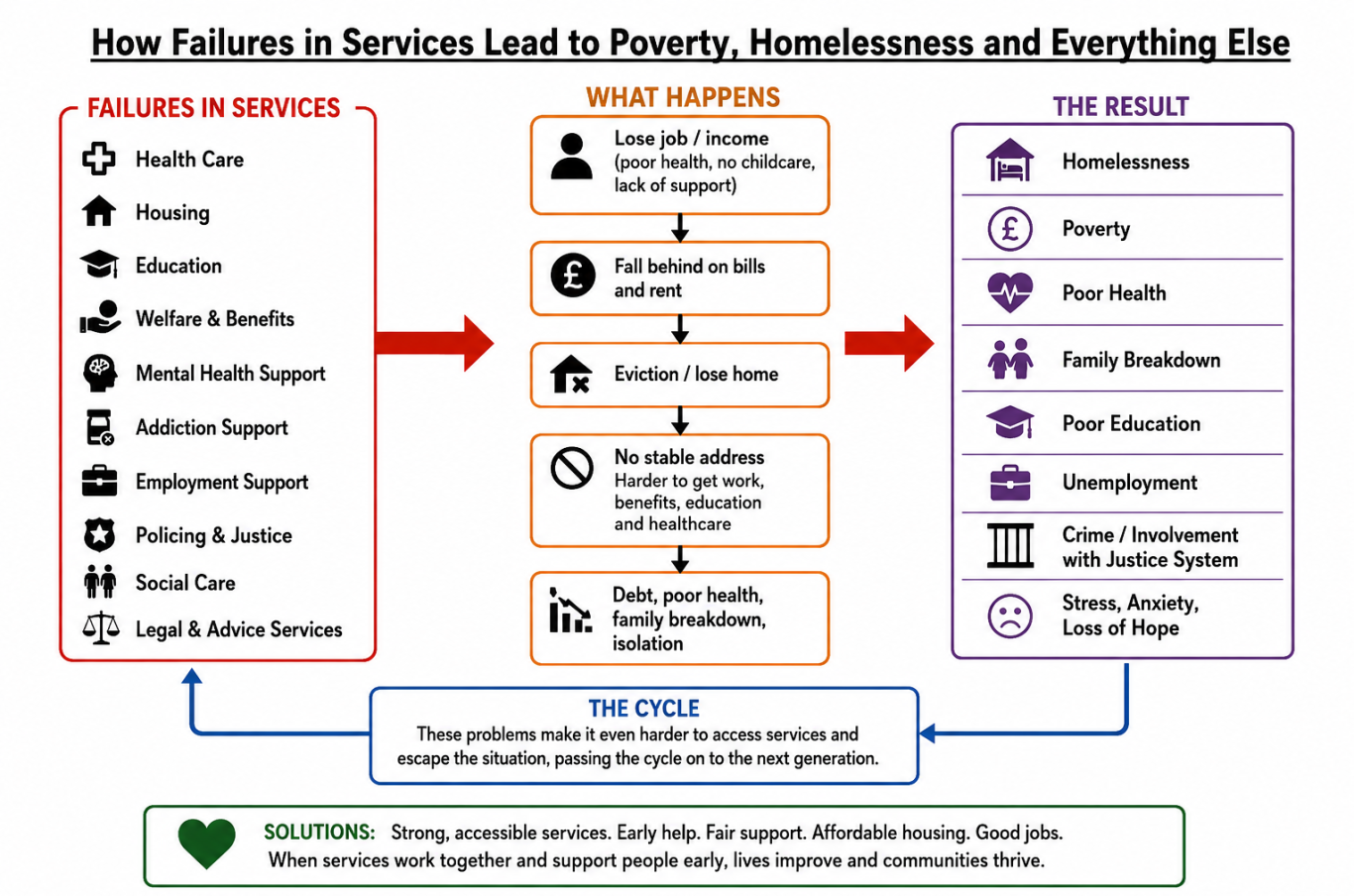
Failures in Public
Services can create a chain Reaction:
When healthcare, housing,
education, welfare, addiction
support, mental health services,
policing, social care, and
employment support do not work properly, people lose the support that keeps them stable.
A person might lose their job
because they cannot access healthcare or childcare. Then they fall
behind on rent. If housing services are slow or underfunded, they may be evicted. Without a stable address, it becomes harder to get work, claim benefits, attend school, or receive medical care. This can lead to debt, poor health, family breakdown, homelessness, and long-term poverty.
Service failures do not usually cause just one problem. They often connect:
Poor education limits job opportunities.
Low wages or unemployment make rent unaffordable.
Weak welfare support leaves people without money during crisis.
Lack of mental health care can worsen addiction, isolation, and unemployment.
Shortage of social housing pushes people into unsafe or expensive housing.
Poor legal and advice services mean people cannot challenge eviction, debt, or benefit mistakes.
These problems reinforce each other. Poverty makes it harder to
access services, and failed services make poverty worse. Homelessness is often the visible result of many earlier failures happening at once.
A strong society needs services that intervene early, before people reach crisis point. When services fail, the cost is not only financial. It is paid through poorer health, lost
education, broken families, crime, unemployment, homelessness, and reduced hope.
Games Policy & Disclaimer
Last updated: 9 August 2026
The games available through Right First Time UK are provided primarily for entertainment, recreation and general enjoyment. Some games may also include educational, calming, problem-solving or awareness-based elements.
1. Free-to-play games
Unless clearly stated otherwise, games provided directly by Right First Time UK are intended to be free to play.
Any coins, Battle Cash, gems, points, characters, upgrades or other virtual items shown within a game are fictional in-game items and have no real-world monetary value.
Where a game does not support real-money purchases, players should never be asked to provide payment or banking information to obtain these items.
2. Children and younger players
Some games may be suitable for children and families.
Parents and guardians should decide whether an individual game is appropriate for their child. Games may contain mild cartoon or fantasy themes including battles, monsters, zombies, explosions, weapons, fictional danger or similar content.
Right First Time UK aims to avoid unnecessarily graphic or disturbing material in games intended for general audiences.
3. No gambling
Right First Time UK games are not intended to provide gambling services.
Where a game contains random rewards, character unlocks, spins, summons or similar mechanics, these should use gameplay-earned virtual currency unless clearly stated otherwise.
Virtual rewards cannot be exchanged with Right First Time UK for real money.
4. Player accounts and personal information
Games that operate entirely within a player's browser may save information such as progress, settings, scores or unlocked characters on the player's own device.
If a future game requires an online account or collects personal information, players will be told what information is being collected and why. Appropriate privacy information should be provided before that system is introduced.
Children's personal information should not knowingly be collected unnecessarily.
5. Trading and virtual items
Some games may contain fictional trading systems allowing players to exchange or purchase virtual characters or items using in-game currency.
Virtual items remain part of the game and do not represent real property, investments, cryptocurrency or money.
Players should never send another player real money in return for an in-game item unless Right First Time UK has expressly introduced and authorised such a system.
Right First Time UK may restrict or remove trading features where necessary to protect players or prevent abuse.
6. Online interaction
If multiplayer, chat or player-to-player trading is introduced, additional safety measures may be applied.
Players should never disclose passwords, home addresses, telephone numbers, banking information or other sensitive information to another player.
Abusive behaviour, scams, harassment, exploitation or attempts to obtain personal information may result in access being restricted.
7. Original games and third-party inspiration
Some games may be inspired by popular genres, internet culture, memes or general gaming concepts.
Right First Time UK does not claim ownership of third-party trademarks, characters or intellectual property.
Where appropriate, games developed for the site will use original names, artwork, characters, icons and other assets rather than copying assets from existing games.
Unless expressly stated, Right First Time UK games are not affiliated with, sponsored by or endorsed by Roblox Corporation or other third-party game developers, publishers or platforms.
8. Availability and technical problems
Games are provided on an "as available" basis.
Right First Time UK cannot guarantee that every game will work perfectly on every phone, tablet, browser or computer.
Games may be updated, changed, temporarily unavailable or removed.
Saved progress may occasionally be lost, particularly where progress is stored locally and a player clears browser data, changes device or removes website storage.
9. Health and accessibility
Players should take sensible breaks and stop playing if they experience discomfort, headaches, eye strain, dizziness or other adverse effects.
Some games may contain moving objects, flashing effects or sounds. Where appropriate, accessibility controls should be provided as games are developed further.
Games intended to support relaxation or wellbeing are recreational tools and are not medical treatment or a substitute for professional healthcare or emergency support.
10. Reporting a problem
If a game contains a technical problem, inappropriate material, suspected copyright issue, safety
concern or other problem, users can contact Right First Time UK through the website.
We will consider legitimate reports and may amend or remove material where appropriate.
Important disclaimer
Right First Time UK games are provided for entertainment purposes. Virtual currency and virtual items normally have no cash value. Do not send money or personal information to another player. Parents and guardians are encouraged to supervise younger children where appropriate.
© 2026 Right First Time UK. All rights reserved in original Right First Time UK game content. Third-party names and trademarks remain the property of their respective owners.
Alliance Meme Defense game
Game notice: This is an independently created, fictional tower-defense game. It is not affiliated with or endorsed by Roblox or any other game publisher. Characters, artwork and game assets used by Right First Time UK are intended to be original. Battle Cash and other virtual items have no real-world
monetary value.




Our Mission
Helping People Understand Systems, Access Support, and Find the Right Help First Time
At Right First Time UK, our mission is to make important information easier to understand, easier to access, and easier to use.
Every day, people across the United Kingdom find themselves dealing with public services, support systems, housing issues, child maintenance, disability support, financial hardship, safeguarding concerns, family challenges, complaints procedures, health services, and many other situations that can feel confusing and overwhelming.
Many people are expected to understand complex systems at the very moment they are facing some of the most difficult periods of their lives.
We believe that should not be the case.
No one should have to spend months or years trying to understand how to access support, challenge a decision, raise a complaint, protect their family, or find the help they need.
Why This Mission Matters
Across the UK, many people struggle not because support does not exist, but because they do not know:
- What support is available
- Where to find help
- How systems work
- What their rights are
- What evidence may be needed
- How decisions should be made
- How services should treat them
- What to do when things go wrong
For many individuals and families, the lack of clear information can lead to confusion, frustration, financial hardship, housing instability, family conflict, safeguarding concerns, and emotional distress.
We believe better understanding creates better outcomes.
Learning From Real Experiences
Our mission is inspired by real people and real experiences.
We recognise the experiences of people whose lives were affected by overwhelming pressures,
financial hardship, debt, enforcement action, and difficulties navigating complex systems.
Their stories remind us that information is not simply about forms, policies, or procedures.
Behind every system are real people.
Behind every decision is a life affected.
And behind every request for help is someone looking for answers.
What We Aim To Do
We aim to:
Make Information Easier to Understand
Helping people understand complex systems in plain, accessible language.
Bring Information Together in One Place
Providing guidance, resources, support pathways, and signposting in a way that is easier to navigate.
Improve Public Awareness
Helping people understand services, rights, responsibilities, and support options.
Promote Earlier Access to Support
Encouraging people to seek help before problems become crises.
Support Better Outcomes
Helping people feel more informed, more confident, and better prepared when dealing with life's challenges.
Helping People Understand Services
We work to improve understanding of services and support systems including:
- Housing and Homelessness Services
- Child Maintenance Service (CMS)
- Department for Work and Pensions (DWP)
- Local Council Services
- Disability Support
- Financial Support
- Family and Parenting Support
- Safeguarding Services
- Health and Wellbeing Support
- Employment Rights and Workplace Support
- Complaint and Review Processes
- Ombudsman Services
Understanding how services work helps people access the support they need more effectively.
Helping People Understand How Services Should Treat Them
Many people do not know what standards they should reasonably expect from public services and support organisations.
We believe people should understand:
- How decisions should be explained
- How evidence should be considered
- How complaints can be raised
- How services should communicate
- What support may be available
- What review processes exist
- Where independent help can be found
Knowledge helps people advocate for themselves.
Understanding helps people navigate systems more confidently.
Supporting Families and Communities
Everything we do is centred around helping people feel:
- Informed
- Supported
- Respected
- Empowered
- Less isolated
We recognise that behind every issue is a person, a family, a child, a carer, or a community seeking support.
By improving understanding, we hope to reduce unnecessary confusion, encourage earlier intervention, and help people access the right support at the right time.
Our Vision
We want to see a future where:
- Information is accessible
- Support is easier to find
- Families receive help earlier
- People understand their rights and options
- Safeguarding concerns are recognised sooner
- Individuals feel more confident navigating services
- Fewer people feel overwhelmed by systems designed to support them
Because understanding the system should not be harder than receiving the support it exists to provide.
Our Mission
To help people understand.
To help people access support.
To improve awareness.
To encourage fairness, accountability, safeguarding, transparency, reforms
and improvement across public services
To bring information together in one place.
And to help individuals, families, and communities find answers before problems become crises.
Because information can change outcomes.
Understanding creates confidence.
And sometimes, understanding can save lives.
Right First Time UK
Helping People Find Answers Before Systems Create Harm
Information • Awareness • Guidance • Support


About us
Helping People Understand Systems, Access Support, and Navigate Life's Challenges with Confidence
Right First Time UK is looking to be a not-for-profit organisation dedicated to improving access to
information, guidance, awareness, and support resources for individuals, families, carers, workers, and communities across the United Kingdom.
Right First Time UK is an independent advocacy and information platform that highlights issues affecting people across the United Kingdom and signposts users to official sources of help and support.
Right First Time UK was created after personal experiences navigating complaints and public services, with the aim of helping others access information and support.
We recognise that many people face situations involving housing, homelessness, child maintenance,
disability support, safeguarding concerns, financial hardship, family separation, health challenges,
complaints processes, and public services that can often feel confusing and overwhelming.
Our aim is to make important information easier to find, easier to understand, and easier to access.
Because no one should need specialist knowledge simply to understand the services designed to help them.
What We Do
Right First Time UK brings together information, guidance, support pathways, complaint routes, and public awareness campaigns with resources in one place.
We provide information on a wide range of topics, including:
- Housing and Homelessness
- Child Maintenance Service (CMS)
- Department for Work and Pensions (DWP)
- Disability Support
- Financial Support
- Family and Parenting Support
- Health and Wellbeing
- Safeguarding and Protection
- Employment Rights
- Local Council Services
- Complaints and Accountability Processes
- Public Service Information
We aim to help people better understand:
- How services work
- What support may be available
- Where to find help
- What their rights and responsibilities may be
- How complaints can be raised
- How systems should communicate and operate
Knowledge helps people ask better questions.
Understanding helps people make informed decisions.
Why Right First Time UK Was Started
Right First Time UK to help people understand systems, access support, and navigate services with confidence.
Too often, people are left struggling to understand decisions that affect their lives. They face confusing
processes, unclear information, delayed responses, and systems that can feel impossible to navigate without specialist knowledge. When this happens, people can feel
isolated, overwhelmed, and unsure where to turn.
We believe everyone deserves access to clear information, fair treatment, and the knowledge needed to make informed decisions about their lives.
The inspiration behind Right First Time UK comes from Robert Andrew Kellett — known to many as Andy.
Andy understood first-hand the challenges that people can face when dealing with complex systems and public services. Through his own experiences, he learned how important it was for people to
understand their rights, know where to find support, and have access to information that was clear, practical, and easy to understand.
Rather than keeping that knowledge to himself, Andy shared it freely with others. He helped people
understand processes, complaint routes, available support, and the responsibilities that organisations must consider when making decisions. Many people turned to him for guidance because they simply did not know where else to go.
Andy believed that information should be accessible to everyone, not just professionals or those with
specialist knowledge. He believed that people should be empowered with the information they need to ask questions, challenge decisions, and seek the support they deserve.
His example continues to inspire our work today.
At Right First Time UK, we are committed to making information easier to access, easier to understand, and easier to use.
We help people navigate services, understand processes, access support, and better understand the rules, duties, and responsibilities that organisations are expected to follow.
Our goal is simple: to help people feel informed, supported, and confident when dealing with systems that can often seem confusing or overwhelming.
By sharing knowledge, promoting understanding, and encouraging accountability, we hope to make a
positive difference for individuals, families, and communities across the United Kingdom.
Because when people have the right information, they are better equipped to get the right support, make informed decisions, and achieve better outcomes.
Built on Real Experiences
Right First Time UK was created not only to improve access to
information, but also to recognise the very real human consequences that can occur when people become overwhelmed by complex systems, financial pressures, unresolved disputes, and a lack of accessible support.
Across the United Kingdom, there have been individuals and families whose lives have been profoundly
affected by debt, enforcement action, financial hardship, housing instability, safeguarding concerns, and difficulties navigating public services.
We remember people such as Gavin Briggs, and many others whose experiences highlighted the need for greater awareness, understanding, compassion, and accountability within the systems that serve the public.
While every person's circumstances are unique, their stories remind us that behind every case file,
complaint, debt notice, tribunal, or enforcement action is a real human being.
Too often, people find themselves facing situations they do not fully understand, struggling to access clear information, unsure of their rights, unaware of available support, or overwhelmed by processes that feel impossible to navigate alone.
Financial hardship, unmanageable debt, family pressures, housing difficulties, mental health challenges, and prolonged disputes can have devastating effects on individuals and families.
We believe that better information, earlier support, clearer communication, and greater public
understanding can help prevent avoidable harm.
Our work is dedicated to helping people understand the systems around them, access support sooner, and make informed decisions before problems escalate into crisis.
Because information is not just about paperwork.
Information can protect wellbeing.
Information can protect families.
And sometimes, information can save lives.
Our Values
Everything we do is guided by:
Fairness
Everyone deserves fair treatment and access to information.
Respect
People should be treated with dignity and understanding.
Accessibility
Information should be available and understandable for all.
Transparency
Clear information helps build trust and confidence.
Safeguarding
The safety and wellbeing of children, families, and vulnerable people must remain a priority.
Accountability
Understanding systems helps people hold services to the standards they should meet.
What We Are Not
Right First Time UK is not:
- A legal service
- A law firm
- A government department
- A medical provider
- A financial adviser
- A social work service
- An emergency service
We do not provide legal
representation, medical diagnoses, official decisions, or regulated advice.
Instead, we focus on information, awareness, guidance, education, and signposting.
Looking Forward
We want to help create a future where:
- Information is easier to access
- Support is easier to understand
- People know where to turn for help
- Families feel less alone
- Public awareness is improved
- Individuals feel more confident navigating services
Because understanding how a system works should never be harder than receiving the support it exists to provide.
In memory of those who struggled, those who helped others, and those whose
experiences continue to
inspire change.
Right First Time UK exists to help people find answers,
understand support, and feel less alone when facing life's challenges.
Fair Decisions. Public Money. Real Accountability.






Fighting for Fairness. Demanding Accountability.
Right First Time UK was established to address the persistent challenges faced by people wronged by public service decisions.
Our mission is to raise awareness of systemic failures, advocate for greater
fairness, accountability, safeguarding, transparency, reforms and
improvement across public services and empower people with the
knowledge and resources to protect themselves.
Donate to us
Your donation helps us support
families, challenge
injustice, expose failures, and push for real legal reforms
Sign Petition
We call on Parliament to request the National Audit Office (NAO) to
conduct an audit of all arrears
transferred between CSA and CMS (1993–2025), with results made public. Contractor data handling and verification must be transparent, and
arrears checks kept active during any upgrades.
Partners & Supporters
We work alongside a range of trusted organisations, charities, community groups and support services that share our commitment to helping people through difficult times. These partnerships help us connect individuals with the
information, guidance and practical support they may need.
Your Support and Donations Go a Long Way
Support Right First Time UK
Your support helps protect families,
prevent hardship, and
challenge public
system failures before lives are damaged
And protecting children's futures
Right First Time UK exists to help people facing homelessness, unfair public decisions, family court
difficulties, child maintenance
disputes, council failures,
employment hardship, and barriers to justice.
We believe fairness should not
depend on who can fight the longest.
Your donation helps turn support into action.
Why Donate?
Support Our Work
Too many people face financial
hardship, homelessness, poor
mental health, and unfair treatment
because public systems fail them.
Many cannot challenge these
systems alone.
Your donation helps us support
vulnerable people, promote public accountability, raise awareness, and campaign for fairer services and
lasting reform.
What Your Support Helps Fund
- Homelessness prevention initiatives
- Crisis support information and resources
- Public accountability campaigns
- Research, evidence gathering and investigations
- Reform campaigns, including the Kellett and Briggs Bill
- Community awareness and education
Donation Transparency
We are committed to using
donations responsibly and transparently.
Funds support:
- Public benefit work
- Campaign delivery
- Organisational sustainability
- Safeguarding and compliance
- Protecting vulnerable people
We do not use donations for private personal gain.
Ways to Support
- One-off donations
- Monthly donations
- Business sponsorship
- Campaign sponsorship
We help ensure support reaches the organisations, projects and
initiatives where it is needed most.
Thank You
Every donation helps someone feel less alone.
Every donation helps challenge unfairness.
Every donation helps create change.
Right First Time UK
Fair Decisions. Public Money. Real Accountability.
Volunteer With Us
Help Us Create Real Change
Right First Time UK is built on people who care about fairness, accountability, and protecting families from avoidable hardship.
We believe real change happens when people come together.
Volunteers help us raise awareness, support campaigns, share information, strengthen communities, and make sure people are not left facing difficult systems alone.
You do not need legal qualifications or professional experience to help.
You only need the willingness to stand for fairness.
Why Volunteer?
Many people facing public service failures feel isolated, unheard, and overwhelmed.
Sometimes the biggest difference comes from someone simply helping them find the right information, the right complaint route, or the confidence to keep going.
Volunteers help us make that possible.
By volunteering, you help support:
- families facing hardship
- homelessness prevention
- complaint guidance resources
- public awareness campaigns
- community support projects
- reform campaigns like the Kellett and Briggs Bill
Support creates change.
Trustee Applications
We are also welcoming applications for Trustees to help guide and strengthen Right First Time UK.
Trustees help oversee:
- governance
- safeguarding
- finance
- public accountability
- strategic decisions
- community leadership
We welcome people with:
- lived experience
- community leadership
- financial skills
- safeguarding awareness
- campaign experience
- strong values and commitment to fairness
Trustees & Volunteers do not need formal charity experience—we value integrity and commitment.
Apply to Become a Trustee or Volunteer
Please complete our Trustee Application Form.
Please complete our Volunteer Application Form
Your voice and experience matter.
Volunteer Roles
We welcome support across many areas, including:
Community Support Volunteers
Helping share information, resources, and signposting within local communities.
Campaign Support Volunteers
Helping with:
- awareness campaigns
- petitions
- research support
- public engagement
- campaign coordination
Fundraising Volunteers
Helping us raise support through:
- fundraising events
- community sponsorship
- donation campaigns
- local business outreach
- charity fundraising activities
Administrative Support
Helping with:
- organising documents
- website updates
- social media support
- email administration
- campaign preparation
Employer and Community Outreach
Helping connect with:
- local businesses
- employers
- housing providers
- community groups
- support organisations
Strong partnerships create stronger outcomes.
Community Ambassadors
Community Ambassadors help represent Right First Time UK in local areas.
They help:
- raise awareness
- support local campaigns
- connect people to resources
- promote fairness and accountability
- build trusted local networks
Ambassadors help ensure people know they are not alone.
This role is powerful.
Fundraising Help
Fundraising is not just about money—it is about protection.
Funds help us provide:
- homelessness support resources
- complaint templates
- awareness campaigns
- public interviews and investigations
- parliamentary submissions
- campaign growth
- community support projects
Every fundraiser helps protect someone.
Who Can Volunteer?
We welcome:
- parents
- campaigners
- professionals
- retired individuals
- community leaders
- students
- people with lived experience
- anyone who believes fairness matters
You do not need to be an expert.
You just need to care.
What We Ask From Volunteers
We ask volunteers to:
- act respectfully
- protect confidentiality
- follow safeguarding standards
- represent the organisation professionally
- support fairness and public trust
Integrity matters.
Join Us
If you want to help create stronger communities, better public accountability, and real support for families facing hardship, we would love to hear from you.
Change does not happen alone.
It happens when people stand together.
Contact Us to Volunteer
Right First Time UK
Email: dan@rightfirsttimeuk.com
Website: www.rightfirsttimeuk.com
Please contact us to discuss volunteering, trustee applications, campaign support, or becoming a Community Ambassador.
Right First Time UK
Real People. Real Support. Real Change.
Volenter Recognitions
Our team consists of motivated professionals, who are all experts in their field. With many years of experience in the industry
Volunteers who run
social media groups and pages
Valuable work
In building communities, sharing information, supporting members, and keeping people connected. Their time, effort, and dedication help create stronger engagement and make these spaces welcoming and useful for everyone.
Volunteers who work in mental health services
Whose compassion, dedication, and selfless support
Make a meaningful difference in the lives of others. Their time, empathy, and commitment help provide comfort, guidance, and hope to individuals facing emotional and psychological challenges. Through listening, supporting, and creating safe spaces, they strengthen communities and remind people that they are not alone. Their contribution is invaluable and deeply appreciated.
Volunteers who help gather information
Whose time, effort, and commitment play an
essential role
Supporting services and
communities. Their dedication to collecting, organizing, and sharing accurate information helps improve decision-making, strengthens communication, and ensures that people receive the support they need. Their behind-the-scenes work is invaluable and greatly appreciated, as it contributes to better outcomes for everyone they serve.
Volunteers who help give advice
Whose knowledge, guidance, and willingness to support
others make a lasting difference
Their patience, understanding, and dedication help individuals make informed decisions, overcome challenges, and feel supported during difficult times. By sharing their time and experience, they provide reassurance and confidence to those in need. Their valuable contribution is deeply appreciated and recognized.
Complaint Processes
Clear Steps. Better Outcomes. Real Accountability.
Many people are left struggling because they do not know where to start when a public body gets something wrong.
Right First Time UK helps by sharing clear information, complaint routes, and practical guidance so people can understand the process and take the next step with confidence.
We do not provide legal advice or act as solicitors.
We provide information, templates, and signposting to help people understand their options.
Because complaints should not be harder than the problem itself.
Step-by-Step Complaint Routes
Most complaint processes follow a similar structure:
Step 1 — Raise the Issue Directly
Start with the department, council, service provider, or organisation responsible.
Always:
- keep copies of all communication
- ask for written responses
- record dates and times
- request clear explanations
- gather evidence early
Many issues can be resolved at this stage.
Step 2 — Formal Complaint
If the issue is not resolved:
- submit a formal complaint
- follow the organisation’s complaint procedure
- ask for escalation if needed
- request a complaint reference number
Use written complaints wherever possible.
Clear records protect you.
Step 3 — Review or Reconsideration
Some public bodies require an internal review before appeal.
Examples include:
- DWP Mandatory Reconsideration
- Child Maintenance Service review requests
- housing review decisions
- council complaint escalation
This stage is often critical.
Step 4 — Independent Appeal or Tribunal
If internal review fails, the next step may be:
- First-tier Tribunal
- Social Security Tribunal
- Housing Tribunal
- Family Court review routes
- specialist appeal processes
Independent review is often where errors are corrected.
Step 5 — Ombudsman or External Oversight
Where complaints remain unresolved, external review may include:
- Parliamentary and Health Service Ombudsman
- Local Government and Social Care Ombudsman
- Housing Ombudsman
- Independent Case Examiner
- Financial Ombudsman (where relevant)
These bodies review fairness, process, and service failure.
Mandatory Reconsideration (DWP)
Before most benefit appeals, you must request a:
Mandatory Reconsideration (MR)
This asks DWP to review its own decision.
Important points:
- request it quickly
- explain clearly why the decision is wrong
- provide supporting evidence
- keep copies of everything
If the MR fails, you may then appeal to tribunal.
Tribunal Process
Tribunals are independent from the department making the decision.
They review:
- facts
- evidence
- fairness
- legal application
Preparation helps.
Useful steps:
- organise documents clearly
- create a timeline
- explain the impact
- submit evidence early
- stay focused on facts
Tribunals often correct avoidable mistakes.
Ombudsman Routes
Ombudsman services review complaints after internal processes are completed.
They look at:
- maladministration
- poor service
- unfair process
- unreasonable delay
- failure to follow policy
They can recommend:
- apologies
- compensation
- correction of decisions
- service improvements
MP Escalation
Your Member of Parliament (MP) can help raise serious public service failures.
MPs may assist with:
- DWP delays
- CMS complaints
- housing issues
- safeguarding concerns
- council failures
- NHS delays
- unresolved tribunal issues
Sometimes escalation through an MP creates movement where systems have stalled.
Council Complaints
Council complaints may involve:
- housing
- homelessness
- safeguarding
- social services
- council tax
- benefits administration
- local authority failures
Usually the process is:
- Internal complaint
- Complaint escalation
- Local Government Ombudsman
Always request written decisions.
NHS Complaints
NHS complaints may involve:
- treatment concerns
- safeguarding failures
- delayed care
- poor communication
- service failures
- discharge issues
Usually the process is:
- Raise concern directly
- Formal NHS complaint
- Parliamentary and Health Service Ombudsman
Clear timelines matter.
Child Maintenance Service (CMS) Complaints
CMS complaints may involve:
- incorrect calculations
- shared care disputes
- enforcement action
- disputed arrears
- delays
- communication failures
- case closure issues
The usual process is:
- Raise issue with CMS
- Formal complaint
- Complaint review
- Independent Case Examiner
- Parliamentary Ombudsman (through MP)
Keep records of every call and letter.
This is extremely important.
Complaint Templates
We provide complaint guidance templates to help with:
- councils
- DWP
- CMS
- NHS
- safeguarding concerns
- housing issues
- local authority complaints
- public contractor failures
Knowing how to start often makes the biggest difference.
You Should Not Have to Fight Alone
Understanding the system helps people protect themselves.
Good records create stronger complaints.
Clear information creates confidence.
Fair systems should work the first time.
But when they do not, people deserve to know what comes next.
If you need a guidance template letter and for something not listed please get in touch.
dan@rightfirsttimeuk.com
Right First Time UK
Helping People Understand the Process Before the Process Overwhelms Them
Information. Accountability. Fairness. Real Support.
Complete Guide to Power of Attorney
What is a Power of Attorney?
A Power of Attorney allows someone you trust to legally act for you if:
- You are abroad
- You become ill
- You are unable to make decisions
- You simply want someone else to manage certain matters
The person giving authority remains in control unless the type of POA says otherwise.
Key People
Donor (Principal)
The person giving the authority.
They must:
- Understand what they are signing
- Have legal mental capacity (unless creating arrangements that apply after loss of capacity where permitted by law)
Attorney (Agent)
The trusted person receiving authority.
They can be:
- spouse
- child
- parent
- friend
- solicitor
- professional adviser
You may appoint:
- one attorney
- multiple attorneys
- replacement attorneys
Types of Power of Attorney
1. General Power of Attorney
Usually temporary.
Allows someone to:
- manage bank accounts
- sign contracts
- buy or sell property
- manage business affairs
Ends if:
- cancelled
- donor dies
- donor loses mental capacity (in many jurisdictions)
2. Lasting (or Enduring) Power of Attorney
Designed for long-term use.
Usually continues after loss of mental capacity once properly registered (depending on local law).
Two common categories:
Property and Financial Affairs
Attorney may:
- pay bills
- manage pensions
- manage investments
- buy or sell property
- deal with tax
- manage bank accounts
Health and Welfare
Attorney may decide:
- medical treatment
- care home arrangements
- daily care
- living arrangements
Some jurisdictions allow decisions about life-sustaining treatment only if specifically authorized.
3. Limited (Specific) Power of Attorney
Only grants authority for one task.
Examples:
- selling one house
- collecting documents
- signing papers while abroad
- managing one bank account
Ends once that task is completed.
What Can an Attorney Do?
Depending on the document, they may:
✔ Pay bills
✔ Access bank accounts
✔ Collect pensions
✔ Sign legal documents
✔ Manage investments
✔ Buy or sell property
✔ Deal with government agencies
✔ Run a business
✔ Arrange care
✔ Speak with doctors
What Can't an Attorney Do?
Generally they cannot:
- change your will (except in rare court-approved situations)
- vote on your behalf
- marry or divorce for you
- act outside the authority granted
- use your money for themselves
- ignore your instructions
Doing so may be unlawful and can lead to civil or criminal consequences.
Choosing an Attorney
Choose someone who is:
- trustworthy
- financially responsible
- organized
- willing to serve
- able to communicate well
Avoid appointing someone who:
- has serious financial problems
- has conflicts of interest
- is unreliable
- may misuse your finances
Duties of an Attorney
An attorney must:
- act honestly
- act in your best interests
- keep accurate records
- avoid conflicts of interest
- keep your money separate from theirs
- follow the law and the POA document
When Does a POA Take Effect?
This depends on the type.
Some begin:
- immediately after signing
Others begin:
- only after registration
- only if you lose mental capacity
- only on a specified date or event
Ending a Power of Attorney
A POA usually ends when:
- you revoke it (while you have capacity)
- the attorney resigns (if permitted)
- the donor dies
- a court cancels it
- the purpose is completed (for a limited POA)
Risks
Potential risks include:
- financial abuse
- unauthorized spending
- fraud
- conflicts within families
Ways to reduce risk:
- appoint someone trustworthy
- appoint more than one attorney
- require joint decisions
- keep family informed
- include restrictions in the document
Typical Documents Needed
Requirements vary, but often include:
- proof of identity
- proof of address
- signatures
- witnesses
- certificate or legal confirmation of capacity (where required)
- registration with the appropriate authority (for certain POAs)
UK Guide (England and Wales)
In England and Wales there are two types of Lasting Power of Attorney (LPA):
- Property and Financial Affairs LPA
- Health and Welfare LPA
An LPA:
- must be completed correctly
- requires a certificate provider to confirm the donor understands the document
- must be registered with the appropriate authority before it can be used
You can appoint attorneys to act:
- jointly
- jointly and severally (independently)
- or a combination for different decisions
Scotland
Scotland has different legislation and uses:
- Continuing Power of Attorney
- Welfare Power of Attorney
Northern Ireland
Northern Ireland has separate rules and currently uses Enduring Power of Attorney (EPA) rather than the LPA system used in England and Wales.
Costs
Depending on your jurisdiction, costs may include:
- registration fees
- solicitor's fees (optional but often helpful)
- witness or notary fees (where required)
Many people complete straightforward POAs themselves using official forms, while others choose legal advice for more complex estates or family situations.
Frequently Asked Questions
Can I appoint more than one attorney?
Yes. You can require them to act together or allow them to act independently, depending on local law.
Can I cancel my POA?
Yes, provided you still have the required mental capacity and follow the legal revocation process.
Does my spouse automatically have power of attorney?
No. Marriage or civil partnership does not automatically give someone legal authority to make financial or medical decisions for you.
Can my attorney use my money?
Only for your benefit and within the authority granted by the POA.
Practical Tips
- Choose attorneys carefully and discuss your wishes with them in advance.
- Consider appointing replacement attorneys in case your first choice cannot act.
- Review your POA after major life events, such as marriage, divorce, or changes in health.
- Store the original document safely and let your attorneys know where it is kept.
- If you're in the UK, use the official government forms and registration process rather than unofficial templates.
England and Wales
Official GOV.UK guidance
- Make, register or end a Lasting Power of Attorney (LPA)
- Make a Lasting Power of Attorney (online or paper)
- Valid examples of Lasting and Enduring Powers of Attorney
- Who needs a Lasting Power of Attorney?
Scotland
Official Office of the Public Guardian (Scotland)
Scottish Powers of Attorney include:
- Continuing Power of Attorney (financial/property)
- Welfare Power of Attorney
- Combined Continuing and Welfare Power of Attorney
Northern Ireland
Northern Ireland currently uses:
- Enduring Power of Attorney (EPA)
The process differs from England, Wales and Scotland.
NHS information
UK legislation
- Mental Capacity Act 2005
- Mental Capacity Act Code of Practice
- Legislation.gov.uk (UK legislation)
- Court of Protection information (GOV.UK)
Office of the Public Guardian
Free advice and support
- Citizens Advice — Free advice.
- Age UK — Free guidance, especially for older people.
- Law Centres Network — Free legal advice where eligible.
- Support Through Court — Free support for people involved in court proceedings.
- Carers UK — Guidance for carers, including legal planning.
Paid legal services (optional)
Separated Families, Shared Care, Parenting Conflict & Mental Health Support Guide (UK)
This guide is for separated parents, carers, guardians, step-parents, kinship carers, grandparents, children, young people, and families
affected by separation, shared care, child arrangements, child
maintenance, conflict, stopped contact, or emotional pressure.
It is neutral and child-focused. It does not assume one parent is right or wrong. The main aim is to protect children’s wellbeing, support safe parenting, reduce harm, and help families find the right support.
Understanding Separation and Shared Parenting
When parents separate, families often need to agree:
- Where children will live
- How much time children spend with each parent
- How handovers will work
- School, health and routine decisions
- Holidays and birthdays
- Financial support and child maintenance
GOV.UK explains that separated parents may be able to avoid court if they agree where children live, how much time they spend with each parent, and how they will be financially supported.
Useful links:
GOV.UK child arrangements:
https://www.gov.uk/looking-after-children-divorce
Citizens Advice child arrangements:
https://www.citizensadvice.org.uk/family/making-agreements-about-your-children/making-child-arrangements/
Cafcass parenting resources:
https://www.cafcass.gov.uk/parent-carer-or-family-member/my-family-involved-private-law-proceedings/resources-help-you-make-arrangements-are-your-childs-best-interests
Children Should Not Be Put in the Middle
Children can be harmed when adults offload adult worries onto them.
This may include:
- Telling children adult arguments
- Asking children to take sides
- Blaming the other parent in front of them
- Using children as messengers
- Asking children to spy or report back
- Talking about court, money or child maintenance in detail
- Making children feel responsible for adult emotions
- Telling children they must choose one parent
Children need safety, stability, love, routine and permission to care about both sides of their family where it is safe to do so.
The Harm of Offloading Adult Conflict Onto Children
When children are exposed to ongoing parental conflict, they may experience:
- Anxiety
- Low mood
- Sleep problems
- School difficulties
- Anger
- Withdrawal
- People-pleasing
- Guilt
- Feeling responsible for adults
- Fear of upsetting either parent
- Loss of trust
- Behaviour changes
- Stomach aches or headaches
- Reduced confidence
Cafcass says its Planning Together for Children course is designed to protect children from harmful effects of parental conflict and help parents focus on communication and parenting arrangements.
Stopping Contact and the Impact on Children and Parents
Contact should always be considered around the child’s welfare and safety. There may be valid safeguarding reasons to stop or restrict contact, such as abuse, violence, coercive control, neglect, substance misuse, unsafe behaviour, or risk of harm.
However, where it is safe, children can be harmed when contact with a loving and safe parent or family member is stopped without good reason.
Possible effects on children:
- Grief and loss
- Confusion
- Rejection feelings
- Anxiety
- Low self-worth
- Anger
- Loyalty conflict
- Attachment difficulties
- Behaviour changes
- School problems
- Long-term relationship difficulties
Possible effects on parents:
- Depression
- Anxiety
- Trauma symptoms
- Sleep problems
- Panic attacks
- Financial stress
- Isolation
- Suicidal thoughts
- Physical health decline
- Loss of confidence
- Work difficulties
Cafcass guidance says children’s needs change as they grow, and separated parents should review arrangements as children develop. It says it is better for children when parents work together to plan around children’s needs.
Shared Care and Healthy Co-Parenting
Healthy co-parenting does not mean parents must be friends. It means adults try to keep children safe, loved and out of adult conflict.
Good shared care may include:
- Clear routines
- Calm communication
- Respectful handovers
- Written agreements
- School information shared with both parents where safe
- Medical information shared where safe
- Not using children as messengers
- Supporting the child’s relationship with safe family members
- Flexibility where possible
- Child-focused decisions
Cafcass provides resources to help separated parents understand co-parenting and make arrangements in children’s best interests.
When Contact May Need Safeguarding
Contact may need to be supervised, changed, paused or legally reviewed where there are concerns about:
- Domestic abuse
- Coercive control
- Child abuse
- Neglect
- Substance misuse
- Unsafe mental health crisis
- Threats or intimidation
- Stalking or harassment
- Abduction risk
- Serious emotional harm
Support:
GOV.UK domestic abuse help:
https://www.gov.uk/guidance/domestic-abuse-how-to-get-help
Refuge: 0808 2000 247
https://www.nationaldahelpline.org.uk/
Respect phoneline for people worried about their own behaviour:
https://respectphoneline.org.uk/
Mental and Physical Health Effects on Children
Children affected by separation conflict may experience:
Mental Health Effects
- Anxiety
- Depression
- Low self-esteem
- Self-blame
- Emotional overwhelm
- Fear of abandonment
- Panic
- Social withdrawal
- Anger
- Self-harm risk
- Eating difficulties
- School refusal
Physical Health Effects
- Headaches
- Stomach aches
- Tiredness
- Sleep problems
- Bedwetting
- Appetite changes
- Feeling sick before contact or handovers
- Stress-related symptoms
NHS children and young people’s mental health services can support young people with low mood, anxiety, self-harm, difficult life events, bullying and other emotional difficulties.
NHS children’s mental health:
https://www.nhs.uk/mental-health/children-and-young-adults/
Mental and Physical Health Effects on Parents
Separated parents may experience:
- Depression
- Anxiety
- Panic attacks
- PTSD symptoms
- Burnout
- Grief
- Anger
- Shame
- Isolation
- Sleep problems
- Weight changes
- High blood pressure
- Headaches
- Digestive problems
- Substance misuse
- Suicidal thoughts
- Work problems
- Financial distress
Support:
NHS mental health services:
https://www.nhs.uk/nhs-services/mental-health-services/
NHS Talking Therapies:
https://www.nhs.uk/nhs-services/mental-health-services/nhs-talking-therapies-for-anxiety-and-depression/
Mind: 0300 123 3393
https://www.mind.org.uk/
Child Maintenance and Financial Stress
Child maintenance and child arrangements are separate issues. GOV.UK says child maintenance is about paying towards a child’s living costs when one parent does not live with the child, and arrangements to see the child are separate.
Support links:
GOV.UK Child Maintenance Service:
https://www.gov.uk/child-maintenance-service
GOV.UK apply for child maintenance:
https://www.gov.uk/child-maintenance-service/how-to-apply
MoneyHelper child maintenance guidance:
https://www.moneyhelper.org.uk/en/family-and-care/divorce-and-separation/how-do-i-arrange-child-maintenance
Citizens Advice:
https://www.citizensadvice.org.uk/
StepChange debt support:
https://www.stepchange.org/
Mediation, Parenting Plans and Court Support
If parents cannot agree, support may include:
- Parenting plan
- Family mediation
- Solicitor advice
- Legal aid checks
- Child arrangements order
- Cafcass involvement where court proceedings happen
Useful links:
GOV.UK child arrangements:
https://www.gov.uk/looking-after-children-divorce
Family Mediation Council:
https://www.familymediationcouncil.org.uk/
Cafcass:
https://www.cafcass.gov.uk/
Resolution family law support:
https://resolution.org.uk/
Child Law Advice:
https://childlawadvice.org.uk/
Support for Children and Young People
Children may need someone safe to talk to outside the conflict.
Support:
Childline: 0800 1111
https://www.childline.org.uk/
YoungMinds:
https://www.youngminds.org.uk/
The Mix, under 25s: 0808 808 4994
https://www.themix.org.uk/
NHS children and young people’s mental health services:
https://www.nhs.uk/mental-health/children-and-young-adults/
School pastoral support, safeguarding lead, GP, CAMHS, youth services and local family hubs can also help.
Support for Parents and Families
Useful support:
Family Lives: 0808 800 2222
https://www.familylives.org.uk/
Gingerbread, single parent support:
https://www.gingerbread.org.uk/
Relate relationship support:
https://www.relate.org.uk/
Citizens Advice:
https://www.citizensadvice.org.uk/
Hub of Hope local support finder:
https://hubofhope.co.uk/
Find your local council:
https://www.gov.uk/find-local-council
Support for Domestic Abuse and Unsafe Relationships
Domestic abuse can affect anyone. It can include physical, emotional, psychological, sexual, financial or digital abuse.
Support:
Refuge National Domestic Abuse Helpline: 0808 2000 247
https://www.nationaldahelpline.org.uk/
Women’s Aid:
https://www.womensaid.org.uk/
Men’s Advice Line: 0808 801 0327
https://mensadviceline.org.uk/
Galop LGBT+ abuse support:
https://galop.org.uk/
Respect phoneline:
https://respectphoneline.org.uk/
GOV.UK domestic abuse help:
https://www.gov.uk/guidance/domestic-abuse-how-to-get-help
Practical Ways Parents Can Reduce Harm
Parents can help children by:
- Keeping adult conflict away from children
- Not criticising the other parent in front of them
- Not using children as messengers
- Reassuring children they are loved
- Keeping routines predictable
- Listening to children without pressure
- Supporting safe relationships with both sides of family
- Being honest but age-appropriate
- Getting help early
- Using written communication if talking causes conflict
- Avoiding arguments at handovers
- Putting safeguarding first where risk exists
Additional Topics for Separated Families, Shared Care & Mental Health Support
These topics are important because separation can affect children, parents, carers, grandparents and wider family members emotionally, practically, financially and physically. The focus should always be child safety, child wellbeing, fair support, mental health, and reducing conflict.
Parental Alienation Concerns
Parental alienation concerns may arise when a child appears strongly rejecting of one parent and there are worries that the child has been influenced by adult conflict. This is a sensitive area and should be handled carefully, because children may also reject contact for valid reasons such as fear, abuse, poor relationship quality, trauma, or unsafe experiences.
Support should focus on:
- Listening to the child safely
- Avoiding blame in front of the child
- Not pressuring the child to choose sides
- Understanding safeguarding concerns
- Seeking professional advice where needed
- Keeping communication child-focused
Useful links:
- Cafcass child arrangements resources: https://www.cafcass.gov.uk/
- GOV.UK child arrangements: https://www.gov.uk/looking-after-children-divorce
- Child Law Advice: https://childlawadvice.org.uk/
Domestic Abuse and Safe Contact
Contact should never place a child or parent at risk. Domestic abuse can include physical, emotional, psychological, sexual, financial, digital abuse, stalking, harassment and coercive control. NHS guidance explains that domestic abuse can happen to anyone and includes physical, emotional and sexual abuse in relationships or between family members.
Safe contact may involve:
- No direct contact between adults
- Supervised contact
- Supported handovers
- Neutral handover locations
- Court orders
- Safety planning
- Domestic abuse support services
Support:
- Refuge: 0808 2000 247 — https://www.nationaldahelpline.org.uk/
- Men’s Advice Line: 0808 801 0327 — https://mensadviceline.org.uk/
- Galop LGBT+ abuse support: https://galop.org.uk/
- GOV.UK domestic abuse help: https://www.gov.uk/guidance/domestic-abuse-how-to-get-help
Coercive Control After Separation
Coercive control can continue after separation. It may involve using children, money, contact arrangements, court proceedings, messages, threats, or child maintenance as a way to control or distress the other parent.
Examples include:
- Repeated threatening messages
- Using children as messengers
- Monitoring movements
- Financial control
- Harassment at handovers
- False or repeated accusations
- Preventing safe communication
- Using court or contact arrangements to intimidate
Support:
- GOV.UK domestic abuse help: https://www.gov.uk/guidance/domestic-abuse-how-to-get-help
- Refuge: https://www.nationaldahelpline.org.uk/
- Respect phoneline: https://respectphoneline.org.uk/
- Citizens Advice: https://www.citizensadvice.org.uk/
Court Stress and Mental Health
Family court can be stressful for everyone involved. Parents may feel anxious, frightened, angry, overwhelmed or unheard. Children may also feel worried if they know adults are in conflict.
Court stress may cause:
- Anxiety
- Depression
- Panic attacks
- Sleep problems
- Poor concentration
- Anger
- Exhaustion
- Financial pressure
- Suicidal thoughts
Helpful support:
- Speak to a GP
- Use NHS Talking Therapies
- Speak to a solicitor or legal adviser
- Use mediation where safe
- Ask court staff about reasonable adjustments
- Keep children away from adult court discussions
Useful links:
- GOV.UK Form C100 child arrangements application: https://www.gov.uk/government/publications/form-c100-application-under-the-children-act-1989-for-a-child-arrangements-prohibited-steps-specific-issue-section-8-order-or-to-vary-or-discharge
- Cafcass resources: https://www.cafcass.gov.uk/
- Find legal aid adviser: https://find-legal-advice.justice.gov.uk/
- NHS Talking Therapies: https://www.nhs.uk/nhs-services/mental-health-services/nhs-talking-therapies-for-anxiety-and-depression/
Child Maintenance Debt and Distress
Child maintenance can be a major source of stress for both paying and receiving parents. GOV.UK says child maintenance can be arranged privately if both parents agree, or through the Child Maintenance Service, which can calculate payments, arrange payments, take action if a parent does not pay and help with parentage disagreements.
Child maintenance stress may involve:
- Debt
- Arrears
- Income changes
- Enforcement action
- Disputes about calculations
- Financial hardship
- Anxiety and depression
- Fear of not being able to provide for children
Important: contact arrangements and child maintenance are separate issues. Children should not be used as leverage in money disputes.
Support:
- Child Maintenance Service: 0800 171 2345
- GOV.UK CMS: https://www.gov.uk/child-maintenance-service
- MoneyHelper child maintenance: https://www.moneyhelper.org.uk/en/family-and-care/divorce-and-separation/how-do-i-arrange-child-maintenance
- StepChange debt charity: https://www.stepchange.org/
- Citizens Advice: https://www.citizensadvice.org.uk/
Grandparent Contact
Grandparents can be important emotional support for children after separation. However, arrangements should always consider the child’s welfare, safety and family circumstances.
Grandparents may need support with:
- Loss of contact
- Family breakdown
- Mediation
- Legal advice
- Supporting children without taking sides
Support:
- Child Law Advice: https://childlawadvice.org.uk/
- Family Mediation Council: https://www.familymediationcouncil.org.uk/
- Citizens Advice: https://www.citizensadvice.org.uk/
- Grandparents Plus / Kinship: https://kinship.org.uk/
Step-Parenting After Separation
Step-parenting can be positive but may also bring emotional challenges. Children may be adjusting to separation, new homes, new routines and changing family roles.
Helpful approaches:
- Move slowly
- Do not force closeness
- Respect the child’s existing parent relationships
- Keep rules clear and fair
- Avoid adult conflict
- Support the child’s emotional adjustment
Support:
- Family Lives: 0808 800 2222 — https://www.familylives.org.uk/
- Relate: https://www.relate.org.uk/
- NHS family mental health support: https://www.nhs.uk/mental-health/
Blended Families
Blended families may include step-parents, half-siblings, step-siblings, new partners and extended family. Children may feel loyalty conflicts, jealousy, grief, confusion or anxiety.
Supportive blended families often need:
- Clear routines
- Patience
- Age-appropriate communication
- Consistency
- Respect for existing relationships
- Space for children’s feelings
Support:
- Family Lives: https://www.familylives.org.uk/
- Relate family counselling: https://www.relate.org.uk/
- YoungMinds parent support: https://www.youngminds.org.uk/
School Support During Separation
Schools can help children affected by separation, especially where behaviour, attendance, concentration or emotional wellbeing changes.
School support may include:
- Pastoral support
- Safeguarding lead involvement
- School counselling
- SEND support
- Emotional literacy support
- A trusted adult in school
- Support during handover or contact worries
Support:
- Speak to the school safeguarding lead
- Speak to the class teacher, tutor or pastoral team
- Contact GP or CAMHS if mental health concerns continue
- NHS children’s mental health: https://www.nhs.uk/mental-health/children-and-young-adults/
Child Therapy and Counselling
Children may benefit from therapy if they are experiencing anxiety, sadness, trauma, anger, withdrawal, self-harm, school refusal, sleep problems or confusion after separation.
Support may include:
- Play therapy
- Counselling
- Family therapy
- CAMHS
- School counselling
- Bereavement support
- Trauma-informed support
Useful links:
- NHS children and young people mental health: https://www.nhs.uk/mental-health/children-and-young-adults/
- YoungMinds: https://www.youngminds.org.uk/
- Childline: 0800 1111 — https://www.childline.org.uk/
Parent Mental Health Crisis Planning
Separated parents under extreme stress may need a crisis plan, especially where there is depression, suicidal thoughts, panic attacks, trauma, debt, court stress or loss of contact.
A crisis plan can include:
- Who to call in a crisis
- Safe people to contact
- GP or crisis team details
- Removing immediate risks
- Debt and legal support contacts
- Childcare backup
- Medication and health information
- Warning signs that help is needed
Urgent support:
- Emergency: 999
- NHS 111 mental health option: 111
- Samaritans: 116 123
- Shout: text SHOUT to 85258
- Papyrus HOPELINE247: 0800 068 4141
Social Care and Safeguarding
Safeguarding means protecting children from harm. Social care may become involved where there are concerns about abuse, neglect, domestic abuse, mental health crisis, substance misuse, exploitation or unsafe home environments.
Social care can support with:
- Child protection
- Family support
- Early help
- Parenting support
- Young carers support
- Safeguarding assessments
- Referrals to services
Support:
- Find your local council: https://www.gov.uk/find-local-council
- NSPCC: 0808 800 5000 — https://www.nspcc.org.uk/
- Childline: 0800 1111 — https://www.childline.org.uk/
Mediation and Parenting Plans
Mediation can help separated parents agree arrangements without going straight to court, where it is safe. Cafcass explains mediation involves an independent trained mediator helping parents or carers work out agreements.
Parenting plans can help agree:
- Living arrangements
- Handovers
- Holidays
- Birthdays
- School decisions
- Health decisions
- Communication
- New partners
- Emergency arrangements
Cafcass has “Our Child’s Plan”, an online written agreement tool for co-parenting arrangements.
Useful links:
- Family Mediation Council: https://www.familymediationcouncil.org.uk/
- Cafcass parenting plan: https://www.cafcass.gov.uk/
- GOV.UK mediation information: https://www.gov.uk/looking-after-children-divorce/mediation
Legal Aid and Advice
Legal advice can help parents understand options without escalating conflict. Legal aid may be available in some cases, especially where there is domestic abuse, child protection, or qualifying financial circumstances.
Support:
- Find legal aid adviser: https://find-legal-advice.justice.gov.uk/
- Child Law Advice: https://childlawadvice.org.uk/
- Citizens Advice: https://www.citizensadvice.org.uk/
- Rights of Women: https://rightsofwomen.org.uk/
- Advocate free legal help: https://weareadvocate.org.uk/
Benefits, Housing and Debt Support
Separation can affect money, housing, benefits and debts.
Support may include:
- Universal Credit
- Child Benefit
- Council housing support
- Homelessness prevention
- Debt advice
- Food banks
- Budgeting support
- Child maintenance advice
Useful links:
- GOV.UK benefits: https://www.gov.uk/browse/benefits
- GOV.UK homelessness help: https://www.gov.uk/if-youre-homeless-at-risk-of-homelessness
- Turn2us benefits calculator: https://www.turn2us.org.uk/
- StepChange: https://www.stepchange.org/
- MoneyHelper: https://www.moneyhelper.org.uk/
- Shelter: https://www.shelter.org.uk/
Suicide Prevention for Separated Parents
Separation, court stress, debt, child contact problems, isolation and family breakdown can increase distress. Anyone feeling hopeless, trapped, unsafe or suicidal needs urgent support.
Warning signs may include:
- Talking about wanting to die
- Saying children are “better off without me”
- Giving possessions away
- Sudden withdrawal
- Severe hopelessness
- Increased alcohol or drug use
- Not sleeping
- Talking about being trapped by debt or court
Support now:
- Emergency: 999
- NHS 111 mental health option: 111
- Samaritans: 116 123
- Shout: text SHOUT to 85258
- Papyrus HOPELINE247: 0800 068 4141
- CALM: 0800 58 58 58 — https://www.thecalmzone.net/
Supporting Children With SEND During Separation
Children with SEND may find separation especially difficult because changes in routine, homes, carers, school support and communication can feel overwhelming.
Support may include:
- Visual timetables
- Consistent routines
- Sensory support
- Calm handovers
- Clear communication
- School SENCO involvement
- EHCP review if needed
- Child-centred planning
Useful links:
- GOV.UK SEND: https://www.gov.uk/children-with-special-educational-needs
- IPSEA SEND advice: https://www.ipsea.org.uk/
- Contact charity: https://contact.org.uk/
- Council for Disabled Children: https://councilfordisabledchildren.org.uk/
Separated Parents and Neurodivergent Children
Neurodivergent children may need extra support with change, transitions, sensory needs, communication and emotional regulation.
Helpful approaches:
- Keep routines predictable
- Use visual plans
- Prepare children before handovers
- Avoid sudden changes where possible
- Share key information between safe adults
- Support regulation before and after contact
- Avoid blaming the child for distress
Support:
- NHS autism: https://www.nhs.uk/conditions/autism/
- NHS ADHD children: https://www.nhs.uk/conditions/adhd-children-teenagers/
- National Autistic Society: https://www.autism.org.uk/
- ADHD Foundation: https://www.adhdfoundation.org.uk/
Young Carers in Separated Families
Some children become young carers after separation, especially where a parent has illness, disability, mental health needs, addiction, trauma or financial hardship.
Young carers may:
- Provide emotional support
- Look after siblings
- Help with household tasks
- Support a parent’s mental health
- Miss school or social time
- Feel responsible for adults
Support:
- Local council young carers assessment: https://www.gov.uk/find-local-council
- Carers UK: https://www.carersuk.org/
- YoungMinds: https://www.youngminds.org.uk/
- Childline: 0800 1111
UK Crisis and Emotional Support
Emergency: 999
NHS 111 mental health option: 111
Samaritans: 116 123
https://www.samaritans.org/
Shout: text SHOUT to 85258
https://giveusashout.org/
Papyrus HOPELINE247: 0800 068 4141
https://www.papyrus-uk.org/
Mind: 0300 123 3393
https://www.mind.org.uk/
Key Message
Separated families often face emotional, legal, financial and practical pressures. Children should never be used as messengers, placed in the middle of adult conflict, or made responsible for adult emotions. Where it is safe, children benefit from stable, loving relationships with safe parents and family members. Where there is abuse, coercive control, neglect or risk of harm, safeguarding must come first.
Support is available through the NHS, Cafcass, schools, local authorities, mediation services, legal advice, domestic abuse services, debt support, SEND services, young carers services, mental health charities and crisis helplines. Getting help early can reduce conflict, protect children, support parents’ mental health and help families move forward safely.
Intrusive Thoughts, Paranoia & Mental Health Support (UK)
Understanding Intrusive Thoughts and Paranoia
Many people experience unwanted thoughts, worries, fears, suspicions, or feelings that can be distressing, confusing, or frightening. These experiences can occur during periods of stress, anxiety, trauma, depression, OCD, sleep deprivation, neurodivergence, bereavement, physical illness, substance misuse, or other mental health difficulties.
Experiencing intrusive thoughts or feelings of paranoia does not automatically mean someone is dangerous, losing
control, or developing a severe mental illness. However, when these experiences become frequent, overwhelming, or affect daily life, professional support may be helpful.
The NHS, GPs, mental health services, talking therapies,
community organisations, and specialist support services can all help people understand these experiences and
develop coping strategies.
What Are Intrusive Thoughts?
Intrusive thoughts are unwanted thoughts, images, urges, worries, or ideas that enter a person's mind unexpectedly.
These thoughts are often:
- Unwanted
- Distressing
- Repetitive
- Difficult to ignore
- Opposite to a person's values or beliefs
Many people experience intrusive thoughts at some point in their lives.
Common Examples of Intrusive Thoughts
Examples may include:
- Fear of harming someone accidentally
- Fear of saying something inappropriate
- Worries about contamination
- Repeated doubts about safety
- Fear of making mistakes
- Disturbing mental images
- Health worries
- Relationship doubts
- Religious or moral worries
- Fear of losing control
Having a thought does not mean someone wants to act on it.
Thoughts are not actions.
Why Do Intrusive Thoughts Happen?
Intrusive thoughts can occur alongside:
- Anxiety disorders
- OCD
- Depression
- PTSD
- Trauma
- Stress
- Sleep deprivation
- ADHD
- Autism
- Health anxiety
- Bereavement
- Major life changes
The more people try to force thoughts away, the more noticeable they may become.
Understanding Paranoia
Paranoia involves excessive suspicion, mistrust, or fears that other people may intend harm, judgement, criticism, manipulation, or negative actions.
Paranoia can vary from mild worries to more severe experiences.
Examples of Paranoid Thoughts
People may worry:
- Others are talking about them
- Friends secretly dislike them
- Neighbours are watching them
- Colleagues are plotting against them
- Strangers are judging them
- People are trying to harm them
- Their phone or online activity is being monitored
Not all suspicious thoughts are paranoia. Sometimes concerns are realistic. Mental health professionals can help people understand the difference.
What Can Cause Paranoia?
Paranoia may be linked to:
- Anxiety
- Trauma
- PTSD
- Depression
- Severe stress
- Sleep deprivation
- Substance misuse
- Physical illness
- Psychosis
- Schizophrenia
- Social isolation
- Bullying
- Domestic abuse
Signs You May Need Additional Support
Consider seeking support if intrusive thoughts or paranoia:
- Cause significant distress
- Affect sleep
- Affect relationships
- Affect work or education
- Cause avoidance behaviours
- Lead to isolation
- Cause panic attacks
- Affect daily functioning
- Make you feel unsafe
Ways To Manage Intrusive Thoughts
Recognise Thoughts as Thoughts
A thought is not a fact.
Many intrusive thoughts feel real because they trigger strong emotions.
Learning to recognise thoughts as mental events rather than evidence can help reduce their impact.
Avoid Fighting the Thought
Trying to completely suppress intrusive thoughts can sometimes make them stronger.
Instead:
- Notice the thought
- Acknowledge it
- Allow it to pass
Without engaging with it repeatedly.
Challenge Catastrophic Thinking
Ask yourself:
- Is there evidence for this thought?
- Is there another explanation?
- Am I assuming the worst-case scenario?
Reduce Reassurance Seeking
Repeatedly asking others for reassurance may provide short-term relief but can sometimes reinforce anxiety.
Focus on the Present Moment
Grounding exercises may help:
5-4-3-2-1 Grounding Method
Identify:
- 5 things you can see
- 4 things you can touch
- 3 things you can hear
- 2 things you can smell
- 1 thing you can taste
Maintain Healthy Routines
Helpful habits include:
- Regular sleep
- Physical activity
- Balanced meals
- Social contact
- Reducing alcohol and drug use
Ways To Manage Paranoia
Examine the Evidence
Ask yourself:
- What evidence supports this belief?
- What evidence does not support it?
- Could there be another explanation?
Speak To Trusted People
Trusted friends, family members, support workers, or professionals can provide perspective.
Reduce Isolation
Isolation can increase suspicious thinking.
Maintaining safe social contact can help reduce loneliness and anxiety.
Monitor Stress Levels
Stress often increases paranoid thoughts.
Managing stress may help reduce symptoms.
Prioritise Sleep
Sleep deprivation can worsen:
- Anxiety
- Intrusive thoughts
- Suspicious thinking
- Emotional regulation
Intrusive Thoughts and OCD
Popular searches:
- Why do I get intrusive thoughts?
- OCD intrusive thoughts
- Harm OCD
- Relationship OCD
Many intrusive thoughts are associated with OCD.
Common themes include:
- Harm
- Contamination
- Relationships
- Religion
- Morality
- Sexual thoughts
Useful information:
Intrusive Thoughts and Anxiety
Anxiety often causes:
- Excessive worrying
- Catastrophic thinking
- Repetitive thoughts
- Fear of uncertainty
Useful information:
Trauma, PTSD and Hypervigilance
People affected by trauma may experience:
- Hypervigilance
- Feeling constantly on alert
- Difficulty trusting others
- Intrusive memories
- Flashbacks
These reactions may be linked to past experiences rather than present danger.
Useful information:
Psychosis and Severe Paranoia
Some people experience more severe symptoms such as:
- Hearing voices
- Strong fixed beliefs
- Severe paranoia
- Confusion
- Disconnection from reality
Professional assessment is important if these symptoms occur.
Useful information:
Additional Topics You May Wish To Explore
Mental Health Conditions
- Anxiety disorders
- OCD
- Depression
- PTSD
- Psychosis
- Bipolar disorder
- Personality disorders
- Health anxiety
Neurodiversity
- ADHD and intrusive thoughts
- Autism and anxiety
- Rejection sensitivity
- Emotional regulation
- Executive dysfunction
Lifestyle and Wellbeing
- Stress management
- Sleep and mental health
- Exercise and wellbeing
- Mindfulness
- Emotional resilience
Relationships and Support
- Family support
- Relationship anxiety
- Trust and communication
- Social isolation
- Loneliness
NHS and Professional Support
Speak To Your GP
A GP can:
- Discuss symptoms
- Rule out physical causes
- Refer to mental health services
- Refer for talking therapies
NHS Talking Therapies
Support for:
- Anxiety
- OCD
- Stress
- Depression
NHS Talking Therapies
NHS Mental Health Services
Mental Health Organisations
Mind
Mental health information and support.
Phone: 0300 123 3393
Rethink Mental Illness
Support and information.
OCD Action
Phone: 0300 636 5478
OCD UK
Anxiety UK
Phone: 03444 775 774
Crisis Support
If thoughts are causing someone to feel unsafe, hopeless, or at risk:
Emergency
999
NHS Mental Health Crisis Support
111 (Mental Health Option)
Samaritans
116 123 (24 Hours)
Shout
Text SHOUT to 85258
Key Message
Intrusive thoughts and feelings of paranoia can be frightening, confusing, and distressing, but they are more common than many people realise. Having intrusive thoughts does not mean someone will act on them, and experiencing suspicious or fearful thoughts does not automatically mean someone is developing a severe mental illness.
These experiences are often linked to anxiety, OCD, trauma, stress, depression, sleep problems, neurodivergence, or other mental health difficulties. Understanding what is happening, learning coping strategies, maintaining healthy routines, reducing isolation, and accessing appropriate support can make a significant difference.
The NHS, GPs, mental health services, talking therapies, community organisations, specialist charities, and support networks can all help people understand their experiences, manage symptoms, improve wellbeing, and move towards recovery. No one should feel they have to face intrusive thoughts or paranoia alone, and support is available whenever it is needed.
Rehabilitation (Rehab) & Recovery Support Guide (UK)
Understanding Rehabilitation and Recovery
Rehabilitation (often called "rehab") is a broad term used to describe support, treatment, education, therapy, and recovery services that help people regain independence, improve wellbeing, recover from illness or injury, overcome addiction, manage mental health conditions, and rebuild their lives.
Rehabilitation is not only for addiction. People may access rehabilitation following:
- Alcohol dependency
- Drug dependency
- Gambling addiction
- Prescription medication dependency
- Mental health difficulties
- Physical illness
- Cancer treatment
- Stroke
- Brain injury
- Long COVID
- Chronic pain
- Disability
- Serious injury
- Neurological conditions
- Eating disorders
- Trauma
- Domestic abuse
- Homelessness
- Criminal justice involvement
Recovery looks different for everyone. Some people need short-term support, while others benefit from ongoing rehabilitation and community services.
Types of Rehabilitation Available in the UK
Addiction Rehabilitation
Support for:
- Alcohol dependency
- Drug dependency
- Prescription medication dependency
- Gambling addiction
- Behavioural addictions
May include:
- Detoxification
- Residential rehabilitation
- Community treatment
- Counselling
- Group therapy
- Peer support
- Relapse prevention
- Family support
Mental Health Rehabilitation
Support for people experiencing:
- Severe mental illness
- Long-term mental health conditions
- Psychosis
- Schizophrenia
- Bipolar disorder
- PTSD
- Complex trauma
- Personality disorders
May include:
- Community mental health teams
- Rehabilitation units
- Supported living
- Occupational therapy
- Psychological therapies
- Recovery programmes
Physical Rehabilitation
Support following:
- Surgery
- Serious injury
- Stroke
- Heart attack
- Cancer treatment
- Long-term illness
May include:
- Physiotherapy
- Occupational therapy
- Speech and language therapy
- Mobility support
- Pain management
Neurological Rehabilitation
Support for:
- Brain injury
- Stroke
- Multiple sclerosis
- Parkinson's disease
- Neurological conditions
Vocational Rehabilitation
Support with:
- Returning to work
- Retraining
- Employment support
- Workplace adjustments
Social Rehabilitation
Support with:
- Housing
- Independent living
- Education
- Community participation
- Relationships
- Social skills
Alcohol Rehabilitation
Signs Someone May Need Help
- Drinking daily
- Needing alcohol to cope
- Withdrawal symptoms
- Relationship problems
- Work difficulties
- Financial difficulties
- Health concerns
Additional Rehabilitation & Recovery Guide
Recovery is not just about stopping a behaviour, completing treatment, or leaving hospital. Recovery is about rebuilding health, wellbeing, confidence, relationships, independence, housing, education, employment, and quality of life.
The following rehabilitation and recovery services are available across the UK and can support people with addiction, mental health difficulties, physical health conditions, disabilities, trauma, homelessness, criminal justice involvement, bereavement, and life-changing events.
Detox Services
What is Detox?
Detoxification (detox) is the process of safely managing withdrawal symptoms when reducing or stopping alcohol, drugs, or certain medications.
Detox may be:
- Community-based
- Outpatient
- Residential
- Hospital-based
Some substances can cause dangerous withdrawal symptoms, so medical advice should always be sought.
Support
NHS Addiction Support
FRANK
0300 123 6600
Change Grow Live
Residential Rehab
What is Residential Rehabilitation?
Residential rehab provides structured treatment in a live-in setting.
Support may include:
- Detox
- Therapy
- Group work
- Life skills
- Relapse prevention
- Family support
Length of stay varies depending on individual needs.
Finding Residential Rehab
NHS Information
Turning Point
Community Recovery Programmes
Many people recover successfully while living at home.
Services may offer:
- Recovery workers
- Counselling
- Peer support
- Group programmes
- Harm reduction support
- Family support
Support
Change Grow Live
Turning Point
Recovery Housing
Recovery housing can support people moving on from:
- Rehab
- Homelessness
- Addiction
- Mental health services
- Prison
Support may include:
- Safe accommodation
- Recovery-focused environment
- Life skills support
- Housing support
Housing Support
Shelter
0808 800 4444
Supported Living
Supported living helps people maintain independence while receiving practical support.
Available for:
- Mental health conditions
- Learning disabilities
- Autism
- Physical disabilities
- Brain injuries
Support
GOV.UK Care and Support
Peer Mentoring
Peer mentors are people with lived experience who support others through recovery.
Benefits include:
- Shared understanding
- Reduced isolation
- Hope and encouragement
- Practical advice
Find Local Peer Support
Hub of Hope
Mind
Recovery Colleges
Recovery Colleges provide courses that help people manage mental health, wellbeing, confidence, and recovery.
Topics may include:
- Mental health recovery
- Self-management
- Confidence building
- Employment skills
- Wellbeing
Find Recovery Colleges
NHS Recovery Colleges Directory
Recovery College Network
Trauma Recovery
Trauma can result from:
- Abuse
- Violence
- Accidents
- Bereavement
- Military experiences
- Childhood experiences
Recovery may include:
- Trauma-informed therapy
- Counselling
- Peer support
- Mental health treatment
Support
NHS PTSD Information
Mind
Domestic Abuse Recovery
Recovery after abuse may involve:
- Trauma recovery
- Housing support
- Legal advice
- Emotional support
- Safety planning
Support
Refuge
0808 2000 247
Women's Aid
Men's Advice Line
0808 801 0327
Veterans Recovery Services
Veterans may require support for:
- PTSD
- Injury recovery
- Addiction
Available Support
NHS Alcohol Support
Alcoholics Anonymous (AA)
Phone: 0800 917 7650
Change Grow Live
Turning Point
Drug Rehabilitation
Support for:
- Cocaine
- Cannabis
- Heroin
- Crack cocaine
- Ketamine
- Ecstasy
- Prescription medication misuse
NHS Drug Support
Find Local Drug Services
Helpline:
0300 123 6600
Prescription Medication Dependency
Support for:
- Codeine
- Tramadol
- Diazepam
- Sleeping tablets
- Pain medication dependency
Never stop prescribed medication without medical advice.
Support:
- GP
- NHS addiction services
- Specialist dependency services
Gambling Addiction Support
Signs may include:
- Debt
- Financial hardship
- Secretive behaviour
- Relationship difficulties
- Mental health deterioration
Support
GamCare
Phone: 0808 8020 133
NHS Gambling Clinics
NHS Gambling Addiction Support
Mental Health Recovery Services
Support for:
- Depression
- Anxiety
- Bipolar disorder
- Psychosis
- PTSD
- OCD
- Personality disorders
NHS Mental Health Services
NHS Talking Therapies
Rethink Mental Illness
Mind
Phone: 0300 123 3393
Eating Disorder Recovery Support
Support for:
- Anorexia
- Bulimia
- Binge Eating Disorder
- ARFID
Beat Eating Disorders
Helpline:
0808 801 0677
Physical Rehabilitation
NHS Physiotherapy
Occupational Therapy
Royal College of Occupational Therapists
Stroke Rehabilitation
Stroke Association
Helpline:
0303 3033 100
Brain Injury Rehabilitation
Headway UK
Helpline:
0808 800 2244
Cancer Recovery Support
Macmillan Cancer Support
Phone:
0808 808 0000
Cancer Research UK
Long COVID Rehabilitation
NHS Long COVID Information
Disability Rehabilitation & Independent Living
Support for:
- Mobility difficulties
- Long-term disability
- Independent living
- Adaptations
Disability Rights UK
Scope
Housing Recovery Support
People recovering from addiction, mental illness, domestic abuse or homelessness may need housing support.
Shelter
Helpline:
0808 800 4444
GOV.UK Housing Help
Employment Recovery Support
Access to Work
Support for disabled people returning to employment.
Jobcentre Plus
Benefits & Financial Support
Universal Credit
Personal Independence Payment (PIP)
Personal Independence Payment (PIP)
Attendance Allowance
Turn2Us Benefits Checker
Family Support During Recovery
Families may also need support with:
- Relationship breakdown
- Carer stress
- Financial pressure
- Parenting difficulties
- Trauma recovery
Support:
Family Lives
0808 800 2222
Relate
Carers UK
Finding Local Rehabilitation Services
NHS Service Finder
Search by postcode:
Hub of Hope
Mental health and wellbeing support directory.
Find Your Local Council
Crisis Support
If someone feels unable to stay safe:
Emergency
999
NHS Mental Health Crisis Support
111 (Mental Health Option)
Samaritans
116 123
Shout
Text SHOUT to 85258
Papyrus HOPELINE247
0800 068 4141
Key Message
Recovery is possible. Whether someone is recovering from addiction, mental health difficulties, illness, injury, disability, trauma, homelessness, relationship breakdown, or major life changes, support is available throughout the UK. Rehabilitation is not simply about treating a condition—it is about helping people rebuild confidence, improve wellbeing, regain independence, strengthen relationships, access education and employment, and create a healthier future.
The NHS, local authorities, charities, community organisations, peer support groups, housing services, employment programmes, advocacy organisations, and specialist rehabilitation providers all have a role in helping people recover and thrive. No one should feel they have to face recovery alone.
Supporting a Friend or Family Member
Helping Someone With Their Mental Health, Knowing What To Say, Crisis Support, Boundaries, Self-Care & UK Support Services
Introduction
Watching a friend, partner, family member, colleague, child, parent, or loved one struggle with their mental health can be difficult and sometimes overwhelming.
Many people worry:
- What should I say?
- What if I say the wrong thing?
- How do I help?
- What if they refuse support?
- What if they are suicidal?
- How do I protect my own wellbeing?
You do not need to be a mental health professional to make a positive difference.
Simply being present, listening without judgment, and helping someone access support can have a significant impact.
Signs Someone May Be Struggling
Mental health difficulties can affect people differently.
Common signs may include:
- Withdrawing from others
- Appearing sad or low
- Increased anxiety
- Irritability or anger
- Changes in sleep
- Changes in eating habits
- Loss of motivation
- Missing work or school
- Increased alcohol or drug use
- Self-harm
- Talking about hopelessness
- Loss of interest in hobbies
- Avoiding social situations
- Talking about feeling like a burden
Some people hide their struggles very well.
Starting A Conversation
Many people worry about starting a conversation.
Simple, honest approaches often work best.
Examples:
- "I've noticed you don't seem yourself lately."
- "How have things been recently?"
- "I'm here if you want to talk."
- "You don't have to go through this alone."
- "I've been worried about you."
What To Say
Helpful approaches include:
✓ Listen carefully.
✓ Stay calm.
✓ Be patient.
✓ Validate feelings.
✓ Show empathy.
✓ Ask open questions.
✓ Let them speak at their own pace.
Examples:
- "That sounds really difficult."
- "Thank you for telling me."
- "I believe you."
- "You're not alone."
- "How can I support you?"
What Not To Say
Avoid comments such as:
✗ "Just cheer up."
✗ "Others have it worse."
✗ "Snap out of it."
✗ "You should be grateful."
✗ "You're overreacting."
✗ "Everything will be fine."
Although well-intentioned, these responses may make someone feel unheard.
Listening Is Often More Important Than Fixing
Many people feel pressure to solve problems.
Often the most valuable support is:
- Listening
- Understanding
- Reassurance
- Compassion
- Being present
You do not need all the answers.
Encouraging Professional Support
You can encourage someone to seek help.
Options may include:
- GP appointment
- NHS Talking Therapies
- Mental health services
- School support
- University support services
- Workplace support
- Charities
- Community organisations
Try:
- Offering to help make appointments.
- Helping complete forms.
- Accompanying them to appointments.
- Helping them understand available support.
NHS Mental Health Support
Mental health support is available through the NHS.
Website:
https://www.nhs.uk/mental-health/
Support may include:
- GP assessment
- Talking therapies
- Mental health teams
- Crisis services
- Specialist support
NHS Talking Therapies
For anxiety, depression and related difficulties.
Website:
Supporting Someone With Anxiety
People experiencing anxiety may struggle with:
- Excessive worry
- Panic attacks
- Social anxiety
- Avoidance
- Physical symptoms
Helpful approaches:
✓ Remain calm.
✓ Listen.
✓ Avoid criticism.
✓ Encourage professional support.
✓ Encourage healthy routines.
✓ Respect their pace.
Supporting Someone With Depression
Depression may affect:
- Motivation
- Energy
- Concentration
- Self-esteem
- Relationships
Helpful approaches:
✓ Keep in regular contact.
✓ Encourage small steps.
✓ Offer practical support.
✓ Help with appointments.
✓ Continue checking in.
Supporting Someone Who Is Suicidal
Always take suicidal thoughts seriously.
Warning signs may include:
- Talking about wanting to die.
- Feeling hopeless.
- Saying others would be better off without them.
- Giving possessions away.
- Increased risk-taking.
- Sudden withdrawal.
If Someone Talks About Suicide
Stay calm.
Listen carefully.
Ask directly:
"Are you thinking about harming yourself?"
Research shows asking about suicide does not put the idea into someone's mind.
If Immediate Risk Exists
Call:
999
Or attend A&E.
Do not leave the person alone if you believe there is immediate danger.
PAPYRUS HOPELINE247
Support for young people under 35 and those concerned about them.
Call:
0800 068 4141
Text:
88247
Website:
Supporting Someone Who Self-Harms
Self-harm should always be taken seriously.
Helpful responses:
✓ Stay calm.
✓ Listen.
✓ Avoid judgment.
✓ Encourage support.
✓ Seek medical help if needed.
Avoid punishment, criticism, or shaming.
Supporting Children & Young People
Children may show distress differently.
Signs may include:
- School refusal
- Behaviour changes
- Anger
- Withdrawal
- Sleep problems
- Anxiety
- Self-harm
Useful support:
Childline
0800 1111
YoungMinds
NSPCC
0808 800 5000
Supporting Someone Through Bereavement
Grief affects everyone differently.
Helpful support includes:
- Listening
- Practical help
- Patience
- Ongoing contact
Support:
Cruse Bereavement Support
Supporting Someone Facing Domestic Abuse
Mental health difficulties may be linked to abuse.
Support:
National Domestic Abuse Helpline
0808 2000 247
https://www.nationaldahelpline.org.uk
Men's Advice Line
0808 801 0327
Supporting Someone With Financial Stress
Money problems can affect mental health significantly.
Useful support:
Citizens Advice
https://www.citizensadvice.org.uk
StepChange
MoneyHelper
https://www.moneyhelper.org.uk
Practical Ways To Help
You may be able to help by:
- Checking in regularly.
- Helping with appointments.
- Helping organise paperwork.
- Providing transport.
- Assisting with shopping.
- Helping with meals.
- Encouraging healthy routines.
- Supporting benefit or housing applications.
- Helping them contact services.
Small acts of support can make a significant difference.
Looking After Yourself
Supporting someone else can be emotionally demanding.
You cannot pour from an empty cup.
Remember:
✓ Take breaks.
✓ Maintain your own support network.
✓ Set healthy boundaries.
✓ Seek support if needed.
✓ Recognise your own limits.
You can support someone without carrying their problems alone.
Setting Healthy Boundaries
Healthy boundaries help protect both people.
Examples:
- Being honest about what you can do.
- Encouraging professional help.
- Maintaining your own wellbeing.
- Taking time for yourself.
Supporting someone does not mean sacrificing your own health.
If They Refuse Help
Many people initially refuse support.
You can still:
- Keep communication open.
- Continue checking in.
- Provide information.
- Encourage help gently.
- Seek advice if risk increases.
If you believe someone is at immediate risk, seek emergency help.
Safeguarding Concerns
If a child or vulnerable adult is at risk of abuse, neglect, exploitation, or significant harm:
Contact:
- Social services
- Police
- Safeguarding teams
- NHS services
Emergency situations should always be reported through 999.
Government safeguarding guidance:
https://www.gov.uk/government/publications/working-together-to-safeguard-children--2
Supporting Someone With SEND, Autism or ADHD
Some people may need:
- Clear communication.
- Predictability.
- Reduced sensory demands.
- Additional processing time.
- Reasonable adjustments.
Support should be adapted to the individual's needs.
Advanced Support & Protection
When supporting someone:
Keep Emergency Numbers Available
Know Their Support Network
Encourage Professional Help
Take Concerns Seriously
Keep Important Information Safe
Seek Advice Early
Protect Your Own Wellbeing
Useful Support Links & Numbers
Emergency Services
999
NHS 111
111
Samaritans
116 123
Shout
Text SHOUT to 85258
NHS Mental Health
https://www.nhs.uk/mental-health/
NHS Talking Therapies
Childline
0800 1111
YoungMinds
PAPYRUS
0800 068 4141
Mind
Rethink Mental Illness
NSPCC
0808 800 5000
Cruse Bereavement Support
Supporting A Friend Or Family Member Checklist
✓ Listen without judgment.
✓ Take concerns seriously.
✓ Encourage professional support.
✓ Know crisis numbers.
✓ Stay connected.
✓ Offer practical help.
✓ Respect boundaries.
✓ Protect your own wellbeing.
✓ Seek urgent help if risk increases.
✓ Remember that support and recovery are possible.
Key Message
You do not need to be a mental health expert to help someone who is struggling. Being present, listening, showing compassion, and helping them access support can make a significant difference.
Mental health challenges can affect anyone. Recovery is often easier when people feel supported, understood, and connected. Help is available through the NHS, charities, crisis services, schools, workplaces, community organisations, and local support networks across the UK.
Supporting someone else is important, but looking after your own wellbeing matters too. You are allowed to ask for support as well.
Supporting a Child's Mental Health
A UK Guide for Parents, Carers, Families, Schools & Trusted Adults
YoungMinds Parents HelplineFor parents and carers worried about a child or young person aged 25 or under.
Website:
https://www.youngminds.org.uk/parent/parents-helpline/
Introduction
Children's mental health matters.
A child may struggle with their mental health because of school pressure, bullying, family problems, trauma, bereavement, separation, poverty, abuse, online harms, disability, neurodiversity, illness, social isolation, exam stress, identity worries, or changes at home.
Mental health difficulties can affect any child, in any family, from any background.
Supporting a child's mental health does not mean having all the answers. It means noticing changes, listening carefully, creating safety, seeking help early, and making sure the child is not left to cope alone.
Common Signs A Child May Be Struggling
A child may need support if they are:
- Often sad, tearful, angry or withdrawn
- Very anxious or worried
- Having panic attacks
- Avoiding school
- Sleeping much more or much less
- Eating much more or much less
- Losing interest in things they enjoyed
- Self-harming
- Talking about death or not wanting to be here
- Becoming unusually aggressive
- Isolating themselves
- Struggling with friendships
- Experiencing bullying
- Using alcohol or drugs
- Showing sudden behaviour changes
Some children hide distress, so small changes can matter.
How To Talk To A Child About Mental Health
Choose a calm time.
Use simple language.
Try saying:
- "I've noticed you seem upset lately."
- "I'm here to listen."
- "You are not in trouble."
- "We can get help together."
- "You do not have to handle this alone."
Avoid:
- Dismissing feelings
- Shaming
- Blaming
- Overreacting
- Forcing them to talk immediately
- Telling them others have it worse
Listening is often more helpful than lecturing.
What Children Need From Adults
Children often need:
- Safety
- Routine
- Reassurance
- Patience
- Warmth
- Clear boundaries
- Predictability
- Someone who believes them
- Someone who notices changes
- Help accessing support
A trusted adult can make a major difference.
NHS Support For Children & Young People
The NHS provides information about children and young people's mental health support, including support for low mood, anxiety, eating difficulties, self-harm, bullying, grief, and unusual experiences.
NHS support page:
https://www.nhs.uk/mental-health/children-and-young-adults/mental-health-support/
Children and young people's mental health services may include:
- GP support
- School support
- NHS mental health services
- CAMHS
- Crisis support
- Talking therapies
- Family-based support
- Specialist assessment
Speak To A GP
A GP can help by:
- Listening to concerns
- Checking physical health
- Referring to mental health services
- Referring to CAMHS where appropriate
- Providing advice about sleep, eating, anxiety or mood
- Supporting safeguarding concerns
- Linking with other services
Ask for an urgent appointment if risk is increasing.
CAMHS
CAMHS means Child and Adolescent Mental Health Services.
CAMHS may support children and young people with:
- Anxiety
- Depression
- Self-harm
- Eating disorders
- Trauma
- Severe emotional distress
- Behaviour that may be linked to mental health
- Complex mental health needs
Access routes vary by area. Some referrals come from GPs, schools, social care or other professionals.
School Support
Schools can often help early.
Support may include:
- Pastoral support
- SENCO involvement
- Safeguarding lead
- School nurse
- Counselling
- Mental health support teams
- Attendance support
- Anti-bullying support
- Reasonable adjustments
The Department for Education says schools and colleges are being supported to promote mental wellbeing, identify needs and offer targeted support through trained senior mental health leads and wider school-based mental health support.
When School Is Part Of The Problem
A child may struggle because of:
- Bullying
- Unmet SEND needs
- Anxiety
- School refusal
- Exam pressure
- Poor relationships
- Discrimination
- Trauma triggers
- Attendance enforcement without support
Ask the school for a meeting and request written support plans.
Useful people to contact:
- Class teacher
- Form tutor
- Head of year
- SENCO
- Safeguarding lead
- Headteacher
- School nurse
SEND, Autism, ADHD & Mental Health
Children with SEND, autism, ADHD, learning disabilities, speech and language needs, sensory needs or health conditions may experience mental health difficulties when their needs are not understood.
Support may include:
- SEN support
- Reasonable adjustments
- EHCP needs assessment
- Sensory support
- Reduced timetable only where lawful and properly agreed
- Communication support
- School anxiety support
- Specialist referrals
Useful support:
IPSEA
Contact
National Autistic Society
Bullying & Online Harm
Bullying can seriously affect mental health.
It may happen:
- At school
- Online
- In friendship groups
- Through messages
- Through social media
- Through exclusion or humiliation
Take screenshots where safe and keep evidence.
Support:
NSPCC Online Safety
https://www.nspcc.org.uk/keeping-children-safe/online-safety/
Childline Bullying Support
Self-Harm
Self-harm should always be taken seriously.
Helpful steps:
- Stay calm
- Ask if they are safe
- Remove immediate risks where possible
- Seek medical help for injuries
- Contact GP, NHS 111, CAMHS or crisis services
- Do not punish or shame the child
- Create a safety plan
If life is at risk, call 999.
Suicidal Thoughts
If a child says they do not want to live, wants to disappear, or has a plan to harm themselves, take it seriously.
Do not leave them alone if immediate risk is present.
Contact:
- 999 if immediate danger
- NHS 111 for urgent mental health help
- GP urgently
- CAMHS crisis team if already involved
- Childline
- PAPYRUS HOPELINE247
PAPYRUS HOPELINE247
For young people under 35 and anyone worried about them.
Call:
0800 068 4141
Text:
88247
Website:
Eating Difficulties
Seek help if a child is:
- Restricting food
- Binge eating
- Making themselves sick
- Exercising excessively
- Losing weight quickly
- Obsessed with weight, calories or body shape
- Avoiding meals
Speak to a GP urgently. Eating disorders can become medically serious.
NHS eating disorder information:
https://www.nhs.uk/mental-health/feelings-symptoms-behaviours/behaviours/eating-disorders/overview/
Trauma, Abuse & Safeguarding
Mental health difficulties may be linked to trauma, abuse, neglect, exploitation, domestic abuse, sexual abuse, violence, bullying, or unsafe home situations.
Safeguarding concerns should always be taken seriously.
Support:
NSPCC Helpline
Call:
0808 800 5000
Website:
Childline
Call:
0800 1111
Website:
If a child is in immediate danger, call 999.
GOV.UK safeguarding guidance:
https://www.gov.uk/government/publications/working-together-to-safeguard-children--2
Family Stress, Separation & Conflict
Children may be affected by:
- Parental separation
- Domestic abuse
- Financial stress
- Housing problems
- Bereavement
- Conflict between adults
- Court proceedings
- Caring responsibilities
Try to protect children from adult conflict where possible.
Support:
Family Lives
https://www.familylives.org.uk
Relate
Cruse Bereavement Support
Practical Ways To Support A Child Daily
Helpful actions include:
- Keep routines predictable
- Encourage sleep
- Encourage movement and outdoor time
- Eat regular meals where possible
- Reduce pressure where needed
- Make time to talk
- Notice small improvements
- Limit harmful online exposure
- Encourage trusted friendships
- Ask what helps them feel safe
- Praise effort, not perfection
Supporting Teenagers
Teenagers may need:
- Privacy
- Respect
- Choice
- Clear boundaries
- Non-judgmental listening
- Help accessing support
- Safe adults outside the family
- Support with school, identity, friendships and pressure
Try not to take withdrawal personally, but do not ignore serious changes.
Reasonable Adjustments
A child with disability, mental health needs, neurodiversity or long-term health conditions may need reasonable adjustments.
Examples:
- Quiet spaces
- Extra time
- Flexible communication
- Sensory breaks
- Support with transitions
- Adjusted homework
- Modified attendance support
- Written instructions
- Safe person at school
Equality support:
https://www.equalityadvisoryservice.com
When To Seek Professional Help
Seek help if:
- Problems last more than a few weeks
- The child is self-harming
- The child talks about suicide
- Eating or sleeping changes significantly
- School attendance is affected
- Behaviour changes suddenly
- Anxiety stops normal life
- Trauma symptoms are present
- You feel unable to keep them safe
Keeping Records
Good records can help families get support.
Keep:
- Dates of concerns
- School emails
- GP appointments
- CAMHS referrals
- Safeguarding contacts
- Behaviour changes
- Attendance records
- Screenshots of bullying
- Support plans
- EHCP/SEND documents
- Medication notes
Good records can help if services need evidence.
Useful Support Links & Numbers
Emergency
999
NHS 111
NHS urgent mental health help
https://www.nhs.uk/nhs-services/mental-health-services/where-to-get-urgent-help-for-mental-health/
NHS children and young people mental health
https://www.nhs.uk/mental-health/children-and-young-adults/mental-health-support/
NHS Every Mind Matters – children's mental health
https://www.nhs.uk/every-mind-matters/supporting-others/childrens-mental-health/
Childline
0800 1111
https://www.childline.org.uk
YoungMinds Parents Helpline
https://www.youngminds.org.uk/parent/parents-helpline/
Samaritans
116 123
https://www.samaritans.org
Shout
Text SHOUT to 85258
https://giveusashout.org
PAPYRUS
0800 068 4141
Text 88247
https://www.papyrus-uk.org
NSPCC
0808 800 5000
https://www.nspcc.org.uk
Family Lives
https://www.familylives.org.uk
Mind
Rethink Mental Illness
GOV.UK safeguarding children
https://www.gov.uk/government/publications/working-together-to-safeguard-children--2
Supporting A Child's Mental Health Checklist
✓ Listen calmly.
✓ Take changes seriously.
✓ Ask directly about safety if worried.
✓ Contact GP, school or NHS 111 where needed.
✓ Call 999 if there is immediate danger.
✓ Keep school involved.
✓ Keep records.
✓ Ask for reasonable adjustments.
✓ Seek safeguarding help if abuse or harm is suspected.
✓ Remind the child they are not alone.
Key Message
Supporting a child's mental health starts with noticing, listening, believing, protecting and seeking help early. Children and young people need safe adults, clear routines, emotional reassurance, and access to the right support when difficulties arise.
Help is available through the NHS, schools, GPs, CAMHS, charities, safeguarding services, helplines and community organisations. No child should be left to struggle alone.
Exercise & Wellbeing
Physical Activity, Mental Health, Emotional Wellbeing, NHS Guidance, Accessible Support & Healthy Living
Introduction
Exercise and physical activity play an important role in both physical and mental wellbeing. Regular movement can help improve mood, reduce stress, support better sleep, increase confidence, improve physical health, and strengthen overall quality of life.
Exercise does not have to mean going to a gym or taking part in intense workouts. Small, regular activities can provide significant benefits.
Why Exercise Matters
Physical activity affects both the body and mind.
Research consistently shows that regular activity can help:
✓ Reduce stress.
✓ Improve mood.
✓ Increase energy levels.
✓ Improve sleep.
✓ Reduce anxiety symptoms.
✓ Support recovery from depression.
✓ Improve concentration.
✓ Improve self-esteem.
✓ Strengthen social connections.
✓ Improve overall wellbeing.
Mental Health Benefits
Exercise is increasingly recognised as an important part of maintaining positive mental health.
Stress Reduction
Physical activity helps the body manage stress more effectively.
Exercise can help reduce tension and improve emotional resilience.
Anxiety
Many people find that exercise helps manage:
- Worry
- Nervousness
- Restlessness
- Physical symptoms of anxiety
Depression
Regular activity may help improve:
- Motivation
- Mood
- Energy levels
- Self-confidence
Exercise should not replace professional treatment where required but may form part of a wider support plan.
Better Sleep
Physical activity can support healthier sleep patterns.
Good sleep is closely linked to emotional wellbeing and mental health.
Social Wellbeing
Group activities may reduce:
- Isolation
- Loneliness
- Social withdrawal
Examples include:
- Walking groups
- Community sports
- Fitness classes
- Volunteering activities
Physical Health Benefits
Regular exercise may help reduce the risk of:
- Heart disease
- Stroke
- Type 2 diabetes
- High blood pressure
- Obesity
- Some cancers
- Osteoporosis
It can also improve:
- Strength
- Mobility
- Flexibility
- Balance
- Cardiovascular fitness
NHS Physical Activity Guidelines
The NHS recommends that adults aim to be active regularly throughout the week.
NHS guidance generally recommends:
Adults (19–64)
At least:
- 150 minutes of moderate activity each week
or
- 75 minutes of vigorous activity
plus
- Strength activities on at least two days per week.
Website:
https://www.nhs.uk/live-well/exercise/
Exercise For Children & Young People
Children and young people benefit from daily physical activity.
Benefits may include:
- Better concentration
- Improved confidence
- Improved physical health
- Better emotional wellbeing
- Social development
NHS guidance:
https://www.nhs.uk/live-well/exercise/physical-activity-guidelines-children-and-young-people/
Exercise For Older Adults
Older adults can benefit greatly from regular activity.
Activities may support:
- Mobility
- Balance
- Independence
- Mental wellbeing
- Fall prevention
Suitable activities may include:
- Walking
- Swimming
- Tai Chi
- Gentle exercise classes
- Chair-based exercises
Exercise & Disability
Physical activity should be accessible to everyone.
Many disabled people can benefit from activity adapted to individual needs.
Examples include:
- Wheelchair sports
- Adaptive fitness
- Swimming
- Seated exercise
- Physiotherapy-based programmes
- Walking aids supported exercise
Support:
Disability Rights UK
https://www.disabilityrightsuk.org
Scope
Types Of Exercise
Walking
One of the simplest and most effective activities.
Benefits include:
- Low cost
- Accessible
- Flexible
- Suitable for many fitness levels
Running & Jogging
May improve:
- Cardiovascular health
- Endurance
- Mood
Cycling
Supports:
- Heart health
- Fitness
- Mental wellbeing
Swimming
Often suitable for people with:
- Joint problems
- Mobility difficulties
- Chronic pain
Strength Training
Can improve:
- Muscle strength
- Bone health
- Independence
Yoga
May support:
- Flexibility
- Relaxation
- Stress reduction
- Balance
Tai Chi
Can improve:
- Balance
- Mobility
- Relaxation
- Wellbeing
Exercise & Long-Term Health Conditions
People living with health conditions should speak to appropriate healthcare professionals where necessary.
Conditions may include:
- Heart disease
- Arthritis
- Diabetes
- Respiratory conditions
- Chronic pain
- Neurological conditions
Many people can still benefit from activity adapted to their circumstances.
Mental Health Recovery & Exercise
Exercise may form part of wider recovery plans.
This could include:
- NHS Talking Therapies
- Counselling
- Medication
- Peer support
- Lifestyle changes
- Community activities
Exercise is often most effective when combined with broader support.
Wellbeing Beyond Exercise
Wellbeing is about more than physical activity.
Important areas include:
Sleep
NHS sleep guidance:
Healthy Eating
NHS healthy eating guidance:
https://www.nhs.uk/live-well/eat-well/
Social Connections
Maintaining supportive relationships can improve wellbeing.
Managing Stress
Learning healthy coping strategies can reduce emotional pressure.
Taking Breaks
Rest and recovery are important parts of wellbeing.
NHS Every Mind Matters
Every Mind Matters provides practical wellbeing advice.
Topics include:
- Stress
- Anxiety
- Sleep
- Low mood
- Self-care
Website:
https://www.nhs.uk/every-mind-matters/
Community Exercise & Wellbeing Support
Many local communities offer:
- Walking groups
- Community fitness classes
- Sports clubs
- Park activities
- Wellbeing programmes
- Social groups
Contact your local council to find local opportunities.
Find your council:
https://www.gov.uk/find-local-council
Advanced Wellbeing Protection
When improving wellbeing:
Start Small
Small changes are often easier to maintain.
Be Consistent
Regular activity is usually more beneficial than occasional intense exercise.
Listen To Your Body
Avoid overexertion.
Seek Medical Advice When Needed
Particularly where health conditions exist.
Combine Physical & Mental Health Support
Wellbeing often improves most when multiple areas are addressed together.
Evidence Standards Handbook
If health or disability affects activity levels, useful records may include:
- GP records
- Hospital records
- Physiotherapy reports
- Occupational therapy assessments
- Care plans
- Disability assessments
These may help when requesting support, adaptations, or reasonable adjustments.
Useful Support Organisations
NHS Live Well
NHS Every Mind Matters
https://www.nhs.uk/every-mind-matters/
Mind
Rethink Mental Illness
Sport England
Disability Rights UK
https://www.disabilityrightsuk.org
Scope
Citizens Advice
https://www.citizensadvice.org.uk
Support Numbers
Emergency Services
999
NHS 111
111
Samaritans
116 123
Shout Crisis Text Service
Text SHOUT to 85258
Exercise & Wellbeing Checklist
✓ Move regularly.
✓ Start with manageable goals.
✓ Prioritise sleep.
✓ Stay socially connected.
✓ Eat well where possible.
✓ Seek support if struggling.
✓ Use NHS wellbeing resources.
✓ Access community activities.
✓ Ask for reasonable adjustments if needed.
✓ Seek urgent help if experiencing a mental health crisis.
Key Message
Exercise and wellbeing are closely connected. Regular physical activity can improve both mental and physical health, reduce stress, improve sleep, boost confidence, and support long-term wellbeing. Small, sustainable changes often have the greatest impact.
If you are struggling with your mental health, remember that support is available through the NHS, local services, charities, community groups, and crisis support organisations. You do not need to face challenges alone, and help is available regardless of age, gender, background, health condition, or circumstances.
Building Confidence & Resilience
Self-Belief, Emotional Strength, Coping Skills, Personal Growth, Mental Wellbeing & Support
Introduction
Confidence and resilience are important parts of mental wellbeing.
Confidence is the belief in your ability to cope with challenges, make decisions, learn from experiences, and move forward in life.
Resilience is the ability to adapt, recover, and continue moving forward during difficult times.
Everyone experiences setbacks, disappointment, stress, mistakes, uncertainty, and life challenges. Building confidence and resilience does not mean never struggling—it means developing healthy ways to manage difficulties and continue growing.
What Is Confidence?
Confidence is trusting your ability to cope with situations and challenges.
Confident people do not always feel fearless.
Instead they often:
✓ Accept uncertainty.
✓ Learn from mistakes.
✓ Try new things.
✓ Ask for help when needed.
✓ Understand their strengths and weaknesses.
✓ Continue despite setbacks.
Confidence can be learned and strengthened over time.
What Is Resilience?
Resilience is the ability to:
- Adapt to change.
- Recover from setbacks.
- Manage stress.
- Cope with uncertainty.
- Continue moving forward after difficult experiences.
Resilience does not mean ignoring emotions or pretending everything is fine.
It means developing healthy ways to manage challenges.
Why Confidence & Resilience Matter
Strong confidence and resilience may help:
✓ Reduce stress.
✓ Improve mental wellbeing.
✓ Improve decision-making.
✓ Increase independence.
✓ Strengthen relationships.
✓ Improve work performance.
✓ Improve educational outcomes.
✓ Support recovery from setbacks.
✓ Increase motivation.
✓ Improve self-esteem.
Common Challenges That Affect Confidence
Many people struggle with confidence because of:
- Bullying
- Abuse
- Trauma
- Disability
- Health conditions
- Financial difficulties
- Relationship breakdown
- Redundancy
- Bereavement
- Social anxiety
- Negative experiences
- Childhood adversity
- Discrimination
These experiences can affect anyone regardless of age, gender, background, or circumstances.
Building Self-Confidence
Challenge Negative Self-Talk
Many people are harder on themselves than they would be on others.
Try replacing:
"I always fail."
with:
"Things did not go well this time, but I can learn from it."
Focus On Strengths
Everyone has strengths.
Examples may include:
- Kindness
- Patience
- Creativity
- Problem solving
- Reliability
- Determination
- Compassion
Recognising strengths can help build confidence.
Set Small Achievable Goals
Confidence often grows through success.
Start with manageable goals.
Examples:
✓ Take a short walk.
✓ Make a phone call.
✓ Attend an appointment.
✓ Join a community group.
✓ Learn a new skill.
Small successes can build momentum.
Celebrate Progress
Not every achievement needs to be major.
Progress is still progress.
Recognising achievements can improve self-belief and motivation.
Building Emotional Resilience
Accept That Difficult Times Happen
Life includes challenges.
Resilience is not avoiding difficulty but learning how to respond to it.
Focus On What You Can Control
Many situations involve factors outside our control.
It can help to focus energy on:
- Actions you can take.
- Decisions you can make.
- Support you can access.
Learn Healthy Coping Skills
Examples include:
- Exercise
- Walking
- Journaling
- Meditation
- Talking to trusted people
- Counselling
- Creative activities
- Volunteering
Develop Problem-Solving Skills
Breaking problems into smaller steps can reduce overwhelm.
Ask:
- What is the problem?
- What options exist?
- What support is available?
- What is my next step?
Confidence In Children & Young People
Confidence develops throughout childhood.
Children often build confidence through:
- Encouragement
- Supportive relationships
- Learning opportunities
- Positive experiences
- Achievable challenges
Parents, carers, schools, and communities all play important roles.
Support For Young People
YoungMinds
Childline
0800 1111
NHS Young People Mental Health Support
https://www.nhs.uk/mental-health/children-and-young-adults/
Confidence At Work
Work can affect confidence significantly.
Challenges may include:
- Workplace stress
- Bullying
- Discrimination
- Redundancy
- Imposter syndrome
- Lack of support
Helpful steps may include:
- Speaking to a manager.
- Using employee assistance programmes.
- Seeking occupational health support.
- Accessing counselling.
ACAS Support
Social Confidence
Many people struggle with:
- Meeting new people.
- Public speaking.
- Social anxiety.
- Group situations.
Building confidence gradually can help.
Examples:
✓ Join local groups.
✓ Volunteer.
✓ Attend community activities.
✓ Practice communication skills.
✓ Take small social steps.
Confidence After Trauma
Trauma can affect:
- Self-belief
- Trust
- Relationships
- Emotional wellbeing
Recovery often takes time.
Support may include:
- Counselling
- Therapy
- Peer support
- NHS services
- Trauma-informed support
Seeking help is a sign of strength, not weakness.
Confidence & Physical Wellbeing
Physical wellbeing can affect confidence.
Helpful areas include:
- Exercise
- Healthy eating
- Sleep
- Managing health conditions
- Accessing support when needed
NHS Every Mind Matters:
https://www.nhs.uk/every-mind-matters/
Building Resilience During Difficult Times
When facing challenges:
✓ Maintain routines.
✓ Stay connected to supportive people.
✓ Focus on one step at a time.
✓ Ask for help when needed.
✓ Take care of physical health.
✓ Limit negative influences where possible.
✓ Celebrate small achievements.
✓ Remember that setbacks are part of life.
Additional Support For Mental Wellbeing
NHS Every Mind Matters
https://www.nhs.uk/every-mind-matters/
Mind
Rethink Mental Illness
Mental Health Foundation
https://www.mentalhealth.org.uk
Samaritans
116 123
Shout
Text SHOUT to 85258
Advanced Wellbeing Protection
If confidence difficulties are affecting daily life:
Speak To Your GP
Mental health support may be available.
Seek Early Support
Early support can often prevent problems becoming more severe.
Ask For Reasonable Adjustments
If mental health conditions affect work, education, or access to services.
Build A Support Network
Friends, family, support groups, professionals, and community organisations can help.
Keep A Personal Progress Journal
Recording achievements can help identify growth over time.
Evidence Standards Handbook
Where confidence, anxiety, trauma, or mental health difficulties affect daily life, useful records may include:
- GP records
- Mental health assessments
- Counselling records
- Care plans
- Occupational health reports
- Education support plans
- Personal wellbeing journals
These may help when accessing support or requesting adjustments.
Support Numbers
Emergency Services
999
NHS 111
111
Samaritans
116 123
Shout
Text SHOUT to 85258
Childline
0800 1111
Building Confidence & Resilience Checklist
✓ Challenge negative self-talk.
✓ Focus on strengths.
✓ Set achievable goals.
✓ Celebrate progress.
✓ Develop healthy coping skills.
✓ Build supportive relationships.
✓ Maintain physical wellbeing.
✓ Seek help when needed.
✓ Learn from setbacks.
✓ Remember that confidence grows through practice.
Key Message
Confidence and resilience are not personality traits that some people have and others do not. They are skills that can be developed over time through experience, support, learning, and self-care.
Everyone faces challenges at different points in life. Building confidence and resilience can help people navigate difficulties, improve mental wellbeing, strengthen relationships, and move forward with greater self-belief and emotional strength.
Support is available through the NHS, mental health charities, community organisations, schools, workplaces, and local services. No one has to face challenges alone.
Mindfulness & Stress Management (UK)
Understanding Stress, Mindfulness and Emotional Wellbeing
Stress is a normal part of life. Most people experience stress at some point due to work, education, family
responsibilities, finances, health concerns, relationships, caring responsibilities, bereavement, or major life changes.
While some stress can help people stay motivated, ongoing or overwhelming stress can affect both physical and mental health. Long-term stress may contribute to anxiety, depression, burnout, sleep problems, physical illness, relationship difficulties, and reduced quality of life.
Mindfulness and stress management techniques can help people better understand their thoughts, emotions, physical responses, and behaviours. These approaches are not a cure for mental health conditions, but many people find they help reduce stress, improve wellbeing, strengthen resilience, and support recovery alongside other forms of support.
Support is available through the NHS, mental health services, community organisations, workplaces, schools, colleges, universities, charities, and wellbeing services across the UK.
What Is Stress?
Stress is the body's natural response to pressure, challenge, uncertainty, danger, or change.
Common causes include:
- Work pressures
- Financial worries
- Debt
- Housing problems
- Relationship difficulties
- Family conflict
- Caring responsibilities
- Illness or injury
- Bereavement
- Exam stress
- Unemployment
- Major life changes
Signs and Symptoms of Stress
Emotional Signs
- Anxiety
- Irritability
- Feeling overwhelmed
- Frustration
- Mood changes
- Feeling unable to cope
- Low mood
Physical Signs
- Headaches
- Muscle tension
- Fatigue
- Poor sleep
- Digestive problems
- Increased heart rate
- Frequent illness
Behavioural Signs
- Avoiding responsibilities
- Increased alcohol use
- Smoking more
- Comfort eating
- Social withdrawal
- Reduced motivation
Cognitive Signs
- Racing thoughts
- Difficulty concentrating
- Memory problems
- Constant worry
- Negative thinking
What Is Mindfulness?
Mindfulness involves paying attention to the present moment with awareness, openness, and without judgement.
Mindfulness encourages people to:
- Notice thoughts
- Recognise emotions
- Understand physical sensations
- Reduce automatic reactions
- Improve emotional regulation
Mindfulness does not mean:
- Clearing the mind completely
- Ignoring problems
- Being positive all the time
- Avoiding emotions
Instead, it encourages awareness and acceptance of experiences as they happen.
Benefits of Mindfulness
Research suggests mindfulness may help improve:
- Stress management
- Anxiety symptoms
- Sleep quality
- Emotional regulation
- Concentration
- Self-awareness
- Resilience
- Overall wellbeing
Some people also report improvements in:
- Chronic pain management
- Workplace stress
- Burnout recovery
- Relationship wellbeing
Simple Mindfulness Techniques
Mindful Breathing
Focus attention on breathing.
Notice:
- Breathing in
- Breathing out
- Physical sensations
If thoughts wander, gently return attention to breathing.
Body Scan
Bring attention to different parts of the body.
Notice:
- Tension
- Discomfort
- Relaxation
- Physical sensations
Without trying to change anything.
Grounding Techniques
Useful during stress or anxiety.
5-4-3-2-1 Method
Identify:
- 5 things you can see
- 4 things you can touch
- 3 things you can hear
- 2 things you can smell
- 1 thing you can taste
This can help bring attention back to the present moment.
Mindful Walking
Focus on:
- Movement
- Breathing
- Surroundings
- Physical sensations
Walking mindfully can help reduce stress and improve focus.
Mindful Eating
Pay attention to:
- Taste
- Texture
- Smell
- Eating pace
Mindful eating may help improve awareness of eating habits and emotional triggers.
Stress Management Techniques
Identify Stress Triggers
Understanding what causes stress can help people plan practical solutions.
Examples include:
- Workload
- Financial concerns
- Family pressures
- Health problems
- Social situations
Create Healthy Routines
Helpful routines may include:
- Regular sleep
- Healthy eating
- Physical activity
- Social connection
- Relaxation time
Prioritise Tasks
Breaking tasks into smaller steps can reduce feelings of overwhelm.
Set Realistic Expectations
Perfection is rarely achievable.
Learning to set realistic goals can reduce stress and improve wellbeing.
Learn To Say No
Healthy boundaries can help protect mental health and prevent burnout.
Relaxation Techniques
Deep Breathing
Slow, controlled breathing can help calm the body's stress response.
Progressive Muscle Relaxation
Involves gradually tensing and relaxing muscle groups.
May help reduce:
- Stress
- Anxiety
- Physical tension
Guided Relaxation
Many people benefit from:
- Relaxation recordings
- Guided meditation
- Mindfulness apps
Burnout Prevention
Burnout can occur when prolonged stress becomes overwhelming.
Common signs include:
- Exhaustion
- Emotional numbness
- Reduced motivation
- Feeling detached
- Increased anxiety
Reducing Burnout Risk
Helpful strategies include:
- Taking breaks
- Managing workload
- Seeking support early
- Maintaining work-life balance
- Rest and recovery
Sleep and Stress
Stress and sleep are closely connected.
Stress can contribute to:
- Insomnia
- Night-time anxiety
- Poor sleep quality
Poor sleep can worsen:
- Anxiety
- Depression
- Concentration difficulties
- Stress levels
Sleep Support
Useful information:
Physical Activity and Wellbeing
Regular movement may help:
- Reduce stress
- Improve mood
- Improve sleep
- Increase energy levels
Activities may include:
- Walking
- Swimming
- Cycling
- Yoga
- Stretching
- Team sports
Nature and Mental Health
Spending time in nature may support wellbeing through:
- Reduced stress
- Improved mood
- Better sleep
- Increased relaxation
Even short periods outdoors can be beneficial.
Additional Mindfulness & Stress Management Topics You May Wish To Explore
Mental Wellbeing
- Anxiety management
- Depression support
- Emotional regulation
- Building resilience
- Self-esteem
- Confidence
Workplace Wellbeing
- Workplace stress
- Burnout
- Work-life balance
- Returning to work after illness
- Mental health at work
Education and Young People
- Exam stress
- Student mental health
- University anxiety
- Social media stress
Family and Relationships
- Parenting stress
- Caring responsibilities
- Relationship pressures
- Family conflict
Physical Health
- Chronic pain
- Long-term illness
- Long COVID
- Disability and wellbeing
- Chronic fatigue
Neurodiversity
- ADHD burnout
- Autistic burnout
- Executive dysfunction
- Sensory overwhelm
- Rejection sensitivity
Lifestyle Wellbeing
- Healthy routines
- Time management
- Digital wellbeing
- Financial stress management
- Healthy boundaries
NHS Support and Self-Help Resources
Every Mind Matters
Free NHS wellbeing support and personalised plans.
NHS Mental Health Services
NHS Talking Therapies
NHS Talking Therapies
Mental Health Support Organisations
Mind
Mental health information and support.
Phone: 0300 123 3393
Mental Health Foundation
Resources on mindfulness and wellbeing.
Anxiety UK
Support for anxiety and stress-related difficulties.
Phone: 03444 775 774
Stress Management Society
Information and wellbeing resources.
Crisis Support
If stress has developed into a mental health crisis or someone feels unable to stay safe:
Emergency
999
NHS Urgent Mental Health Support
111 (Mental Health Option)
Samaritans
116 123 (24 Hours)
Shout
Text:
SHOUT to 85258
Key Message
Stress is a normal part of life, but prolonged or overwhelming stress can affect mental health, physical health, relationships, work, education, and overall wellbeing. Mindfulness and stress management techniques can help people better understand their thoughts, emotions, behaviours, and physical responses while developing healthier coping strategies.
Whether stress is caused by work, finances, family pressures, health problems, caring responsibilities, education, bereavement, or major life changes, support is available. The NHS, mental health services, charities, community organisations, workplaces, schools, colleges, universities, and local wellbeing services can all play an important role in helping people manage stress, improve resilience, protect mental health, and maintain a healthy balance in life.
No one should feel they have to carry stress alone. Seeking support early is a positive step towards better wellbeing, improved coping, and a healthier future.
Mental Health Support Directory (UK)
Who Can Help Me Right Now?
If you are struggling with your mental health, supporting someone else, experiencing a crisis, or simply looking for advice, support is available.
This directory brings together trusted NHS services, charities, helplines, support groups, counselling organisations, crisis services, advocacy organisations, and specialist support providers across the UK.
Whether you need help with:
- Anxiety
- Depression
- Stress
- Burnout
- Trauma
- PTSD
- OCD
- Self-Harm
- Suicidal Thoughts
- Bereavement
- Addiction
- Eating Disorders
- ADHD
- Autism
- Loneliness
- Relationship Difficulties
- Financial Stress
- Housing Problems
- Domestic Abuse
- LGBTQ+ Support
- Young People's Mental Health
There are organisations ready to help.
Emergency & Crisis Support
Emergency Services
If someone is in immediate danger or cannot stay safe:
Call 999
or attend your nearest:
Accident & Emergency (A&E)
NHS Urgent Mental Health Support
If you need urgent mental health support:
Call 111
Select:
Mental Health Option
Available 24 hours a day.
NHS Crisis Support
NHS Mental Health Services
NHS Mental Health Services
Assessment, treatment, therapy and specialist support.
NHS Talking Therapies
Support for:
- Anxiety
- Depression
- Stress
- PTSD
- Panic Disorder
- OCD
NHS Talking Therapies
NHS Every Mind Matters
Practical mental wellbeing support.
Samaritans
Emotional Support 24 Hours A Day
Support for anyone experiencing:
- Emotional distress
- Crisis
- Loneliness
- Suicidal thoughts
Phone
116 123
Free, confidential and available 24 hours.
Website
Shout
Free Crisis Text Service
Text support for anyone struggling to cope.
Text
SHOUT to 85258
Website
Mental Health Local Support Finder (UK)
Find Mental Health Support Near You
Finding the right support can sometimes feel difficult, especially when you are already struggling with your mental health. This Local Support Finder is designed to help people quickly find trusted services within their local area using their postcode.
Whether you are experiencing anxiety, depression, stress, burnout, trauma, self-harm, addiction,
bereavement, loneliness, relationship difficulties, neurodivergence, or any other mental health
concern, support is available.
This guide helps people locate:
✅ NHS Mental Health Services
✅ Counsellors and Therapists
✅ Support Groups
✅ Community Organisations
✅ Crisis Services
✅ Advocacy Services
✅ Wellbeing Services
✅ Local Authority Support
✅ Bereavement Services
✅ Addiction Support
✅ LGBTQ+ Support
✅ Neurodiversity Support
✅ Carers Support
How To Find Support By Postcode
Most UK support services can be found using:
- Your postcode
- GP surgery
- NHS service finder
- Local council website
- Charity directories
- Community support hubs
Many organisations now offer:
- Face-to-face appointments
- Telephone support
- Online counselling
- Video appointments
- Live chat services
- Peer support groups
NHS Mental Health Services Finder
Find NHS Services Near You
Search by postcode for:
- Mental Health Teams
- Crisis Teams
- Community Mental Health Services
- Talking Therapies
- Psychologists
- Counsellors
- Specialist Services
NHS Service Finder
NHS Talking Therapies
Search for NHS counselling and therapy services.
Useful for:
- Anxiety
- Depression
- PTSD
- OCD
- Stress
- Panic attacks
NHS Talking Therapies Finder
Find NHS Talking Therapies Services
NHS Mental Health Services
NHS Mental Health Support
Find Counsellors & Therapists By Postcode
British Association for Counselling and Psychotherapy (BACP)
Find accredited counsellors and therapists.
Search by:
- Postcode
- Town
- Specialism
BACP Therapist Directory
UK Council for Psychotherapy (UKCP)
Search accredited psychotherapists.
UKCP Find A Therapist
Counselling Directory
Find:
- Counsellors
- Psychotherapists
- Specialist therapists
Counselling Directory
Psychology Today
Search therapists by:
- Location
- Condition
- Therapy type
Psychology Today Directory
Psychology Today UK Counsellors
Find Mental Health Support Groups
Hub of Hope
One of the UK's largest mental health support directories.
Search using:
- Postcode
- Town
- Area
Find:
- Support groups
- Charities
- Community organisations
- Crisis services
Hub of Hope
Local Mind Services
Find local Mind organisations offering:
- Support groups
- Counselling
- Wellbeing services
- Peer support
Local Mind Search
Rethink Mental Illness
Find local support groups and services.
Rethink Local Services
Find Rethink Services Near You
Community Organisations & Wellbeing Services
Find Your Local Council
Many councils provide:
- Mental health support
- Wellbeing services
- Social prescribing
- Family support
- Carer support
- Housing support
Local Authority Search
Citizens Advice
Local advice services can help with:
- Mental health-related problems
- Debt
- Benefits
- Housing
- Employment
Citizens Advice
Find Local Citizens Advice Services
Crisis Services By Postcode
NHS Urgent Mental Health Support
Available 24 hours a day.
Call
111
Select:
Mental Health Option
NHS Crisis Support
Crisis Team Search
Ask:
- NHS 111
- GP Surgery
- Community Mental Health Team
for your local Crisis Resolution and Home Treatment Team.
Emergency Services
If someone is at immediate risk:
Call
999
or attend:
A&E
Specialist Mental Health Support Finders
Anxiety Support
OCD Support
Bipolar Support
Eating Disorders
Self-Harm Support
Addiction Support
Bereavement Support
Cruse Bereavement Support
Neurodiversity Support
ADHD Support
Autism Support
LGBTQ+ Support
Switchboard LGBTQIA+
0800 0119 100
LGBT Foundation
Young People & Student Support
YoungMinds
The Mix
0808 808 4994
Student Minds
Carers Support
Carers UK
Veterans Mental Health Support
NHS Op COURAGE
NHS Op COURAGE Veterans Service
Additional Local Support You May Wish To Search For
Using your postcode, you may also find:
- Community Mental Health Teams
- Wellbeing Hubs
- Recovery Colleges
- Peer Support Networks
- Men's Groups
- Women's Groups
- Parent Support Services
- Young Adult Services
- Youth Clubs
- Carer Support Groups
- Bereavement Groups
- Domestic Abuse Services
- Debt Advice Services
- Food Banks
- Housing Advice Services
- SEND Services
- Disability Advocacy Services
- Faith-Based Support Organisations
- Community Centres
- Volunteer Services
- Social Prescribing Services
National Mental Health Helplines
NHS Mental Health Support
111 (Mental Health Option)
Samaritans
116 123 (24 Hours)
Shout Crisis Text Service
Text:
SHOUT to 85258
Papyrus HOPELINE247
0800 068 4141
Childline
0800 1111
Mind
0300 123 3393
Key Message
Mental health support is available in every part of the UK. Whether you are looking for NHS services, counselling, therapy, crisis intervention, support groups, community organisations, bereavement support, addiction services, neurodiversity support, LGBTQ+ services, housing assistance, or local wellbeing programmes, there are trusted organisations ready to help.
Using postcode-based search tools, local authority services, NHS directories, charities, advocacy groups, and community organisations can help people find the right support, in the right place, at the right time. No one should feel they have to struggle alone, and reaching out for help is a positive step towards recovery, wellbeing, and a healthier future.
Self-Care & Recovery
Supporting Emotional Wellbeing, Healing & Stability
Life can sometimes become emotionally overwhelming due to stress, trauma, mental health struggles, family breakdown, financial pressure, isolation, grief, domestic abuse, safeguarding concerns, work pressures, or difficult life experiences.
During challenging periods, people often focus on surviving immediate problems and may neglect their own emotional wellbeing, physical health, or recovery. Self-care is not selfish or a sign of weakness — it is an important part of emotional wellbeing, recovery, resilience, and long-term stability.
Right First Time UK aims to provide balanced, supportive, and non-judgemental information to help people better understand self-care, emotional recovery, and ways to rebuild stability during difficult periods of life.
This page provides general guidance and signposting only and is not medical or therapeutic advice.
Understanding Self-Care
Self-care means taking steps to support emotional wellbeing, physical health, mental health, and personal stability.
Self-care looks different for everyone and may involve:
- Rest and recovery
- Emotional support
- Healthy routines
- Safe relationships
- Managing stress
- Taking breaks when overwhelmed
- Rebuilding confidence
- Seeking professional support
- Creating healthier environments
Self-care is not about ignoring problems. It is about supporting wellbeing while working through difficult situations safely and gradually.
Understanding Recovery
Recovery is not always quick or straightforward. Emotional recovery may take time after:
- Family separation
- Domestic abuse
- Mental health struggles
- Financial hardship
- Trauma
- Grief or bereavement
- Housing instability
- Safeguarding concerns
- Long-term stress
- Emotional exhaustion
People recover in different ways and at different speeds. Healing is rarely a straight line, and setbacks do not mean failure.
Signs Someone May Need Rest & Support
A person may need additional emotional support or recovery time if they are experiencing:
- Emotional exhaustion
- Constant stress or anxiety
- Sleep difficulties
- Panic or overwhelm
- Withdrawal from others
- Low mood or hopelessness
- Difficulty coping daily
- Burnout
- Irritability or emotional outbursts
- Loss of motivation
- Feeling emotionally numb
Ignoring emotional wellbeing for long periods may increase stress and emotional pressure over time.
Looking After Physical Wellbeing
Physical health and emotional wellbeing are closely connected.
Helpful steps may include:
- Maintaining regular sleep
- Eating regularly and staying hydrated
- Gentle exercise or movement
- Spending time outdoors
- Reducing alcohol or harmful coping behaviours
- Taking breaks when emotionally overwhelmed
- Attending medical appointments where needed
Even small improvements in routine and self-care can help support emotional recovery over time.
Emotional Self-Care
Emotional wellbeing matters just as much as physical wellbeing.
Helpful emotional self-care may include:
- Talking to trusted people
- Allowing time to rest emotionally
- Taking breaks from conflict or stressful situations
- Limiting overwhelming environments
- Reducing pressure where possible
- Expressing emotions safely
- Seeking counselling or emotional support
- Avoiding self-isolation
- Practising patience with yourself during recovery
People should not feel guilty for needing support or time to recover.
Recovery After Family Difficulties
Family conflict, separation, safeguarding concerns, or relationship breakdown can have a lasting emotional impact on adults and children.
People recovering from difficult family experiences may need support with:
- Rebuilding routines
- Emotional reassurance
- Co-parenting adjustments
- Parenting stress
- Housing or financial pressures
- Rebuilding confidence
- Emotional exhaustion
Children may also need patience, stability, reassurance, and emotional support during periods of family recovery or change.
Recovery After Trauma or Abuse
Trauma or abuse can affect emotional wellbeing, confidence, trust, sleep, relationships, and feelings of safety.
Recovery may involve:
- Rebuilding emotional safety
- Accessing specialist support
- Establishing healthy boundaries
- Reducing isolation
- Regaining confidence gradually
- Learning healthy coping strategies
- Rebuilding stable routines
Recovery after trauma often takes time, understanding, and safe support.
Reducing Stress & Emotional Overload
During periods of high stress, people may benefit from:
- Breaking problems into smaller steps
- Prioritising immediate needs first
- Taking pauses before reacting emotionally
- Limiting unnecessary conflict
- Creating calmer environments
- Reducing overwhelming demands where possible
- Asking for help early
No person is expected to manage overwhelming situations entirely alone.
Building Healthy Support Networks
Supportive relationships can play an important role in recovery and emotional wellbeing.
Healthy support networks may include:
- Trusted family members
- Friends
- Support groups
- Counsellors or therapists
- Community organisations
- Mental health services
- Parenting or family support services
People recovering from difficult experiences often benefit from feeling listened to, respected, safe, and supported without judgement.
Helping Children & Young People Recover Emotionally
Children may also need support recovering from:
- Family conflict
- Separation
- Bullying
- Trauma
- Safeguarding concerns
- Emotional instability
- Loss or grief
Children often benefit from:
- Stable routines
- Emotional reassurance
- Calm communication
- Safe relationships
- Opportunities to express emotions
- Supportive adults who listen patiently
Children’s emotional wellbeing should always remain a priority during periods of recovery or change.
Practical Self-Care Ideas
Simple self-care activities may include:
- Taking regular breaks
- Listening to calming music
- Reading
- Spending time with supportive people
- Limiting social media where overwhelming
- Spending time outdoors
- Maintaining routines
- Going for a walk
- Keeping a journal
- Attending support groups
- Practising breathing or grounding exercises
Small positive steps can build gradually over time.
Support Services
Mental Health & Emotional Support
- NHS Mental Health Services
- Mind UK
- Samaritans
- Rethink Mental Illness
Family & Relationship Support
- Family Lives
- Relate UK
- Citizens Advice
Trauma & Domestic Abuse Support
- Women’s Aid
- Refuge
- Men’s Advice Line
- ManKind Initiative
Children & Young People
- Childline
- NSPCC
- YoungMinds
Crisis Support
If emotional distress becomes overwhelming:
- Contact NHS 111
- Speak to your GP
- Contact Samaritans
- Seek local mental health support services
If you or someone else is in immediate danger:
Call 999 immediately.
Seeking support is a sign of strength, not weakness.
Our Message
Recovery takes time, patience, support, and understanding. Difficult experiences, emotional exhaustion, trauma, family pressure, financial stress, or mental health struggles can affect anyone.
Self-care is not about perfection — it is about taking small steps toward emotional wellbeing, stability, safety, and recovery.
People deserve support while healing and rebuilding their lives.
Rest matters.
Recovery matters.
People matter.
What To Do During an Emotional or Mental Health Crisis
A Simple Grounding & Safety Guide
When stress, panic, anxiety, emotional overwhelm, or crisis feelings become intense, it can feel difficult to think clearly. During these moments, slowing things down and focusing on simple steps can help calm the body and mind.
You do not need to solve everything immediately. Focus first on safety, breathing, and getting through the next few moments.
Step 1 — Pause & Breathe Slowly
Try slowing your breathing down gently.
Simple Breathing Technique
Breathe in slowly:
1… 2…
Breathe out slowly:
1… 2…
Repeat slowly several times.
Do not rush.
Focus only on your breathing for the moment.
Slow breathing can help reduce panic, stress, racing thoughts, and physical tension.
Step 2 — Ground Yourself
Look around and focus on your surroundings.
Try naming:
- 5 things you can see
- 4 things you can touch
- 3 things you can hear
- 2 things you can smell
- 1 thing you can focus on
This can help bring your mind back to the present moment.
Step 3 — Move to a Safe & Calm Space
If possible:
- Sit somewhere quiet
- Step outside for fresh air
- Move away from arguments or stressful situations
- Lower noise and distractions
- Drink some water
You do not have to deal with everything at once.
Step 4 — Contact Someone You Trust
You do not need to struggle alone.
Consider contacting:
- A trusted family member
- A friend
- Your GP
- A support worker
- A mental health support line
Simply telling someone:
“I’m struggling right now”
can be an important first step.
Step 5 — Avoid Making Major Decisions in Crisis
During periods of extreme stress or emotional overwhelm:
- avoid impulsive decisions
- avoid aggressive conflict
- avoid harmful coping behaviours
- avoid isolating yourself completely
Focus first on calming, safety, and support.
Step 6 — Reach Out for Professional Support
If things continue to feel overwhelming, seek support early.
Support Services
- NHS 111
- Samaritans
- Mind UK
- GP services
- Local mental health teams
If you or someone else is in immediate danger:
Call 999 immediately.
Important Reminder
Strong emotions can pass, even when they feel overwhelming in the moment.
Stress, anxiety, panic, trauma, grief, financial pressure, family conflict, isolation, or emotional exhaustion can affect anyone.
Taking one small step at a time matters.
Breath by breath.
Moment by moment.
Support is available.
Suicide Prevention & Crisis Awareness
Support, Understanding & Hope During Difficult Times
Thoughts of hopelessness, emotional overwhelm, crisis, or suicide can affect anyone regardless of age, gender, background, relationship status, or life circumstances. Mental health struggles, trauma, financial pressure, family breakdown, isolation, abuse, grief, housing insecurity, stress, or long-term emotional exhaustion can sometimes leave people feeling unable to cope.
Right First Time UK believes every life matters and that people deserve support, understanding, compassion, and access to help during difficult periods.
This page aims to provide balanced, supportive, and non-judgemental information about emotional crisis, suicide prevention, warning signs, and where to seek help.
This page provides general guidance and signposting only and is not medical or crisis intervention advice.
Understanding Emotional Crisis
An emotional or mental health crisis may happen when stress, emotional pain, trauma, or pressure becomes overwhelming and difficult to manage safely.
People in crisis may feel:
- Hopeless
- Trapped
- Exhausted emotionally
- Overwhelmed
- Isolated or alone
- Unable to see solutions
- Numb or disconnected
- Frightened about the future
- Like they are a burden to others
Crisis can affect anyone differently, and not all signs are obvious to others.
Factors That Can Affect Emotional Wellbeing
Many different experiences may contribute to emotional crisis or suicidal thoughts, including:
- Mental health struggles
- Family separation or relationship breakdown
- Domestic abuse or trauma
- Financial hardship or debt
- Housing instability or homelessness
- Bereavement or grief
- Isolation or loneliness
- Work or employment stress
- Safeguarding concerns
- Long-term emotional pressure
- Substance misuse difficulties
- Feeling unsupported or unheard
Often it is not one single issue, but a combination of pressures building over time.
Warning Signs Someone May Be Struggling
A person experiencing emotional crisis may:
- Withdraw from family or friends
- Speak about hopelessness or feeling trapped
- Seem emotionally overwhelmed
- Show major mood changes
- Lose interest in daily life
- Struggle with sleep or eating
- Become unusually quiet or isolated
- Increase alcohol or substance use
- Speak negatively about themselves
- Give away belongings unexpectedly
- Express feelings of being a burden
- Talk about not wanting to be here anymore
Some people may hide how they are feeling while struggling internally.
What To Do If You Are Struggling
If emotions feel overwhelming:
- Pause and focus on breathing slowly
- Move to a calmer or safer environment if possible
- Contact someone trusted
- Speak to a GP or mental health service
- Reach out to crisis support organisations
- Avoid isolating yourself completely
- Take problems one step at a time
- Focus on getting through the current moment safely
Strong emotions can pass, even when they feel overwhelming at the time.
You do not have to face crisis alone.
Supporting Someone In Crisis
If someone may be struggling emotionally:
- Listen calmly without judgement
- Take concerns seriously
- Encourage them to seek support
- Avoid criticism or dismissing feelings
- Help them contact support services
- Stay with them if immediate risk exists where possible
- Encourage professional help early
People do not always need perfect answers — sometimes they need someone willing to listen and support them safely.
Looking After Emotional Wellbeing
Helpful steps that may support emotional wellbeing include:
- Maintaining healthy routines
- Prioritising sleep and physical health
- Reducing conflict and overwhelming situations
- Staying connected with supportive people
- Accessing counselling or emotional support
- Limiting isolation
- Seeking support early
- Taking breaks from stressful environments where possible
Recovery and emotional stability often take time, support, and understanding.
Children & Young People in Crisis
Children and young people may also experience emotional crisis, anxiety, self-harm, or overwhelming emotional distress.
Warning signs may include:
- Withdrawal from others
- Sudden behavioural changes
- School difficulties
- Low mood
- Isolation
- Emotional outbursts
- Talking negatively about themselves
- Self-harm concerns
Young people should always be taken seriously if they express emotional distress or hopelessness.
Children and young people benefit from:
- Feeling listened to
- Emotional reassurance
- Safe environments
- Trusted adults
- Early emotional support
Crisis Support Services
Emergency Help
If someone is in immediate danger:
Call 999 immediately.
Mental Health & Crisis Support
- NHS 111
- Samaritans
- Shout Crisis Text Line
- Mind UK
- Local Crisis Teams
Children & Young People
- Childline
- YoungMinds
- NSPCC
Domestic Abuse & Safety Support
- Women’s Aid
- Refuge
- Men’s Advice Line
- ManKind Initiative
Important Reminder
Asking for help is not weakness.
Emotional crisis, trauma, stress, grief, financial pressure, isolation, or mental health struggles can affect anyone. Support is available, and many people who once felt hopeless later found stability, support, and reasons to keep moving forward.
Taking one small step toward support matters.
One conversation can matter.
One moment of support can matter.
One life can matter.
Our Message
Nobody should feel they have to suffer alone or in silence.
Support, understanding, emotional safety, and early intervention can make a meaningful difference during periods of crisis or emotional overwhelm.
Every person’s life has value, and support should always be available without judgement.
Hope matters.
Support matters.
People matter.
What To Do During an Emotional or Mental Health Crisis
A Simple Grounding & Safety Guide
When stress, panic, anxiety, emotional overwhelm, or crisis feelings become intense, it can feel difficult to think clearly. During these moments, slowing things down and focusing on simple steps can help calm the body and mind.
You do not need to solve everything immediately. Focus first on safety, breathing, and getting through the next few moments.
Step 1 — Pause & Breathe Slowly
Try slowing your breathing down gently.
Simple Breathing Technique
Breathe in slowly:
1… 2…
Breathe out slowly:
1… 2…
Repeat slowly several times.
Do not rush.
Focus only on your breathing for the moment.
Slow breathing can help reduce panic, stress, racing thoughts, and physical tension.
Step 2 — Ground Yourself
Look around and focus on your surroundings.
Try naming:
- 5 things you can see
- 4 things you can touch
- 3 things you can hear
- 2 things you can smell
- 1 thing you can focus on
This can help bring your mind back to the present moment.
Step 3 — Move to a Safe & Calm Space
If possible:
- Sit somewhere quiet
- Step outside for fresh air
- Move away from arguments or stressful situations
- Lower noise and distractions
- Drink some water
You do not have to deal with everything at once.
Step 4 — Contact Someone You Trust
You do not need to struggle alone.
Consider contacting:
- A trusted family member
- A friend
- Your GP
- A support worker
- A mental health support line
Simply telling someone:
“I’m struggling right now”
can be an important first step.
Step 5 — Avoid Making Major Decisions in Crisis
During periods of extreme stress or emotional overwhelm:
- avoid impulsive decisions
- avoid aggressive conflict
- avoid harmful coping behaviours
- avoid isolating yourself completely
Focus first on calming, safety, and support.
Step 6 — Reach Out for Professional Support
If things continue to feel overwhelming, seek support early.
Support Services
- NHS 111
- Samaritans
- Mind UK
- GP services
- Local mental health teams
If you or someone else is in immediate danger:
Call 999 immediately.
Important Reminder
Strong emotions can pass, even when they feel overwhelming in the moment.
Stress, anxiety, panic, trauma, grief, financial pressure, family conflict, isolation, or emotional exhaustion can affect anyone.
Taking one small step at a time matters.
Breath by breath.
Moment by moment.
Support is available.
Bereavement & Grief Support Guide (UK)
Bereavement and grief can affect anyone, and there is no "right" or "wrong" way to grieve.
Grief can follow the death of a loved one, but it can also
occur after other significant losses, including pregnancy loss, stillbirth, the end of a relationship, loss of health,
loss of independence, or other major life changes.
Support is available through the NHS, local services,
bereavement organisations, community groups, faith
communities, employers, schools, universities, and UK Government services.
Understanding Bereavement and Grief
What is Bereavement?
Bereavement refers to the experience of losing someone through death.
What is Grief?
Grief is the emotional, psychological, physical, and social response to loss.
Everyone experiences grief differently.
There is no fixed timetable and no universal grieving process.
Common Reactions to Grief
People may experience:
Emotional Reactions
- Sadness
- Shock
- Anger
- Guilt
- Relief
- Anxiety
- Loneliness
- Emotional numbness
- Fear about the future
Physical Reactions
- Fatigue
- Sleep difficulties
- Appetite changes
- Headaches
- Muscle tension
- Difficulty concentrating
Behavioural Reactions
- Social withdrawal
- Crying
- Restlessness
- Forgetfulness
- Difficulty making decisions
These reactions are often normal responses to loss.
Useful NHS information:
- NHS Coping With Bereavement and Grief
Losing a Loved One
Understanding Loss
Popular search: "Grief support"
Losing a loved one can be one of life's most difficult experiences.
The impact may vary depending on:
- Relationship with the person
- Circumstances of the death
- Previous losses
- Personal coping style
- Support networks
- Cultural or religious beliefs
Common Experiences
People may experience:
- Intense sadness
- Difficulty accepting the death
- Changes in routine
- Loss of identity
- Financial concerns
- Family changes
- Sleep difficulties
Grief often comes in waves and may change over time.
Grief Is Not Linear
People often hear about stages of grief, but grief does not always follow a predictable pattern.
Emotions may come and go unexpectedly.
It is normal to have good days and difficult days.
Loss of a Parent
Popular search: "Loss of parent"
The death of a parent can affect people at any age.
Common experiences may include:
- Feeling orphaned, even in adulthood
- Changes in family dynamics
- Increased responsibilities
- Identity changes
- Regret about unresolved issues
- Loneliness
The relationship with a parent is often unique, and grief may continue to evolve over many years.
Loss of a Partner or Spouse
The death of a partner may affect:
- Daily routines
- Financial circumstances
- Housing
- Parenting responsibilities
- Social connections
People may experience:
- Intense loneliness
- Anxiety about the future
- Changes in identity
- Practical difficulties
Support from family, friends, and bereavement services can be helpful during adjustment.
Child Bereavement
When a Child Experiences Bereavement
Children and young people grieve differently from adults.
Their understanding of death may vary depending on age and development.
Signs of Grief in Children
Children may show grief through:
- Changes in behaviour
- Anxiety
- Anger
- Withdrawal
- Sleep difficulties
- School difficulties
- Physical complaints
Children may move in and out of grief more quickly than adults.
Supporting a Bereaved Child
Helpful approaches include:
- Honest age-appropriate communication
- Maintaining routines
- Encouraging questions
- Providing reassurance
- Allowing emotional expression
Bereaved Parents
The death of a child can have a profound impact on mental health and wellbeing.
Parents may experience:
- Intense grief
- Trauma
- Guilt
- Anger
- Anxiety
- Depression
There is no correct timeline for grieving the loss of a child.
Specialist bereavement support may be helpful.
Sudden Loss
Understanding Sudden Bereavement
Sudden deaths may occur through:
- Accidents
- Medical emergencies
- Suicide
- Violence
- Unexpected illness
Popular search: "Sudden loss grief"
Sudden bereavement can be particularly difficult because there is often little or no time to prepare emotionally.
Common Reactions
People may experience:
- Shock
- Disbelief
- Trauma symptoms
- Anger
- Confusion
- Intrusive thoughts
- Difficulty accepting what happened
Traumatic Grief
Some people experience grief alongside trauma symptoms such as:
- Flashbacks
- Nightmares
- Hypervigilance
- Panic
- Emotional numbness
Professional support may be beneficial if trauma symptoms persist.
Suicide Bereavement
People bereaved by suicide may experience additional challenges including:
- Shock
- Guilt
- Shame
- Anger
- Unanswered questions
Support is available through bereavement services and mental health organisations.
No one is responsible for another person's suicide.
Grief Support Services
Bereavement Counselling
Popular search: "Bereavement counselling"
Bereavement counselling provides a safe space to explore feelings and experiences following loss.
Counselling may help with:
- Processing grief
- Understanding emotions
- Managing anxiety
- Coping with life changes
- Trauma-related difficulties
NHS Support
Support may be available through:
- GP services
- NHS Talking Therapies
- Mental health services
- Community wellbeing services
Useful resources:
- NHS Talking Therapies
- NHS Mental Health Services
Workplace Support
Many employers provide:
- Employee Assistance Programmes (EAPs)
- Compassionate leave
- Bereavement leave
- Occupational health support
You may wish to speak with your employer about available support.
Coping With Anniversaries
Why Anniversaries Can Be Difficult
Popular search: "Coping with anniversaries after loss"
Certain dates can trigger grief responses, including:
- Birthdays
- Anniversaries
- Holidays
- Religious celebrations
- Dates connected to the death
Even many years later, these dates can bring strong emotions.
Helpful Strategies
Plan Ahead
Consider how you would like to spend significant dates.
Lower Expectations
It may be helpful to reduce pressure on yourself during difficult periods.
Create Meaningful Rituals
Examples include:
- Visiting a meaningful place
- Lighting a candle
- Looking at photographs
- Sharing memories
- Supporting a cause important to the person
Seek Support
Talking with trusted people can help reduce feelings of isolation.
Delayed Grief
Some people experience grief months or years after a loss.
This may happen because:
- Responsibilities delayed emotional processing
- Other life events triggered memories
- Trauma complicated the grieving process
Delayed grief is not uncommon.
Complicated Grief
Most grief gradually becomes easier to carry over time, even though the loss remains significant.
Some people experience prolonged or particularly intense grief that significantly affects daily functioning.
Support may be helpful if:
- Daily life feels impossible to manage
- Intense grief continues without improvement
- Mental health is worsening
- Isolation is increasing
Professional support can help.
Grief and Mental Health
Bereavement may increase the risk of:
- Anxiety
- Depression
- Sleep difficulties
- Panic attacks
- Substance misuse
- Trauma symptoms
Experiencing these difficulties does not mean grief is being handled incorrectly.
Cultural, Religious and Personal Differences
Grief is influenced by:
- Culture
- Religion
- Spiritual beliefs
- Family traditions
- Personal values
There is no universally correct way to mourn.
Respecting individual grieving styles is important.
Practical Support After a Death
Government support and information may help with practical matters following a death.
Useful resources:
Supporting Someone Who Is Grieving
Helpful approaches include:
- Listening without judgement
- Avoiding pressure to "move on"
- Offering practical help
- Checking in regularly
- Respecting different grieving styles
Simple support and presence can be valuable.
When to Seek Professional Help
Consider seeking additional support if:
- Grief feels overwhelming
- Anxiety or depression is worsening
- Sleep problems become severe
- Trauma symptoms develop
- Daily functioning becomes difficult
- Thoughts of self-harm occur
Support may include:
- GP appointments
- NHS Talking Therapies
- Bereavement counselling
- Mental health services
- Community support organisations
Urgent Mental Health Support
Seek urgent help if:
- You feel unable to keep yourself safe
- You are experiencing suicidal thoughts
- You are at immediate risk of harm
- Someone else is in immediate danger
Support:
- Call 999 in an emergency.
- Attend A&E if immediate help is needed.
- Call NHS 111 and select the mental health option for urgent mental health support.
Useful information:
Additional Bereavement & Grief Topics (UK)
These additional topics expand on the Bereavement & Grief Support Guide and recognise that grief can affect people in many different ways depending on the relationship, circumstances of the loss, personal experiences, cultural background, faith, age, and support network.
There is no right or wrong way to grieve, and support is available regardless of the type of loss experienced.
Pregnancy Loss and Miscarriage
Understanding Pregnancy Loss
Pregnancy loss can occur at any stage of pregnancy and may include:
- Miscarriage
- Ectopic pregnancy
- Molar pregnancy
- Pregnancy termination for medical reasons
Pregnancy loss can affect:
- Parents
- Partners
- Intended parents
- Surrogates
- Family members
Emotional Impact
People may experience:
- Shock
- Sadness
- Guilt
- Anger
- Anxiety
- Isolation
- Depression
Many people find pregnancy loss difficult because the grief may not always be recognised by others.
Support
Support may include:
- GP support
- Bereavement counselling
- Pregnancy loss support organisations
- Mental health services
Useful information:
- NHS Miscarriage Information
Stillbirth Support
Understanding Stillbirth
A stillbirth occurs when a baby dies before or during birth after 24 weeks of pregnancy.
The emotional impact can be profound and long-lasting.
Common Experiences
Parents may experience:
- Intense grief
- Trauma
- Shock
- Anger
- Feelings of emptiness
- Anxiety about future pregnancies
There is no timeline for grieving the loss of a baby.
Support
Specialist bereavement support and perinatal mental health services may be available through the NHS.
Useful information:
- NHS Stillbirth Information
Infant Loss
Understanding Infant Loss
Infant loss refers to the death of a baby during infancy.
This may include:
- Neonatal death
- Sudden Infant Death Syndrome (SIDS)
- Medical conditions
- Accidents
Emotional Impact
Families may experience:
- Grief
- Trauma
- Guilt
- Anxiety
- Relationship strain
- Isolation
Support from bereavement organisations and healthcare professionals can be valuable.
Sibling Bereavement
Losing a Brother or Sister
The death of a sibling can affect people at any age.
Siblings often share:
- Childhood experiences
- Family history
- Personal memories
- Lifelong connections
Common Experiences
People may experience:
- Sadness
- Anger
- Loneliness
- Survivor guilt
- Changes in family relationships
Sibling grief is sometimes overlooked despite its significant impact.
Loss of a Grandparent
Understanding Grandparent Loss
For many people, grandparents provide:
- Emotional support
- Family traditions
- Guidance
- Stability
The loss of a grandparent may be a person's first experience of bereavement.
Common Reactions
- Sadness
- Nostalgia
- Family changes
- Reflection on ageing and mortality
Children and young people may need additional support following the death of a grandparent.
Loss of a Friend
Friendship Bereavement
Popular search: "Loss of a friend grief"
The death of a close friend can be deeply distressing.
Friendship losses are sometimes underestimated by others.
Emotional Impact
People may experience:
- Loneliness
- Sadness
- Shock
- Loss of shared experiences
- Social isolation
Friend grief is a valid form of bereavement and deserves support.
Pet Bereavement
Understanding Pet Loss
Pets are often important members of a household.
The death of a pet can cause genuine grief.
Common Reactions
- Sadness
- Loneliness
- Guilt
- Loss of routine
- Emotional distress
People who have not experienced pet loss may not always understand the significance of the relationship.
Support
Talking with others who understand pet bereavement can be helpful.
Pet Bereavement Support
- Blue Cross Pet Loss Support Service
- Free, confidential support for anyone grieving the loss of a pet.
- Helpline: 0800 096 6606
- Open daily, 8:30am–8:30pm.
- RSPCA Pet Bereavement Resources
- Advice on coping with pet loss, supporting children, and finding additional help.
Losing a pet can be as painful as losing a family member, and many people feel their grief is misunderstood. Seeking support is completely valid.
Grief in Older Age
Unique Challenges
Older adults may experience multiple losses over time, including:
- Partners
- Friends
- Siblings
- Family members
They may also face:
- Retirement
- Health challenges
- Reduced independence
Mental Health Considerations
Grief in later life can increase the risk of:
- Isolation
- Depression
- Anxiety
- Loneliness
Maintaining social connections can be particularly important.
Anticipatory Grief
What is Anticipatory Grief?
Anticipatory grief occurs before a death happens.
It is common when someone has:
- Dementia
- Cancer
- Terminal illness
- Progressive neurological conditions
Common Feelings
People may experience:
- Sadness
- Anxiety
- Guilt
- Helplessness
- Fear of the future
Anticipatory grief can occur months or years before a bereavement.
Military Bereavement
Understanding Military Loss
Military bereavement may involve additional factors such as:
- Sudden death
- Overseas service
- Traumatic circumstances
- Public attention
- Long-term uncertainty
Mental Health Impact
Families may experience:
- Trauma
- Complicated grief
- Anxiety
- Post-traumatic stress symptoms
Specialist support organisations may be available for military families and veterans.
UK military bereavement support resources:
- Bereavement and Aftercare Support (British Army) – Information on the Army's Bereavement and Aftercare Support team, Visiting Officers, and family support following the death of a serving soldier.
- The Purple Book Bereavement Guide (MOD) – Official Ministry of Defence guide for bereaved military families, including support organizations and practical information.
- SSAFA Bereavement Support Groups – SSAFA offers support groups for bereaved military families, including families affected by suicide.
- War Widows Association Support Directory – A directory of bereavement, financial, family, mental health, and veterans' support services for military bereaved families.
- Veterans UK Welfare Support – Welfare, compensation, and bereavement support for veterans and their families. Helpline: 0808 1914 218.
- NHS Armed Forces Charities Directory – Directory of military charities including mental health and family support services.
Bereavement After Dementia
Understanding Dementia-Related Loss
When someone dies following dementia, grief can be complex.
Many families experience loss before death occurs due to changes in memory, communication, and personality.
Common Experiences
- Anticipatory grief
- Relief
- Sadness
- Guilt
- Emotional exhaustion
It is normal to experience several emotions at the same time.
Support
Useful information:
Bereavement and Trauma
When Loss Is Traumatic
Some deaths involve traumatic circumstances such as:
- Accidents
- Suicide
- Violence
- Sudden illness
- Disasters
Possible Trauma Symptoms
- Flashbacks
- Nightmares
- Hypervigilance
- Panic
- Intrusive thoughts
- Emotional numbness
Trauma and grief can occur together.
Professional support may be beneficial when trauma symptoms persist.
Cultural and Faith-Based Grieving Practices
Respecting Different Grieving Traditions
Grieving practices vary widely between:
- Cultures
- Faiths
- Communities
- Families
Some people may find comfort through:
- Religious ceremonies
- Prayer
- Spiritual practices
- Community gatherings
- Traditional mourning customs
Others may not identify with any religious or spiritual tradition.
All grieving styles deserve respect.
Returning to Work After Bereavement
Challenges of Returning to Work
Returning to work after a loss can be difficult.
People may experience:
- Reduced concentration
- Fatigue
- Emotional distress
- Anxiety
- Reduced confidence
Helpful Approaches
Support may include:
- Bereavement leave
- Flexible working arrangements
- Phased returns
- Occupational health support
- Employee Assistance Programmes
Useful information:
Supporting Grieving Children
How Children Experience Grief
Children often understand death differently depending on:
- Age
- Development
- Previous experiences
- Family circumstances
Signs a Child May Be Grieving
- Behaviour changes
- Anxiety
- Sleep difficulties
- Anger
- Withdrawal
- School difficulties
Helpful Support
- Honest communication
- Reassurance
- Stable routines
- Opportunities to express feelings
- Professional support where needed
Useful information:
Financial Support After Bereavement
Practical Challenges
Bereavement can create financial difficulties relating to:
- Housing
- Income
- Bills
- Funeral costs
- Childcare
- Caring responsibilities
Government Support
Support may be available through:
- Bereavement Support Payment
- Universal Credit
- Pension-related benefits
- Local authority support
Useful information:
Key Message
Bereavement and grief are deeply personal experiences that affect people in different ways. Grief can arise from many types of loss, including pregnancy loss, miscarriage, stillbirth, infant loss, the death of a parent, child, partner, sibling, grandparent, friend, family member, pet, or someone you have cared for. Bereavement may also be shaped by circumstances such as trauma, dementia, military service, cultural traditions, faith, financial pressures, caring responsibilities, and other major life changes.
Every grieving experience is unique. There is no correct way to grieve, no standard emotional response, and no fixed timeline for healing. Grief can affect emotional, physical, mental, social, spiritual, and practical aspects of life. People may experience sadness, anger, guilt, anxiety, relief, confusion, exhaustion, loneliness, or a mixture of emotions that change over time. All of these experiences can be valid parts of the grieving process.
Whether your loss is recent or occurred many years ago, support is available. The NHS, bereavement counselling services, local authorities, employers, educational settings, community organisations, faith groups, charities, and UK Government support programmes can all play an important role in helping people navigate loss and adjust to life after bereavement.
Seeking support is not a sign of weakness. Looking after your wellbeing during grief is an important part of coping with loss, maintaining your health, and finding ways to move forward while continuing to honour the person, relationship, or life chapter that has been lost. No one is expected to face bereavement alone, and help is available whenever it is needed.
Help Someone Else: Supporting Someone With Their Mental Health (UK)
Introduction
One of the most common mental health questions people ask is:
How do I help someone with depression?
How do I help someone with anxiety?
How do I help someone who is suicidal?
What should I say to someone struggling?
How can families support mental health?
Supporting someone who is struggling with their mental health can feel overwhelming, especially when you are worried about saying the wrong thing. Many people fear making matters worse, but simply listening, showing kindness, and helping someone access support can make a significant difference.
You do not need to be a counsellor, therapist, doctor, or mental health expert to support someone. Often, the most important things are compassion, patience, understanding, and being willing to listen.
Support is available for both the person struggling and the people supporting them.
Understanding Mental Health Difficulties
Mental health difficulties can affect anyone regardless of:
- Age
- Gender
- Sexual orientation
- Disability
- Ethnicity
- Faith
- Income
- Education
- Employment status
Mental health difficulties may include:
- Anxiety
- Depression
- Panic attacks
- PTSD
- OCD
- Bipolar disorder
- Eating disorders
- Psychosis
- Self-harm
- Addiction
- Suicidal thoughts
- Stress and burnout
- Bereavement and grief
Every person's experience is different.
Signs Someone May Be Struggling
Emotional Signs
- Persistent sadness
- Tearfulness
- Anxiety
- Irritability
- Hopelessness
- Mood swings
- Increased anger
- Emotional numbness
Behavioural Signs
- Withdrawing from friends or family
- Avoiding social activities
- Increased alcohol or drug use
- Missing work or education
- Changes in daily routines
- Risk-taking behaviour
- Self-harm
Physical Signs
- Fatigue
- Sleep difficulties
- Appetite changes
- Weight changes
- Frequent illness
- Lack of energy
Cognitive Signs
- Poor concentration
- Forgetfulness
- Constant worry
- Negative thinking
- Feelings of worthlessness
How To Support A Friend, Partner, Family Member or Colleague
Start a Conversation
Choose a quiet and private place.
You could say:
- "I've noticed you don't seem yourself lately."
- "I'm here if you want to talk."
- "How have things been recently?"
- "You don't have to go through this alone."
- "I care about you."
Simple conversations can help people feel less isolated.
Listen Without Judgement
Allow them to speak openly.
Try to:
- Listen more than you talk
- Avoid interrupting
- Be patient
- Acknowledge their feelings
- Show empathy
People often remember how supported they felt more than the exact words used.
Take Concerns Seriously
Never assume someone is exaggerating.
If someone tells you they are struggling:
- Believe them
- Listen
- Encourage support
- Stay calm
Stay Connected
Recovery often takes time.
Small acts of support can help:
- Checking in regularly
- Sending a message
- Meeting for a coffee
- Offering practical help
Consistent support often matters more than finding perfect words.
What To Say
Helpful phrases include:
- "I'm here for you."
- "Thank you for telling me."
- "That sounds really difficult."
- "You're not alone."
- "It's OK to ask for help."
- "I care about you."
- "What can I do to support you?"
- "You don't need to face this on your own."
- "Let's look at support options together."
What Not To Say
Avoid statements such as:
- "Just cheer up."
- "Everyone feels like that."
- "Others have it worse."
- "Get over it."
- "You're being dramatic."
- "Snap out of it."
- "You have nothing to be depressed about."
- "It's all in your head."
Even if well intended, these comments may make people feel misunderstood or dismissed.
How To Help Someone With Depression
Popular search: How to help someone with depression
People with depression may struggle to:
- Get out of bed
- Attend work or education
- Socialise
- Complete daily tasks
Helpful support may include:
- Listening
- Encouraging professional support
- Offering practical help
- Remaining patient
- Avoiding judgement
Useful information:
How To Help Someone With Anxiety
Popular search: How to help someone with anxiety
Support may include:
- Remaining calm
- Listening
- Avoiding criticism
- Helping reduce immediate stressors
- Encouraging professional support
Avoid telling someone to simply "stop worrying."
Useful information:
How To Help Someone Who Self-Harms
If someone tells you they self-harm:
- Stay calm
- Listen
- Avoid judgement
- Encourage support
- Take concerns seriously
Do not:
- Punish them
- Shame them
- Threaten them
- Demand explanations
Useful information:
- NHS Self-Harm Information
How To Help Someone Who May Be Suicidal
Popular search: How to help someone suicidal
If you are concerned someone may be suicidal:
Ask Directly
Research shows asking about suicide does not increase risk.
You could ask:
- "Are you thinking about suicide?"
- "Have you been having thoughts about ending your life?"
- "Do you feel safe?"
Listen Calmly
- Stay calm
- Listen carefully
- Avoid judgement
- Take what they say seriously
Encourage Immediate Support
Do not leave someone alone if they are at immediate risk.
Help them contact:
- NHS 111 Mental Health Support
- GP
- Crisis Team
- Samaritans
- Emergency Services
Emergency Warning Signs
Seek urgent help if someone:
- Says they want to die
- Talks about suicide
- Has a suicide plan
- Has access to means of self-harm
- Gives away possessions
- Says goodbye to people
- Appears unable to stay safe
- Has severely deteriorating mental health
- Experiences psychosis or severe confusion
Crisis Guidance
Immediate Danger
Call:
999
or attend:
A&E
Urgent Mental Health Help
Call:
NHS 111 and choose the mental health option.
Useful link:
Supporting Children and Young People
Children and young people may not always have the words to explain how they feel.
Warning signs may include:
- Behaviour changes
- School difficulties
- Withdrawal
- Self-harm
- Mood changes
- Increased anxiety
Support may include:
- Listening
- Reassurance
- School support
- GP support
- CAMHS referrals
Useful links:
Supporting Someone With Psychosis
Seek professional help if someone is experiencing:
- Hallucinations
- Delusions
- Extreme confusion
- Significant changes in behaviour
Useful information:
Looking After Yourself While Supporting Others
Supporting someone can be emotionally demanding.
It is important to:
- Maintain boundaries
- Take breaks
- Seek support yourself
- Protect your own wellbeing
- Recognise your limits
You cannot pour from an empty cup.
Additional Topics You May Wish To Explore
Family and Carer Support
- Supporting a partner with depression
- Supporting a child with anxiety
- Supporting an autistic family member
- Supporting someone with ADHD
- Mental health and caring responsibilities
- Compassion fatigue
- Carer burnout
Crisis and Suicide Prevention
- Suicide prevention
- Safety planning
- Crisis intervention
- Mental health first aid
- Self-harm support
Education Support
- Student mental health
- Exam stress
- University wellbeing
- School mental health support
Workplace Support
- Supporting colleagues
- Mental health at work
- Employee wellbeing
- Workplace adjustments
Specialist Support
- Bereavement support
- Addiction recovery support
- Domestic abuse support
- LGBTQ+ mental health support
- Neurodiversity support
- Trauma support
UK Support Services
NHS
Crisis Support
Samaritans
116 123 (24 hours)
Shout
Text SHOUT to 85258
Papyrus HOPELINE247
0800 068 4141
Childline
0800 1111
Mental Health Charities
Mind
0300 123 3393
Rethink Mental Illness
Mental Health Foundation
YoungMinds
Advice and Advocacy
Citizens Advice
Carers UK
Disability Rights UK
Key Message
Supporting someone with their mental health can feel challenging, but you do not need to have all the answers. Listening, showing compassion, taking concerns seriously, encouraging professional support, and staying connected can make a significant difference.
Whether someone is experiencing anxiety, depression, self-harm, trauma, addiction, psychosis, suicidal thoughts, bereavement, stress, or another mental health difficulty, help is available. The NHS, schools, colleges, universities, employers, local authorities, charities, community organisations, families, carers, and support networks all play an important role in helping people feel safe, supported, understood, and valued.
You do not have to fix someone's problems to help them. Sometimes, simply being there and helping them access the right support at the right time can change — and even save — a life.
Isolation & Loneliness
Understanding Emotional Isolation & Rebuilding Support
Isolation and loneliness can affect anyone, regardless of age, gender, background, relationship status, or life circumstances. Many people experience periods where they feel emotionally disconnected, unsupported, overwhelmed, or alone.
Loneliness is not always about physically being alone. A person may be surrounded by others and still feel isolated emotionally.
Relationship breakdown, family conflict, financial pressure, mental health struggles, housing difficulties, caring responsibilities, work stress, bereavement, trauma, or major life changes can all contribute to feelings of isolation and emotional disconnection.
Right First Time UK aims to provide balanced, supportive, and non-judgemental guidance to help people better understand isolation, emotional wellbeing, and ways to reconnect with support and stability.
This page provides general guidance and signposting only and is not counselling or medical advice.
Understanding Isolation & Loneliness
People may experience loneliness or isolation for many different reasons, including:
- Family separation
- Relationship breakdown
- Mental health struggles
- Financial hardship
- Domestic abuse
- Loss of friendships or support networks
- Bullying or social exclusion
- Bereavement or grief
- Long-term stress
- Housing instability
- Unemployment or workplace stress
- Caring responsibilities
- Social anxiety or low confidence
Periods of loneliness can affect emotional wellbeing, confidence, motivation, and mental health over time.
How Isolation Can Affect Emotional Wellbeing
Long-term isolation may contribute to:
- Anxiety
- Stress
- Depression
- Emotional exhaustion
- Low confidence
- Sleep difficulties
- Panic or overwhelm
- Feelings of hopelessness
- Withdrawal from others
- Difficulty coping emotionally
People experiencing isolation may sometimes feel:
- Unheard
- Unsupported
- Disconnected
- Forgotten
- Ashamed to ask for help
- Unsure where to turn
No person should feel embarrassed for struggling emotionally or needing support.
Family Separation & Isolation
Family separation or relationship breakdown can sometimes increase feelings of loneliness or emotional isolation.
People may experience:
- Loss of daily routines
- Reduced social contact
- Emotional exhaustion
- Housing instability
- Financial stress
- Reduced contact with children or family
- Feeling unsupported during disputes or conflict
Children and young people may also feel isolated emotionally during periods of family change or instability.
Maintaining healthy communication, emotional reassurance, and supportive relationships where safe and appropriate can help reduce emotional isolation for both adults and children.
Isolation & Mental Health
Isolation and mental health can strongly affect one another. Emotional distress may cause people to withdraw from others, while long-term loneliness may worsen anxiety, depression, stress, or emotional wellbeing difficulties.
People struggling emotionally may find it difficult to:
- Ask for help
- Leave the house
- Maintain friendships
- Stay motivated
- Trust others
- Feel emotionally connected
Supportive relationships and early emotional support can make a significant difference during difficult periods.
Domestic Abuse & Emotional Isolation
Abusive or controlling relationships may sometimes involve emotional isolation.
A person experiencing abuse may be:
- Isolated from friends or family
- Controlled emotionally or financially
- Made to feel dependent or trapped
- Discouraged from seeking support
- Left feeling fearful or alone
Isolation can increase emotional vulnerability and make it harder for individuals to access help or support.
No person should remain in unsafe or abusive situations.
Social Media & Emotional Wellbeing
Although social media can help people stay connected, it may also sometimes increase:
- Comparison pressure
- Anxiety
- Bullying
- Emotional overwhelm
- Feelings of loneliness or exclusion
Taking breaks from overwhelming online environments and focusing on healthy real-life support and communication may help improve emotional wellbeing.
Rebuilding Support & Connection
Rebuilding emotional connection often takes time, especially after difficult experiences or periods of isolation.
Helpful steps may include:
- Speaking to trusted people
- Reconnecting with supportive friends or family
- Joining local support groups or activities
- Accessing counselling or wellbeing support
- Maintaining routines and structure
- Spending time outdoors
- Volunteering or community involvement
- Reducing isolation gradually
- Seeking support early
Small steps toward connection and support can make a meaningful difference over time.
Supporting Someone Who Feels Isolated
People can support others experiencing loneliness by:
- Listening without judgement
- Checking in regularly
- Encouraging healthy support
- Including them socially where possible
- Taking emotional concerns seriously
- Encouraging professional support if needed
Sometimes simply knowing someone cares can help reduce feelings of isolation.
Looking After Emotional Wellbeing
Helpful ways to support emotional wellbeing may include:
- Maintaining healthy routines
- Prioritising sleep and physical health
- Reducing conflict and stress where possible
- Limiting overwhelming situations
- Taking breaks from social media
- Accessing emotional support services
- Talking openly about feelings safely
People do not need to have everything “perfect” before reaching out for support.
Support Services
Mental Health & Emotional Wellbeing
- NHS Mental Health Services
- Mind UK
- Samaritans
- Rethink Mental Illness
Family & Relationship Support
- Family Lives
- Relate UK
- Citizens Advice
Community & Loneliness Support
- The Marmalade Trust
- Age UK
- Local community groups
- Volunteer support organisations
Domestic Abuse Support
- Women’s Aid
- Refuge
- Men’s Advice Line
- ManKind Initiative
Crisis Support
If emotional distress, loneliness, or isolation becomes overwhelming:
- Contact your GP
- Contact NHS 111
- Reach out to trusted people
- Contact Samaritans or mental health support services
If you or someone else is in immediate danger:
Call 999 immediately.
Seeking support is a sign of strength, not weakness.
Our Message
Isolation and loneliness can affect anyone, and nobody should feel ashamed for struggling emotionally or feeling disconnected during difficult times.
Support, understanding, community, and emotional connection matter. Even small steps toward rebuilding support and stability can make a meaningful difference over time.
No person should feel they have to face life’s challenges completely alone.
Support matters.
Connection matters.
People matter.
What To Do During an Emotional or Mental Health Crisis
A Simple Grounding & Safety Guide
When stress, panic, anxiety, emotional overwhelm, or crisis feelings become intense, it can feel difficult to think clearly. During these moments, slowing things down and focusing on simple steps can help calm the body and mind.
You do not need to solve everything immediately. Focus first on safety, breathing, and getting through the next few moments.
Step 1 — Pause & Breathe Slowly
Try slowing your breathing down gently.
Simple Breathing Technique
Breathe in slowly:
1… 2…
Breathe out slowly:
1… 2…
Repeat slowly several times.
Do not rush.
Focus only on your breathing for the moment.
Slow breathing can help reduce panic, stress, racing thoughts, and physical tension.
Step 2 — Ground Yourself
Look around and focus on your surroundings.
Try naming:
- 5 things you can see
- 4 things you can touch
- 3 things you can hear
- 2 things you can smell
- 1 thing you can focus on
This can help bring your mind back to the present moment.
Step 3 — Move to a Safe & Calm Space
If possible:
- Sit somewhere quiet
- Step outside for fresh air
- Move away from arguments or stressful situations
- Lower noise and distractions
- Drink some water
You do not have to deal with everything at once.
Step 4 — Contact Someone You Trust
You do not need to struggle alone.
Consider contacting:
- A trusted family member
- A friend
- Your GP
- A support worker
- A mental health support line
Simply telling someone:
“I’m struggling right now”
can be an important first step.
Step 5 — Avoid Making Major Decisions in Crisis
During periods of extreme stress or emotional overwhelm:
- avoid impulsive decisions
- avoid aggressive conflict
- avoid harmful coping behaviours
- avoid isolating yourself completely
Focus first on calming, safety, and support.
Step 6 — Reach Out for Professional Support
If things continue to feel overwhelming, seek support early.
Support Services
- NHS 111
- Samaritans
- Mind UK
- GP services
- Local mental health teams
If you or someone else is in immediate danger:
Call 999 immediately.
Important Reminder
Strong emotions can pass, even when they feel overwhelming in the moment.
Stress, anxiety, panic, trauma, grief, financial pressure, family conflict, isolation, or emotional exhaustion can affect anyone.
Taking one small step at a time matters.
Breath by breath.
Moment by moment.
Support is available.
LGBTQ+ Mental Health Support Guide (UK)
This guide is written for everyone in LGBTQ+ communities, including lesbian, gay, bisexual, trans, queer, questioning,
intersex, asexual, non-binary, gender-diverse people, and people who do not use a label.
LGBTQ+ people can experience the same mental health
difficulties as anyone else, including
anxiety, depression, trauma, stress, loneliness, self-harm,
addiction, and suicidal thoughts. The NHS explains that
mental health problems can
affect anyone, but may be more common among
LGBTQ+ people because of discrimination,
bullying, social isolation, homophobia,
transphobia, or rejection linked to sexuality or gender identity.
Urgent support first
If someone is in immediate danger, call 999 or go to A&E.
For urgent mental health help in England, call NHS 111 and select the mental health option.
Useful urgent support:
Samaritans: 116 123, open 24/7
Shout: text SHOUT to 85258
Switchboard LGBTQIA+ Support Line: 0800 0119 100, 10am–10pm
Papyrus HOPELINE247: 0800 068 4141, for people under 35 and those worried about them
Childline: 0800 1111, for under 19s
Emotional Wellbeing
LGBTQ+ emotional wellbeing can be affected by:
- Feeling unsafe being open about identity
- Bullying, harassment, or discrimination
- Family rejection
- Religious or cultural pressure
- Relationship difficulties
- Loneliness or isolation
- Fear of judgement
- Hate crime or abuse
- Waiting for gender identity or healthcare support
- Pressure to hide or “mask” parts of yourself
Support may include:
- LGBTQ+ affirming counselling
- NHS mental health services
- Peer support groups
- Community organisations
- Safe friends, family, or allies
- University, college, workplace, or youth support services
Useful links:
NHS LGBTQ+ mental health support
NHS mental health services
NHS Talking Therapies
Mind LGBTQIA+ mental health
Rethink LGBT+ mental health
Identity Support
Identity can include sexuality, gender identity, gender expression, romantic attraction, body confidence, cultural identity, faith, disability, neurodiversity, and personal values.
Some people feel confident in their identity from a young age. Others may explore, question, change language, or take time to understand themselves. There is no correct timeline.
Identity-related stress may include:
- Fear of coming out
- Confusion or uncertainty
- Not feeling accepted
- Pressure to explain yourself
- Feeling “not LGBTQ+ enough”
- Gender dysphoria
- Shame caused by stigma
- Fear of rejection
Support can include LGBTQ+ peer spaces, counselling, trusted adults, student support, workplace networks, and specialist charities. Switchboard describes itself as the national LGBTQIA+ support line for anyone across the country, at any point in their journey, to talk about sexuality, gender identity, relationships, sexual health, or how they are feeling.
Useful links:
Switchboard LGBTQIA+ Support Line
Stonewall information and support
Gendered Intelligence
Mermaids
AKT young LGBTQ+ homelessness support
Family Rejection Support
Family rejection can have a serious impact on mental health. It can affect confidence, safety, housing, finances, education, culture, faith, and relationships.
Family rejection may include:
- Being ignored, criticised, or shamed
- Being forced to hide identity
- Threats or emotional abuse
- Being made homeless
- Pressure to change sexuality or gender identity
- Losing family or community support
Support options:
- Speak to a trusted person
- Contact an LGBTQ+ helpline
- Speak to school, college, university, employer, or youth support
- Contact local council housing support if unsafe or at risk of homelessness
- Contact domestic abuse support if abuse or coercive control is present
Useful links:
GOV.UK homelessness help
AKT LGBTQ+ youth homelessness support
Shelter housing advice
Stonewall coming out support
GOV.UK domestic abuse help
Community Organisations
Community support can reduce isolation and help people feel seen, understood, and safer.
UK-wide and national support:
Switchboard LGBTQIA+ Support Line
0800 0119 100
https://switchboard.lgbt/
Stonewall
Information, inclusion, rights, education, and workplace support. Stonewall says it provides information, support and guidance on LGBTQ+ inclusion and equal rights.
https://www.stonewall.org.uk/
MindOut
LGBTQ mental health service.
https://mindout.org.uk/
LGBT Foundation
Health and wellbeing support, helpline, sexual health, domestic abuse support, and community services.
https://lgbt.foundation/
Gendered Intelligence
Support for trans, non-binary, and gender-questioning people.
https://genderedintelligence.co.uk/
Mermaids
Support for trans, non-binary and gender-diverse young people and families.
https://mermaidsuk.org.uk/
Galop
LGBT+ anti-abuse charity supporting people affected by hate crime, domestic abuse, sexual violence, and conversion practices.
https://galop.org.uk/
AKT
Supports LGBTQ+ young people aged 16–25 facing homelessness or unsafe housing.
https://www.akt.org.uk/
Terrence Higgins Trust
HIV and sexual health support.
https://www.tht.org.uk/
Rights, Discrimination and Safety
LGBTQ+ people are protected under discrimination law. GOV.UK lists sexual orientation and gender reassignment among protected characteristics under discrimination law, alongside disability, race, religion or belief, sex, age and others.
Support links:
GOV.UK discrimination rights
Equality Act 2010
Citizens Advice discrimination
Equality Advisory Support Service
ACAS workplace discrimination
Coming Out
Understanding the Coming Out Process
Coming out means sharing information about your sexual orientation, gender identity, or both with others.
For some people, coming out can feel:
- Positive
- Liberating
- Empowering
- Exciting
For others it may feel:
- Stressful
- Frightening
- Uncertain
- Unsafe
There is no right or wrong time to come out.
Nobody should feel pressured to disclose their identity before they feel ready.
Questioning Identity
Exploring Identity
Some people spend months or years exploring:
- Sexual orientation
- Gender identity
- Gender expression
- Romantic attraction
Questioning identity is a normal part of self-discovery.
People may experience:
- Confusion
- Curiosity
- Relief
- Anxiety
- Uncertainty
Supportive environments can help individuals explore identity safely.
Gender Dysphoria
Understanding Gender Dysphoria
Some people experience distress because their gender identity differs from the sex assigned at birth.
This distress is often referred to as gender dysphoria.
Gender dysphoria can affect:
- Mental health
- Confidence
- Relationships
- Daily life
Support may include:
- Mental health support
- Peer support
- NHS gender services
- Advocacy organisations
Useful information:
Trans and Non-Binary Wellbeing
Common Challenges
Some trans and non-binary people experience:
- Misgendering
- Discrimination
- Delays accessing healthcare
- Social exclusion
- Family rejection
Protective Factors
Positive wellbeing may be supported by:
- Inclusive communities
- Respectful healthcare
- Safe workplaces
- Supportive relationships
- Access to affirming services
LGBTQ+ Young Adults
Common Challenges
Young LGBTQ+ adults may face:
- Coming out
- Bullying
- Identity exploration
- Housing concerns
- Family conflict
- Educational pressures
Support through youth-focused organisations can be particularly beneficial.
LGBTQ+ Older Adults
Unique Experiences
Older LGBTQ+ adults may have experienced:
- Historical discrimination
- Criminalisation of homosexuality
- Social exclusion
- Loss of partners or support networks
Support Needs
Support may relate to:
- Loneliness
- Care services
- Housing
- Bereavement
- Healthcare access
LGBTQ+ Disabled People
Multiple Barriers
Some people experience challenges related to both disability and LGBTQ+ identity.
Issues may include:
- Accessibility
- Healthcare barriers
- Social exclusion
- Lack of inclusive services
Support should recognise all aspects of a person's identity.
LGBTQ+ Neurodivergent People
Understanding Intersectionality
Many LGBTQ+ people are also:
- Autistic
- ADHD
- Dyslexic
- Dyspraxic
- Neurodivergent in other ways
Common Challenges
May include:
- Communication differences
- Sensory overwhelm
- Social isolation
- Increased anxiety
Support should be both neurodiversity-informed and LGBTQ+ inclusive.
LGBTQ+ People of Colour
Identity and Belonging
Some people may experience:
- Racism
- Homophobia
- Biphobia
- Transphobia
- Cultural pressures
Mental Health Impact
These experiences can affect:
- Confidence
- Emotional wellbeing
- Sense of belonging
Culturally sensitive support can be important.
Faith, Culture and Identity
Navigating Multiple Identities
Many LGBTQ+ people have strong connections to:
- Faith
- Religion
- Spirituality
- Cultural traditions
Challenges
Some may experience:
- Family pressure
- Community expectations
- Identity conflict
Others find faith and culture provide strength, support, and resilience.
Homelessness
LGBTQ+ Housing Issues
Some LGBTQ+ people experience homelessness because of:
- Family rejection
- Abuse
- Unsafe living situations
Support
Useful links:
Hate Crime
Understanding Hate Crime
LGBTQ+ people may experience:
- Verbal abuse
- Harassment
- Threats
- Physical violence
- Online abuse
Reporting and Support
Useful links:
Domestic Abuse
Abuse in LGBTQ+ Relationships
Domestic abuse can affect anyone regardless of:
- Sexual orientation
- Gender identity
- Relationship status
Support
Useful links:
Sexual Violence
Understanding Support
Sexual violence can affect people of all genders and sexual orientations.
Support is available through:
- NHS services
- Sexual Assault Referral Centres (SARCs)
- Specialist charities
Useful links:
Conversion Practices
Understanding Conversion Practices
Conversion practices attempt to suppress, change, or deny someone's:
- Sexual orientation
- Gender identity
Major medical, psychological, and human rights organisations widely oppose such practices.
Support organisations can provide advice and assistance for affected individuals.
Relationship Support
Healthy Relationships
Support may be helpful for:
- Dating
- Long-term relationships
- Communication
- Breakups
- Family relationships
Healthy relationships should be based on:
- Respect
- Consent
- Trust
- Safety
Sexual Health and HIV Support
Sexual Wellbeing
Sexual health is an important part of overall wellbeing.
Support is available for:
- HIV prevention
- HIV treatment
- STI testing
- Sexual health advice
Useful links:
Alcohol, Drugs and Coping
Understanding Coping Behaviours
Some people use alcohol or substances to cope with:
- Stress
- Trauma
- Rejection
- Anxiety
- Isolation
Support
Useful links:
Self-Harm Support
Self-harm may occur alongside:
- Anxiety
- Depression
- Trauma
- Identity-related stress
Support and recovery are possible.
Useful links:
- NHS Self-Harm Information
- Harmless
Suicide Prevention
Crisis Support
If someone is at immediate risk:
- Call 999
- Attend A&E
- Contact NHS 111 Mental Health Support
Support:
- Samaritans: 116 123
- Shout: Text SHOUT to 85258
- Papyrus HOPELINE247: 0800 068 4141
Workplace Discrimination
Employment Rights
LGBTQ+ people have legal protection against discrimination in employment.
Useful links:
University and Student Support
Students may benefit from:
- LGBTQ+ societies
- Student unions
- Counselling services
- Wellbeing teams
- Disability support services
Useful links:
Loneliness and Isolation
Feeling Alone
Many LGBTQ+ people experience loneliness due to:
- Rejection
- Discrimination
- Lack of community
- Rural isolation
Building supportive connections can improve wellbeing and resilience.
Finding Safe Community Spaces
Community Matters
Supportive communities can provide:
- Friendship
- Belonging
- Advice
- Advocacy
- Emotional support
Safe spaces may include:
- LGBTQ+ centres
- Community groups
- Online support communities
- Student societies
- Peer support groups
Additional LGBTQ+ Mental Health Topics You May Wish to Explore
- Biphobia and bisexual visibility
- Asexual and aromantic wellbeing
- Intersex support
- LGBTQ+ parenting
- Adoption and fostering
- Fertility and family planning
- Surrogacy support
- Bereavement in LGBTQ+ communities
- LGBTQ+ carers
- Military and veterans support
- Prison and justice system support
- Refugees and asylum seekers
- Immigration and family rights
- Rural LGBTQ+ isolation
- Social media and online safety
- Body image and eating disorders
- LGBTQ+ homelessness prevention
- Ageing and later-life support
- Menopause and LGBTQ+ wellbeing
- Healthy ageing in LGBTQ+ communities
- Advocacy and legal rights
Where to Get Help: UK Support Links and Numbers
Emergency and NHS
Emergency: 999
NHS 111: call 111 and select mental health option in England
NHS urgent mental health help
NHS LGBTQ+ mental health support
NHS mental health services
NHS Talking Therapies
LGBTQ+ support
Switchboard LGBTQIA+ Support Line: 0800 0119 100
Switchboard
MindOut: LGBTQ mental health support
MindOut
LGBT Foundation:
https://lgbt.foundation/
Galop: LGBT+ abuse and hate crime support
https://galop.org.uk/
AKT: LGBTQ+ youth homelessness support
https://www.akt.org.uk/
General crisis and mental health
Samaritans: 116 123
Shout: text SHOUT to 85258
Papyrus HOPELINE247: 0800 068 4141
Childline: 0800 1111
Mind: 0300 123 3393
The Mix: 0808 808 4994, for under 25s
Key Message
LGBTQ+ mental health matters. Being LGBTQ+ is not a mental health problem, but discrimination, bullying, rejection, isolation, unsafe environments, trauma, and lack of understanding can seriously affect wellbeing.
Everyone deserves dignity, safety, respect, community, and support. Whether someone is exploring identity, coming out, facing family rejection, dealing with discrimination, struggling with anxiety or depression, or looking for safe community spaces, help is available.
The NHS, LGBTQ+ organisations, mental health services, schools, colleges, universities, employers, local authorities, charities, housing services, helplines, and community groups all have a role in helping LGBTQ+ people feel safe, supported, understood, and valued.
Financial Stress & Mental Health
Understanding the Emotional Impact of Financial Pressure
Financial pressure can affect anyone at any stage of life. Rising living costs, debt, housing concerns, benefit issues, employment difficulties, family changes, and unexpected financial hardship can place significant emotional strain on individuals and families.
Financial stress does not only affect money — it can also affect mental health, relationships, physical wellbeing, confidence, parenting, sleep, and daily life.
Right First Time UK aims to provide balanced, supportive, and practical information to help people better understand the connection between financial stress and emotional wellbeing, while encouraging early support and healthy coping strategies.
This page provides general guidance and signposting only and is not financial, legal, or medical advice.
Understanding Financial Stress
Financial stress can happen for many different reasons, including:
- Rising household bills
- Debt or arrears
- Loss of employment
- Reduced income
- Relationship breakdown
- Housing insecurity
- Benefit delays or disputes
- Child maintenance concerns
- Unexpected life changes
- Caring responsibilities
- Health problems affecting work
Financial pressure can build gradually or happen suddenly after major life events.
Many people feel embarrassed or isolated when struggling financially, but financial hardship can affect individuals and families from all backgrounds.
How Financial Stress Can Affect Mental Health
Long-term financial pressure may contribute to:
- Anxiety
- Stress
- Depression
- Panic or overwhelm
- Sleep difficulties
- Emotional exhaustion
- Relationship strain
- Low confidence
- Isolation or withdrawal
- Feelings of hopelessness
Worry about money can sometimes feel constant and overwhelming, especially when combined with housing worries, parenting responsibilities, health problems, or family pressures.
Stress can also affect physical wellbeing, concentration, energy levels, and emotional regulation.
Financial Pressure & Family Life
Financial stress can affect:
- Relationships
- Parenting
- Housing stability
- Emotional wellbeing
- Family routines
- Communication within the home
Families experiencing financial pressure may worry about:
- Paying rent or mortgages
- Heating and food costs
- Childcare expenses
- Transport costs
- Debt recovery
- Maintaining safe and stable housing
- Supporting children emotionally during difficult periods
Children can sometimes be affected by financial stress within the home, particularly where there is ongoing conflict, instability, or emotional pressure.
Reducing conflict around children and maintaining emotional reassurance can help support children during financially difficult periods.
Financial Stress After Separation
Family separation can sometimes increase financial pressure for adults and children. Changes in housing, household bills, childcare arrangements, work patterns, or financial responsibilities may create additional emotional strain.
People may experience:
- Housing instability
- Increased living costs
- Debt concerns
- Child maintenance worries
- Employment pressure
- Emotional exhaustion
- Anxiety about providing for children
Where safe and appropriate, calm communication and early support may help families manage financial changes more effectively.
Debt, Arrears & Emotional Wellbeing
Debt and arrears can have a serious emotional impact, especially where individuals feel overwhelmed, unsupported, or uncertain about the future.
People struggling with debt may experience:
- Constant worry
- Fear of losing housing
- Sleep problems
- Panic or anxiety
- Isolation
- Shame or embarrassment
- Difficulty coping emotionally
Seeking support early may help prevent situations from escalating further.
No person should feel ashamed for asking for help during periods of financial hardship.
Housing Insecurity & Emotional Stress
Housing instability can create significant emotional pressure for individuals and families.
People may feel stressed or frightened about:
- Eviction notices
- Rent arrears
- Temporary accommodation
- Homelessness risk
- Unsafe housing conditions
- Providing stable housing for children
Stable housing plays an important role in emotional wellbeing, family stability, safeguarding, and child development.
Early housing advice and support may help reduce pressure and prevent homelessness.
Looking After Mental Wellbeing During Financial Stress
Financial difficulties can feel emotionally exhausting, but there are steps that may help support emotional wellbeing during difficult periods.
Helpful approaches may include:
- Speaking to trusted people
- Seeking debt or budgeting advice early
- Contacting support organisations
- Talking to a GP if stress becomes overwhelming
- Maintaining routines where possible
- Prioritising sleep and physical wellbeing
- Taking problems one step at a time
- Avoiding isolation
- Asking for emotional support
People should not feel they must manage everything alone.
Practical Steps That May Help
Depending on individual circumstances, helpful actions may include:
- Creating a simple budget
- Prioritising essential bills
- Seeking benefits or welfare advice
- Requesting payment plans where appropriate
- Contacting housing support services early
- Seeking debt advice from trusted organisations
- Keeping important paperwork organised
- Asking employers about support options if work is affected
Early action can sometimes prevent situations becoming more serious.
Support Services
Financial & Debt Support
Citizens Advice
- Free, independent advice on debt, benefits, housing and money issues.
- Telephone: 0800 144 8848
- Website: https://www.citizensadvice.org.uk
StepChange Debt Charity
- Free debt advice, budgeting support and debt solutions.
- Telephone: 0800 138 1111
- Website: https://www.stepchange.org
National Debtline
- Free, confidential debt advice and practical support.
- Telephone: 0808 808 4000
- Website: https://www.nationaldebtline.org
Shelter UK
- Advice on housing issues, rent arrears, eviction and homelessness.
- Telephone: 0808 800 4444
- Website: https://www.shelter.org.uk
Turn2Us
- Help with grants, benefits and financial support.
- Telephone: 0808 802 2000
- Website: https://www.turn2us.org.uk
Housing Support
Shelter UK
- Housing advice, homelessness prevention and tenancy support.
- Telephone: 0808 800 4444
- Website: https://www.shelter.org.uk
Local Council Housing Teams
- Assistance with housing needs, homelessness prevention and emergency accommodation.
- Contact your local council directly.
- Website: https://www.gov.uk/find-local-council
Homelessness Prevention Services
- Available through local authorities and housing charities.
- Contact your local council housing department for support and referrals.
Mental Health & Emotional Support
NHS Mental Health Services
- Mental health advice, crisis support and referrals.
- Telephone: 111 (NHS 111)
- Website: https://www.nhs.uk/mental-health
Mind UK
- Information, support and mental health resources.
- Infoline: 0300 123 3393
- Website: https://www.mind.org.uk
Samaritans
- 24-hour confidential emotional support.
- Telephone: 116 123
- Website: https://www.samaritans.org
Rethink Mental Illness
- Advice and support for people affected by mental illness.
- Advice Line: 0808 801 0525
- Website: https://www.rethink.org
Family & Relationship Support
Family Lives
- Support for families, parenting and emotional wellbeing.
- Telephone: 0808 800 2222
- Website: https://www.familylives.org.uk
Relate UK
- Relationship counselling and family support services.
- Telephone: 0300 100 1234
- Website: https://www.relate.org.uk
Crisis Support
If financial stress is seriously affecting mental health or emotional wellbeing:
- Contact your GP
- Contact NHS 111
- Speak to trusted support services
- Reach out to Samaritans or mental health charities
Emergency
If you or someone else is in immediate danger:
Call 999 immediately.
Seeking support early is a sign of strength, not failure.
Our Message
Financial hardship can place enormous emotional pressure on individuals and families, but nobody should feel ashamed for struggling during difficult times.
Support, guidance, practical help, and emotional support are available. Taking one step at a time and seeking help early may help reduce pressure and improve stability for both adults and children.
Financial difficulties do not define a person’s worth.
Support matters.
Stability matters.
People matter.
What To Do During an Emotional or Mental Health Crisis
A Simple Grounding & Safety Guide
When stress, panic, anxiety, emotional overwhelm, or crisis feelings become intense, it can feel difficult to think clearly. During these moments, slowing things down and focusing on simple steps can help calm the body and mind.
You do not need to solve everything immediately. Focus first on safety, breathing, and getting through the next few moments.
Step 1 — Pause & Breathe Slowly
Try slowing your breathing down gently.
Simple Breathing Technique
Breathe in slowly:
1… 2…
Breathe out slowly:
1… 2…
Repeat slowly several times.
Do not rush.
Focus only on your breathing for the moment.
Slow breathing can help reduce panic, stress, racing thoughts, and physical tension.
Step 2 — Ground Yourself
Look around and focus on your surroundings.
Try naming:
- 5 things you can see
- 4 things you can touch
- 3 things you can hear
- 2 things you can smell
- 1 thing you can focus on
This can help bring your mind back to the present moment.
Step 3 — Move to a Safe & Calm Space
If possible:
- Sit somewhere quiet
- Step outside for fresh air
- Move away from arguments or stressful situations
- Lower noise and distractions
- Drink some water
You do not have to deal with everything at once.
Step 4 — Contact Someone You Trust
You do not need to struggle alone.
Consider contacting:
- A trusted family member
- A friend
- Your GP
- A support worker
- A mental health support line
Simply telling someone:
“I’m struggling right now”
can be an important first step.
Step 5 — Avoid Making Major Decisions in Crisis
During periods of extreme stress or emotional overwhelm:
- avoid impulsive decisions
- avoid aggressive conflict
- avoid harmful coping behaviours
- avoid isolating yourself completely
Focus first on calming, safety, and support.
Step 6 — Reach Out for Professional Support
If things continue to feel overwhelming, seek support early.
Support Services
- NHS 111
- Samaritans
- Mind UK
- GP services
- Local mental health teams
If you or someone else is in immediate danger:
Call 999 immediately.
Important Reminder
Strong emotions can pass, even when they feel overwhelming in the moment.
Stress, anxiety, panic, trauma, grief, financial pressure, family conflict, isolation, or emotional exhaustion can affect anyone.
Taking one small step at a time matters.
Breath by breath.
Moment by moment.
Support is available.
Veterans & Armed Forces Mental Health Support (UK)
Serving in the Armed Forces can involve experiences and pressures that are different from civilian life. Many serving personnel, reservists, veterans, and military families successfully adapt to these challenges. However, some may experience difficulties with mental health, emotional wellbeing, relationships, employment, housing, finances, physical injuries, trauma, or adjusting to civilian life after service.
Mental health difficulties can affect anyone regardless of rank, role, age, gender, length of service, or branch of the Armed Forces. Experiencing mental health challenges is not a sign of weakness, failure, or lack of resilience. Seeking support is a positive step towards recovery and wellbeing.
Support is available through the NHS, the Ministry of Defence, specialist veteran mental health services, local authorities, charities, community organisations, employers, housing services, and UK Government support programmes.
Getting Support
Reaching out for support can sometimes be one of the hardest steps to take, particularly for serving
personnel, reservists, veterans, and military families who may be used to dealing with challenges
independently. Many people worry about being judged, appearing weak, burdening others, or admitting that they are struggling. However, mental health difficulties are common, and seeking support is a sign of strength, self-awareness, and courage.
Support is available whether difficulties are recent or have been affecting you for many years. You do not need to be in crisis before asking for help. Early support can often prevent problems from becoming more severe and can help people regain confidence, improve wellbeing, strengthen relationships, and build a positive future.
PTSD (Post-Traumatic Stress Disorder)
Understanding PTSD
- PTSD symptoms
- Veteran PTSD support
- Military trauma
- Combat stress
- PTSD treatment
PTSD can develop following exposure to traumatic events.
Examples may include:
- Combat experiences
- Military operations
- Serious accidents
- Physical injury
- Witnessing death
- Terrorist incidents
- Military training incidents
- Humanitarian operations
Symptoms of PTSD
Symptoms may include:
Re-experiencing
- Flashbacks
- Nightmares
- Intrusive memories
- Distressing thoughts
Avoidance
- Avoiding reminders of trauma
- Avoiding certain places or conversations
Hyperarousal
- Being constantly alert
- Difficulty relaxing
- Sleep difficulties
- Irritability
Emotional Changes
- Anxiety
- Depression
- Emotional numbness
- Anger
- Guilt
- Shame
Treatment
PTSD can be treated.
Support may include:
- Trauma-focused therapy
- CBT
- EMDR
- Mental health services
- Specialist veteran services
Useful links:
- NHS PTSD Information
- Op COURAGE Veteran Mental Health Services
Transition to Civilian Life
Leaving the Armed Forces
Popular search:
- Leaving the military
- Transition support
- Veteran adjustment
Many veterans adjust successfully to civilian life.
Others may experience challenges relating to:
- Identity
- Purpose
- Employment
- Housing
- Social connections
- Mental health
- Family life
Common Feelings
People may experience:
- Isolation
- Loneliness
- Anxiety
- Loss of routine
- Loss of military community
- Reduced confidence
Support Available
Support may include:
- Career guidance
- Employment support
- Housing advice
- Mental health services
- Veteran peer support
Useful links:
- Veterans UK
- Career Transition Partnership
Family Support
Supporting Military Families
Military life affects entire families.
Family members may experience:
- Separation
- Relocation
- Deployment stress
- Relationship pressures
- Caring responsibilities
- Bereavement
Children and Young People
Military children may experience:
- School changes
- Separation from parents
- Anxiety
- Emotional challenges
Support is available through schools, family services, and Armed Forces charities.
Military Spouses and Partners
Partners may face:
- Isolation
- Parenting pressures
- Frequent moves
- Employment difficulties
- Emotional strain
Support services exist specifically for military families.
Veteran Mental Health Services
Op COURAGE
The NHS provides dedicated veteran mental health services through Op COURAGE.
Services may support:
- Anxiety
- Depression
- PTSD
- Trauma
- Substance misuse
- Adjustment difficulties
Useful link:
Veterans Gateway
Veterans Gateway acts as a central access point to support services.
Support includes:
- Housing
- Employment
- Mental health
- Finances
- Family support
Useful link:
Additional Veterans & Armed Forces Topics You May Wish to Explore
Anxiety and Depression
Many veterans experience:
- Anxiety
- Depression
- Panic attacks
- Stress
Moral Injury
Moral injury may occur when someone feels they witnessed, participated in, or were unable to prevent events that conflict with their personal values.
This can contribute to:
- Guilt
- Shame
- Emotional distress
Substance Misuse and Alcohol Dependency
Some veterans experience difficulties with:
- Alcohol
- Prescription medication
- Drug misuse
Support is available through NHS and specialist services.
Physical Injury and Mental Health
Mental health may be affected by:
- Service-related injuries
- Disability
- Chronic pain
- Rehabilitation
Chronic Pain and Trauma
Long-term pain may increase risks of:
- Anxiety
- Depression
- Sleep difficulties
Housing and Homelessness
Some veterans experience:
- Housing insecurity
- Homelessness
- Financial difficulties
Specialist housing support is available.
Employment and Career Support
Support may include:
- CV assistance
- Retraining
- Career coaching
- Employment programmes
Benefits and Financial Support
Veterans may be eligible for:
- Armed Forces Compensation Scheme
- War Pension Scheme
- Universal Credit
- Disability benefits
Military Sexual Trauma
Some personnel and veterans may have experienced:
- Sexual harassment
- Sexual assault
- Abuse
Specialist support is available.
Bereavement and Military Families
Support may be available for:
- War widows
- Bereaved partners
- Bereaved children
- Families affected by service-related deaths
Serving Personnel Mental Health
Support is available for:
- Regular personnel
- Reservists
- Service leavers
Older Veterans
Older veterans may experience:
- Isolation
- Bereavement
- Dementia
- Long-term health conditions
Veteran Suicide Prevention
Veterans experiencing severe distress should seek support immediately.
Emergency support:
- 999
- NHS 111
- Samaritans 116 123
UK Support Organisations, Numbers & Help Services
NHS Veteran Mental Health Services
Specialist NHS veteran mental health support.
Veterans Gateway
24/7 Support:
0808 802 1212
Support with:
- Mental health
- Housing
- Employment
- Benefits
- Family support
Combat Stress
The UK's leading charity for veterans' mental health.
24-hour Helpline:
0800 138 1619
Help for Heroes
Support with:
- Recovery
- Mental health
- Physical wellbeing
- Welfare support
SSAFA
Provides support for:
- Veterans
- Serving personnel
- Families
- Bereaved military families
Royal British Legion
Support with:
- Welfare
- Financial support
- Housing
- Mental health
Helpline:
0808 802 8080
Veterans UK
Official government support and pension services.
Walking With The Wounded
Support for:
- Employment
- Mental health
- Care coordination
Blesma
Support for veterans living with limb loss and life-changing injuries.
Samaritans
24-hour emotional support.
116 123
Shout
Text:
SHOUT to 85258
Free confidential support.
NHS Urgent Mental Health Support
Call:
111 and select the mental health option.
Additional Veterans & Armed Forces Mental Health Support
Military service can have a lasting impact on mental health, wellbeing, family life, physical health,
employment, housing, finances, and relationships. While many veterans successfully adapt to civilian life, others may face challenges during service, immediately after leaving, or many years later.
The following topics reflect some of the most common issues affecting serving personnel, reservists,
veterans, military families, and the wider Armed Forces community.
Anxiety, Depression & Stress
Understanding Common Mental Health Conditions
Not all veterans experience PTSD. Many veterans seek support for:
- Anxiety
- Depression
- Panic attacks
- Stress
- Low mood
- Burnout
- Sleep problems
- Social isolation
- Anger difficulties
Mental health difficulties can develop during service, after leaving the Armed Forces, or many years later.
Some veterans may struggle with:
- Adjusting to civilian life
- Employment changes
- Relationship difficulties
- Physical injuries
- Financial pressures
- Bereavement
- Loss of military identity
Common Symptoms
- Constant worry
- Feeling overwhelmed
- Panic attacks
- Poor concentration
- Sleep difficulties
- Loss of motivation
- Social withdrawal
- Irritability
- Feelings of hopelessness
Support Available
Early support can prevent difficulties from worsening.
Support may include:
- GP support
- NHS Talking Therapies
- Op COURAGE
- Veteran charities
- Peer support groups
- Counselling
Useful links:
- NHS Mental Health Services
- NHS Talking Therapies
Moral Injury
Understanding Moral Injury
Moral injury is increasingly recognised within military and veteran communities.
It may occur when someone:
- Witnesses events that conflict with their values
- Participates in actions they later struggle to process
- Feels responsible for events beyond their control
- Is unable to prevent harm occurring
- Experiences perceived betrayal by trusted individuals or institutions
Unlike PTSD, moral injury often centres around:
- Guilt
- Shame
- Regret
- Loss of trust
- Anger
- Spiritual conflict
Impact on Wellbeing
Moral injury may affect:
- Mental health
- Relationships
- Self-worth
- Identity
- Faith and beliefs
Support is available through specialist veteran mental health services, counselling, chaplaincy services, and peer support organisations.
Substance Misuse & Alcohol Dependency
Understanding Addiction in Veterans
Some veterans use alcohol, medication, or substances as a way of coping with:
- Trauma
- Anxiety
- Depression
- Stress
- Sleep difficulties
- Physical pain
Common concerns include:
- Alcohol dependency
- Prescription medication dependency
- Drug misuse
- Gambling addiction
- Compulsive behaviours
Recovery Support
Recovery is possible.
Support is available through:
- NHS addiction services
- Op COURAGE
- Combat Stress
- Community recovery services
- Peer support groups
Useful links:
Physical Injury & Mental Health
Understanding the Connection
Service-related injuries can affect mental health as well as physical wellbeing.
Examples include:
- Limb loss
- Mobility difficulties
- Brain injuries
- Hearing loss
- Chronic illness
- Permanent disability
Many veterans experience:
- Loss of independence
- Frustration
- Grief
- Anxiety
- Depression
Mental health support should be considered part of rehabilitation.
Chronic Pain & Trauma
Living With Long-Term Pain
Chronic pain can affect:
- Sleep
- Mood
- Relationships
- Employment
- Daily activities
Pain and trauma can reinforce one another, making recovery more challenging.
Common experiences include:
- Anxiety
- Depression
- Sleep difficulties
- Isolation
- Reduced quality of life
Support may include:
- Pain management services
- Mental health support
- Occupational therapy
- Physiotherapy
- Veteran rehabilitation programmes
Housing, Homelessness & Welfare Support
Housing Challenges
Some veterans face difficulties with:
- Housing insecurity
- Rent arrears
- Homelessness
- Emergency accommodation
- Relationship breakdown
- Financial hardship
The Armed Forces Covenant recognises that veterans should not be disadvantaged when accessing public services.
Where To Get Help
Support may be available through:
- Local councils
- Veterans Gateway
- Royal British Legion
- SSAFA
- Housing charities
- Citizens Advice
Useful links:
Employment, Careers & Civilian Life
Transitioning To Civilian Employment
Many veterans possess valuable skills including:
- Leadership
- Teamwork
- Problem solving
- Adaptability
- Resilience
However, some may struggle with:
- Confidence
- Translating military skills
- Interview anxiety
- Career changes
Support Available
- Career Transition Partnership
- Walking With The Wounded
- Jobcentre Plus
- Veterans charities
- Armed Forces Covenant employers
Useful links:
- Career Transition Partnership
- National Careers Service
Benefits, Compensation & Financial Support
Financial Assistance
Veterans may be entitled to:
Armed Forces Compensation Scheme (AFCS)
Compensation for injury, illness or death caused by service.
War Pension Scheme
Support for eligible veterans injured before April 2005.
Universal Credit
Financial support for those on low income or unemployed.
Personal Independence Payment (PIP)
Support for people living with disabilities or long-term health conditions.
Useful links:
Military Sexual Trauma (MST)
Understanding Military Sexual Trauma
Military Sexual Trauma may include:
- Sexual harassment
- Sexual assault
- Sexual abuse
- Unwanted sexual behaviour
MST can affect:
- Men
- Women
- Serving personnel
- Veterans
Impact
May contribute to:
- PTSD
- Anxiety
- Depression
- Self-harm
- Relationship difficulties
Specialist trauma support is available through NHS and veteran services.
Bereavement & Military Families
Supporting Military Families
Military families may experience:
- Bereavement
- Service-related deaths
- Deployment separation
- Emotional strain
Support may be available for:
- Bereaved spouses
- War widows
- Partners
- Children
- Parents
- Siblings
Useful links:
Serving Personnel, Reservists & Service Leavers
Mental health support is available for:
- Serving personnel
- Reservists
- Mobilised reservists
- Service leavers
- Recently discharged personnel
Early intervention often improves outcomes.
Support can be accessed without waiting until difficulties become severe.
Older Veterans
Additional Challenges
Older veterans may experience:
- Loneliness
- Isolation
- Bereavement
- Dementia
- Physical illness
- Reduced mobility
- Financial concerns
Support may be available through:
- Local authorities
- Veterans charities
- NHS services
- Social care providers
Veteran Suicide Prevention
Recognising Crisis
Seek urgent help if someone:
- Feels unable to stay safe
- Is talking about ending their life
- Has a suicide plan
- Is experiencing severe emotional distress
Emergency Support
999 – Immediate danger
NHS 111 – Select Mental Health Option
Samaritans – 116 123 (24 hours)
Shout – Text SHOUT to 85258
No veteran should feel they must struggle alone.
UK Veterans Support Organisations
NHS Veterans Mental Health
Specialist NHS mental health service for veterans, reservists and service leavers.
Veterans Gateway
24/7 Support Line: 0808 802 1212
Provides help with:
- Mental health
- Housing
- Benefits
- Employment
- Family support
Combat Stress
Combat Stress
24-Hour Helpline: 0800 138 1619
The UK's leading veterans mental health charity.
Help for Heroes
Support for:
- Physical recovery
- Mental wellbeing
- Welfare advice
- Rehabilitation
SSAFA
Provides support for:
- Veterans
- Serving personnel
- Families
- Bereaved military families
Royal British Legion
Helpline: 0808 802 8080
Support with:
- Housing
- Welfare
- Grants
- Benefits
- Mental health
Walking With The Wounded
Support for:
- Employment
- Mental health
- Care coordination
Blesma
Support for veterans with life-changing injuries and limb loss.
Additional Support Services
- Armed Forces Covenant Support Services
- Armed Forces Champions within Local Authorities
- Community Mental Health Teams
- GP Services
- Occupational Health Services
- Military Family Federations
- Citizens Advice
- Disability Rights UK
- Local Veterans Breakfast Clubs
- Peer Support Networks
- Armed Forces Community Hubs
- Local Mind Services
- Welfare Rights Advice Services
- Housing Support Services
Key Message
Military service can bring unique experiences that affect mental health long after service has ended. Whether someone is experiencing PTSD, anxiety, depression, trauma, adjustment difficulties, relationship challenges, physical injury, chronic pain, substance misuse, housing concerns, employment difficulties, or the challenges of transitioning to civilian life, support is available.
Veterans, serving personnel, reservists, military spouses, partners, children, carers, and bereaved military families all deserve access to appropriate support. Recovery is possible, and many people go on to build fulfilling, meaningful lives following military service. The NHS, Armed Forces charities, veteran support
organisations, local authorities, housing providers, employers, and Government services all play an important role in supporting mental health and wellbeing.
Whether you served for a few months or a full career, your service matters and your wellbeing matters. Mental health difficulties, trauma, anxiety, depression, moral injury, addiction, housing problems, financial pressures, relationship difficulties, or physical injuries can affect anyone.
Seeking support is not a sign of weakness—it is a sign of strength. There are dedicated NHS services, Armed Forces charities, Government programmes, peer support groups, and specialist organisations across the UK ready to help veterans, serving personnel, reservists, and military families.
You served your country. You do not have to face life's challenges alone. Support is available. Recovery is possible. The future is still yours.
Physical Health & Mental Health Guide (UK)
Physical health and mental health are closely connected. Living with a physical illness, disability, injury, chronic pain condition, long-term health condition, cancer, or post-viral illness can have a significant impact on emotional
wellbeing, mental health, relationships, finances,
employment, education, family life, and quality of life.
Experiencing anxiety, depression, stress, grief, anger,
frustration, or uncertainty following a diagnosis or health change is common. Support is available through the NHS, local authorities, employers, community organisations,
disability services, carers' services, charities, and UK Government support programmes.
Useful resources:
- NHS Mental Health Services
- NHS Every Mind Matters
- NHS Living With a Long-Term Condition
- GOV.UK Disability Benefits Information
Understanding Physical Health & Mental Health
The Mind-Body Connection
Physical health and mental health affect each other.
Physical illness can contribute to:
- Anxiety
- Depression
- Stress
- Loneliness
- Sleep difficulties
- Loss of confidence
- Trauma
- Emotional exhaustion
Likewise, mental health difficulties can affect:
- Pain levels
- Energy
- Sleep
- Recovery
- Motivation
- Physical wellbeing
Looking after both physical and mental health is important.
Chronic Pain
What is Chronic Pain?
Chronic pain is pain that lasts for more than three months.
Conditions may include:
- Fibromyalgia
- Arthritis
- Back pain
- Migraines
- Nerve pain
- Chronic fatigue conditions
- Musculoskeletal conditions
"Chronic illness depression"
Mental Health Impact of Chronic Pain
Living with ongoing pain can affect:
- Mood
- Sleep
- Relationships
- Employment
- Daily activities
- Independence
Many people experience:
- Anxiety
- Depression
- Frustration
- Grief
- Social isolation
Pain and Emotional Wellbeing
Pain can be exhausting.
People may experience:
- Loss of hobbies
- Reduced mobility
- Financial concerns
- Feeling misunderstood
- Reduced social contact
These reactions are understandable and common.
Support
Support may include:
- Pain management services
- Physiotherapy
- Occupational therapy
- Talking therapies
- Mental health support
- Support groups
Useful information:
- NHS Chronic Pain Information
Long-Term Illness
Understanding Long-Term Health Conditions
Long-term conditions may include:
- Diabetes
- Heart disease
- Multiple sclerosis
- Parkinson's disease
- Epilepsy
- Kidney disease
- Respiratory conditions
- Autoimmune conditions
Mental Health After Diagnosis
"Mental health after diagnosis"
Receiving a diagnosis can bring:
- Relief
- Shock
- Anxiety
- Fear
- Grief
- Uncertainty
Many people experience a period of emotional adjustment.
Common Emotional Reactions
People may worry about:
- Treatment
- Employment
- Family responsibilities
- Finances
- Future health
- Independence
Support is available and these reactions are common.
Adjustment and Acceptance
Over time many people develop:
- New routines
- Coping strategies
- Support networks
- Greater confidence in managing their condition
Adjustment is a process rather than a single event.
Cancer Support
Cancer and Mental Health
A cancer diagnosis can affect mental wellbeing at every stage, including:
- Diagnosis
- Treatment
- Recovery
- Remission
- Living with cancer
- End-of-life care
Common Emotional Reactions
People may experience:
- Fear
- Anxiety
- Shock
- Anger
- Depression
- Uncertainty
- Loneliness
Family members and carers may also experience emotional distress.
Mental Health During Treatment
Treatment may affect:
- Energy levels
- Body image
- Independence
- Relationships
- Employment
- Finances
Support for emotional wellbeing is an important part of cancer care.
Cancer Recovery
Recovery may involve:
- Physical rehabilitation
- Emotional recovery
- Managing uncertainty
- Rebuilding confidence
- Adjusting to long-term changes
Support Available
Support may include:
- NHS cancer services
- Specialist nurses
- Counselling
- Support groups
- Rehabilitation services
Useful information:
Long COVID Support
What is Long COVID?
Long COVID describes symptoms that continue for weeks or months after a COVID-19 infection.
Popular search: "Long COVID anxiety"
Common Symptoms
Symptoms may include:
- Fatigue
- Brain fog
- Breathlessness
- Sleep difficulties
- Headaches
- Muscle pain
- Concentration problems
- Anxiety
Mental Health Impact
Long COVID may affect:
- Confidence
- Employment
- Social life
- Physical activity
- Mental wellbeing
People may experience:
- Anxiety
- Depression
- Frustration
- Isolation
- Fear about recovery
Support Available
Support may include:
- GP support
- Long COVID clinics where available
- Rehabilitation services
- Talking therapies
- Occupational health support
Useful information:
Disability and Wellbeing
Understanding Disability and Mental Health
Disability can affect physical, sensory, cognitive, neurological, or mental functioning.
Many disabled people enjoy positive wellbeing and fulfilling lives.
However, barriers created by society can affect mental health.
Challenges Disabled People May Face
Examples include:
- Accessibility barriers
- Discrimination
- Social exclusion
- Financial pressures
- Employment difficulties
- Housing issues
- Healthcare access barriers
Mental Health Impact
Possible effects include:
- Anxiety
- Depression
- Stress
- Low self-esteem
- Isolation
Many difficulties arise from barriers and lack of support rather than disability itself.
Independent Living and Wellbeing
Support may include:
- Accessible housing
- Mobility support
- Personal assistance
- Assistive technology
- Social care support
- Community support
Useful information:
Fatigue and Mental Health
Living With Fatigue
Persistent fatigue may occur with:
- Chronic illness
- Cancer
- Long COVID
- Autoimmune conditions
- Neurological conditions
Emotional Impact
Fatigue can contribute to:
- Frustration
- Anxiety
- Depression
- Isolation
- Reduced confidence
Many people find fatigue difficult because it is often invisible to others.
Sleep and Physical Health Conditions
Physical health conditions can affect:
- Falling asleep
- Staying asleep
- Sleep quality
Poor sleep may worsen:
- Pain
- Anxiety
- Mood
- Concentration
Seeking support for sleep difficulties may improve both physical and mental wellbeing.
Body Image and Self-Esteem
Some health conditions may affect:
- Appearance
- Mobility
- Independence
- Confidence
Examples include:
- Cancer treatment
- Visible disabilities
- Chronic illness
- Weight changes
- Scarring
Support with body image and self-esteem may be beneficial.
Grief, Loss and Health Conditions
People may grieve:
- Loss of health
- Loss of independence
- Loss of employment
- Loss of previous lifestyle
- Loss of future plans
These feelings are valid and common.
Support can help people adapt to change.
Relationships and Physical Health
Long-term conditions may affect:
- Family life
- Friendships
- Parenting
- Intimate relationships
Open communication and support can help people navigate these changes.
Employment and Physical Health
Health conditions may affect:
- Attendance
- Work capacity
- Career progression
- Financial stability
Support may include:
- Flexible working
- Occupational health
- Reasonable adjustments
- Access to Work
Useful information:
Financial Impact of Illness
Physical health conditions can create additional costs relating to:
- Travel
- Heating
- Equipment
- Care needs
- Reduced earnings
Support may be available through:
- Benefits
- Grants
- Local authority support
- Charitable support
Useful information:
Carers and Family Wellbeing
Health conditions often affect:
- Partners
- Parents
- Children
- Carers
- Friends
Carers may need support for their own mental health and wellbeing.
Useful information:
When to Seek Professional Help
Consider seeking support if:
- Anxiety is worsening
- Depression develops
- Sleep problems become severe
- Isolation is increasing
- Daily life feels difficult to manage
- Physical illness is affecting mental wellbeing
Support may include:
- GP appointments
- NHS Talking Therapies
- Community mental health services
- Specialist health services
- Support groups
Useful information:
- NHS Talking Therapies
Urgent Mental Health Support
Seek urgent help if:
- You feel unable to keep yourself safe
- You are experiencing suicidal thoughts
- Your mental health is in crisis
- Someone else is in immediate danger
Support:
- Call 999 in an emergency.
- Attend A&E if immediate help is needed.
- Call NHS 111 and select the mental health option.
Useful information:
Additional Physical Health & Mental Health
These topics expand on the Physical Health & Mental Health Guide and recognise that living with a health condition, disability, injury, or long-term illness can affect emotional wellbeing, mental health, relationships, employment, education, finances, independence, and quality of life.
Many people experience emotional challenges alongside physical health conditions. This does not mean they are coping poorly—it is often a normal response to significant changes, uncertainty, pain, treatment, or disability.
Fibromyalgia and Mental Health
Understanding Fibromyalgia
Fibromyalgia is a long-term condition that can cause:
- Widespread pain
- Fatigue
- Sleep difficulties
- Cognitive difficulties ("brain fog")
- Sensory sensitivity
Mental Health Impact
People may experience:
- Anxiety
- Depression
- Frustration
- Isolation
- Feeling misunderstood
Because symptoms are often invisible, some people feel their experiences are not taken seriously.
Support
Support may include:
- Pain management services
- Occupational therapy
- Talking therapies
- Sleep support
- Peer support groups
Useful information:
Chronic Fatigue Syndrome (ME/CFS)
Understanding ME/CFS
ME/CFS is a complex long-term condition that can affect:
- Energy levels
- Concentration
- Physical functioning
- Sleep
A key feature is worsening symptoms after activity.
Mental Health Impact
People may experience:
- Grief
- Isolation
- Anxiety
- Depression
- Loss of independence
Support
Helpful support may include:
- Energy management
- Medical support
- Mental health support
- Occupational therapy
Useful information:
Arthritis and Wellbeing
Living With Arthritis
Arthritis can affect:
- Mobility
- Daily activities
- Sleep
- Employment
- Independence
Emotional Impact
People may experience:
- Frustration
- Anxiety
- Depression
- Loss of confidence
- Social withdrawal
Support
Support may include:
- Physiotherapy
- Occupational therapy
- Pain management
- Mental health support
Useful information:
Diabetes and Mental Health
Understanding the Connection
Managing diabetes involves ongoing monitoring and decision-making.
Some people experience:
- Stress
- Anxiety
- Burnout
- Fear of complications
Diabetes Distress
Diabetes distress refers to the emotional burden of living with and managing diabetes.
This is different from depression but can affect wellbeing.
Support
Useful information:
Heart Disease and Anxiety
Emotional Impact of Heart Conditions
Heart disease can lead to:
- Fear about health
- Anxiety about symptoms
- Worry about future health
- Reduced confidence
Common Experiences
People may become highly aware of:
- Heart rate
- Chest sensations
- Physical symptoms
This can contribute to anxiety.
Support
Support may include:
- Cardiac rehabilitation
- Talking therapies
- Health education
- Anxiety support
Useful information:
Stroke Recovery and Emotional Wellbeing
Emotional Impact of Stroke
Stroke can affect:
- Mobility
- Speech
- Memory
- Independence
- Confidence
Common Mental Health Effects
People may experience:
- Anxiety
- Depression
- Anger
- Frustration
- Grief
Support
Support may include:
- Rehabilitation services
- Speech and language therapy
- Psychological support
- Community support
Useful information:
Neurological Conditions and Mental Health
Examples
Neurological conditions may include:
- Epilepsy
- Motor neurone disease
- Huntington's disease
- Brain injury
- Neuropathy
Mental Health Impact
People may experience:
- Anxiety
- Depression
- Fatigue
- Cognitive difficulties
- Social isolation
Support
Support may involve:
- Specialist healthcare teams
- Mental health services
- Occupational therapy
- Advocacy services
Multiple Sclerosis (MS) Support
Understanding MS
Multiple sclerosis affects the central nervous system and can cause a wide range of symptoms.
Emotional Impact
People may experience:
- Uncertainty
- Anxiety
- Fatigue
- Depression
- Concerns about the future
Support
Support may include:
- Specialist MS services
- Mental health support
- Physiotherapy
- Occupational therapy
Useful information:
Parkinson's Disease Support
Understanding Parkinson's
Parkinson's affects movement and can also affect mood, sleep, and cognition.
Mental Health Considerations
People may experience:
- Anxiety
- Depression
- Sleep difficulties
- Changes in confidence
Support
Useful information:
Chronic Pain Management
Beyond Physical Treatment
Pain management often involves both physical and emotional support.
Helpful Approaches
Support may include:
- Pain clinics
- Physiotherapy
- Occupational therapy
- Psychological support
- Relaxation techniques
- Sleep support
Mental Health and Pain
Reducing stress and anxiety may sometimes help reduce the impact of pain.
Invisible Disabilities
What Are Invisible Disabilities?
Invisible disabilities may not be immediately obvious to others.
Examples include:
- Chronic pain
- Autism
- ADHD
- Fibromyalgia
- Epilepsy
- ME/CFS
- Mental health conditions
Common Challenges
People may experience:
- Misunderstanding
- Stigma
- Lack of support
- Disbelief from others
Support
Advocacy and reasonable adjustments may help reduce barriers.
Disability Rights and Advocacy
Understanding Rights
Disabled people have legal protections under the Equality Act 2010.
Support may include:
- Reasonable adjustments
- Accessible services
- Protection from discrimination
Advocacy Support
Useful resources:
Rare Diseases Support
Living With a Rare Condition
Rare diseases can present unique challenges including:
- Delayed diagnosis
- Limited specialist knowledge
- Isolation
- Uncertainty
Emotional Impact
People may experience:
- Frustration
- Anxiety
- Feeling overlooked
- Difficulty accessing support
Support
Peer support groups and specialist organisations may be valuable.
Palliative Care and Emotional Wellbeing
Understanding Palliative Care
Palliative care focuses on quality of life and symptom management for people living with serious illness.
Emotional Impact
People and families may experience:
- Anxiety
- Fear
- Grief
- Uncertainty
Support
Support may include:
- Counselling
- Family support
- Spiritual support
- Healthcare teams
Useful information:
Health Anxiety
What is Health Anxiety?
Popular search: "Health anxiety"
Health anxiety involves excessive worry about health or illness.
Possible Signs
- Frequently checking symptoms
- Seeking reassurance repeatedly
- Excessive online searching
- Fear of serious illness
Support
Support may include:
- Talking therapies
- Anxiety management techniques
- GP support
Useful information:
Medical Trauma
Understanding Medical Trauma
Some people experience trauma related to:
- Serious illness
- Intensive care
- Surgery
- Medical emergencies
- Difficult treatments
Symptoms
- Flashbacks
- Anxiety
- Avoidance
- Hypervigilance
- Sleep difficulties
Support
Trauma-informed mental health support may help recovery.
Adjustment After Life-Changing Injury
Understanding Adjustment
Life-changing injuries may affect:
- Mobility
- Independence
- Employment
- Identity
- Relationships
Emotional Reactions
People may experience:
- Grief
- Anger
- Anxiety
- Depression
- Frustration
Support
Adjustment takes time and support can be beneficial.
Hospital-Related Anxiety
Understanding Hospital Anxiety
Some people experience anxiety relating to:
- Appointments
- Procedures
- Scans
- Treatments
- Hospital admissions
Helpful Strategies
- Asking questions
- Bringing support people
- Relaxation techniques
- Seeking emotional support
Carer Wellbeing and Support
Caring Responsibilities
Carers often support people with:
- Illness
- Disability
- Dementia
- Mental health conditions
Mental Health Impact
Carers may experience:
- Burnout
- Anxiety
- Fatigue
- Isolation
- Depression
Support
Useful information:
Returning to Work After Illness
Common Challenges
People may experience concerns about:
- Stamina
- Confidence
- Symptoms returning
- Workplace expectations
Support
Support may include:
- Phased return
- Flexible working
- Occupational health support
- Reasonable adjustments
Useful information:
Physical Health & Mental Health Support & Advocacy Services (UK)
These organisations provide information, advocacy, emotional support, practical guidance, disability rights advice, financial support information, condition-specific resources, and mental health support for people living with physical health conditions, disabilities, long-term illnesses, injuries, and chronic health conditions across the UK.
NHS Support Services
Provides access to:
- Mental health services
- Community mental health teams
- Talking therapies
- Crisis support
- Specialist services
NHS Talking Therapies
Support for:
- Anxiety
- Depression
- Health anxiety
- Stress
- Adjustment difficulties
- Long-term condition related mental health difficulties
Free resources covering:
- Mental wellbeing
- Stress
- Sleep
- Anxiety
- Self-care
Disability Rights & Advocacy
Provides:
- Disability rights advice
- Benefits guidance
- Independent living information
- Employment support
- Education guidance
Support with:
- Benefits
- Debt
- Housing
- Employment rights
- Disability discrimination
- Consumer issues
Equality Advisory Support Service (EASS)
Advice relating to:
- Equality Act 2010
- Disability discrimination
- Reasonable adjustments
- Employment issues
- Education issues
- Service access
Government Financial Support
Information on:
- Personal Independence Payment (PIP)
- Disability Living Allowance (DLA)
- Attendance Allowance
- Universal Credit disability elements
GOV.UK Personal Independence Payment (PIP)
Financial support for eligible people with long-term health conditions or disabilities.
Provides:
- Benefits calculator
- Grant searches
- Financial support information
- Cost of living support
Chronic Pain Support
Provides:
- Pain management information
- Self-management support
- Education resources
- Support for people living with chronic pain
Information about:
- Pain services
- Pain management
- Clinical support pathways
Fibromyalgia Support
Provides:
- Fibromyalgia information
- Peer support
- Advocacy information
- Self-management guidance
ME/CFS Support
Support for:
- ME/CFS
- Long-term fatigue conditions
- Information and advocacy
Provides:
- Advice and support
- Educational resources
- Advocacy information
Arthritis Support
Provides:
- Arthritis information
- Pain management support
- Emotional wellbeing resources
- Community support
Diabetes Support
Provides:
- Diabetes information
- Emotional wellbeing support
- Peer support
- Education resources
Heart Disease Support
Support for:
- Heart disease
- Stroke prevention
- Recovery information
- Emotional wellbeing resources
Stroke Support
Provides:
- Stroke recovery support
- Emotional wellbeing resources
- Family support
- Local services
Multiple Sclerosis Support
Provides:
- MS information
- Benefits guidance
- Peer support
- Emotional wellbeing resources
Provides:
- Practical support
- Treatment information
- Mental wellbeing resources
Parkinson's Support
Provides:
- Information
- Support services
- Benefits advice
- Emotional support
Cancer Support
Provides:
- Emotional support
- Financial advice
- Benefits guidance
- Cancer information
Provides:
- Cancer information
- Treatment guidance
- Patient resources
Provides:
- Emotional support
- Family support
- Practical advice
- Cancer wellbeing services
Long COVID Support
Official NHS guidance.
Peer-led support organisation providing:
- Information
- Community support
- Advocacy resources
Rare Diseases Support
Support for people affected by:
- Rare diseases
- Genetic conditions
- Undiagnosed conditions
Provides:
- Advocacy
- Information
- Awareness resources
Carers Support
Provides:
- Carers rights advice
- Financial guidance
- Emotional support
- Peer support
Official government support information.
Employment Support
Support may include:
- Workplace adjustments
- Specialist equipment
- Job coaching
- Mental health support
Advice on:
- Employment rights
- Disability rights
- Flexible working
- Workplace adjustments
GOV.UK Reasonable Adjustments for Disabled Workers
Official guidance explaining employer responsibilities.
Mental Health Support
Provides:
- Mental health information
- Local support services
- Rights advice
- Wellbeing resources
Provides:
- Mental health advice
- Support services
- Carer support
24-hour emotional support.
Call: 116 123
Additional Support You May Wish to Explore
- Local Authority Adult Social Care Services
- Community Mental Health Teams
- Occupational Therapy Services
- Pain Management Clinics
- Long COVID Clinics
- Macmillan Welfare Rights Services
- Local Disability Advocacy Services
- Independent Living Services
- Welfare Rights Advice Services
- Hospital Patient Advice and Liaison Service (PALS)
- Local Carers Centres
- Peer Support Groups
- Condition-Specific Charities
Living with a physical health condition, disability, chronic illness, injury, cancer, Long COVID, neurological condition, rare disease, or long-term health challenge can be emotionally demanding as well as physically difficult. Support is available across the UK to help people access healthcare, mental health services, disability rights advice, financial support, employment assistance, advocacy, and peer support.
Whether you are newly diagnosed, adjusting to a long-term condition, supporting a family member, returning to work, managing chronic pain, or dealing with the emotional impact of illness, you do not have to navigate these challenges alone. The NHS, charities, disability organisations, advocacy services, local authorities, community groups, and Government support programmes can provide practical help, emotional support, and guidance to improve wellbeing and quality of life.
Key Message
Physical health and mental health are closely connected. Living with a physical health condition, disability, injury, chronic illness, chronic pain condition, rare disease, neurological condition, cancer, Long COVID, or another long-term medical condition can affect far more than physical health alone. It can influence emotional wellbeing, mental health, relationships, family life, employment, education, finances, independence, confidence, identity, daily activities, and future plans.
Experiencing anxiety, depression, stress, grief, frustration, fear, exhaustion, uncertainty, anger, sadness, loneliness, or emotional overwhelm following a diagnosis, illness, injury, treatment, or significant change in health is not a sign of weakness—it is a common and understandable human response. Many people also experience grief for the life they expected, concerns about the future, loss of independence, changes in relationships, worries about employment or finances, and the challenge of adapting to new limitations, symptoms, or routines.
Whether someone is coping with chronic pain, fatigue, disability, cancer, heart disease, stroke recovery, neurological conditions, Long COVID, medical trauma, health anxiety, a life-changing injury, or the emotional impact of a long-term condition, their experiences and emotions are valid. The psychological impact of physical illness can be just as important as the physical symptoms themselves and deserves the same level of understanding, support, and care.
With the right support, people can continue to live meaningful, fulfilling, rewarding, and independent lives while managing physical health challenges. Support may come from healthcare professionals, family members, carers, employers, educational providers, peer support groups, charities, advocacy organisations, disability services, and community networks.
No one should have to face the emotional impact of illness, disability, injury, or long-term health conditions alone. The NHS, specialist healthcare teams, mental health services, disability organisations, advocacy groups, employers, educational institutions, carers' services, charities, local authorities, community organisations, and UK Government support programmes all have an important role in supporting wellbeing and reducing barriers.
Seeking support is not a sign of weakness. It is a positive and important step towards protecting mental health, improving quality of life, maintaining independence, building resilience, strengthening support networks, and helping people adapt to the challenges that physical health conditions can bring. With understanding, practical support, accessible services, and the right adjustments, people can continue to thrive and achieve their goals while living with physical health conditions or disabilities.
Domestic Abuse & Trauma Support
Understanding Abuse, Emotional Trauma & Safe Support
Domestic abuse and trauma can affect anyone regardless of age, gender, background, relationship status, sexuality, culture, or financial circumstances. Abuse is never acceptable, and no person or child should feel unsafe, controlled, frightened, threatened, or isolated within a relationship or home environment.
Domestic abuse is not always physical. Emotional harm, coercive control, intimidation, financial abuse, manipulation, threats, and psychological abuse can also have serious and lasting effects on emotional wellbeing and mental health.
Right First Time UK aims to provide balanced, supportive, and non-judgemental information to help individuals and families better understand domestic abuse, emotional trauma, safety, recovery, and where to access support.
This page provides general guidance and signposting only and is not legal, safeguarding, or medical advice.
Understanding Domestic Abuse
Domestic abuse can happen in:
- Married relationships
- Partner relationships
- Former relationships
- Family relationships
- Shared households
Abuse may involve:
- Physical violence
- Emotional abuse
- Coercive or controlling behaviour
- Threats or intimidation
- Financial abuse
- Isolation from support networks
- Harassment or stalking
- Digital or online abuse
- Sexual abuse
- Verbal abuse or humiliation
Abuse can develop gradually over time and may become increasingly controlling or harmful.
Emotional Abuse & Coercive Control
Not all abuse leaves visible injuries. Emotional abuse and coercive control can seriously affect emotional wellbeing, confidence, independence, and feelings of safety.
Examples may include:
- Constant criticism or humiliation
- Monitoring communication or movements
- Threatening behaviour
- Isolation from friends or family
- Manipulation or intimidation
- Financial control
- Blaming or gaslighting
- Creating fear or dependency
People experiencing emotional abuse may feel:
- Trapped
- Confused
- Anxious
- Isolated
- Emotionally exhausted
- Fearful of speaking out
Emotional abuse should always be taken seriously.
The Emotional Impact of Abuse & Trauma
Trauma affects people differently. Domestic abuse or long-term emotional stress may contribute to:
- Anxiety
- Depression
- Panic or overwhelm
- Sleep difficulties
- Emotional exhaustion
- Low confidence
- Isolation
- Hypervigilance or fear
- Difficulty trusting others
- Emotional numbness
- Post-traumatic stress symptoms
People may continue experiencing emotional effects long after abusive situations have ended.
Recovery takes time, safety, and support.
Children & Domestic Abuse
Children can also be deeply affected by domestic abuse or high-conflict environments, even if abuse is not directed toward them directly.
Children may experience:
- Anxiety or fear
- Emotional distress
- Behavioural changes
- Sleep difficulties
- School problems
- Emotional insecurity
- Trauma responses
- Withdrawal or anger
Children benefit from:
- Safe environments
- Emotional reassurance
- Stable routines
- Calm communication
- Trusted adults who listen
- Early emotional support
Children should never be used within adult conflict or exposed to abusive behaviour.
Recognising Warning Signs
Possible signs someone may be experiencing abuse include:
- Fearfulness around a partner or family member
- Withdrawal from friends or family
- Sudden changes in behaviour
- Low confidence or anxiety
- Isolation
- Financial dependence
- Frequent emotional distress
- Unexplained injuries
- Fear of speaking openly
- Changes in communication or social activity
Some people may hide abuse due to fear, shame, emotional pressure, financial concerns, or worries about not being believed.
Supporting Someone Experiencing Abuse
If someone may be experiencing abuse:
- Listen calmly without judgement
- Take concerns seriously
- Avoid blaming or pressuring them
- Respect their safety and choices
- Encourage access to specialist support
- Help them identify safe support options
- Contact emergency services if immediate danger exists
People experiencing abuse often need support, patience, understanding, and safe opportunities to seek help.
Safety Planning
Where abuse or safeguarding concerns exist, safety should always remain the priority.
Safety planning may include:
- Keeping important documents accessible
- Identifying trusted support contacts
- Planning safe places to go if needed
- Keeping emergency phone numbers available
- Seeking specialist domestic abuse support
- Contacting police where immediate danger exists
People should never be pressured into unsafe situations or forced mediation where abuse or fear is present.
Trauma Recovery & Emotional Healing
Recovery after abuse or trauma often takes time and support. People may benefit from:
- Counselling or therapy
- Emotional support services
- Trauma-informed support
- Safe housing or safeguarding support
- Healthy support networks
- Rest and recovery time
- Rebuilding confidence gradually
- Reducing isolation
- Accessing mental health support where needed
Healing is not always straightforward, and setbacks do not mean failure.
Healthy Relationships
Healthy relationships should involve:
- Respect
- Safety
- Trust
- Communication
- Equality
- Emotional support
- Personal boundaries
- Freedom from fear or control
No relationship should involve intimidation, fear, abuse, or harm.
Support Services
Domestic Abuse Support
- Women’s Aid
- Refuge
- Men’s Advice Line
- ManKind Initiative
- Respect Phoneline
- Galop
Mental Health & Emotional Support
- NHS Mental Health Services
- Mind UK
- Samaritans
- Rethink Mental Illness
Family & Child Support
- NSPCC
- Childline
- Family Lives
- Relate UK
Crisis & Emergency Support
If you or someone else is in immediate danger:
Call 999 immediately.
If emotional distress or trauma becomes overwhelming:
- Contact NHS 111
- Speak to a GP
- Contact Samaritans
- Reach out to specialist support organisations
No person should feel they have to suffer abuse or trauma alone.
Our Message
Domestic abuse and emotional trauma can have serious and lasting effects on adults, children, families, emotional wellbeing, and mental health.
Support, understanding, safety, and early intervention matter. Every person deserves to feel safe, respected, listened to, and protected from harm.
Recovery is possible with the right support and safe environments.
Safety matters.
Support matters.
People matter.
What To Do During an Emotional or Mental Health Crisis
A Simple Grounding & Safety Guide
When stress, panic, anxiety, emotional overwhelm, or crisis feelings become intense, it can feel difficult to think clearly. During these moments, slowing things down and focusing on simple steps can help calm the body and mind.
You do not need to solve everything immediately. Focus first on safety, breathing, and getting through the next few moments.
Step 1 — Pause & Breathe Slowly
Try slowing your breathing down gently.
Simple Breathing Technique
Breathe in slowly:
1… 2…
Breathe out slowly:
1… 2…
Repeat slowly several times.
Do not rush.
Focus only on your breathing for the moment.
Slow breathing can help reduce panic, stress, racing thoughts, and physical tension.
Step 2 — Ground Yourself
Look around and focus on your surroundings.
Try naming:
- 5 things you can see
- 4 things you can touch
- 3 things you can hear
- 2 things you can smell
- 1 thing you can focus on
This can help bring your mind back to the present moment.
Step 3 — Move to a Safe & Calm Space
If possible:
- Sit somewhere quiet
- Step outside for fresh air
- Move away from arguments or stressful situations
- Lower noise and distractions
- Drink some water
You do not have to deal with everything at once.
Step 4 — Contact Someone You Trust
You do not need to struggle alone.
Consider contacting:
- A trusted family member
- A friend
- Your GP
- A support worker
- A mental health support line
Simply telling someone:
“I’m struggling right now”
can be an important first step.
Step 5 — Avoid Making Major Decisions in Crisis
During periods of extreme stress or emotional overwhelm:
- avoid impulsive decisions
- avoid aggressive conflict
- avoid harmful coping behaviours
- avoid isolating yourself completely
Focus first on calming, safety, and support.
Step 6 — Reach Out for Professional Support
If things continue to feel overwhelming, seek support early.
Support Services
- NHS 111
- Samaritans
- Mind UK
- GP services
- Local mental health teams
If you or someone else is in immediate danger:
Call 999 immediately.
Important Reminder
Strong emotions can pass, even when they feel overwhelming in the moment.
Stress, anxiety, panic, trauma, grief, financial pressure, family conflict, isolation, or emotional exhaustion can affect anyone.
Taking one small step at a time matters.
Breath by breath.
Moment by moment.
Support is available.
Addiction & Mental Health Guide (UK)
Addiction and dependency can affect anyone and are often closely linked to mental health, physical health, trauma, life experiences, stress, and social circumstances.
Addiction is not simply a lack of willpower. Many people
experiencing addiction are coping with emotional distress, trauma, mental health conditions, loneliness, grief, chronic pain, financial difficulties, or other challenges. Recovery is possible, and support is available through the NHS, local
services, charities, community organisations, and UK Government-funded programmes.
Understanding Addiction and Mental Health
What is Addiction?
Addiction is a pattern of behaviour where a person finds it difficult to stop using a substance or engaging in an activity despite negative consequences.
Addiction may involve:
- Alcohol
- Drugs
- Gambling
- Compulsive sexual behaviours
- Online activities
- Gaming
- Shopping
- Other behaviours
Mental Health and Addiction
Mental health difficulties and addiction often occur together.
Someone may use substances or behaviours to cope with:
- Anxiety
- Depression
- Trauma
- Stress
- Loneliness
- Sleep problems
- Grief
- Low self-esteem
Likewise, addiction itself can worsen mental health symptoms.
This is sometimes called co-occurring or dual diagnosis.
Useful NHS information:
Alcohol Dependency
What is Alcohol Dependency?
Alcohol dependency occurs when someone becomes physically or psychologically reliant on alcohol.
Popular search: "Alcohol and depression"
Alcohol can temporarily change mood, but long-term alcohol use is linked to increased risks of:
- Depression
- Anxiety
- Sleep difficulties
- Relationship problems
- Financial difficulties
- Physical health conditions
Signs of Alcohol Dependency
Possible signs include:
- Drinking more than intended
- Difficulty cutting down
- Cravings for alcohol
- Drinking to cope with emotions
- Withdrawal symptoms
- Continuing to drink despite harm
Alcohol Withdrawal
Withdrawal symptoms can include:
- Tremors
- Sweating
- Anxiety
- Nausea
- Difficulty sleeping
Severe alcohol withdrawal can be dangerous and may require medical support.
Seek medical advice before stopping alcohol suddenly if dependency is present.
Support Available
Support may include:
- GP support
- NHS alcohol services
- Community recovery programmes
- Counselling
- Peer support groups
Useful information:
Drug Support
Understanding Drug Dependency
Drug dependency may involve:
- Prescription medication
- Illegal drugs
- Novel psychoactive substances
- Misuse of over-the-counter medication
People may use substances for different reasons, including:
- Emotional distress
- Trauma
- Pain management
- Social factors
- Mental health difficulties
Signs of Drug Dependency
Possible signs include:
- Increased tolerance
- Withdrawal symptoms
- Difficulty stopping
- Cravings
- Neglecting responsibilities
- Financial difficulties
- Relationship problems
Recovery Support
Treatment may include:
- Drug treatment services
- Psychological therapies
- Medication-assisted treatment
- Recovery programmes
- Harm reduction services
- Mental health support
Useful information:
Gambling Addiction
What is Gambling Addiction?
Gambling addiction, sometimes called gambling disorder or problem gambling, involves difficulty controlling gambling behaviour despite harmful consequences.
Popular search: "Gambling addiction support"
Common Signs
- Spending more money than planned
- Chasing losses
- Borrowing money to gamble
- Secrecy around gambling
- Relationship difficulties
- Financial problems
- Anxiety and stress
Mental Health Impact
Gambling problems may contribute to:
- Depression
- Anxiety
- Sleep problems
- Relationship breakdown
- Financial hardship
Available Support
Support may include:
- Specialist gambling treatment services
- Counselling
- Financial advice
- Mental health support
Useful information:
Pornography Addiction and Compulsive Sexual Behaviour
Understanding Compulsive Sexual Behaviour
Popular search: "Pornography addiction"
Some people experience difficulties managing pornography use or other sexual behaviours.
In healthcare settings, this is often discussed as compulsive sexual behaviour rather than being formally classified as a substance addiction.
Possible Signs
- Repeated unsuccessful attempts to stop
- Spending excessive time viewing pornography
- Relationship difficulties
- Feelings of shame or distress
- Impact on work, study, or daily life
- Escalating use despite negative consequences
Mental Health Considerations
Compulsive behaviours may be linked with:
- Anxiety
- Depression
- Trauma
- Loneliness
- Low self-esteem
- Relationship difficulties
Support Options
Support may include:
- Counselling
- CBT
- Specialist therapy
- Mental health services
- Relationship support
Speaking to a GP can be a useful first step.
Recovery Support
What is Recovery?
Recovery looks different for everyone.
Recovery may involve:
- Reducing harm
- Stopping a behaviour completely
- Managing cravings
- Improving wellbeing
- Rebuilding relationships
- Improving physical health
- Improving mental health
Recovery is often a process rather than a single event.
Common Challenges During Recovery
People may experience:
- Cravings
- Relapse
- Anxiety
- Depression
- Loneliness
- Stress
- Sleep difficulties
Experiencing setbacks does not mean recovery has failed.
Building a Recovery Plan
Helpful approaches may include:
Professional Support
- GP appointments
- Addiction services
- Counselling
- Mental health support
Social Support
- Friends
- Family
- Peer support groups
- Recovery communities
Lifestyle Support
- Healthy routines
- Exercise
- Sleep management
- Stress reduction
- Structured activities
Addiction and Family Members
Addiction affects not only the individual but often:
- Partners
- Parents
- Children
- Friends
- Carers
Family members may experience:
- Anxiety
- Stress
- Financial concerns
- Relationship difficulties
- Emotional exhaustion
Support services may be available for affected family members as well.
Addiction, Trauma and Mental Health
Many people experiencing addiction have also experienced:
- Trauma
- Abuse
- Neglect
- Bereavement
- Adverse childhood experiences
- Major life stresses
Trauma-informed support recognises these experiences and focuses on safety, dignity, and recovery.
Young People and Addiction
Young people may experience difficulties relating to:
- Alcohol
- Drugs
- Gambling-like activities
- Online behaviours
Early support can help reduce long-term difficulties.
Parents, carers, schools, and healthcare professionals can play an important role in supporting young people.
Work, Education and Addiction
Addiction may affect:
- Attendance
- Concentration
- Performance
- Relationships
- Finances
Support may be available through:
- Occupational health
- Employee Assistance Programmes
- Student wellbeing services
- NHS services
Financial Difficulties and Addiction
Addiction can sometimes lead to:
- Debt
- Housing difficulties
- Employment concerns
- Financial stress
Useful information:
When to Seek Professional Help
Consider seeking support if:
- Addiction is affecting daily life
- Mental health is worsening
- Relationships are suffering
- Finances are becoming difficult to manage
- Physical health is affected
- Attempts to stop have been unsuccessful
- You feel unable to cope
Support options include:
- GP appointments
- NHS addiction services
- NHS Talking Therapies
- Community recovery services
- Mental health services
Urgent Support
Seek urgent help if:
- There is a risk of overdose
- Severe withdrawal symptoms occur
- You feel unable to keep yourself safe
- You are experiencing suicidal thoughts
- Someone else is in immediate danger
Support:
- Call 999 in an emergency.
- Attend A&E if immediate help is needed.
- Call NHS 111 for urgent health advice.
Useful information:
Additional Addiction & Mental Health Topics (UK)
These topics expand on the Addiction & Mental Health Guide and recognise that addiction can involve
substances, behaviours, habits, and coping mechanisms. Addiction affects people from all backgrounds and can occur alongside mental health difficulties, physical health conditions, trauma, financial challenges, social pressures, or life changes.
Support is available through the NHS, local addiction services, mental health services, community organisations, recovery programmes, educational settings, employers, and UK Government-funded support services.
Prescription Medication Dependency
What is Prescription Medication Dependency?
Some people develop a dependency on medications that were originally prescribed for legitimate medical reasons.
Examples may include:
- Opioid painkillers
- Sleeping tablets
- Anti-anxiety medications
- Certain sedatives
Dependency can develop gradually and may affect people who follow medical advice exactly as prescribed.
Signs of Dependency
- Needing higher doses
- Difficulty reducing medication
- Anxiety about missing doses
- Withdrawal symptoms
- Cravings
- Continuing use despite concerns
Support
Never stop prescribed medication suddenly without medical advice.
Support may include:
- GP review
- Medication reduction plans
- Specialist services
- Psychological support
Useful information:
Codeine Dependency
Understanding Codeine Dependency
Codeine is an opioid medicine used for pain relief.
Dependency can develop from:
- Prescription codeine
- Over-the-counter products containing codeine
Signs
- Taking larger amounts than recommended
- Frequent purchases
- Withdrawal symptoms between doses
- Difficulty stopping
Support
Professional support can help people reduce codeine safely.
GPs and addiction services can provide guidance.
Cannabis and Mental Health
Understanding the Connection
Cannabis affects people differently.
Some people report temporary relaxation, while others experience:
- Anxiety
- Panic
- Paranoia
- Low motivation
- Sleep disruption
Mental Health Risks
Regular cannabis use may be associated with increased mental health difficulties in some individuals, particularly those already vulnerable to anxiety, depression, or psychosis.
Support
Support may include:
- Drug services
- Mental health services
- Counselling
- Recovery programmes
Cocaine and Mental Health
Mental Health Effects
Cocaine use may be associated with:
- Anxiety
- Panic attacks
- Depression
- Irritability
- Sleep difficulties
- Mood swings
After-Effects
People may experience a "crash" after use involving:
- Low mood
- Fatigue
- Increased cravings
- Emotional distress
Support
Specialist drug treatment services and mental health support can help people reduce or stop cocaine use safely.
Steroid Misuse
Understanding Steroid Misuse
Some people use anabolic steroids to increase muscle mass or athletic performance.
Mental Health Effects
Possible effects include:
- Mood changes
- Aggression
- Anxiety
- Depression
- Dependence
- Body image concerns
Support
Support may include:
- GP assessment
- Drug services
- Mental health support
- Body image support
Vaping and Nicotine Dependency
Understanding Nicotine Addiction
Nicotine is highly addictive and can be found in:
- Cigarettes
- Vapes
- Tobacco products
Signs of Dependency
- Cravings
- Irritability when not using nicotine
- Difficulty stopping
- Regular use throughout the day
Mental Health Impact
Nicotine may temporarily reduce cravings and withdrawal symptoms but can contribute to ongoing cycles of dependence, stress, and anxiety.
Support
Useful information:
Gaming Addiction
Understanding Problem Gaming
Popular search: "Gaming addiction"
Gaming can be an enjoyable hobby, but some people experience difficulties controlling gaming behaviour.
Signs
- Gaming for excessive periods
- Neglecting responsibilities
- Sleep disruption
- Relationship difficulties
- Distress when unable to play
Support
Support may include:
- Behavioural strategies
- Counselling
- Mental health support
- Family support
Gaming addiction support in the UK,
NHS National Centre for Gaming Disorders
The UK's specialist NHS clinic for people aged 13+ who are struggling to control their gaming and whose gaming is having a significant impact on their lives. Self-referral information, treatment details, and resources are available here.
NHS National Centre for Gaming Disorders
NHS Self-Help Resources
Practical guides for gamers, parents, and carers, including screen-time management, wellbeing advice, and alternatives to gaming.
Gaming Disorder Self-Help Resources
NHS Addiction Support
General NHS information on addiction, including advice on getting help and accessing treatment services.
Mental Health Support
If gaming is affecting your mental health, relationships, education, or work, you can also speak with your GP or access broader mental health support. A UK mental health resource directory is available here.
Mental Health UK Resources Directory
Internet Addiction
Understanding Problematic Internet Use
Some people find it difficult to manage time spent online.
This may affect:
- Sleep
- Relationships
- Education
- Employment
- Mental wellbeing
Signs
- Excessive internet use
- Loss of control
- Social withdrawal
- Difficulty reducing use
Social Media Addiction
Understanding Social Media Dependency
Excessive social media use may affect:
- Self-esteem
- Body image
- Sleep
- Anxiety levels
- Mood
Signs
- Constant checking
- Fear of missing out (FOMO)
- Difficulty disconnecting
- Comparing yourself to others
Helpful Approaches
- Screen time limits
- Digital wellbeing tools
- Social media breaks
- Mental health support
Shopping Addiction
Understanding Shopping Addiction
Shopping addiction involves compulsive purchasing despite negative consequences.
Signs
- Frequent unnecessary purchases
- Financial difficulties
- Feelings of guilt after spending
- Using shopping to cope emotionally
Mental Health Links
Shopping addiction may be linked with:
- Anxiety
- Depression
- Stress
- Low self-esteem
Compulsive Spending
What is Compulsive Spending?
Compulsive spending is a pattern of repetitive spending that becomes difficult to control.
People may spend money to cope with:
- Emotional distress
- Loneliness
- Boredom
- Anxiety
Support
Support may include:
- Financial advice
- Counselling
- Mental health support
- Debt support services
Food Addiction and Emotional Eating
Understanding Emotional Eating
Some people use food to cope with emotions such as:
- Stress
- Sadness
- Anxiety
- Loneliness
Common Signs
- Eating in response to emotions
- Feeling unable to stop eating
- Guilt after eating
- Repeated cycles of overeating
Support
Support may include:
- GP support
- Nutritional advice
- Eating disorder services
- Psychological therapies
Exercise Addiction
Understanding Exercise Addiction
Exercise is generally beneficial, but some people develop unhealthy relationships with physical activity.
Signs
- Exercising despite injury
- Anxiety when unable to exercise
- Prioritising exercise over responsibilities
- Feelings of guilt if exercise is missed
Support
Support may include:
- Mental health services
- Counselling
- Eating disorder services where relevant
Recovery After Relapse
Understanding Relapse
Relapse can occur during recovery from addiction.
Experiencing relapse does not mean failure.
Recovery often involves learning from setbacks.
Helpful Approaches
- Seeking support early
- Reviewing triggers
- Reconnecting with recovery services
- Avoiding self-blame
- Updating recovery plans
Family Support for Addiction
Impact on Families
Addiction can affect:
- Partners
- Parents
- Children
- Carers
- Friends
Common Experiences
Family members may experience:
- Anxiety
- Financial stress
- Emotional exhaustion
- Relationship difficulties
Support
Family members may benefit from:
- Counselling
- Support groups
- Carer services
- Mental health support
Dual Diagnosis (Mental Health and Addiction)
What is Dual Diagnosis?
Dual diagnosis refers to someone experiencing both:
- Mental health difficulties
- Addiction or substance use difficulties
Examples include:
- Depression and alcohol dependency
- Anxiety and drug misuse
- PTSD and addiction
Why Integrated Support Matters
Treating both issues together often improves outcomes.
Support may include:
- Mental health services
- Addiction services
- Trauma-informed care
Trauma and Addiction Recovery
Understanding Trauma
Many people affected by addiction have experienced:
- Abuse
- Neglect
- Violence
- Bereavement
- Adverse childhood experiences
Trauma-Informed Recovery
Recovery services increasingly recognise the importance of addressing trauma alongside addiction.
Addiction in Young People
Young People and Addiction
Young people may experience difficulties involving:
- Alcohol
- Drugs
- Gambling-like activities
- Gaming
- Social media
- Online behaviours
Support
Support may include:
- Parents and carers
- Schools and colleges
- Youth services
- NHS services
- Mental health support
Addiction and Homelessness
Understanding the Relationship
Addiction and homelessness can sometimes occur together.
Contributing factors may include:
- Trauma
- Poverty
- Mental health difficulties
- Relationship breakdown
- Financial hardship
Support
People experiencing homelessness may be able to access:
- Housing support
- Addiction services
- NHS healthcare
- Mental health services
- Local authority support
Useful information:
- GOV.UK Housing and Homelessness Support
Workplace Addiction Support
Addiction in the Workplace
Addiction can affect:
- Attendance
- Performance
- Safety
- Relationships
- Mental wellbeing
Support Available
Employers may offer:
- Employee Assistance Programmes (EAPs)
- Occupational health services
- Mental health support
- Flexible support plans
Employment Rights and Support
Useful information:
Addiction support in the UK,
NHS Addiction Support
General NHS guidance on addiction, including drugs, alcohol, and gambling, with links to treatment and support services.
FRANK (Drug Support)
Confidential advice on drugs, treatment options, and local support services. Helpline: 0300 123 6600.
We Are With You
Free support for drug, alcohol, and mental health issues, including online and local services.
Turning Point
Support for drug and alcohol addiction, detox, rehabilitation, and recovery services.
Alcoholics Anonymous (AA)
Peer-support groups for people who want to stop drinking.
Narcotics Anonymous (NA)
Peer-support meetings for people recovering from drug addiction.
SMART Recovery UK
Evidence-based recovery groups for addictions and compulsive behaviours.
Support for Families
If you're affected by someone else's addiction:
- Adfam – support for families and carers.
- Families Anonymous – support groups for relatives and friends.
Key Message
Addiction and mental health are often closely connected. Addiction can involve substances, behaviours, habits, and coping mechanisms, and may affect anyone regardless of age, gender, background, disability, culture, religion, sexuality, income, or life circumstances. Whether someone is experiencing difficulties with alcohol, drugs, prescription medications, gambling, compulsive sexual behaviours, nicotine, gaming, social media, shopping, spending, food, exercise, or other addictive behaviours, support is available and recovery is possible.
Addiction can affect emotional wellbeing, mental health, physical health, relationships, family life, education, employment, housing, finances, and overall quality of life. Many people experiencing addiction are also coping with anxiety, depression, trauma, grief, stress, loneliness, low self-esteem, adverse life experiences, or other personal challenges. Experiencing addiction does not define a person's character, worth, potential, or ability to recover.
Recovery looks different for everyone and is not always a straight line. Some people may experience setbacks, relapses, or periods of difficulty during recovery. These experiences do not mean failure and do not take away from progress already made. Recovery can involve reducing harm, improving wellbeing, rebuilding relationships, developing healthier coping strategies, improving physical and mental health, and creating greater stability in daily life.
The NHS, local addiction services, mental health services, recovery programmes, community organisations, peer support networks, employers, educational settings, housing services, family support services, and UK Government support programmes can all play an important role in recovery. Seeking help is not a sign of weakness or failure—it is a positive and important step towards improving wellbeing, reducing harm, strengthening resilience, rebuilding stability, and creating a healthier and more hopeful future. No one is expected to face addiction alone, and support is available at every stage of the recovery journey.
Self-Harm Support Guide (UK)
Important: Self-harm and suicide are not the same thing. While some people who self-harm may also experience
suicidal thoughts, many people who self-harm are not trying to end their life. Self-harm is often a way of coping with
overwhelming emotional distress, difficult feelings, trauma, anxiety, depression, stress, or other challenges.
This section focuses specifically on self-harm support,
understanding, recovery, and help-seeking. If you are looking for information about suicide prevention, crisis support, or suicidal thoughts, please refer to the separate Suicide Prevention section.
Support is available through the NHS, mental health services, schools, colleges, universities, community organisations, charities, employers, and local support services across the UK.
Useful resources:
- NHS Self-Harm Information
- NHS Mental Health Services
- NHS Urgent Mental Health Help
Understanding Self-Harm
What is Self-Harm?
Self-harm refers to intentionally hurting yourself as a way of coping with emotional distress, overwhelming feelings, difficult experiences, or mental health difficulties.
Self-harm can affect people of all:
- Ages
- Genders
- Backgrounds
- Cultures
- Religions
- Sexual orientations
- Life circumstances
Self-harm is often linked to emotional pain rather than physical pain.
Why Do People Self-Harm?
There is no single reason why someone may self-harm.
People may self-harm to cope with:
- Anxiety
- Depression
- Trauma
- Stress
- Bullying
- Abuse
- Bereavement
- Loneliness
- Emotional numbness
- Relationship difficulties
- Family conflict
- Low self-esteem
- Neurodivergent overwhelm
- Feelings that seem impossible to express
For some people, self-harm may temporarily relieve emotional distress, but it does not address the underlying difficulties causing the distress.
Self-Harm Is Not Attention Seeking
One of the most harmful myths about self-harm is that it is simply attention-seeking.
People who self-harm are often experiencing genuine emotional pain and distress.
Seeking attention, support, understanding, or help is not a negative thing. Everyone deserves support when they are struggling.
Common Signs Someone May Be Struggling
Signs may include:
- Unexplained injuries
- Wearing clothing that covers injuries
- Withdrawal from friends or family
- Mood changes
- Increased anxiety
- Low mood
- Changes in eating or sleeping patterns
- Avoiding activities
- Feeling overwhelmed
- Expressions of hopelessness
Not everyone will show obvious signs.
Mental Health Conditions Linked to Self-Harm
Self-harm can occur alongside:
- Anxiety disorders
- Depression
- PTSD and trauma
- OCD
- Eating disorders
- Personality disorders
- Autism
- ADHD
- Substance misuse
- Bereavement-related distress
Support should focus on understanding the underlying difficulties rather than judgement.
Getting Support
Speaking to Someone
Many people find it difficult to talk about self-harm.
Helpful people may include:
- GP
- Mental health professional
- Trusted friend
- Family member
- Teacher
- College support worker
- University wellbeing service
- Employer support service
- Community support worker
You do not need to cope alone.
NHS Support
Support may include:
- GP referrals
- NHS Talking Therapies
- Community mental health services
- Specialist mental health teams
- CAMHS for children and young people
- Crisis services where required
Useful resources:
- NHS Talking Therapies
- NHS Children and Young People's Mental Health Services
Talking Therapies
Therapies may help people:
- Understand triggers
- Develop coping strategies
- Process trauma
- Manage anxiety
- Improve emotional regulation
- Build self-esteem
Different approaches work for different people.
Recovery Resources
Recovery Is Possible
Many people recover from self-harm and develop safer ways of managing difficult emotions.
Recovery may not always be a straight line.
Some people experience setbacks before making progress.
This does not mean recovery has failed.
Understanding Triggers
Triggers may include:
- Stress
- Conflict
- Loneliness
- Trauma reminders
- Relationship difficulties
- Academic pressure
- Work pressure
- Social media
- Significant life events
Understanding triggers can help people identify support needs.
Building Alternative Coping Strategies
Helpful coping strategies vary from person to person.
Examples may include:
- Talking to someone
- Creative activities
- Journaling
- Exercise
- Relaxation techniques
- Grounding exercises
- Support groups
- Professional support
The goal is to develop safer ways of managing distress.
Self-Compassion
Many people who self-harm are highly critical of themselves.
Recovery often involves:
- Reducing self-blame
- Building self-worth
- Learning self-compassion
- Accepting support
Helping Someone Who Self-Harms
How to Support Someone
Popular search: "Helping someone who self-harms"
If someone tells you they self-harm:
Stay Calm
Try to remain calm and supportive.
Listen Without Judgement
Allow them to talk about their experiences.
Take Them Seriously
Avoid dismissing or minimising their feelings.
Encourage Support
Encourage them to seek help from appropriate services.
Respect Their Dignity
Avoid shame, blame, punishment, or criticism.
What Not to Do
Avoid:
- Judging
- Threatening
- Punishing
- Demanding immediate explanations
- Making assumptions
- Comparing their experiences to others
Supportive conversations are often more helpful than confrontation.
Supporting Children and Young People
Parents, carers, teachers, and professionals may find self-harm particularly worrying.
Helpful approaches include:
- Open communication
- Listening without panic
- Seeking professional advice
- Working with mental health services
- Supporting emotional wellbeing
Self-Harm and Online Content
Online content can sometimes:
- Trigger distress
- Encourage harmful comparisons
- Increase feelings of isolation
However, online communities can also provide:
- Peer support
- Recovery information
- Emotional connection
It is important to seek safe, supportive, and recovery-focused resources.
Self-Harm and Neurodiversity
Some autistic people, people with ADHD, and other neurodivergent individuals may experience:
- Sensory overwhelm
- Emotional dysregulation
- Burnout
- Anxiety
Support should take neurodivergent needs into account.
Self-Harm and Trauma
Many people who self-harm have experienced:
- Abuse
- Neglect
- Bullying
- Violence
- Bereavement
- Significant life stress
Trauma-informed support can be particularly helpful.
School, College and University Support
Educational settings may offer:
- Student wellbeing services
- Counselling
- Pastoral support
- SEND support
- Mental health support plans
Seeking help early can reduce difficulties escalating.
Work and Employment Support
Mental health difficulties affecting work may be supported through:
- Occupational health
- Employee Assistance Programmes
- Flexible working
- Mental health support services
Useful information:
When to Seek Urgent Help
Seek urgent support if:
- Injuries require medical treatment.
- Someone feels unable to stay safe.
- Self-harm is escalating significantly.
- There are thoughts of suicide.
- Someone is at immediate risk.
Support:
- Call 999 in an emergency.
- Attend A&E if urgent medical help is needed.
- Call NHS 111 and select the mental health option.
Useful information:
Additional Self-Harm Support
These topics expand on the Self-Harm Support Guide and provide further information for individuals, families, carers, professionals, educators, employers, and support services.
Self-harm can affect people of all ages and backgrounds. While everyone's experience is different, understanding the factors that may contribute to self-harm can help people access appropriate support and recovery resources.
Self-Harm and Anxiety
Understanding the Connection
Many people who self-harm also experience anxiety.
Anxiety can create:
- Constant worry
- Racing thoughts
- Panic symptoms
- Physical tension
- Feelings of overwhelm
Some people describe self-harm as an attempt to gain temporary relief from intense anxiety or emotional distress.
Support
Support may include:
- Anxiety management techniques
- Talking therapies
- Relaxation strategies
- Mental health support
- Emotional regulation support
Useful information:
Self-Harm and Depression
Understanding the Link
Popular search: "Self-harm and depression"
Depression may contribute to:
- Feelings of hopelessness
- Emotional numbness
- Self-criticism
- Low self-worth
- Persistent sadness
Some people self-harm while struggling with depression as a way of coping with overwhelming emotions.
Support
Support may include:
- GP support
- Talking therapies
- Community mental health services
- Peer support
Useful information:
Self-Harm and Trauma
Understanding Trauma
Many people who self-harm have experienced:
- Abuse
- Neglect
- Bullying
- Violence
- Bereavement
- Significant life events
Trauma Responses
Trauma may contribute to:
- Emotional overwhelm
- Flashbacks
- Anxiety
- Hypervigilance
- Emotional numbness
Trauma-Informed Support
Support should focus on:
- Safety
- Understanding
- Choice
- Empowerment
- Emotional healing
Self-Harm in Young People
Understanding Self-Harm in Children and Teenagers
Young people may struggle to express difficult emotions.
Factors may include:
- Academic pressure
- Social pressures
- Bullying
- Family difficulties
- Anxiety
- Depression
- Identity issues
Warning Signs
Possible signs include:
- Behaviour changes
- Withdrawal
- Mood changes
- School difficulties
- Changes in friendships
Support
Support may include:
- Parents and carers
- Schools
- CAMHS
- Youth mental health services
Useful information:
Adult Self-Harm Support
Self-Harm Is Not Limited to Young People
Adults may also self-harm.
Popular search: "Adult self-harm support"
Some adults have self-harmed since adolescence, while others begin later in life.
Common Factors
- Trauma
- Anxiety
- Depression
- Relationship difficulties
- Work stress
- Financial pressures
- Bereavement
Support
Adults deserve the same compassion and support as young people.
Support may include:
- NHS Talking Therapies
- Mental health services
- Counselling
- Support groups
Self-Harm and Autism
Understanding Autism and Self-Harm
Some autistic people may experience:
- Sensory overwhelm
- Emotional dysregulation
- Burnout
- Communication difficulties
Support Considerations
Support should be:
- Autism-informed
- Sensory-aware
- Accessible
- Non-judgemental
Understanding sensory needs and communication differences is important.
Self-Harm and ADHD
ADHD and Emotional Regulation
People with ADHD may experience:
- Emotional intensity
- Impulsivity
- Rejection sensitivity
- Anxiety
Support
Helpful support may include:
- ADHD assessment and support
- Emotional regulation strategies
- Mental health support
- Practical coping skills
Emotional Regulation Skills
What Is Emotional Regulation?
Emotional regulation involves managing and responding to emotions in healthy ways.
Helpful Skills
Examples include:
- Grounding exercises
- Deep breathing
- Journaling
- Physical activity
- Mindfulness
- Creative activities
- Talking to trusted people
Developing emotional regulation skills takes time and practice.
Self-Harm Recovery Journeys
Recovery Is Different for Everyone
Popular search: "Self-harm recovery"
Recovery may involve:
- Fewer self-harm incidents
- Understanding triggers
- Developing coping strategies
- Improving self-esteem
- Building support networks
Setbacks and Recovery
Some people experience setbacks during recovery.
Setbacks do not mean recovery has failed.
Many people recover gradually over time.
Family Support After Self-Harm Disclosure
When Someone Tells You They Self-Harm
Families often experience:
- Shock
- Fear
- Worry
- Confusion
These reactions are understandable.
Helpful Responses
- Stay calm
- Listen
- Avoid judgement
- Encourage support
- Maintain communication
Family support can play an important role in recovery.
School Support Plans
Educational Support
Schools may provide:
- Pastoral support
- Counselling
- Wellbeing support
- SEND support where appropriate
Helpful Adjustments
Examples include:
- Safe spaces
- Trusted staff members
- Flexible support plans
- Mental health support pathways
University Wellbeing Services
Student Support
Universities often provide:
- Counselling
- Disability support
- Wellbeing services
- Mental health advisers
Common Student Challenges
Students may experience:
- Academic pressure
- Isolation
- Anxiety
- Financial concerns
Early support can be beneficial.
Self-Harm and Eating Disorders
Understanding the Relationship
Self-harm and eating disorders can sometimes occur together.
Conditions may include:
- Anorexia
- Bulimia
- Binge Eating Disorder
Shared Factors
Possible contributing factors include:
- Emotional distress
- Trauma
- Anxiety
- Low self-esteem
Support
Specialist eating disorder services may be appropriate.
Useful information:
- NHS Eating Disorders Information
Self-Harm and Substance Misuse
Understanding the Link
Some people experiencing self-harm may also struggle with:
- Alcohol misuse
- Drug use
- Other addictive behaviours
Why This Can Happen
Substances may be used to:
- Cope with distress
- Manage emotions
- Escape difficult experiences
Support
Integrated support addressing both mental health and substance use may be beneficial.
Building Healthier Coping Strategies
Replacing Harmful Coping Methods
Recovery often involves finding alternative ways to cope with difficult emotions.
Examples
People may find support through:
- Exercise
- Art
- Music
- Writing
- Support groups
- Relaxation techniques
- Talking therapies
Different strategies work for different people.
Understanding Emotional Triggers
What Are Triggers?
Triggers are situations, experiences, thoughts, or feelings that increase distress.
Common Triggers
- Conflict
- Rejection
- Loneliness
- Trauma reminders
- Academic pressure
- Work stress
- Relationship difficulties
Why Understanding Triggers Helps
Identifying triggers can help people:
- Plan ahead
- Seek support early
- Build coping strategies
- Reduce risk during difficult periods
Mental Health Crisis Support
Recognising a Crisis
A mental health crisis may involve:
- Feeling unable to cope
- Severe distress
- Significant risk of harm
- Feeling unsafe
Getting Help
Support may include:
- NHS 111 (mental health option)
- Crisis teams
- GP support
- Emergency services if required
Useful information:
Self-Harm Support & Advocacy Services (UK)
If you or someone you know is struggling with self-harm, support is available across the UK. These organisations provide confidential advice, emotional support, crisis help, counselling information, family support, educational resources, and mental health guidance.
If there is an immediate risk to life or serious injury, call 999 or attend A&E immediately.
NHS Support
NHS Self-Harm Information
Official NHS guidance covering:
- Understanding self-harm
- Why people self-harm
- Treatment options
- Getting support
- Helping someone else
Information about:
- Community mental health teams
- Talking therapies
- Crisis support
- Specialist mental health services
NHS Talking Therapies
Free NHS support for:
- Anxiety
- Depression
- Trauma
- Stress
- Emotional wellbeing difficulties
For urgent mental health support when someone feels unable to cope or is at risk.
Crisis Support
Confidential emotional support 24 hours a day.
Call 116 123 (free)
Support for:
- Emotional distress
- Self-harm
- Suicidal thoughts
- Crisis situations
- Loneliness
Free confidential text support service.
Text:
SHOUT to 85258
Support available for:
- Self-harm
- Anxiety
- Depression
- Crisis support
- Emotional distress
Support for children, teenagers, young adults, and those concerned about them.
Provides:
- Crisis support
- Suicide prevention support
- Emotional support
Call:
0800 068 4141
Mental Health Charities
Provides:
- Mental health information
- Self-harm guidance
- Local support services
- Legal rights information
One of the UK's largest mental health charities.
Provides:
- Mental health support
- Family support
- Advice services
- Community support
Provides:
- Mental wellbeing information
- Prevention resources
- Emotional health guidance
Self-Harm Specific Support
A UK organisation specialising in:
- Self-harm support
- Recovery resources
- Family support
- Professional guidance
- Training and education
One of the leading UK self-harm support organisations.
Provides:
- Self-harm support
- Information resources
- Emotional support
- Recovery guidance
Particularly supports women and girls but offers information useful to everyone.
Children & Young People
Provides:
- Mental health information
- Self-harm guidance
- Parent resources
- Crisis support information
Support for young people under 25.
Provides:
- Mental health support
- Self-harm information
- Crisis guidance
- Counselling support
Free confidential support for children and young people.
Call:
0800 1111
Support available 24 hours a day.
Student Support
Mental health support for students including:
- Emotional wellbeing
- Crisis support guidance
- University support information
Neurodiversity & Self-Harm Support
Provides support and guidance around:
- Autism
- Mental health
- Emotional wellbeing
- Family support
Provides:
- ADHD support
- Mental health resources
- Emotional regulation guidance
Family & Carer Support
Support for carers who may be supporting someone who self-harms.
Provides:
- Parenting support
- Family advice
- Guidance on supporting young people
Workplace Support
Advice on:
- Mental health at work
- Employee support
- Workplace wellbeing
Support for eligible people experiencing health or disability-related barriers in employment.
Rights, Advocacy & Support
Advice on:
- Benefits
- Employment
- Housing
- Debt
- Rights and support services
Support relating to:
- Mental health rights
- Disability rights
- Reasonable adjustments
- Benefits
Additional Support You May Wish to Explore
- Local NHS Mental Health Teams
- Community Mental Health Services
- Crisis Resolution Teams
- CAMHS (Children and Adolescent Mental Health Services)
- School Counsellors
- College Wellbeing Teams
- University Mental Health Services
- Occupational Health Services
- Employee Assistance Programmes (EAPs)
- Local Peer Support Groups
- Local Mind Services
- Local Authority Wellbeing Services
- Youth Services
- Family Support Services
Nobody should have to face self-harm, emotional distress, or mental health difficulties alone. Whether you are seeking help for yourself, supporting a family member, caring for a child or young person, or looking for professional guidance, there are organisations across the UK that can provide information, emotional support, advocacy, counselling, crisis assistance, and recovery resources.
Support is available at every stage, from early concerns through to crisis intervention and long-term recovery. Reaching out for help is a positive step, and many people find that talking to someone, accessing support services, and building a support network can make a significant difference to their wellbeing and recovery journey.
Key Message
Self-harm is often a sign that someone is experiencing emotional pain, distress, overwhelming feelings, or mental health difficulties. It is not a sign of weakness, failure, attention-seeking, or a lack of character. Self-harm is often connected to experiences such as anxiety, depression, trauma, neurodivergence, bereavement, relationship difficulties, bullying, stress, loneliness, low self-esteem, family conflict, or other life events that feel difficult to manage. Every person's experience is unique, and there is no single reason why someone may self-harm.
People who self-harm deserve compassion, understanding, dignity, respect, and access to appropriate support. Recovery is possible, and many people go on to develop safer coping strategies, improve their emotional wellbeing, strengthen their resilience, and build healthier ways of managing distress. Understanding emotional triggers, developing emotional regulation skills, building supportive relationships, improving self-compassion, and accessing appropriate mental health care can all play an important role in recovery.
Whether someone is a child, young person, adult, parent, carer, student, employee, or professional seeking information, support is available. The NHS, mental health services, schools, colleges, universities, employers, community organisations, families, carers, support groups, and peer support networks all have an important role in helping people feel heard, understood, supported, and safe.
No one should have to face emotional distress alone. Seeking help is a positive and courageous step towards recovery, emotional wellbeing, improved resilience, and finding healthier ways to cope with life's challenges. With the right support, understanding, and treatment, recovery from self-harm is possible, and people can move forward towards a safer, healthier, and more hopeful future.
Contact us
We'd Love to Hear From You
Whether you have a question, would like to share feedback, Your story to be put on this website,
report an issue, suggest new information, or are interested in supporting our work, we welcome your message.
You may wish to contact us if you:
✅ Need help finding information on our website
✅ Have spotted an error, broken link, or problem with a page
✅ Would like to suggest a topic, guide, or resource for us to cover
✅ Want to share your experience or feedback
✅ Have a safeguarding concern relating to our website or services
✅ Would like to thank us for information that has helped you
✅ Have an enquiry about partnerships, sponsorship, or community projects
✅ Are interested in volunteering or becoming involved with Right First Time UK
✅ Would like information about becoming a Trustee
✅ Wish to support our work through fundraising or donations
✅ You wish to make a complaint
✅ Have a media, press, or public awareness enquiry
✅ Need assistance finding the right organisation or support service Before You Contact Us
Please remember that Right First Time UK provides:
- Information
- Guidance
- Awareness
- Signposting
We do not provide:
- Legal advice
- Legal representation
- Medical advice
- Emergency services
- Financial advice
- Crisis intervention
If you require urgent assistance,
please contact the appropriate emergency, medical, legal, or support services.
Your Feedback Matters
Right First Time UK continues to grow through the experiences, ideas, and feedback of the people we support.
Whether you are contacting us with a question, a concern, a suggestion, or simply to say thank you, your message is important to us.
Together, we can help make information easier to understand and
support easier to access.
Get in Touch
Please complete the contact form below and a member of our team will respond as soon as reasonably possible.
For purpose if email fails to send please email dan@rightfirsttimeuk.com by doing so you accept terms of use for purpose of making contact.
Right First Time UK
Helping People Understand Systems, Access Support, and
Find the Right Help First Time
Sleep & Mental Health Guide (UK)
Sleep difficulties can affect anyone, and poor sleep can have a significant impact on mental health and wellbeing.
Why Sleep Matters for Mental Health
Sleep and mental health are closely connected.
Poor sleep can contribute to:
- Anxiety
- Depression
- Stress
- Irritability
- Difficulty concentrating
- Low motivation
- Mood swings
- Emotional overwhelm
Mental health difficulties can also affect sleep, creating a cycle where poor sleep worsens mental health and mental health difficulties worsen sleep.
The NHS explains that sleep problems are common and can affect both physical and mental wellbeing.
Useful NHS resources:
- NHS Sleep and Tiredness Information
- NHS Mental Health Services
- NHS Talking Therapies
Insomnia
What is Insomnia?
Insomnia is a common sleep problem where someone has difficulty:
- Falling asleep
- Staying asleep
- Waking too early
- Returning to sleep
- Feeling refreshed after sleep
It may be short-term or long-term.
Symptoms of Insomnia
Common symptoms include:
- Lying awake for long periods
- Frequent waking during the night
- Feeling tired during the day
- Poor concentration
- Low mood
- Irritability
- Reduced energy
Causes
Insomnia may be linked to:
- Anxiety
- Depression
- Stress
- Trauma
- Chronic pain
- Medication side effects
- Shift work
- Physical health conditions
- Substance use
Treatment and Support
Support may include:
- Sleep hygiene improvements
- Cognitive Behavioural Therapy for Insomnia (CBT-I)
- Stress management
- Mental health support
- GP assessment where needed
Official information:
Sleep Anxiety
What is Sleep Anxiety?
Sleep anxiety occurs when worries about sleep make it harder to sleep.
People may become concerned about:
- Not sleeping enough
- Being tired the next day
- Work or study performance
- Health consequences of poor sleep
- Night-time worries
This can create a cycle where fear of not sleeping increases alertness and makes sleep more difficult.
Can't Sleep Because of Anxiety
Popular search: "Can't sleep because of anxiety"
Many people find anxiety becomes stronger at night when distractions reduce and thoughts become more noticeable.
Symptoms may include:
- Racing thoughts
- Constant worrying
- Feeling on edge
- Increased heart rate
- Restlessness
- Overthinking conversations or events
- Catastrophic thinking
Helpful strategies include:
- Writing worries down earlier in the evening
- Relaxation exercises
- Reducing screen time before bed
- Following a regular sleep schedule
- Seeking support for underlying anxiety
Anxiety at Night
Popular search: "Anxiety at night"
Night-time anxiety can involve:
- Panic symptoms
- Fear of being unable to sleep
- Feeling unsafe
- Health worries
- Intrusive thoughts
- Increased emotional distress
Some people experience anxiety attacks or panic attacks during the night.
If anxiety regularly affects sleep, NHS Talking Therapies may be helpful.
Useful support:
Poor Sleep and Depression
The Link Between Sleep and Depression
Popular search: "Sleep and mental health"
Sleep difficulties are common in depression.
Some people experience:
- Insomnia
- Waking very early
- Broken sleep
- Difficulty getting out of bed
- Sleeping much longer than usual
Poor sleep can increase:
- Low mood
- Fatigue
- Lack of motivation
- Feelings of hopelessness
- Difficulty coping
Improving sleep can be an important part of managing depression.
When to Seek Help
Consider seeking support if:
- Low mood lasts more than two weeks
- Sleep problems are persistent
- Daily functioning is affected
- Symptoms continue despite self-help measures
Official information:
Sleep Routines
Why Sleep Routines Matter
A consistent sleep routine helps regulate the body's internal clock.
Benefits may include:
- Falling asleep more easily
- Better quality sleep
- Improved mood
- Reduced anxiety
- Better concentration
- Increased energy
Building a Healthy Sleep Routine
Try to:
Keep Regular Sleep Times
- Go to bed at a similar time each night.
- Wake up at a similar time each morning.
Create a Wind-Down Period
Spend 30–60 minutes before bed doing calming activities such as:
- Reading
- Listening to relaxing music
- Gentle stretching
- Meditation
- Taking a warm bath
Reduce Stimulation
Consider limiting:
- Bright screens
- Caffeine late in the day
- Nicotine
- Heavy meals before bedtime
Make Your Sleep Environment Comfortable
Aim for:
- Comfortable bedding
- Reduced noise
- A dark room where possible
- A comfortable temperature
Relaxation Techniques
Relaxation techniques can help calm the body and mind before sleep.
Deep Breathing
Slow breathing may reduce physical symptoms of anxiety.
Example:
- Breathe in through your nose.
- Count slowly to four.
- Hold briefly.
- Breathe out slowly.
- Repeat several times.
Progressive Muscle Relaxation
This involves:
- Tensing muscle groups.
- Releasing tension gradually.
- Working through the body from feet to head.
Many people find this helpful before sleep.
Mindfulness
Mindfulness involves focusing on the present moment rather than worries about the future or past.
Examples include:
- Breathing exercises
- Guided meditation
- Body scans
- Grounding techniques
Gentle Stretching
Light stretching before bed may help reduce physical tension and encourage relaxation.
Guided Relaxation Audio
Some people find relaxation recordings or sleep stories helpful as part of a bedtime routine.
The NHS Every Mind Matters programme provides practical mental wellbeing advice and sleep support resources.
When Sleep Problems Need Professional Support
Speak to a GP or healthcare professional if:
- Sleep problems last several weeks
- Sleep affects work, education, caring responsibilities, or daily life
- Anxiety or depression is worsening
- You regularly experience panic attacks
- You suspect a sleep disorder
- Self-help strategies are not helping
Support may include:
- NHS Talking Therapies
- CBT for insomnia
- Mental health support
- Assessment for physical health causes
- Specialist sleep services where appropriate
Workplace, Education and Disability Support
If a mental health condition and sleep difficulties have a substantial long-term impact on daily life, support may be available through employment, education, or disability-related protections.
Useful government information:
Key Message
Sleep problems are common and treatable. Whether difficulties are linked to anxiety, depression, stress, trauma, physical health conditions, or life pressures, support is available through the NHS, GPs, Talking Therapies services, community organisations, and mental health services across the UK. Early support can often improve both sleep and overall mental wellbeing.
Neurodiversity & Mental Health Guide (UK)
Neurodiversity means that people’s brains can work in different ways.
This can include ADHD, autism, dyslexia, dyspraxia, Tourette’s, learning differences, sensory processing differences, and other neurodevelopmental differences.
Neurodivergent people may have strengths, skills, creativity, focus, honesty, problem-solving ability, pattern recognition, and deep interests, but they may also face barriers that affect mental health.
Useful official links:
NHS ADHD in adults
NHS ADHD in children and young people
NHS Autism
NHS mental health services
GOV.UK Access to Work
GOV.UK reasonable adjustments for disabled workers
Understanding Neurodiversity and Mental Health
Neurodivergent people may be more likely to experience mental health difficulties when their needs are misunderstood, unsupported, dismissed, or masked.
Mental health challenges may include:
- Anxiety
- Depression
- Burnout
- Low self-esteem
- Sleep difficulties
- Panic attacks
- Emotional overwhelm
- Social anxiety
- Trauma from bullying, exclusion, or unmet needs
- Stress from masking or trying to appear “fine”
Being neurodivergent is not the same as having poor mental health. However, lack of support, pressure to fit in, sensory overload, social misunderstanding, and delayed diagnosis can all affect wellbeing.
ADHD Support
What is ADHD?
ADHD stands for Attention Deficit Hyperactivity Disorder. NHS describes ADHD as a condition where the brain works differently, and people may have difficulties with attention, hyperactivity, impulsivity, organisation, time management, or emotional regulation. NHS explains that ADHD can affect both children and adults.
ADHD can affect:
- Concentration
- Memory
- Organisation
- Timekeeping
- Motivation
- Impulsivity
- Emotional regulation
- Sleep
- Education
- Work
- Relationships
ADHD is not laziness, bad behaviour, lack of intelligence, or failure.
Adult ADHD Support
Popular search: “Adult ADHD support”
Adults with ADHD may experience:
- Difficulty starting or finishing tasks
- Losing things often
- Forgetting appointments
- Feeling restless
- Emotional outbursts
- Impulsive spending
- Difficulty managing admin
- Feeling overwhelmed by normal daily tasks
- Long-term shame from being misunderstood
Support may include:
- GP referral for ADHD assessment
- Specialist ADHD services
- Medication where appropriate
- Coaching or practical strategies
- Workplace adjustments
- Mental health support
- Support with anxiety or depression
NHS says ADHD can be managed in different ways, including lifestyle changes, workplace changes, and medication depending on symptoms and how they affect someone.
ADHD Anxiety
Popular search: “ADHD anxiety”
ADHD and anxiety can occur together. Anxiety may be linked to:
- Feeling behind
- Forgetting tasks
- Repeated criticism
- School or work pressure
- Overthinking mistakes
- Sensory overload
- Difficulty managing time
- Fear of letting people down
Helpful support may include:
- Anxiety management
- CBT or talking therapies
- ADHD assessment
- Practical planning tools
- Reasonable adjustments
- Sleep support
- Reducing shame and self-blame
Autism Support
What is Autism?
Autism is a neurodevelopmental difference. NHS describes autism as a difference in how the brain develops compared with people who are not autistic. NHS information includes signs, assessments, support for autistic children, adult life, and help and support.
Autism may affect:
- Communication
- Social understanding
- Sensory processing
- Routines
- Interests
- Emotional regulation
- Energy levels
- Anxiety
- Daily life
Autism is not an illness to be “cured”. Support should focus on understanding needs, reducing barriers, and improving quality of life.
Autism Mental Health
Popular search: “Autism mental health”
Autistic people may experience mental health difficulties when environments are overwhelming or support needs are not understood.
Common challenges may include:
- Anxiety
- Depression
- Burnout
- Social exhaustion
- Sensory overwhelm
- Sleep difficulties
- Trauma from bullying or exclusion
- Isolation
- Difficulty accessing suitable services
Support may include:
- Autism-informed mental health care
- Reasonable adjustments
- Sensory-friendly spaces
- Clear communication
- Predictable routines
- Support with transitions
- Peer support
- Advocacy
Signs of Autism in Adults
NHS lists adult signs of autism including finding it hard to talk to other people, spending more time alone, difficulty understanding facial expressions, gestures or tone of voice, taking things literally, fixed ways of doing things, distress when routines change, and repetitive movements such as stimming.
Adults may also experience:
- Masking social difficulties
- Feeling exhausted after social situations
- Strong need for routine
- Sensory sensitivity
- Deep interests
- Difficulty with unexpected change
- Feeling different without knowing why
Sensory Overwhelm
What is Sensory Overwhelm?
Sensory overwhelm happens when the brain receives more sensory input than it can comfortably process.
Triggers may include:
- Loud noise
- Bright lights
- Crowds
- Strong smells
- Certain textures
- Busy shops
- Public transport
- Heat or cold
- Unexpected touch
- Multiple conversations at once
Signs of Sensory Overwhelm
Signs may include:
- Anxiety
- Irritability
- Shutdown
- Meltdown
- Panic
- Headaches
- Nausea
- Difficulty speaking
- Needing to leave quickly
- Feeling frozen or trapped
A meltdown or shutdown is not “attention-seeking”. It can be a response to overwhelm, distress, or sensory overload.
Helpful Sensory Supports
Support may include:
- Quiet spaces
- Noise-reducing headphones
- Sunglasses or reduced lighting
- Comfortable clothing
- Clear plans
- Breaks during appointments
- Avoiding unnecessary waiting
- Written communication
- Sensory tools
- Flexible working or learning arrangements
Emotional Regulation
What is Emotional Regulation?
Emotional regulation means managing emotional responses. Neurodivergent people may experience emotions intensely or may need more time and support to process feelings.
Challenges may include:
- Sudden overwhelm
- Strong frustration
- Rejection sensitivity
- Panic
- Anger
- Shutdown
- Crying
- Difficulty explaining feelings
- Feeling emotionally exhausted
Support for Emotional Regulation
Helpful approaches may include:
- Identifying triggers
- Using calm, non-judgemental communication
- Taking breaks before things escalate
- Breathing or grounding techniques
- Visual plans
- Predictable routines
- Sensory regulation
- Sleep support
- Therapy adapted to neurodivergent needs
For children and young people, NHS-linked neurodiversity guidance advises empathy, patience, calm communication, allowing young people to use safe calming methods, and keeping a diary to understand anxiety triggers.
Parent Guidance
Supporting a Neurodivergent Child or Young Person
Parents and carers may need support too. Supporting a neurodivergent child can be rewarding, but it can also involve stress, appointments, school meetings, sensory needs, behaviour misunderstandings, sleep difficulties, and emotional pressure.
Parents may experience:
- Worry
- Guilt
- Exhaustion
- Isolation
- Frustration with systems
- Financial pressure
- Stress from waiting lists
- Anxiety about school or adulthood
This does not mean a parent or carer is failing.
Helpful Parent and Carer Approaches
Supportive approaches may include:
- Learning about ADHD or autism
- Understanding sensory needs
- Using clear routines
- Preparing for transitions
- Reducing shame and punishment
- Working with schools
- Asking for reasonable adjustments
- Keeping records of difficulties and support needs
- Seeking support for your own wellbeing
NHS provides mental health advice and support for children, teenagers, young adults and parents.
School, College and Education Support
Neurodivergent children and young people may need support in education.
Support may include:
- SEN support
- Reasonable adjustments
- Quiet spaces
- Visual timetables
- Sensory breaks
- Extra time
- Reduced timetable where appropriate
- Emotional regulation support
- Education, Health and Care Plan assessment where needed
GOV.UK explains that reasonable adjustments are changes organisations and people providing services must make where a disability places someone at a disadvantage.
Useful link:
GOV.UK children with special educational needs and disabilities
Work and Employment Support
Neurodivergent adults may face difficulties at work due to:
- Sensory environments
- Time pressure
- Unclear instructions
- Social expectations
- Executive function demands
- Interruptions
- Burnout
- Masking
Support may include:
- Written instructions
- Flexible working
- Quiet workspace
- Noise-reducing equipment
- Clear deadlines
- Regular check-ins
- Changes to lighting
- Assistive technology
- Job coaching
- Access to Work support
GOV.UK says Access to Work can help people get or stay in work if they have a physical or mental health condition or disability, and may include practical support, mental health support at work, or communication support at interviews.
Employers must make reasonable adjustments so workers with disabilities or physical or mental health conditions are not substantially disadvantaged.
Diagnosis and Assessment
People may seek assessment for ADHD or autism when differences affect daily life.
Routes may include:
- Speaking to a GP
- School or SENCO referral routes for children
- NHS assessment services
- Mental health services
- Right to Choose options in England where applicable
- Private assessment, with care around quality and follow-up
A diagnosis can help some people access support, understand themselves better, and request adjustments. However, support should still be based on need, not just a label.
Mental Health Support for Neurodivergent People
Support may include:
- GP appointment
- NHS Talking Therapies
- Community mental health services
- Autism or ADHD services
- Occupational therapy
- School or college wellbeing support
- Workplace occupational health
- Peer support groups
- Advocacy services
Useful links:
NHS mental health services
NHS urgent mental health help
NHS Talking Therapies
When to Seek Help
Consider seeking support if:
- Anxiety is affecting daily life
- Depression symptoms are present
- Sleep is badly affected
- Sensory overwhelm is frequent
- School, work, or relationships are suffering
- Emotional regulation feels unmanageable
- There are signs of burnout
- A child is distressed, withdrawing, or struggling to cope
- There are thoughts of self-harm or suicide
For urgent support:
- Call 999 if there is immediate danger.
- Go to A&E if urgent emergency help is needed.
- Call NHS 111 and select the mental health option for urgent mental health support.
Additional Neurodiversity & Mental Health
These topics expand on the Neurodiversity & Mental Health Guide and explore some of the most
commonly searched concerns affecting neurodivergent children, young people, adults, parents, carers,
students, and workers.
Many of these experiences are not mental health conditions themselves, but they can have a significant impact on wellbeing, confidence, relationships, education, employment, and daily life.
ADHD Burnout
What is ADHD Burnout?
ADHD burnout is a state of physical, emotional, and mental exhaustion caused by prolonged effort to manage ADHD-related challenges.
Many people spend years trying to:
- Stay organised
- Meet deadlines
- Mask difficulties
- Manage time
- Remember appointments
- Meet expectations
Eventually this can become overwhelming.
Common Signs
- Extreme fatigue
- Emotional exhaustion
- Reduced motivation
- Difficulty concentrating
- Increased anxiety
- Feeling unable to cope
- Withdrawal from responsibilities
Helpful Support
- Reduced demands where possible
- Rest and recovery
- ADHD-informed support
- Workplace or educational adjustments
- Mental health support
Autistic Burnout
What is Autistic Burnout?
Autistic burnout is increasingly recognised within autistic communities and support services.
It often results from prolonged stress, masking, sensory overload, social demands, and unmet support needs.
Signs
- Extreme exhaustion
- Increased sensory sensitivity
- Difficulty communicating
- Reduced ability to manage daily tasks
- Social withdrawal
- Increased anxiety
Recovery
Recovery often requires:
- Reduced demands
- Increased support
- Sensory regulation
- Rest
- Understanding environments
Autistic burnout is not laziness or lack of effort.
Masking and Mental Health
What is Masking?
Masking involves hiding or suppressing neurodivergent traits to fit social expectations.
Examples may include:
- Forcing eye contact
- Copying social behaviours
- Hiding sensory difficulties
- Suppressing stimming
- Pretending to cope
Mental Health Impact
Long-term masking may contribute to:
- Anxiety
- Depression
- Burnout
- Identity difficulties
- Emotional exhaustion
- Low self-esteem
Many people report feeling they are constantly "performing" rather than being themselves.
Rejection Sensitive Dysphoria (RSD)
What is RSD?
Popular search: "Rejection Sensitive Dysphoria"
RSD is commonly discussed within ADHD communities.
Although not a formal NHS diagnosis, it describes intense emotional reactions to:
- Criticism
- Rejection
- Perceived failure
- Feeling excluded
- Disappointment
Possible Experiences
- Strong emotional pain
- Anxiety about criticism
- Avoidance of challenges
- Perfectionism
- Low self-confidence
Support
Helpful approaches may include:
- ADHD support
- CBT
- Emotional regulation skills
- Self-compassion strategies
Executive Dysfunction
What is Executive Dysfunction?
Executive functions are mental skills that help people:
- Plan
- Organise
- Prioritise
- Start tasks
- Complete tasks
- Manage time
Common Difficulties
People may struggle with:
- Starting tasks
- Completing tasks
- Time management
- Organisation
- Remembering information
- Decision making
This is not laziness or lack of effort.
Helpful Supports
- Visual reminders
- Checklists
- Digital calendars
- Breaking tasks into steps
- Body doubling
- Structured routines
Demand Avoidance
Understanding Demand Avoidance
Some neurodivergent people experience intense stress or anxiety when faced with demands or expectations.
This may include:
- Requests from others
- Deadlines
- Everyday responsibilities
Possible Signs
- Delaying tasks
- Avoiding activities
- Anxiety when pressured
- Needing greater control over situations
Helpful Approaches
- Collaborative communication
- Reducing unnecessary pressure
- Offering choices
- Clear expectations
- Understanding underlying anxiety
Dyslexia and Mental Health
Understanding Dyslexia
Dyslexia primarily affects reading, writing, spelling, and information processing.
Mental Health Impact
Without support, dyslexia may contribute to:
- Anxiety
- Low confidence
- School stress
- Workplace difficulties
- Feelings of failure
Support
Helpful support may include:
- Educational adjustments
- Assistive technology
- Workplace support
- Specialist teaching
Dyspraxia and Mental Health
Understanding Dyspraxia
Dyspraxia affects movement, coordination, planning, and organisation.
Challenges May Include
- Coordination difficulties
- Organisation challenges
- Fatigue
- Social difficulties
Mental Health Impact
People may experience:
- Anxiety
- Frustration
- Low self-esteem
- Social isolation
Tourette's and Mental Health
Understanding Tourette's
Tourette's Syndrome involves involuntary movements or sounds known as tics.
Mental Health Considerations
People with Tourette's may experience:
- Anxiety
- Social stress
- Bullying
- Low confidence
- Depression
Support
Support may include:
- Mental health services
- Educational support
- Workplace adjustments
- Peer support
Neurodivergent Women and Girls
Why Diagnosis Can Be Missed
Women and girls are often underdiagnosed or diagnosed later than boys and men.
This may happen because:
- Symptoms present differently
- Strong masking skills
- Stereotypes about neurodiversity
- Misdiagnosis as anxiety or depression
Mental Health Impact
Many women report:
- Chronic anxiety
- Exhaustion
- Burnout
- Low self-esteem
- Feeling misunderstood
Late Diagnosis
Being Diagnosed Later in Life
Many people receive a diagnosis in adulthood.
Popular search: "Adult ADHD support"
Common Reactions
People may experience:
- Relief
- Validation
- Grief
- Anger
- Confusion
- Hope
Adjustment Period
Learning about neurodiversity can help people better understand:
- Relationships
- Education experiences
- Work difficulties
- Mental health challenges
Neurodiversity and Trauma
Understanding the Link
Neurodivergent people may be more vulnerable to trauma because of:
- Bullying
- Exclusion
- Abuse
- Misunderstanding
- Repeated negative experiences
Possible Effects
- Anxiety
- Hypervigilance
- Low self-worth
- PTSD symptoms
- Emotional exhaustion
Trauma-informed support can be beneficial.
Neurodiversity and Sleep
Sleep Difficulties
Many neurodivergent people experience:
- Insomnia
- Delayed sleep patterns
- Restless sleep
- Racing thoughts
- Sensory disruption
Impact
Poor sleep may worsen:
- Anxiety
- Emotional regulation
- Concentration
- Burnout
Support
- Sleep routines
- Sensory adjustments
- Mental health support
- Medical assessment if required
Neurodivergent Relationships
Understanding Relationship Challenges
Relationships may be affected by:
- Communication differences
- Sensory needs
- Emotional regulation
- Executive function challenges
Helpful Strategies
- Clear communication
- Respecting boundaries
- Understanding differences
- Relationship counselling where appropriate
Neurodivergent relationships can be healthy, successful, and fulfilling.
Neurodiversity and Employment
Common Workplace Challenges
People may experience difficulties with:
- Sensory environments
- Time management
- Meetings
- Social expectations
- Organisational demands
Support
Useful information:
Reasonable Adjustments
What Are Reasonable Adjustments?
Reasonable adjustments are changes designed to remove barriers.
Examples include:
Education
- Extra time
- Quiet spaces
- Flexible deadlines
Employment
- Flexible hours
- Written instructions
- Home working
- Noise reduction
Healthcare
- Longer appointments
- Written information
- Reduced waiting times
SEND Support and EHCPs
What is SEND?
SEND stands for:
Special Educational Needs and Disabilities
What is an EHCP?
An Education, Health and Care Plan (EHCP) is a legal document that outlines support needs for some children and young people.
Support May Include
- Educational support
- Therapy services
- Specialist provision
- Mental health support
Useful information:
Transition to Adulthood
Common Challenges
Moving into adulthood may involve:
- Employment
- Higher education
- Independent living
- Managing finances
- Healthcare transitions
Mental Health Considerations
Transitions can increase:
- Anxiety
- Stress
- Uncertainty
- Burnout
Planning and support can help reduce difficulties.
University and Student Support
Neurodivergent Students
Students may experience challenges involving:
- Organisation
- Independent study
- Social pressures
- Accommodation
- Mental health
Available Support
Many universities offer:
- Disability support services
- Study support
- Counselling
- Reasonable adjustments
Useful information:
Social Isolation and Loneliness
Understanding Isolation
Many neurodivergent people report feeling:
- Different
- Misunderstood
- Excluded
- Lonely
Mental Health Impact
Isolation may increase:
- Anxiety
- Depression
- Low self-esteem
- Emotional distress
Building Connection
Helpful approaches may include:
- Peer support groups
- Community activities
- Neurodivergent communities
- Online support spaces
- Shared-interest groups
Neurodiversity Support & Advocacy Services (UK)
These organisations provide information, advocacy, peer support, education guidance, workplace support, benefits advice, family support, and mental health resources for neurodivergent people and their families across the UK.
National Neurodiversity Support Organisations
The UK's largest autism charity providing:
- Autism information and advice
- Education support
- Employment support
- Parent guidance
- Benefits guidance
- Advocacy information
- Helpline services
- Community support
Provides:
- ADHD information
- Assessment guidance
- Adult ADHD support
- Parent support
- Workplace information
- Rights and adjustments guidance
- Peer support resources
ADHD Foundation Neurodiversity Charity
Provides support relating to:
- ADHD
- Autism
- Dyslexia
- Dyspraxia
- Tourette's
- Neurodiversity in education
- Neurodiversity in employment
Provides:
- Dyslexia support
- Education guidance
- Workplace support
- Assessment information
- Parent resources
Provides:
- Dyspraxia information
- Educational support
- Employment guidance
- Family support
- Adult support
Provides:
- Tourette's support
- Family support
- School guidance
- Workplace advice
- Advocacy information
NHS Support
Information on:
- Autism assessments
- Diagnosis pathways
- Support services
- Adult autism support
Includes:
- Symptoms
- Assessment information
- Treatment options
- Adult support services
Access to:
- Mental health support
- Talking therapies
- Community mental health services
- Crisis support
SEND & Education Support
IPSEA (Independent Provider of Special Education Advice)
Provides free legal advice about:
- EHCPs
- School support
- SEND rights
- Education law
- Appeals and tribunals
One of the strongest SEND advocacy organisations in the UK.
Supports families with disabled children and young people through:
- Advice services
- Benefits guidance
- Parent support
- SEND information
Provides information on:
- SEND legislation
- Education rights
- Transition planning
- Family support
Official government guidance covering:
- EHCPs
- School support
- SEND rights
- Local authority duties
Disability Rights & Advocacy
Provides:
- Disability rights advice
- Benefits information
- Education support
- Employment support
- Independent living guidance
Can help with:
- Benefits
- Debt
- Housing
- Employment rights
- Discrimination
- Disability support
Equality Advisory Support Service (EASS)
Provides advice about:
- Equality Act rights
- Disability discrimination
- Reasonable adjustments
- Workplace issues
- Education issues
Employment Support
Can provide support such as:
- Job coaching
- Communication support
- Assistive technology
- Mental health support
- Workplace adjustments
GOV.UK Reasonable Adjustments for Disabled Workers
Official guidance explaining:
- Employer responsibilities
- Employee rights
- Workplace adjustments
Provides advice on:
- Employment rights
- Workplace disputes
- Flexible working
- Disability support
Benefits & Financial Support
GOV.UK Personal Independence Payment (PIP)
Financial support for eligible people with disabilities or long-term health conditions.
Information about:
- PIP
- Disability Living Allowance
- Attendance Allowance
- Universal Credit health elements
Provides:
- Benefits information
- Grant searches
- Financial support guidance
University & Student Support
Disabled Students' Allowance (DSA)
Support can include:
- Specialist equipment
- Study support
- Mentoring
- Assistive technology
Provides:
- Student mental health support
- Neurodiversity resources
- Wellbeing guidance
Parent & Family Support
National Autistic Society Parent Services
Support for:
- Parents
- Carers
- Families
- Schools
Support for parents and carers of disabled children and young people.
Provides grants and practical support for families raising disabled or seriously ill children.
Crisis & Mental Health Support
NHS Urgent Mental Health Support
For urgent mental health support.
Provides:
- Mental health information
- Local support services
- Rights information
- Wellbeing resources
24-hour emotional support for anyone struggling or in distress.
Call: 116 123
Additional Support You May Wish to Explore
- Local Authority SEND Information Advice and Support Services (SENDIASS)
- Parent Carer Forums
- Adult Autism Support Groups
- ADHD Peer Support Groups
- Neurodiversity Employment Networks
- University Disability Services
- Occupational Health Services
- Advocacy Services
- Community Mental Health Teams
- Local Autism Hubs
- Local ADHD Support Services
- Social Care Assessments
- Carer's Assessments
No one should have to navigate neurodiversity, mental health difficulties, education systems, employment challenges, benefits claims, or disability rights alone. Across the UK there are organisations providing advice, advocacy, legal support, peer support, mental health services, educational guidance, employment assistance, and family support.
Whether you are seeking an assessment, appealing an EHCP decision, requesting reasonable adjustments at work, supporting a neurodivergent child, managing mental health difficulties, or looking for a community that understands your experiences, help is available. Accessing support early can reduce stress, improve wellbeing, strengthen resilience, and help ensure that neurodivergent people receive the understanding, respect, and practical support they deserve.
Key Message
Neurodiversity is a natural part of human diversity. ADHD, autism, dyslexia, dyspraxia, Tourette's Syndrome, and other neurodivergent experiences are not signs of failure, weakness, laziness, or lack of ability. Neurodivergent people bring valuable strengths, perspectives, talents, creativity, problem-solving skills, and ways of thinking that contribute positively to families, communities, education, workplaces, and society.
However, many neurodivergent people spend years trying to adapt to environments that were not designed with their needs in mind. Challenges such as ADHD burnout, autistic burnout, masking, executive
dysfunction, sensory overwhelm, rejection sensitivity, social isolation, late diagnosis, educational barriers, workplace pressures, misunderstanding, discrimination, and unmet support needs can have a significant impact on mental health and wellbeing. When people are unsupported, excluded, overwhelmed, or
expected to cope without reasonable adjustments, difficulties such as anxiety, depression, low self-
esteem, burnout, loneliness, and emotional exhaustion can develop.
These challenges are not personal failings. They are often the result of barriers within systems,
environments, services, and attitudes rather than flaws within the individual. Support should focus on
understanding needs, recognising strengths, reducing barriers, improving accessibility, protecting dignity, promoting inclusion, and helping people live safely, independently, and well.
Whether someone is a child, young person, adult, parent, carer, student, employee, job seeker, university student, or someone receiving a diagnosis later in life, support is available. The NHS, schools, colleges, universities, employers, local authorities, SEND services, mental health services, advocacy organisations, community groups, disability support services, and UK Government programmes all have an important role in creating environments where neurodivergent people can thrive.
Seeking support is a positive step. Neurodivergent people deserve respect, understanding, accessible
services, practical support, reasonable adjustments, and mental health care that recognises their
individual strengths, communication styles, sensory experiences, personal circumstances, and life goals. With the right support and opportunities, neurodivergent people can succeed in education, employment,
relationships, family life, independent living, and every aspect of society while maintaining positive mental health and wellbeing.
Work & Employment Stress Guide (UK)
Work-related stress and mental health difficulties can affect anyone, whether they are employed, self-employed, unemployed, in education, volunteering, caring for others, or looking for work.
Understanding Work & Mental Health
Work can provide:
- Financial security
- Purpose and routine
- Social connection
- Skills and development
- Personal achievement
However, work-related pressures can sometimes affect mental health.
Common issues include:
- Workplace stress
- Burnout
- Anxiety
- Depression
- Sleep problems
- Panic attacks
- Reduced confidence
- Work-life balance difficulties
The NHS recognises that stress can affect both mental and physical health.
Useful resources:
- NHS Mental Health Services
- NHS Every Mind Matters
- Health and Safety Executive (HSE) Work-Related Stress Information
Workplace Stress
What is Workplace Stress?
Workplace stress occurs when the demands of work exceed a person's ability to cope.
Stress itself is not necessarily a mental illness, but prolonged stress can contribute to mental and physical health difficulties.
Common Causes of Workplace Stress
Examples include:
- Excessive workload
- Unrealistic deadlines
- Lack of support
- Poor management relationships
- Workplace conflict
- Bullying or harassment
- Job insecurity
- Financial concerns
- Long hours
- Shift work
- Remote working isolation
- Lack of work-life balance
Signs of Workplace Stress
Popular search: "Work stress"
Signs may include:
Emotional Signs
- Feeling overwhelmed
- Increased anxiety
- Irritability
- Frustration
- Low mood
- Loss of motivation
Physical Signs
- Headaches
- Muscle tension
- Sleep difficulties
- Fatigue
- Digestive problems
- Increased heart rate
Workplace Signs
- Difficulty concentrating
- Reduced productivity
- Increased mistakes
- Absenteeism
- Presenteeism (working while unwell)
- Avoiding work-related tasks
Getting Support
Support may include:
- Speaking with a manager
- Occupational health services
- Employee Assistance Programmes (EAPs)
- NHS Talking Therapies
- GP support
- Workplace wellbeing services
Burnout
What is Burnout?
Burnout is a state of physical, mental, and emotional exhaustion caused by prolonged stress.
Although burnout is not a formal medical diagnosis in the UK, it is widely recognised as a serious wellbeing issue.
Burnout Symptoms
Popular search: "Burnout symptoms"
Common symptoms include:
Emotional Symptoms
- Emotional exhaustion
- Feeling detached
- Reduced motivation
- Cynicism
- Feeling ineffective
Physical Symptoms
- Chronic fatigue
- Sleep problems
- Frequent illness
- Headaches
- Muscle aches
Cognitive Symptoms
- Difficulty concentrating
- Poor memory
- Reduced decision-making ability
- Mental fog
Risk Factors
Burnout can affect anyone but may be more common when people:
- Work long hours
- Have caring responsibilities
- Experience financial stress
- Feel unable to take breaks
- Have high-pressure roles
- Lack support
Recovery and Support
Recovery may involve:
- Rest and recovery time
- Reviewing workload
- Flexible working arrangements
- Talking therapies
- GP support
- Occupational health referrals
- Improving work-life balance
Redundancy Worries
Understanding Redundancy Anxiety
Popular search: "Redundancy worries"
Job uncertainty can significantly affect mental health.
People may experience concerns about:
- Finances
- Housing
- Family responsibilities
- Career progression
- Confidence
- Future employment
Common Emotional Reactions
It is normal to experience:
- Anxiety
- Sadness
- Anger
- Shock
- Stress
- Uncertainty
- Grief
These feelings can occur even before redundancy happens.
Practical Support
Useful resources include:
Looking After Your Mental Health During Redundancy
Helpful strategies include:
- Seeking financial advice early
- Maintaining daily routines
- Staying connected to others
- Seeking emotional support
- Accessing NHS mental health services if needed
- Avoiding isolation
Returning to Work After Illness
Returning After Physical or Mental Health Difficulties
Returning to work can feel positive but may also bring anxiety.
This can apply after:
- Anxiety disorders
- Depression
- Burnout
- PTSD
- Physical illness
- Surgery
- Long-term health conditions
Common Concerns
People may worry about:
- Coping with workload
- Colleague reactions
- Confidence
- Relapse
- Performance expectations
- Fatigue
These concerns are common and understandable.
Return-to-Work Adjustments
Possible workplace adjustments include:
- Phased return
- Reduced hours initially
- Flexible working
- Home working arrangements
- Additional supervision
- Temporary workload adjustments
- Additional breaks
Talking to Your Employer
You may choose to discuss:
- What support would help
- Any adjustments needed
- A gradual return plan
- Occupational health involvement
You generally do not need to share every personal detail of a health condition.
Mental Health Leave
Popular search: "Mental health leave"
Mental health conditions can sometimes make it difficult or impossible to work temporarily.
In the UK:
- Mental health conditions can qualify for sick leave.
- A GP may provide a fit note where appropriate.
- Mental health conditions are treated in the same way as physical health conditions regarding sickness absence.
Official information:
- GOV.UK Statutory Sick Pay (SSP)
- GOV.UK Fit Notes Information
Mental Health at Work Rights
Equality Act Protection
Popular search: "Mental health at work rights"
Some mental health conditions may be protected under the Equality Act 2010.
A condition may be considered a disability if it has:
- A substantial effect
- A long-term effect
- A significant impact on day-to-day activities
This can include conditions such as:
- Depression
- Anxiety disorders
- Bipolar disorder
- OCD
- PTSD
- Schizophrenia
- Other long-term mental health conditions
Official guidance:
Reasonable Adjustments
Employers may have a legal duty to consider reasonable adjustments.
Examples include:
- Flexible hours
- Home working
- Additional breaks
- Quiet workspaces
- Changes to duties
- Adjusted targets
- Extra support meetings
- Phased returns after sickness
Adjustments depend on individual circumstances and what is reasonable for the employer.
Workplace Bullying and Harassment
No one should experience:
- Bullying
- Harassment
- Discrimination
- Victimisation
because of a mental health condition.
Support may include:
- HR procedures
- Trade union support
- ACAS guidance
- Formal grievance procedures
Useful resource:
- ACAS Mental Health at Work Guidance
Access to Work
Access to Work is a government scheme that may help people whose disability or health condition affects their ability to work.
Support can sometimes include:
- Mental health support services
- Workplace coaching
- Practical workplace assistance
- Communication support
Official information:
Self-Employment, Freelancers & Gig Workers
Mental health challenges can also affect:
- Self-employed workers
- Freelancers
- Contractors
- Gig economy workers
- Small business owners
Common challenges may include:
- Income uncertainty
- Isolation
- Long hours
- Lack of separation between work and home
- Pressure to remain available
Support may still be available through:
- NHS services
- GP support
- Talking Therapies
- Professional networks
- Charities and community organisations
When to Seek Help
Consider seeking support if work-related stress causes:
- Persistent anxiety
- Depression
- Sleep difficulties
- Panic attacks
- Self-harm thoughts
- Relationship difficulties
- Reduced ability to function
Support options include:
- GP appointment
- NHS Talking Therapies
- Occupational health
- Employee Assistance Programmes
- NHS 111 mental health support
- Community mental health services
For urgent support:
- Call NHS 111 and select the mental health option.
- Call 999 or attend A&E if there is immediate danger to yourself or someone else.
Key Message
Work-related stress, burnout, redundancy concerns, and mental health difficulties are common experiences that can affect anyone. Seeking support early can help prevent problems from becoming more severe. The NHS, employers, occupational health services, ACAS, the Health and Safety Executive, and UK Government support programmes all provide resources to help people stay well, recover, and remain supported in work.
UK-Wide Support
If you are facing pressures, false debt, DWP problems,
family court stress, council
issues, or overwhelming
emotional strain, support is
available across the whole UK.
Important: This website is not an emergency service and cannot provide crisis
intervention, emergency
support, or immediate assistance.
If you or someone else is in immediate danger, call 999 now or go to your nearest Accident & Emergency (A&E) department.
If you need urgent mental health support, call NHS 111 and select the mental health option.
For free, confidential support 24 hours a day:
If you or someone is in
immediate danger
- 999 – Emergency services (ambulance, police, fire)
- A&E / Emergency Department – Go to your nearest hospital emergency department
- NHS 111 – Select the
- mental health option for urgent mental health
- support in England
24/7 Crisis Support
- Samaritans – 116 123 (free, confidential, 24 hours a day)
- Shout Crisis Text Line – Text SHOUT to 85258 (free, confidential, 24/7)
- NHS 111 Mental Health Support – Call 111 and choose the mental health option
Suicide Prevention
- PAPYRUS HOPELINE247 (for children, young people, and those concerned about them)
- Call: 0800 068 4141
- Text: 07860 039 967
Additional Support
- CALM (Campaign Against Living Miserably) – 0800 58 58 58
(for anyone struggling or in crisis)
- Childline (under 19s) – 0800 1111
- Mind Infoline – 0300 123 3393
- SANEline – 0300 304 7000
Other help services but not 24/7
Family, Parenting & Separation Support
- Families Need Fathers
Shared parenting, child arrangements and family court support
- Relate
Relationship, separation and family support
Child Maintenance & Child Benefit Help
- Child Maintenance Service (Official)
- Child Benefit (Official)
- Independent Case Examiner
For complaints after the CMS complaints process - HM Courts & Tribunals Service
Tribunal guidance and appeals information
Benefits, DWP & Public Debt Support
- Citizens Advice
- Turn2us
Benefits, grants and financial support - StepChange Debt Charity
- National Debtline
Employment, Wages & Deduction from Earnings Orders
- ACAS
Employment rights, workplace disputes and deductions from earnings - Gov.uk Employment Rights
Public Services Complaints & Accountability
- Parliamentary and Health Service Ombudsman
- Local Government & Social Care Ombudsman
- Information Commissioner’s Office (ICO)
From us at Right First Time UK
Do not fight alone.
Do not ignore letters.
Do not let false debt consume you.
What To Do During an Emotional or Mental Health Crisis
A Grounding & Safety Guide
When stress, panic, anxiety,
emotional overwhelm, or crisis
feelings become intense, it can feel
difficult to think clearly. During these moments, slowing things down and focusing on simple steps can help calm the body and mind.
You do not need to solve everything immediately. Focus first on safety, breathing, and getting through the next few moments.
Step 1 — Move to a Safe & Calm Space
If possible:
- Sit somewhere quiet
- Step outside for fresh air
- Move away from arguments or stressful situations
- Lower noise and distractions
- Drink some water
You do not have to deal with everything at once.
Step 2 — Pause & Breathe Slowly
Try slowing your breathing down gently.
Breathing Technique
Breathe in slowly:
1… 2…
Breathe out slowly:
1… 2…
Repeat slowly several times.
Do not rush.
Focus only on your breathing for the moment.
Slow breathing can help reduce panic, stress, racing thoughts, and physical tension.
Step 3 — Ground Yourself
Look around and focus on your surroundings.
Try naming:
- 5 things you can see
- 4 things you can touch
- 3 things you can hear
- 2 things you can smell
- 1 thing you can focus on
This can help bring your mind back to the present moment.
Step 4 — Contact Someone You Trust
You do not need to struggle alone.
Consider contacting:
- A trusted family member
- A friend
- Your GP
- A support worker
- A mental health support line
Simply telling someone:
“I’m struggling right now”
can be an important first step.
Step 5 — Avoid Making Major Decisions in Crisis
During periods of extreme stress or emotional overwhelm:
- avoid impulsive decisions
- avoid aggressive conflict
- avoid harmful coping behaviours
- avoid isolating yourself completely
Focus first on calming, safety, and support.
Step 6 — Reach Out for Professional Support
If things continue to feel overwhelming, seek support early.
Support Services
- NHS 111
- Samaritans
- Mind UK
- GP services
- Local mental health teams
If you or someone else is in
immediate danger:
Call 999 immediately.
Important Reminder
Strong emotions can pass, even when they feel overwhelming in the moment.
Stress, anxiety, panic, trauma, grief, financial pressure, family conflict, isolation, or emotional exhaustion can affect anyone.
Taking one small step at a time matters.
Breath by breath.
Moment by moment.
Support is available.
Mental Health Information Hub (UK)
Understanding Mental HealthMental health affects how we think, feel, behave, cope with stress, build relationships, make decisions, and manage daily life. Everyone has mental health, just as everyone has physical health.
Mental health can change throughout life. Many people
experience periods of stress, anxiety, low mood, burnout, grief, loneliness, trauma, or emotional difficulties. Experiencing mental health challenges does not mean someone is weak, failing, or unable to recover.
With the right support, information, treatment, and
understanding, many people recover, manage symptoms
effectively, and live healthy, fulfilling lives.
Useful NHS Information:
NHS Mental Health Services
NHS Every Mind Matters
NHS Mental Health Advice
Signs Someone May Be Struggling
Mental health difficulties are not always obvious. Some people openly discuss their struggles, while others hide how they are feeling.
Possible signs include:
Emotional Signs
- Persistent sadness
- Anxiety
- Excessive worry
- Irritability
- Mood swings
- Feeling overwhelmed
- Emotional numbness
- Hopelessness
- Increased anger
- Tearfulness
Physical Signs
- Fatigue
- Sleep problems
- Appetite changes
- Weight changes
- Headaches
- Stomach problems
- Chronic tension
- Frequent illness
Behavioural Signs
- Withdrawing from others
- Avoiding activities
- Reduced motivation
- Increased alcohol or drug use
- Missing work, school, or appointments
- Neglecting self-care
- Risk-taking behaviour
Cognitive Signs
- Poor concentration
- Forgetfulness
- Racing thoughts
- Negative thinking
- Difficulty making decisions
- Feeling disconnected
Early Warning Signs
Recognising difficulties early can help prevent problems becoming more severe.
Common early warning signs include:
- Feeling stressed most days
- Changes in sleep patterns
- Increased anxiety
- Reduced enjoyment of activities
- Feeling isolated
- Increased irritability
- Avoiding responsibilities
- Constant exhaustion
- Difficulty coping with normal tasks
- Increased worrying
- Changes in eating habits
- Loss of confidence
Seeking support early can often improve outcomes.
When to Seek Help
Many people delay seeking support because they believe they should cope alone.
Consider seeking support if:
- Symptoms persist for several weeks
- Daily life is becoming difficult
- Work or education is affected
- Relationships are suffering
- Anxiety feels overwhelming
- Low mood continues
- You are struggling to cope
- Self-harm is occurring
- Alcohol or substances are becoming a coping mechanism
- You feel hopeless or unsafe
You do not need to wait until a crisis develops before asking for help.
Mental Health Emergencies
Seek urgent help immediately if:
- Someone is at immediate risk of harm
- There are suicidal thoughts with intent
- Someone feels unable to stay safe
- There is a severe mental health crisis
Support:
Emergency: 999
NHS 111: Mental Health Option
Useful links:
How Therapy Works
Therapy provides a safe, confidential space to discuss thoughts, feelings, behaviours, and experiences with a trained professional.
Therapy is not about being told what to do.
Instead, therapy often helps people:
- Understand problems
- Explore emotions
- Learn coping strategies
- Improve wellbeing
- Process difficult experiences
- Build resilience
- Improve relationships
- Manage symptoms
Different therapies suit different people.
What Happens During Therapy?
A therapist may help someone:
- Discuss current difficulties
- Explore past experiences
- Understand behaviour patterns
- Identify triggers
- Learn practical skills
- Set goals
- Develop coping strategies
Many people feel nervous before their first appointment. This is completely normal.
Types of Counselling and Therapy
Counselling
Counselling provides a supportive environment to talk through:
- Stress
- Anxiety
- Relationships
- Bereavement
- Life changes
- Emotional difficulties
Cognitive Behavioural Therapy (CBT)
CBT helps people understand links between:
- Thoughts
- Feelings
- Behaviours
It is commonly used for:
- Anxiety
- Depression
- OCD
- Panic attacks
- PTSD
Useful information:
Talking Therapies
Talking therapies include a range of evidence-based treatments.
Useful information:
- NHS Talking Therapies
Person-Centred Therapy
Focuses on:
- Empathy
- Self-understanding
- Personal growth
Psychodynamic Therapy
Explores how:
- Past experiences
- Relationships
- Unconscious patterns
may influence current difficulties.
Trauma-Informed Therapy
Designed for people affected by:
- Abuse
- Neglect
- Violence
- PTSD
- Significant trauma
Family Therapy
Can help families:
- Improve communication
- Resolve conflict
- Understand each other's experiences
Couples Therapy
Supports people experiencing:
- Relationship difficulties
- Communication challenges
- Trust issues
Group Therapy
Allows people to:
- Share experiences
- Learn from others
- Reduce isolation
Mental Health Conditions You May Wish to Explore
- Anxiety Disorders
- Depression
- Panic Disorder
- PTSD
- OCD
- Bipolar Disorder
- Personality Disorders
- Eating Disorders
- Psychosis
- Schizophrenia
- Self-Harm
- Addiction
- ADHD
- Autism
- Burnout
- Social Anxiety
- Health Anxiety
- Phobias
- Sleep Problems
- Bereavement
- Trauma
Additional Mental Health Topics You May Wish to Explore
Emotional Wellbeing
- Building resilience
- Self-esteem
- Confidence
- Emotional regulation
- Mindfulness
- Self-care
Life Challenges
- Relationship breakdown
- Divorce
- Family conflict
- Parenting stress
- Caring responsibilities
- Financial stress
- Debt worries
- Cost of living pressures
Education and Young People
- Student mental health
- Exam stress
- University anxiety
- Bullying
- Social media pressures
- Young adult wellbeing
Workplace Mental Health
- Stress
- Burnout
- Workplace bullying
- Returning to work after illness
- Reasonable adjustments
Physical Health and Mental Health
- Chronic illness
- Disability
- Chronic pain
- Cancer support
- Long COVID
- Medical trauma
Neurodiversity and Mental Health
- ADHD
- Autism
- Executive dysfunction
- Masking
- Neurodivergent burnout
- Rejection sensitivity
Community and Identity
- LGBTQ+ mental health
- Cultural identity
- Faith and wellbeing
- Loneliness and isolation
- Community support
UK Mental Health Support Services
NHS Support
- NHS Mental Health Services
- NHS Talking Therapies
- NHS Every Mind Matters#
Crisis Support
Samaritans
Phone: 116 123 (24/7)
Shout
Text: SHOUT to 85258
Papyrus HOPELINE247
Phone: 0800 068 4141
Childline
Phone: 0800 1111
Mental Health Charities
Mind
Info Line: 0300 123 3393
Rethink Mental Illness
Mental Health Foundation
Advice and Advocacy
Citizens Advice
Disability Rights UK
GOV.UK Mental Health and Disability Support
Key Message
Mental health difficulties can affect anyone, regardless of age, gender, background, income, culture, sexuality, disability, religion, education, or life circumstances. Experiencing anxiety, depression, stress, burnout, grief, trauma, loneliness, or emotional difficulties does not mean someone is weak or failing.
Recognising early warning signs, understanding available support, learning about therapy options, and seeking help when needed can make a significant difference. The NHS, local authorities, schools, colleges, universities, employers, charities, advocacy organisations, families, carers, and community groups all have a role in supporting mental wellbeing.
No one should feel they have to struggle alone. Support is available, recovery is possible, and seeking help is a positive step towards better mental health, improved wellbeing, and a healthier future.
Adult Mental Health Support
Support, Understanding & Emotional Wellbeing for Everyone
Mental health struggles can affect anyone at any stage of life. Stress, anxiety, depression, emotional exhaustion, trauma, relationship difficulties, financial pressure, housing insecurity, family breakdown, domestic abuse, isolation, and difficult life experiences can all have a serious impact on emotional wellbeing.
No matter your background, gender, relationship status, or personal circumstances, support is available and nobody should feel they have to struggle alone.
Right First Time UK aims to provide balanced, supportive, and easy-to-understand information to help individuals and families better understand mental health, emotional wellbeing, and where to seek support when needed.
This page provides general guidance and signposting only and is not medical advice, counselling, or crisis intervention.
Understanding Mental Health
Mental health affects how people think, feel, cope with stress, build relationships, and manage everyday life. Mental health difficulties can range from temporary periods of stress or low mood through to more serious emotional or psychological conditions.
Many people experience mental health struggles during difficult periods of life, including:
- Family separation or relationship breakdown
- Parenting pressures
- Financial difficulties or debt
- Housing problems or homelessness
- Domestic abuse or unhealthy relationships
- Workplace stress or unemployment
- Court proceedings or ongoing disputes
- Isolation or loneliness
- Grief, trauma, or loss
- Long-term stress and uncertainty
Seeking support early can help prevent emotional difficulties from becoming more serious.
Common Signs Someone May Be Struggling
Mental health difficulties can affect people in different ways. Some common signs may include:
- Constant stress or worry
- Anxiety or panic
- Low mood or depression
- Feeling emotionally overwhelmed
- Difficulty sleeping
- Anger or emotional outbursts
- Withdrawal from family or friends
- Exhaustion or burnout
- Difficulty concentrating
- Feeling hopeless or isolated
- Changes in eating habits
- Loss of confidence or motivation
Not everyone will show the same signs, and some people may hide how they are feeling while continuing to struggle internally.
Family Pressure & Emotional Wellbeing
Family life can sometimes become emotionally challenging. Separation, conflict, financial pressure, parenting disagreements, and safeguarding concerns can affect the emotional wellbeing of adults and children alike.
Parents may experience:
- Stress and emotional exhaustion
- Anxiety about children or finances
- Fear of losing contact with children
- Pressure from legal or financial systems
- Loneliness and isolation
- Work-life pressures
- Emotional burnout
Children may also experience emotional impacts during periods of instability or conflict. Reducing conflict, maintaining routines, and prioritising emotional reassurance can help support children through difficult periods.
Financial Stress & Mental Health
Financial pressure can have a major effect on emotional wellbeing. Debt, benefit concerns, housing instability, rising living costs, and financial uncertainty may contribute to stress, anxiety, low mood, and relationship strain.
People experiencing financial stress may worry about:
- Paying bills or rent
- Providing for children
- Employment stability
- Debt recovery or arrears
- Housing security
- Court or legal costs
- Daily living expenses
Seeking advice and support early may help reduce pressure and prevent situations from escalating further.
Domestic Abuse & Emotional Trauma
Domestic abuse can affect anyone regardless of gender, background, or relationship type. Abuse is not always physical and may include:
- Emotional abuse
- Coercive or controlling behaviour
- Financial abuse
- Threats or intimidation
- Isolation from friends or family
- Online or digital abuse
Living in unsafe or abusive environments can have serious emotional and psychological effects on adults and children. Support services are available for anyone experiencing abuse or emotional harm.
No person or child should remain in a situation that is unsafe or harmful.
Isolation & Loneliness
Many people experiencing mental health struggles may feel isolated or unsupported. Relationship breakdown, family conflict, housing instability, unemployment, or emotional stress can lead to loneliness and social withdrawal.
Building healthy support networks, maintaining communication with trusted people, and accessing support groups or professional services can help reduce feelings of isolation.
Looking After Emotional Wellbeing
Supporting mental health is important for everyone. Helpful steps may include:
- Talking to someone trusted
- Speaking to a GP
- Accessing counselling or therapy
- Maintaining healthy routines
- Prioritising sleep and physical health
- Reducing conflict where possible
- Seeking support early
- Taking breaks from overwhelming situations
- Staying connected with supportive people
- Accessing community or support services
Recovery and emotional wellbeing take time, and seeking support should never be seen as weakness.
Mental Health Support Services
General Mental Health Support
- NHS Mental Health Services
- Mind UK
- Samaritans
- Rethink Mental Illness
- Shout Crisis Text Line
Family & Relationship Support
- Relate UK
- Family Lives
- Citizens Advice
Domestic Abuse Support
- Women’s Aid
- Refuge
- Men’s Advice Line
- ManKind Initiative
- Respect Phoneline
Crisis Support
If you or someone else is in immediate danger, call 999.
If you are struggling emotionally or feel unable to cope, support is available through:
- NHS 111
- Samaritans
- Shout Crisis Text Service
- Local GP services
- Emergency mental health support teams
Reaching out for help can be an important first step.
Our Message
Mental health struggles do not define a person, and nobody should feel ashamed for seeking support.
Difficult experiences, stress, family pressures, financial hardship, trauma, or emotional exhaustion can affect anyone. With the right support, understanding, and guidance, people and families can begin to rebuild stability, emotional wellbeing, and hope for the future.
Support matters.
Understanding matters.
People matter.
What To Do During an Emotional or Mental Health Crisis
A Simple Grounding & Safety Guide
When stress, panic, anxiety, emotional overwhelm, or crisis feelings become intense, it can feel difficult to think clearly. During these moments, slowing things down and focusing on simple steps can help calm the body and mind.
You do not need to solve everything immediately. Focus first on safety, breathing, and getting through the next few moments.
Step 1 — Pause & Breathe Slowly
Try slowing your breathing down gently.
Simple Breathing Technique
Breathe in slowly:
1… 2…
Breathe out slowly:
1… 2…
Repeat slowly several times.
Do not rush.
Focus only on your breathing for the moment.
Slow breathing can help reduce panic, stress, racing thoughts, and physical tension.
Step 2 — Ground Yourself
Look around and focus on your surroundings.
Try naming:
- 5 things you can see
- 4 things you can touch
- 3 things you can hear
- 2 things you can smell
- 1 thing you can focus on
This can help bring your mind back to the present moment.
Step 3 — Move to a Safe & Calm Space
If possible:
- Sit somewhere quiet
- Step outside for fresh air
- Move away from arguments or stressful situations
- Lower noise and distractions
- Drink some water
You do not have to deal with everything at once.
Step 4 — Contact Someone You Trust
You do not need to struggle alone.
Consider contacting:
- A trusted family member
- A friend
- Your GP
- A support worker
- A mental health support line
Simply telling someone:
“I’m struggling right now”
can be an important first step.
Step 5 — Avoid Making Major Decisions in Crisis
During periods of extreme stress or emotional overwhelm:
- avoid impulsive decisions
- avoid aggressive conflict
- avoid harmful coping behaviours
- avoid isolating yourself completely
Focus first on calming, safety, and support.
Step 6 — Reach Out for Professional Support
If things continue to feel overwhelming, seek support early.
Support Services
- NHS 111
- Samaritans
- Mind UK
- GP services
- Local mental health teams
If you or someone else is in immediate danger:
Call 999 immediately.
Important Reminder
Strong emotions can pass, even when they feel overwhelming in the moment.
Stress, anxiety, panic, trauma, grief, financial pressure, family conflict, isolation, or emotional exhaustion can affect anyone.
Taking one small step at a time matters.
Breath by breath.
Moment by moment.
Support is available.
Mental Health Conditions Guide (UK)
This guide is written for everyone, regardless of gender, age,
background, identity, disability, or life circumstances. Mental health conditions can affect anyone, and support is available.
Urgent Mental Health Support
If you or someone else is in immediate danger, call 999 or go to A&E immediately.
If you need urgent mental health help but it is not a life-threatening emergency:
- Call 111 and select the mental health option
- Use NHS 111 Online Mental Health Support
- Mental health crisis support is available 24 hours a day, 7 days a week through NHS 111 in England.
Useful official resources:
Mental Health Conditions
Anxiety Disorders
What is Anxiety?
Anxiety is a natural response to stress, but anxiety disorders involve excessive fear, worry, or nervousness that affects daily life.
Common Symptoms of Anxiety
Popular search: "Symptoms of anxiety"
Symptoms may include:
- Constant worrying
- Feeling restless or on edge
- Racing thoughts
- Difficulty concentrating
- Trouble sleeping
- Muscle tension
- Increased heart rate
- Feeling overwhelmed
- Digestive problems
- Avoiding situations due to fear
Why Do I Feel Anxious All the Time?
Possible reasons include:
- Ongoing stress
- Trauma or difficult experiences
- Health conditions
- Financial concerns
- Work or study pressures
- Relationship difficulties
- Generalised Anxiety Disorder (GAD)
- Other mental health conditions
Getting Help
Support may include:
- NHS Talking Therapies
- Cognitive Behavioural Therapy (CBT)
- Self-help programmes
- Medication where appropriate
- Lifestyle changes and stress management
Depression
What is Depression?
Depression is more than feeling sad. It is a mental health condition that can affect mood, thoughts, energy levels, sleep, appetite, and daily functioning.
Signs of Depression
Popular search: "Signs of depression"
Common signs include:
- Persistent low mood
- Loss of interest in activities
- Fatigue
- Feelings of hopelessness
- Low self-esteem
- Difficulty concentrating
- Changes in sleep
- Changes in appetite
- Irritability
- Thoughts of self-harm or suicide
When to Seek Help
Seek support if symptoms:
- Last more than two weeks
- Affect daily life
- Cause significant distress
- Include thoughts of self-harm or suicide
Treatment Options
- Talking therapies
- CBT
- Counselling
- Medication
- Community mental health support
- Support groups
Panic Attacks
What is a Panic Attack?
A panic attack is a sudden episode of intense fear that can happen unexpectedly.
Symptoms
- Rapid heartbeat
- Chest tightness
- Sweating
- Shaking
- Dizziness
- Tingling sensations
- Shortness of breath
- Feeling detached from reality
- Fear of losing control
- Fear of dying
Although panic attacks can feel frightening, they are not usually physically dangerous.
Support
- Breathing techniques
- Grounding exercises
- CBT
- Panic disorder treatment through NHS services
PTSD & Trauma
What is PTSD?
Post-traumatic Stress Disorder (PTSD) can develop after experiencing or witnessing traumatic events.
PTSD Symptoms
Popular search: "PTSD symptoms"
Common symptoms include:
- Flashbacks
- Nightmares
- Intrusive memories
- Emotional numbness
- Hypervigilance
- Feeling constantly on guard
- Difficulty sleeping
- Avoidance of reminders of the trauma
- Anxiety and depression
Trauma Without PTSD
Not everyone who experiences trauma develops PTSD. Trauma can affect people in different ways and may still benefit from support.
Treatment
- Trauma-focused therapy
- CBT
- EMDR (Eye Movement Desensitisation and Reprocessing)
- Specialist trauma services
Obsessive-Compulsive Disorder (OCD)
What is OCD?
Obsessive-Compulsive Disorder (OCD) involves:
- Obsessions (unwanted thoughts, fears, or urges)
- Compulsions (repetitive actions or mental rituals)
OCD Help
Popular search: "OCD help"
Examples include:
Obsessions:
- Fear of contamination
- Fear of harm
- Intrusive thoughts
- Need for certainty
Compulsions:
- Excessive checking
- Cleaning
- Counting
- Reassurance seeking
Treatment
- CBT with Exposure and Response Prevention (ERP)
- NHS Talking Therapies
- Medication where appropriate
Bipolar Disorder
What is Bipolar Disorder?
Bipolar Disorder affects mood, causing periods of depression and periods of elevated mood (mania or hypomania).
Symptoms During Depressive Episodes
- Low mood
- Lack of energy
- Hopelessness
- Withdrawal
Symptoms During Manic or Hypomanic Episodes
- Increased energy
- Reduced need for sleep
- Racing thoughts
- Increased confidence
- Risk-taking behaviour
- Increased activity levels
Support
Treatment often includes:
- Specialist assessment
- Medication
- Psychological therapies
- Ongoing monitoring and support
Personality Disorders
What Are Personality Disorders?
Personality disorders involve long-term patterns of thinking, feeling, and relating to others that can cause distress or difficulties.
Examples include:
- Borderline (Emotionally Unstable) Personality Disorder
- Avoidant Personality Disorder
- Paranoid Personality Disorder
- Other recognised personality disorders
Possible Symptoms
- Emotional instability
- Difficulties with relationships
- Intense reactions to stress
- Fear of abandonment
- Impulsivity
- Identity difficulties
Support
- Specialist psychological therapies
- Community mental health services
- Long-term support plans
Eating Disorders
What Are Eating Disorders?
Eating disorders are serious mental health conditions involving eating behaviours, body image, and emotional wellbeing.
Examples include:
- Anorexia Nervosa
- Bulimia Nervosa
- Binge Eating Disorder
Warning Signs
- Restricting food
- Binge eating
- Purging behaviours
- Excessive exercise
- Obsession with weight or body shape
- Rapid weight changes
- Social withdrawal
Support
Early intervention is important.
Treatment may involve:
- Specialist eating disorder services
- Psychological therapies
- Dietetic support
- Medical monitoring
Self-Harm Support
What is Self-Harm?
Self-harm refers to intentionally hurting yourself as a way of coping with difficult emotions or distress.
People who self-harm may or may not be suicidal.
Signs
- Unexplained injuries
- Wearing clothes to hide injuries
- Withdrawal from others
- Increased emotional distress
- Feelings of shame or guilt
Getting Help
You deserve support regardless of how severe your situation feels.
If you are struggling:
- Contact your GP
- Use NHS Talking Therapies
- Call NHS 111 and select the mental health option if urgent
- Call 999 if there is immediate danger
NHS Talking Therapies
NHS Talking Therapies can help with:
- Anxiety
- Depression
- OCD
- PTSD
- Eating disorders
- Bipolar disorder support
- Personality disorders support
- Stress and emotional difficulties
Many people can self-refer without seeing a GP first.
Useful link:
Mental Health Conditions
Stress
Stress is the body’s response to pressure. It is not always a mental health condition by itself, but long-term stress can affect mental and physical health.
Common signs include headaches, tiredness, irritability, sleep problems, racing thoughts, stomach issues, low mood, and feeling overwhelmed.
Helpful support can include rest, talking to someone trusted, reducing pressure where possible, exercise, sleep routines, and NHS Talking Therapies if stress is linked to anxiety or depression.
Burnout
Burnout usually happens after long-term emotional, work, caring, study, or life pressure. It can affect anyone.
Common signs include exhaustion, feeling detached, reduced motivation, cynicism, feeling ineffective, poor concentration, and physical symptoms such as headaches or sleep problems.
Support may include speaking to a GP, employer, college, university, carer support service, or occupational health. If work is affected by a mental health condition, GOV.UK explains that support may be available under disability rights and Access to Work.
Social Anxiety
Social anxiety is more than shyness. It is a strong fear of social situations, being judged, embarrassed, watched, or criticised.
Signs can include avoiding social events, fear of speaking in groups, panic before meetings or school, overthinking conversations, blushing, sweating, shaking, nausea, and low confidence.
Treatment may include CBT, gradual exposure, self-help, and NHS Talking Therapies. Social anxiety is listed in NHS mental health condition resources.
Health Anxiety
Health anxiety is when someone worries excessively about being seriously ill, even after reassurance or medical checks.
Signs can include repeatedly checking symptoms, searching symptoms online, seeking reassurance, avoiding health information, fear of test results, or feeling unable to relax about health.
Support may include CBT, reducing reassurance cycles, GP support, and NHS Talking Therapies. It is important not to dismiss real symptoms, but also to get help when worry itself becomes distressing.
Phobias
A phobia is an intense fear of something specific, such as heights, enclosed spaces, flying, animals, needles, vomiting, or open spaces.
Symptoms may include panic, avoidance, sweating, shaking, nausea, dizziness, and feeling out of control.
Support often includes CBT, gradual exposure therapy, relaxation techniques, and sometimes medication for related anxiety. NHS lists phobia-related conditions such as agoraphobia and claustrophobia in its mental health directory.
Psychosis
Psychosis is when someone experiences reality differently from others. It can happen as part of several conditions, but it can also happen during severe stress, trauma, substance use, sleep deprivation, or physical illness.
Possible signs include hallucinations, hearing or seeing things others do not, delusions, paranoia, confused thinking, unusual beliefs, withdrawal, agitation, or difficulty functioning.
Psychosis should be taken seriously. Contact a GP, NHS 111, or a local crisis team urgently if symptoms are new, worsening, or frightening.
Schizophrenia
Schizophrenia is a long-term mental health condition that can involve psychosis, changes in thinking, emotions, motivation, and daily functioning.
Symptoms may include hallucinations, delusions, confused thoughts, social withdrawal, reduced motivation, difficulty expressing emotions, and problems with concentration.
Treatment can include antipsychotic medication, psychological therapy, family support, care planning, community mental health teams, and crisis support. GOV.UK also recognises schizophrenia as one of the mental health conditions that may amount to a disability depending on its impact.
Seasonal Affective Disorder (SAD)
SAD is a type of depression with a seasonal pattern, often worse in autumn and winter, although some people experience it at other times.
Signs may include low mood, low energy, sleeping more, craving carbohydrates, weight changes, irritability, loss of interest, and difficulty concentrating.
Support may include daylight exposure, routine, exercise, talking therapies, light therapy for some people, and antidepressants where appropriate. NHS Inform describes SAD as depression with a seasonal pattern.
Dissociative Disorders
Dissociation is when someone feels disconnected from themselves, their memories, emotions, body, surroundings, or identity.
Symptoms can include feeling unreal, feeling detached from the body, memory gaps, identity confusion, emotional numbness, or feeling like the world is not real.
Dissociation can be linked to trauma, stress, anxiety, or other mental health conditions. NHS lists dissociative disorders in its mental health conditions directory.
Body Dysmorphic Disorder — BDD
BDD is when a person spends a lot of time worrying about perceived flaws in their appearance. These flaws may be minor or not visible to others. NHS says BDD can affect people of any age and affects both men and women.
Signs may include mirror checking, avoiding mirrors, comparing appearance, seeking reassurance, skin picking, avoiding photos, hiding features, cosmetic procedure preoccupation, and distress about appearance.
BDD is not vanity. It can be very distressing and can seriously affect daily life. Treatment may include CBT, exposure work, medication, and specialist support.
Hoarding Disorder
Hoarding disorder involves difficulty discarding possessions, leading to clutter that affects living spaces, safety, hygiene, relationships, or daily life.
Signs may include collecting excessive items, distress when trying to throw things away, rooms becoming unusable, shame, isolation, arguments with others, or safety risks such as falls or fire hazards.
Support may include GP help, mental health services, social care, housing support, fire safety advice, and specialist therapy. Northern Ireland’s public health information describes hoarding disorder as acquiring excessive items and storing them chaotically.
Sleep Problems and Mental Health
Sleep and mental health strongly affect each other. Poor sleep can worsen anxiety, depression, stress, trauma symptoms, mood swings, concentration, and emotional regulation.
Common problems include insomnia, nightmares, waking early, oversleeping, panic at night, racing thoughts, sleep paralysis, and irregular sleep routines.
Support may include sleep hygiene, CBT for insomnia, reducing caffeine, regular wake times, trauma support for nightmares, GP review for medication or physical causes, and mental health support if sleep problems are linked to distress.
UK Government & NHS Resources
NHS
- NHS Mental Health Conditions Directory
- NHS Mental Health Services
- NHS Talking Therapies
- NHS Urgent Mental Health Support
- NHS 111 Online Mental Health Help
UK Government
Extra UK support routes
If symptoms affect daily life, work, education, relationships, safety, or self-care, support may include:
- GP appointment
- NHS Talking Therapies
- NHS 111 mental health option
- Local crisis team
- Community mental health team
- Occupational health
- School, college, or university wellbeing team
- Social care support
- Benefits or workplace support if the condition has a substantial long-term impact
GOV.UK explains that a mental health condition can count as a disability if it has a substantial, adverse, long-term effect on normal day-to-day activities.
Remember
Mental health conditions are common and treatable. Seeking support is a sign of strength, not weakness. Whether symptoms are mild, moderate, or severe, support is available through the NHS, community services, charities, and crisis services across the UK.
Young Adults Mental Health Guide (16–25)
This guide is for young adults aged 16–25,
including students, apprentices, young workers, care leavers, young carers, unemployed young people, disabled young people, LGBTQ+ young people, neurodivergent young people, and
anyone moving into adulthood.
Young adulthood can bring major changes:
exams, college, university, work, relationships, money, housing, identity, independence, family pressure, and future planning. Feeling stressed, anxious, low, overwhelmed, or unsure does not mean someone is failing. Support is available.
Urgent support
If someone is in immediate danger, call 999 or go to A&E.
For urgent mental health help in England, call NHS 111 and select the mental health option. NHS England says this gives access to 24/7 crisis mental health support through 111.
Other urgent support:
Samaritans: 116 123, open 24/7
Childline: 0800 1111, for under 19s
Papyrus HOPELINE247: 0800 068 4141, for under 35s and people worried about them
Shout: text SHOUT to 85258
The Mix: 0808 808 4994, for under 25s
Understanding Young Adult Mental Health
Young adults may experience:
- Anxiety
- Depression
- Panic attacks
- Stress
- Exam pressure
- Low confidence
- Loneliness
- Sleep problems
- Relationship difficulties
- Housing worries
- Money worries
- Work stress
- University stress
- Identity concerns
- Neurodivergent burnout
- Trauma or family difficulties
NHS data found that in 2023, about 1 in 5 children and young people aged 8 to 25 in England had a
probable mental disorder, including 21.7% of 20 to 25-year-olds.
Useful links:
NHS mental health support for children and young people
NHS mental health services
NHS Talking Therapies
YoungMinds
The Mix
Student Minds
Exam Pressure
Exam pressure can affect school, college, apprenticeships, university, training, or professional qualifications.
Signs may include:
- Feeling overwhelmed
- Trouble sleeping
- Panic before exams
- Avoiding revision
- Headaches or stomach problems
- Irritability
- Fear of failure
- Comparing yourself to others
- Feeling like your future depends on one result
Helpful steps:
- Break revision into small tasks.
- Use realistic revision plans.
- Take breaks.
- Speak to a teacher, tutor, lecturer, support worker, or GP.
- Ask about exam adjustments if you have a disability, health condition, neurodivergence, anxiety, or other support needs.
- Contact wellbeing or pastoral support early.
Support links:
YoungMinds exam stress guidance
Childline exam stress support
NHS mental health support for young people
University Stress
Popular search: Student mental health / University anxiety
University can be exciting but also stressful. Common pressures include:
- Moving away from home
- Making friends
- Loneliness
- Academic workload
- Deadlines
- Money worries
- Accommodation problems
- Social pressure
- Alcohol or drug culture
- Managing mental health without family nearby
- Disability or neurodivergent support needs
Support may include:
- University wellbeing team
- Student counselling
- Disability support services
- Personal tutor
- Student union advice
- GP near university
- NHS Talking Therapies
- Disabled Students’ Allowance
GOV.UK explains that Disabled Students’ Allowance can help cover study-related costs caused by a mental health problem, long-term illness, or disability, and it does not need to be paid back.
Useful links:
Disabled Students’ Allowance
Student Minds
NHS Talking Therapies
Citizens Advice student housing
First Jobs and Work Stress
Starting a first job, apprenticeship, placement, or full-time work can be a big adjustment.
Stress may come from:
- New responsibilities
- Workload
- Low pay
- Shift work
- Workplace bullying
- Fear of making mistakes
- Job insecurity
- Pressure to “act adult”
- Balancing work and study
- Mental health conditions at work
Support may include:
- Speaking to a manager or trusted colleague
- Asking for reasonable adjustments
- Occupational health
- Employee Assistance Programme
- ACAS employment advice
- Access to Work
- GP or NHS mental health support
Useful links:
GOV.UK Access to Work
GOV.UK reasonable adjustments for disabled workers
ACAS mental health at work
Citizens Advice employment
Relationship Issues
Relationship stress can involve partners, friends, family, housemates, online relationships, sexuality, breakups, conflict, emotional abuse, loneliness, or pressure to fit in.
Mental health can be affected by:
- Breakups
- Arguments
- Feeling rejected
- Toxic relationships
- Domestic abuse
- Coercive control
- Family conflict
- Isolation
- Pressure around sex or consent
- Online harassment
Support may include:
- Talking to someone trusted
- Counselling or wellbeing services
- Domestic abuse support
- GP or NHS mental health services
- University or college support
- LGBTQ+ support where needed
Useful links:
GOV.UK domestic abuse help
NHS mental health services
The Mix relationships support
Childline relationships support
Housing Worries
Housing stress can strongly affect mental health.
Young adults may worry about:
- Leaving home
- Unsafe housing
- Sofa surfing
- Rent arrears
- University accommodation
- Family breakdown
- Homelessness
- Private renting
- Deposits and bills
- Living with difficult housemates
Support may include:
- Local council housing team
- Shelter
- Citizens Advice
- University accommodation office
- Student union advice
- Social care support for care leavers
- Domestic abuse housing support if unsafe at home
Useful links:
GOV.UK homelessness help
GOV.UK housing and local services
Shelter
Citizens Advice housing
Young Adult Depression
Popular search: Young adult depression
Depression can affect study, work, relationships, sleep, motivation, appetite, confidence, and daily life.
Signs may include:
- Low mood most days
- Loss of interest
- Feeling hopeless
- Exhaustion
- Sleeping too much or too little
- Poor concentration
- Low self-worth
- Withdrawal from others
- Thoughts of self-harm or suicide
Support may include:
- GP appointment
- NHS Talking Therapies
- Counselling
- University wellbeing support
- Community mental health services
- Crisis support if urgent
Useful link:
Additional Young Adult Mental Health Topics (16–25)
These topics expand on the Young Adults Mental Health Guide and reflect some of the most common challenges faced by young people transitioning into adulthood. Many young adults experience several of these issues at the same time, and support is available through the NHS, educational settings, employers, local authorities, charities, community organisations, and UK Government services.
Money Worries and Debt
Financial Pressure and Mental Health
Financial worries are one of the most common causes of stress among young adults.
Concerns may include:
- Student debt
- Credit card debt
- Buy Now Pay Later debt
- Rent and bills
- Cost of living pressures
- Low income
- Unexpected expenses
- Financial dependence on family
Mental Health Impact
Financial stress can contribute to:
- Anxiety
- Depression
- Sleep difficulties
- Panic attacks
- Relationship difficulties
- Feelings of failure
Support
Useful links:
Benefits and Universal Credit
Understanding Financial Support
Some young adults may be entitled to benefits if they are:
- Unemployed
- Working on a low income
- Disabled
- Living with long-term health conditions
- Caring for someone
- Raising children
Support Available
May include:
- Universal Credit
- Personal Independence Payment (PIP)
- Carer's Allowance
- Housing support
Useful links:
Care Leaver Support
Challenges for Care Leavers
Young adults leaving care may face additional challenges relating to:
- Housing
- Employment
- Education
- Finances
- Mental health
- Relationships
Support Available
Local authorities have ongoing duties towards many care leavers.
Useful links:
- GOV.UK Care Leaver Information
- Become Charity
Young Carers
Understanding Young Caring Responsibilities
Some young adults provide unpaid care for:
- Parents
- Grandparents
- Siblings
- Partners
- Family members
Mental Health Impact
Young carers may experience:
- Stress
- Fatigue
- Anxiety
- Isolation
- Reduced educational opportunities
Support
Useful links:
Neurodiversity and Late Diagnosis
Understanding Late Diagnosis
Many young adults receive diagnoses later than expected.
Examples include:
- ADHD
- Autism
- Dyslexia
- Dyspraxia
Common Feelings
People may experience:
- Relief
- Validation
- Grief
- Anger
- Confusion
A diagnosis can help explain experiences that may previously have felt difficult to understand.
ADHD and Autism Support
Common Challenges
Young adults may struggle with:
- Organisation
- Sensory overwhelm
- Social situations
- Emotional regulation
- University demands
- Employment transitions
Support Available
Useful links:
LGBTQ+ Mental Health
Unique Challenges
Some LGBTQ+ young adults may experience:
- Discrimination
- Bullying
- Rejection
- Family conflict
- Isolation
- Identity-related stress
Mental Health Impact
These experiences may increase risks of:
- Anxiety
- Depression
- Self-harm
- Loneliness
Support
Useful links:
Bullying and Online Abuse
Online Challenges
Young adults may experience:
- Cyberbullying
- Harassment
- Online hate
- Relationship abuse
- Social exclusion
Mental Health Impact
Can contribute to:
- Anxiety
- Low confidence
- Depression
- Social withdrawal
Support should be sought if online abuse becomes harmful or persistent.
Social Media Pressure
Social Comparison
Social media can create pressure around:
- Appearance
- Success
- Relationships
- Lifestyle
- Career achievements
Mental Health Effects
May contribute to:
- Anxiety
- Low self-esteem
- Body image concerns
- Fear of missing out (FOMO)
Taking breaks and setting healthy boundaries can be beneficial.
Body Image
Understanding Body Image Concerns
Young adults may experience concerns relating to:
- Weight
- Appearance
- Fitness
- Social expectations
Mental Health Impact
Body image difficulties may affect:
- Confidence
- Relationships
- Eating habits
- Emotional wellbeing
Support
Talking therapies and support services may help improve self-esteem and body image.
Eating Disorders
Understanding Eating Disorders
Eating disorders are serious mental health conditions.
Examples include:
- Anorexia Nervosa
- Bulimia Nervosa
- Binge Eating Disorder
Support
Useful links:
- NHS Eating Disorders Information
- Beat Eating Disorders
Self-Harm Support
Understanding Self-Harm
Self-harm often reflects emotional distress rather than attention-seeking.
Support is available and recovery is possible.
Useful links:
- NHS Self-Harm Information
- Harmless
Addiction and Gambling
Common Issues
Some young adults may experience difficulties with:
- Alcohol
- Drugs
- Gambling
- Gaming
- Social media
- Online behaviours
Support
Useful links:
Sleep Problems
Common Sleep Difficulties
Young adults may experience:
- Insomnia
- Anxiety-related sleep problems
- Irregular sleep patterns
- Sleep disruption caused by study or work
Mental Health Impact
Poor sleep may worsen:
- Anxiety
- Depression
- Stress
- Concentration difficulties
Useful links:
Loneliness
Feeling Alone
Many young adults report feeling lonely despite being surrounded by people.
Transitions such as moving away, starting university, or beginning work can increase isolation.
Support
Building social connections takes time.
Community groups, clubs, volunteering, peer support, and wellbeing services may help reduce loneliness.
Grief and Bereavement
Coping With Loss
Young adults may experience:
- Death of a loved one
- Relationship loss
- Family breakdown
- Significant life changes
Support
Useful links:
Trauma and Abuse
Understanding Trauma
Trauma may result from:
- Abuse
- Neglect
- Violence
- Bullying
- Serious accidents
- Significant life events
Mental Health Impact
Can contribute to:
- PTSD
- Anxiety
- Depression
- Self-harm
- Emotional difficulties
Trauma-informed support can be beneficial.
Pregnancy, Parenting and Caring Responsibilities
Young Adult Responsibilities
Some young adults are:
- Parents
- Expectant parents
- Carers
- Guardians
Common Challenges
- Stress
- Fatigue
- Financial pressure
- Housing concerns
- Work-life balance
Support is available through NHS, local authorities, family services, and community organisations.
Disability and Long-Term Health Conditions
Additional Challenges
Young adults with disabilities or long-term conditions may experience:
- Accessibility barriers
- Social isolation
- Financial pressures
- Employment difficulties
Support
Useful links:
Transition From CAMHS to Adult Mental Health Services
Understanding Transition
Many young people move from Child and Adolescent Mental Health Services (CAMHS) to adult mental health services around age 18.
Common Concerns
- Fear of losing support
- Changes in services
- Anxiety about adulthood
- Repeating personal history
Helpful Approaches
- Planning early
- Asking questions
- Involving support networks
- Understanding available adult services
University Accommodation Problems
Housing Challenges at University
Accommodation difficulties can be a major source of stress.
Examples include:
- Unsuitable accommodation
- Difficult housemates
- Noise and disruption
- Isolation
- Safety concerns
- Rent disputes
- Maintenance problems
- Accessibility barriers
Mental Health Impact
Accommodation problems may contribute to:
- Anxiety
- Stress
- Sleep difficulties
- Loneliness
- Reduced academic performance
Support
Students can seek support from:
- University accommodation services
- Student unions
- Wellbeing teams
- Citizens Advice
- Housing advice services
Student Finance Stress
Financial Pressure
Many students experience stress relating to:
- Tuition fees
- Rent
- Bills
- Food costs
- Travel costs
- Debt concerns
Mental Health Impact
Financial worries may contribute to:
- Anxiety
- Depression
- Sleep difficulties
- Panic attacks
- Reduced concentration
Support
Useful links:
Apprenticeship Wellbeing
Balancing Work and Learning
Apprentices often manage:
- Employment responsibilities
- Training requirements
- Exams
- Assessments
- Financial pressures
Common Challenges
- Stress
- Burnout
- Confidence difficulties
- Work-life balance concerns
Support
Support may be available through:
- Training providers
- Employers
- Wellbeing services
- NHS support
Career Uncertainty
Feeling Unsure About the Future
Many young adults feel uncertain about:
- Career choices
- Qualifications
- Employment opportunities
- Long-term goals
Common Feelings
- Anxiety
- Self-doubt
- Fear of failure
- Feeling behind peers
Career paths rarely follow a perfect plan, and uncertainty is common.
Job Searching Anxiety
The Stress of Looking for Work
Job searching can involve:
- Rejections
- Interviews
- Financial pressure
- Competition
Mental Health Impact
People may experience:
- Anxiety
- Reduced confidence
- Imposter syndrome
- Depression
Support
Useful links:
Workplace Bullying
Understanding Workplace Bullying
Bullying may include:
- Intimidation
- Harassment
- Exclusion
- Unfair treatment
- Excessive criticism
Mental Health Impact
Workplace bullying can contribute to:
- Anxiety
- Depression
- Stress
- Low confidence
Support
Useful links:
Gap Year Mental Health
Challenges During a Gap Year
A gap year can be rewarding but may also involve:
- Isolation
- Financial pressure
- Travel stress
- Uncertainty about the future
Support
Maintaining routines and social connections may help support wellbeing during periods of change.
Driving Anxiety
Understanding Driving Anxiety
Some young adults experience anxiety relating to:
- Learning to drive
- Driving tests
- Motorway driving
- Driving after accidents
Common Symptoms
- Panic
- Avoidance
- Racing thoughts
- Physical anxiety symptoms
Support
Gradual exposure, driving instructors, and anxiety support may help.
Social Anxiety
What is Social Anxiety?
"Social anxiety"
Social anxiety involves intense fear of social situations and concern about being judged by others.
Common Difficulties
- Speaking in groups
- Making friends
- Public speaking
- Interviews
- Social events
Support
Useful links:
Panic Attacks
Understanding Panic Attacks
Panic attacks can feel frightening but are common.
Symptoms may include:
- Racing heart
- Breathlessness
- Dizziness
- Sweating
- Fear of losing control
Support
Useful links:
Obsessive Compulsive Disorder (OCD)
Understanding OCD
Popular search: "OCD help"
OCD involves:
- Unwanted intrusive thoughts
- Anxiety
- Repetitive behaviours or mental rituals
Impact on Young Adults
OCD may affect:
- Education
- Relationships
- Employment
- Daily functioning
Support
Useful links:
PTSD and Trauma Recovery
Understanding Trauma
Trauma can result from:
- Abuse
- Violence
- Accidents
- Bullying
- Bereavement
- Significant life events
Symptoms
- Flashbacks
- Nightmares
- Hypervigilance
- Anxiety
- Emotional numbness
Support
Trauma-informed mental health support can help people recover.
Useful links:
Neurodivergent Burnout
Understanding Burnout
Some neurodivergent young adults experience exhaustion due to:
- Masking
- Sensory overload
- Academic pressure
- Social expectations
Signs
- Fatigue
- Withdrawal
- Increased anxiety
- Reduced functioning
Support should be neurodiversity-informed and supportive.
Rejection Sensitivity
Understanding Rejection Sensitivity
Some people experience strong emotional reactions to:
- Criticism
- Rejection
- Perceived failure
- Exclusion
Mental Health Impact
May contribute to:
- Anxiety
- Low confidence
- Social avoidance
- Emotional distress
Support
Helpful approaches may include:
- Structured feedback
- Occupational health support
- Coaching
- Mental health support
- Reasonable adjustments where appropriate
Useful information:
- GOV.UK Access to Work
- ACAS Mental Health at Work
Digital Wellbeing
Online Life and Mental Health
Digital technology can provide connection and support but may also create pressures.
Common Concerns
- Excessive screen time
- Online comparison
- Social media pressure
- Cyberbullying
- Sleep disruption
Healthy Digital Habits
- Regular breaks
- Screen boundaries
- Positive online communities
- Digital wellbeing tools
Healthy Relationships
Building Positive Relationships
Healthy relationships are based on:
- Respect
- Communication
- Trust
- Consent
- Boundaries
Benefits
Supportive relationships can improve:
- Mental health
- Confidence
- Resilience
- Emotional wellbeing
Consent and Sexual Wellbeing
Understanding Consent
Consent should always be:
- Freely given
- Informed
- Ongoing
- Respected
Mental Health Considerations
Concerns about relationships, sexuality, identity, or sexual experiences can affect emotional wellbeing.
Support is available through healthcare services and specialist organisations.
Cultural Identity and Belonging
Understanding Identity
Many young adults explore:
- Cultural identity
- Heritage
- Community belonging
- Personal values
Challenges
People may experience:
- Discrimination
- Racism
- Exclusion
- Identity conflict
Support
Culturally sensitive support can help improve wellbeing and confidence.
Faith and Mental Health
Understanding Faith and Wellbeing
Faith and spirituality can provide:
- Comfort
- Community
- Purpose
- Resilience
Challenges
Some people may also experience:
- Faith-related conflict
- Community pressures
- Identity concerns
Mental health support should respect individual beliefs and values.
Men's Mental Health
Common Challenges
Some men may experience pressure relating to:
- Masculinity expectations
- Employment
- Relationships
- Emotional expression
Barriers to Seeking Help
Some men report concerns about:
- Stigma
- Judgement
- Appearing weak
Seeking support is a sign of strength, not weakness.
Useful links:
Women's Mental Health
Common Challenges
Women may experience mental health difficulties linked to:
- Hormonal changes
- Relationships
- Caring responsibilities
- Safety concerns
- Social pressures
Support
Women may benefit from:
- Mental health support
- Peer support groups
- Specialist services where appropriate
Useful links:
Additional Young Adult Topics You May Wish to Explore
- Imposter syndrome
- Perfectionism
- Academic burnout
- Financial independence
- Cost of living stress
- Moving away from home
- Returning home after university
- Friendship breakdowns
- Online dating and mental health
- Climate anxiety
- Political stress
- Sleep deprivation
- Exercise and wellbeing
- Nutrition and mental health
- Identity exploration
- Self-confidence and self-esteem
- Volunteering and wellbeing
- Community connection
- Life transitions and change
- Building resilience
Useful links:
GOV.UK benefits
GOV.UK care leavers
GOV.UK carers support
NHS ADHD adults
NHS autism
NHS eating disorders
NHS self-harm
UK Support Links, Numbers and Where to Get Help
NHS and urgent help
Emergency: 999
NHS 111: call 111 and select the mental health option in England
NHS urgent mental health help
NHS mental health services
NHS Talking Therapies
NHS children and young people mental health
Young people and young adults
The Mix: 0808 808 4994, under 25s
The Mix
YoungMinds: support and advice for young people and parents
YoungMinds
Childline: 0800 1111, under 19s
Childline
Papyrus HOPELINE247: 0800 068 4141
Papyrus
Student Minds: student mental health support
Student Minds
Crisis and emotional support
Samaritans: 116 123, 24/7
Samaritans
Shout: text SHOUT to 85258
Shout
Mind: 0300 123 3393
Mind
Rethink Mental Illness: advice and support
Rethink
Housing, money, work and rights
Shelter housing advice
Citizens Advice
GOV.UK benefits
GOV.UK homelessness help
ACAS employment advice
GOV.UK Access to Work
GOV.UK Disabled Students’ Allowance
Key Message
Young adulthood can be a difficult and uncertain stage of life. Exam pressure, university stress, first jobs, relationship issues, housing worries, money concerns, loneliness, identity, family pressures, and future planning can all affect mental health. Struggling does not mean someone is weak, failing, or unable to cope with adulthood.
Support is available through the NHS, schools, colleges, universities, employers, local authorities, housing services, youth organisations, charities, family support services, and UK Government programmes. Whether someone is experiencing anxiety, depression, panic, stress, self-harm, burnout, loneliness, or uncertainty about the future, help is available.
Seeking support early can protect wellbeing, reduce pressure, improve confidence, and help young adults build safer, healthier, and more stable futures.
Children & Young People Support
Helping Children Feel Safe, Supported & Heard
Every child and young person deserves to feel safe, loved, supported, listened to, and emotionally secure. Childhood should be a time where children can learn, grow, build confidence, and develop healthy relationships in stable and supportive environments.
However, children and young people can sometimes face emotional challenges caused by family difficulties, school pressures, bullying, mental health struggles, financial hardship, safeguarding concerns, separation, trauma, abuse, instability, or stressful life events.
Right First Time UK aims to provide balanced, child-focused guidance and information to help families better understand children’s emotional wellbeing, support needs, safety, and development.
This page provides general guidance and signposting only and is not medical, safeguarding, or legal advice.
Understanding Children’s Emotional Wellbeing
Children and young people experience emotions just like adults, but they may not always know how to explain how they feel. Stress, fear, conflict, uncertainty, or major life changes can sometimes affect behaviour, confidence, emotions, relationships, and development.
Children may need extra support during:
- Family separation or conflict
- Changes at home or school
- Bereavement or loss
- Bullying
- Safeguarding concerns
- Domestic abuse within the home
- Financial hardship or housing instability
- Mental health struggles
- Social isolation
- Online pressures or social media issues
Children often cope better when they feel emotionally safe, listened to, reassured, and supported by trusted adults.
Signs a Child or Young Person May Be Struggling
Children can show emotional distress in different ways. Some signs may include:
- Anxiety or excessive worry
- Low mood or sadness
- Anger or emotional outbursts
- Withdrawal from friends or family
- Difficulty sleeping
- Changes in eating habits
- Loss of confidence
- School difficulties or falling attendance
- Trouble concentrating
- Becoming unusually quiet or isolated
- Behavioural changes
- Fearfulness or clinginess
- Emotional overwhelm
Not every child will show the same signs, and some children may hide how they feel.
Helping Children Feel Safe & Supported
Children benefit from:
- Stable routines
- Emotional reassurance
- Calm communication
- Feeling listened to
- Predictable environments
- Positive encouragement
- Healthy boundaries
- Safe relationships
- Time with trusted adults
- Opportunities to express emotions safely
Simple actions can make a significant difference to a child’s emotional wellbeing.
Supporting Children Through Difficult Times
During stressful periods, adults can help children by:
- Listening without judgement
- Reassuring children they are loved
- Keeping routines consistent
- Explaining changes in age-appropriate ways
- Avoiding exposing children to adult conflict
- Encouraging open communication
- Supporting school attendance and friendships
- Spending quality time together
- Seeking support early where needed
Children should never feel responsible for adult problems or conflict.
Family Separation & Emotional Wellbeing
Separation can sometimes feel confusing or upsetting for children, especially if there is ongoing conflict, instability, or uncertainty around them.
Children often cope better when adults:
- Communicate respectfully
- Reduce conflict around children
- Avoid asking children to take sides
- Support safe relationships with both parents where appropriate
- Keep routines and boundaries stable
- Focus on the child’s emotional wellbeing first
Children need protection from conflict — not involvement in it.
Bullying & Online Safety
Bullying can affect emotional wellbeing, confidence, school attendance, and mental health.
Bullying may happen:
- At school
- Online or through social media
- In friendship groups
- Through messages or gaming platforms
Children should feel able to speak to trusted adults if they feel unsafe, bullied, pressured, or threatened.
Parents and carers can help by:
- Encouraging open conversations
- Monitoring online safety appropriately
- Taking bullying concerns seriously
- Reporting harmful behaviour where needed
- Supporting confidence and emotional reassurance
Mental Health & Young People
Children and young people can also experience:
- Anxiety
- Depression
- Panic
- Emotional overwhelm
- Stress
- Low confidence
- Isolation
- Self-esteem difficulties
Seeking emotional wellbeing or mental health support early can help children feel supported before difficulties become more serious.
Support should always be approached with care, patience, understanding, and without judgement.
Healthy Boundaries & Discipline
Children benefit from:
- Clear expectations
- Consistent boundaries
- Fair consequences
- Calm explanations
- Positive reinforcement
Fear, humiliation, intimidation, or emotional harm can negatively affect emotional wellbeing and development.
Healthy discipline should focus on guidance, emotional safety, and helping children learn.
Safeguarding & Child Protection
Every child has the right to:
- Be safe
- Feel protected
- Be free from abuse or neglect
- Feel secure at home, school, and online
- Be listened to when worried or frightened
Safeguarding concerns should always be taken seriously.
If a child may be at immediate risk of harm:
Call 999 immediately.
Children should never be left in unsafe, abusive, or harmful situations.
Helping Young People Build Confidence & Resilience
Children and young people often benefit from:
- Encouragement
- Praise for effort
- Safe friendships
- Opportunities to learn new skills
- Physical activity
- Healthy routines
- Emotional support
- Positive role models
- Feeling included and valued
Confidence and resilience develop over time through safe, stable, and supportive relationships.
Support Services for Children & Young People
Child & Young Person Support
- Childline
- NSPCC
- YoungMinds
- Place2Be
- The Mix
Parenting & Family Support
- Family Lives
- Relate UK
- NSPCC Parenting Support
Mental Health & Emotional Wellbeing
- NHS Mental Health Services
- Mind UK
- YoungMinds
Crisis Support
If a child or young person is in immediate danger:
Call 999 immediately.
If a child is struggling emotionally and needs support:
- Speak to a GP
- Contact school safeguarding or wellbeing staff
- Contact Childline
- Seek mental health or counselling support early
Children and young people should always know:
It is okay to ask for help.
Our Message
Every child deserves safety, stability, emotional support, and the opportunity to grow in healthy and supportive environments.
Children remember how safe, supported, listened to, and valued they felt during difficult times.
Adults may not always have every answer, but calm support, reassurance, understanding, and early help can make a lasting difference in a child’s life.
Children matter.
Their wellbeing matters.
Their future matters.
What To Do During an Emotional or Mental Health Crisis
A Simple Grounding & Safety Guide
When stress, panic, anxiety, emotional overwhelm, or crisis feelings become intense, it can feel difficult to think clearly. During these moments, slowing things down and focusing on simple steps can help calm the body and mind.
You do not need to solve everything immediately. Focus first on safety, breathing, and getting through the next few moments.
Step 1 — Pause & Breathe Slowly
Try slowing your breathing down gently.
Simple Breathing Technique
Breathe in slowly:
1… 2…
Breathe out slowly:
1… 2…
Repeat slowly several times.
Do not rush.
Focus only on your breathing for the moment.
Slow breathing can help reduce panic, stress, racing thoughts, and physical tension.
Step 2 — Ground Yourself
Look around and focus on your surroundings.
Try naming:
- 5 things you can see
- 4 things you can touch
- 3 things you can hear
- 2 things you can smell
- 1 thing you can focus on
This can help bring your mind back to the present moment.
Step 3 — Move to a Safe & Calm Space
If possible:
- Sit somewhere quiet
- Step outside for fresh air
- Move away from arguments or stressful situations
- Lower noise and distractions
- Drink some water
You do not have to deal with everything at once.
Step 4 — Contact Someone You Trust
You do not need to struggle alone.
Consider contacting:
- A trusted family member
- A friend
- Your GP
- A support worker
- A mental health support line
Simply telling someone:
“I’m struggling right now”
can be an important first step.
Step 5 — Avoid Making Major Decisions in Crisis
During periods of extreme stress or emotional overwhelm:
- avoid impulsive decisions
- avoid aggressive conflict
- avoid harmful coping behaviours
- avoid isolating yourself completely
Focus first on calming, safety, and support.
Step 6 — Reach Out for Professional Support
If things continue to feel overwhelming, seek support early.
Support Services
- NHS 111
- Samaritans
- Mind UK
- GP services
- Local mental health teams
If you or someone else is in immediate danger:
Call 999 immediately.
Important Reminder
Strong emotions can pass, even when they feel overwhelming in the moment.
Stress, anxiety, panic, trauma, grief, financial pressure, family conflict, isolation, or emotional exhaustion can affect anyone.
Taking one small step at a time matters.
Breath by breath.
Moment by moment.
Support is available.
Parents & Carers Mental Health Guide (UK)
This guide is written for all parents, carers,
guardians, foster carers, kinship carers, adoptive parents, step-parents, grandparents with caring
responsibilities, and anyone supporting children, young people, or dependent adults.
Parenting and caring can be rewarding, but they can also be emotionally, physically, financially, and mentally demanding. Looking after your own wellbeing is an important part of being able to support others.
Understanding Parents & Carers Mental Health
Parents and carers often balance multiple responsibilities, including:
- Childcare
- Employment
- Education
- Household responsibilities
- Financial pressures
- Health concerns
- Caring for relatives
- Emotional support for others
These responsibilities can sometimes contribute to:
- Stress
- Anxiety
- Depression
- Burnout
- Sleep difficulties
- Isolation
- Emotional exhaustion
Experiencing these challenges does not mean someone is a bad parent or carer.
Useful support:
- NHS Mental Health Services
- NHS Every Mind Matters
- NHS Talking Therapies
Single Parent Stress
Understanding Single Parent Stress
Popular search: "Mental health for single parents"
Single parents often manage parenting responsibilities without a co-parent living in the household.
Challenges may include:
- Financial pressures
- Childcare responsibilities
- Work-life balance
- Housing concerns
- Limited personal time
- Social isolation
- Decision-making responsibilities
Many single parents successfully manage these challenges, but support can be important.
Common Emotional Experiences
Single parents may experience:
- Stress
- Anxiety
- Loneliness
- Fatigue
- Guilt
- Worry about finances
- Feeling overwhelmed
These experiences are common and understandable.
Support Options
Support may include:
- Family members
- Friends
- Community groups
- Parent support organisations
- School support services
- NHS mental health services
- Local authority family services
Useful government information:
Parenting Burnout
What is Parenting Burnout?
Popular search: "Burnt out parent"
Parenting burnout is a state of emotional, physical, and mental exhaustion related to prolonged parenting stress.
It can affect parents of:
- Babies
- Children
- Teenagers
- Adult children with support needs
Signs of Parenting Burnout
Common signs include:
Emotional Symptoms
- Feeling overwhelmed
- Emotional exhaustion
- Increased irritability
- Reduced enjoyment
- Feeling detached
Physical Symptoms
- Fatigue
- Headaches
- Sleep problems
- Reduced energy
Mental Symptoms
- Difficulty concentrating
- Feeling ineffective
- Increased anxiety
- Low mood
Risk Factors
Burnout may be more likely when people experience:
- Limited support
- Financial stress
- Caring responsibilities
- Relationship difficulties
- Disability
- Long-term health conditions
- Sleep deprivation
Recovery and Support
Helpful strategies may include:
- Accepting support when available
- Taking breaks where possible
- Maintaining sleep routines
- Speaking to a GP
- Accessing talking therapies
- Joining support groups
Caring Responsibilities
Understanding Caring Roles
A carer is someone who provides unpaid support to another person due to:
- Disability
- Illness
- Mental health conditions
- Addiction
- Age-related needs
Many carers do not identify themselves as carers even though they provide significant support.
Impact on Mental Health
Caring responsibilities may contribute to:
- Chronic stress
- Anxiety
- Depression
- Sleep difficulties
- Isolation
- Financial pressures
- Burnout
Carer Stress Warning Signs
Possible signs include:
- Constant fatigue
- Feeling overwhelmed
- Increased anxiety
- Emotional exhaustion
- Reduced social contact
- Loss of personal time
- Difficulty coping
Carers' Rights
Carers may be entitled to support and assessments through local authorities.
Useful information:
Special Educational Needs & Disabilities (SEND) Parenting Support
Understanding SEND Parenting Challenges
Parents and carers supporting children with special educational needs or disabilities (SEND) may face additional pressures.
These can include:
- Appointments
- Assessments
- Education plans
- Advocacy responsibilities
- Financial concerns
- Sleep difficulties
- Increased caring responsibilities
Emotional Impact
Popular search: "Special needs parenting support"
Parents may experience:
- Stress
- Anxiety
- Exhaustion
- Isolation
- Grief relating to changed expectations
- Worry about the future
Experiencing these emotions does not mean someone loves or values their child any less.
Available Support
Support may include:
- SEND support services
- Parent carer forums
- Family hubs
- Educational support services
- Community organisations
- Mental health support
Useful information:
Emotional Wellbeing for Parents
Why Parent Wellbeing Matters
Popular search: "Parenting stress"
Looking after your own wellbeing is not selfish.
Supporting your own mental health can help with:
- Emotional resilience
- Relationships
- Parenting confidence
- Stress management
- Physical health
- Decision-making
Signs Your Wellbeing May Need Attention
Consider seeking support if you experience:
- Persistent anxiety
- Low mood
- Loss of enjoyment
- Sleep difficulties
- Increased anger or irritability
- Emotional numbness
- Difficulty coping
Practical Wellbeing Strategies
Rest and Recovery
Try to prioritise:
- Sleep
- Rest periods
- Recovery time
Even short breaks can help.
Social Connection
Maintaining contact with:
- Friends
- Family
- Community groups
- Other parents or carers
can reduce isolation.
Physical Health
Helpful habits include:
- Regular movement
- Nutritious meals
- Hydration
- Medical check-ups
Physical and mental health are closely connected.
Seeking Professional Support
Support may include:
- GP appointments
- NHS Talking Therapies
- Counselling
- Carer support services
- Community organisations
New Parents & Perinatal Mental Health
Mental health difficulties can affect anyone during pregnancy or after becoming a parent.
Conditions may include:
- Anxiety
- Depression
- Postnatal depression
- Birth trauma
- OCD
- PTSD
Support is available through NHS maternity and perinatal mental health services.
Useful information:
Financial Stress and Parenting
Financial pressures can affect mental wellbeing.
Concerns may include:
- Housing costs
- Childcare costs
- Food expenses
- Energy bills
- Debt
Support may be available through:
- Benefits
- Local authority services
- Charitable support
- Debt advice services
Useful information:
Employment and Caring Responsibilities
Balancing work and caring responsibilities can be challenging.
People may experience:
- Burnout
- Fatigue
- Work-related stress
- Guilt
- Time pressures
Support may include:
- Flexible working arrangements
- Carer's leave
- Occupational health support
- Employee assistance programmes
Useful information:
When to Seek Professional Help
Consider seeking support if:
- Stress feels overwhelming
- Anxiety is worsening
- Depression develops
- Sleep is significantly affected
- Relationships are suffering
- Caring responsibilities feel unmanageable
- You feel emotionally exhausted most days
Support options include:
- GP appointments
- NHS Talking Therapies
- Carer support organisations
- Local authority support
- Community mental health services
Urgent Mental Health Support
Seek urgent help if:
- You feel unable to keep yourself safe
- You are having thoughts of self-harm or suicide
- You are experiencing a mental health crisis
- Someone else is at immediate risk
Support:
- Call 999 in an emergency.
- Attend A&E if immediate help is needed.
- Call NHS 111 and select the mental health option for urgent mental health support.
Useful NHS information:
Additional Parents & Carers Mental Health Topics (UK)
Mental health challenges within caring roles can affect anyone, regardless of gender, age, disability, ethnicity, religion, sexuality, family structure, or background.
Parent Guilt
What is Parent Guilt?
Parent guilt refers to feelings of regret, self-blame, or believing you are not doing enough as a parent or carer.
Many parents experience guilt about:
- Work commitments
- Time spent with children
- Financial pressures
- Parenting decisions
- Childcare arrangements
- Screen time
- Behaviour management
- Family changes
Parent guilt is extremely common and does not necessarily reflect reality.
Signs Parent Guilt May Be Affecting Wellbeing
- Constant self-criticism
- Comparing yourself to others
- Feeling like a failure
- Difficulty recognising achievements
- Increased anxiety
- Low mood
Helpful Approaches
- Challenge unrealistic expectations
- Avoid comparing yourself with others
- Focus on what is achievable
- Seek support from trusted people
- Access mental health support if guilt becomes overwhelming
Compassion Fatigue
What is Compassion Fatigue?
Compassion fatigue can occur when someone spends a long time caring for others who need emotional, physical, or psychological support.
It is sometimes described as the emotional cost of caring.
Signs of Compassion Fatigue
- Emotional exhaustion
- Feeling numb
- Reduced empathy
- Increased irritability
- Sleep difficulties
- Feeling overwhelmed
- Withdrawal from others
Who Can Be Affected?
Compassion fatigue may affect:
- Parents
- Family carers
- Foster carers
- Healthcare workers
- Social care workers
- Support workers
Support Strategies
- Taking regular breaks
- Accepting support from others
- Setting boundaries where possible
- Accessing counselling or talking therapies
- Prioritising self-care
Caregiver Burnout
What is Caregiver Burnout?
Caregiver burnout is a state of emotional, mental, and physical exhaustion caused by prolonged caring responsibilities.
Unlike ordinary tiredness, burnout can affect overall wellbeing and functioning.
Symptoms
- Chronic fatigue
- Anxiety
- Depression
- Irritability
- Feeling trapped
- Sleep difficulties
- Reduced ability to cope
Getting Help
Support may include:
- Carer's assessments
- Respite care
- GP support
- Mental health services
- Community support groups
Useful information:
Adoption Support
Mental Health and Adoption
Adoption can be rewarding but may also involve emotional challenges.
Adoptive parents may experience:
- Stress
- Attachment concerns
- Identity questions
- Behavioural challenges
- Trauma-related difficulties
- Anxiety about parenting
Support Available
Support may include:
- Adoption support services
- Counselling
- Parenting programmes
- Mental health services
- Peer support groups
Useful information:
- GOV.UK Adoption Support Information
Foster Carer Wellbeing
Unique Challenges for Foster Carers
Foster carers often support children who have experienced trauma, neglect, abuse, or significant life changes.
This can affect emotional wellbeing.
Common Challenges
- Emotional exhaustion
- Secondary trauma
- Compassion fatigue
- Stress
- Sleep difficulties
- Attachment concerns
Looking After Foster Carer Wellbeing
Helpful strategies include:
- Professional supervision
- Peer support
- Training opportunities
- Accessing mental health support
- Maintaining personal wellbeing routines
Kinship Care Support
What is Kinship Care?
Kinship care occurs when children are raised by relatives or close family friends rather than their parents.
Examples include:
- Grandparents
- Aunts and uncles
- Older siblings
- Family friends
Mental Health Considerations
Kinship carers may experience:
- Stress
- Financial concerns
- Legal uncertainty
- Grief
- Fatigue
- Relationship changes
Support
Useful information:
- GOV.UK Kinship Care Information
Bereaved Parent Support
Understanding Parental Bereavement
The death of a child, pregnancy loss, stillbirth, or loss of an adult child can have a profound impact on mental health.
There is no correct way to grieve.
Common Reactions
- Sadness
- Anger
- Shock
- Guilt
- Anxiety
- Difficulty concentrating
- Sleep difficulties
When Additional Support May Help
Professional support may be beneficial if grief is severely affecting:
- Daily life
- Physical health
- Relationships
- Safety
- Ability to function
Useful information:
- NHS Bereavement and Grief Support
Parenting After Separation or Divorce
Emotional Impact
Family separation can create challenges for:
- Parents
- Children
- Step-families
- Co-parents
Common Concerns
- Child arrangements
- Financial pressures
- Communication difficulties
- Housing changes
- Emotional wellbeing
Helpful Approaches
- Maintaining routines where possible
- Child-focused communication
- Accessing mediation where appropriate
- Seeking emotional support
Useful information:
Supporting a Child with Mental Health Difficulties
Challenges for Parents and Carers
Supporting a child with mental health difficulties can be emotionally demanding.
Parents may experience:
- Anxiety
- Helplessness
- Worry
- Exhaustion
- Guilt
Conditions Children May Experience
- Anxiety disorders
- Depression
- OCD
- Eating disorders
- ADHD
- Autism-related mental health difficulties
- Self-harm concerns
Available Support
Support may include:
- GP referrals
- School support
- CAMHS (Child and Adolescent Mental Health Services)
- Family support services
Useful information:
Young Carers' Mental Health
Who Are Young Carers?
Young carers are children or young people who help care for a family member with:
- Illness
- Disability
- Mental health conditions
- Addiction
Mental Health Challenges
Young carers may experience:
- Stress
- Anxiety
- Isolation
- Fatigue
- Educational pressures
Support Available
Useful information:
- GOV.UK Young Carers Information
Caring for Someone with Dementia
Emotional Impact
Supporting someone with dementia can involve:
- Grief
- Stress
- Emotional exhaustion
- Sleep disruption
- Caring responsibilities
Helpful Support
- Dementia support services
- Carer's assessments
- Respite care
- GP support
- Mental health support
Useful information:
Caring for Someone with a Long-Term Illness
Challenges
Long-term conditions may include:
- Cancer
- Heart disease
- Multiple sclerosis
- Parkinson's disease
- Chronic pain
- Respiratory conditions
Carers may experience uncertainty, stress, fatigue, and financial pressures.
Support
- NHS services
- Carer's assessments
- Benefits advice
- Community support services
Caring for Someone with a Mental Health Condition
Understanding the Role
Supporting someone with anxiety, depression, bipolar disorder, schizophrenia, PTSD, or other mental health conditions can be emotionally demanding.
Common Experiences
- Worry
- Hypervigilance
- Stress
- Sleep disruption
- Emotional fatigue
Looking After Yourself
Carers need support too.
Helpful approaches include:
- Maintaining personal boundaries
- Seeking emotional support
- Accessing carer services
- Taking breaks where possible
Family Conflict and Wellbeing
Impact of Family Conflict
Ongoing family conflict can affect:
- Parents
- Children
- Carers
- Extended family members
Mental Health Effects
Possible effects include:
- Anxiety
- Stress
- Depression
- Sleep difficulties
- Emotional exhaustion
Support
Helpful support may include:
- Family mediation
- Counselling
- Mental health services
- Parenting programmes
Work-Life-Parenting Balance
Why Balance Matters
Balancing employment, parenting, caring responsibilities, education, and personal wellbeing can be challenging.
Common Pressures
- Time constraints
- Financial demands
- Fatigue
- Burnout
- Reduced personal time
Helpful Strategies
- Flexible working where available
- Setting realistic expectations
- Sharing responsibilities where possible
- Prioritising rest and recovery
- Seeking support early
Useful information:
Key Message
Parenting and caring responsibilities can be rewarding, meaningful, and fulfilling, but they can also place significant demands on mental health and wellbeing. Experiencing stress, anxiety, parent guilt, compassion fatigue, burnout, fatigue, grief, emotional exhaustion, family conflict, or challenges related to caring responsibilities does not mean someone is failing as a parent or carer.
Parents and carers often spend a great deal of time supporting others, yet their own mental health is equally important. Whether you are a single parent, kinship carer, foster carer, adoptive parent, SEND parent, young carer, or someone supporting a child, family member, or loved one with physical health needs, dementia, disability, or a mental health condition, support is available.
Help can be accessed through the NHS, local authorities, carers' services, SEND support networks, educational services, family support organisations, community groups, and UK Government programmes. Seeking support early can help protect your wellbeing, strengthen resilience, improve quality of life, and support the wellbeing of the children, young people, adults, and family members you care for.
Remember: looking after your own mental health is not selfish—it is an important part of being able to care for others. No one is expected to manage parenting or caring responsibilities alone, and help is available whenever it is needed.
Family Separation & Emotional Support
Supporting Families Through Change With Safety, Stability & Understanding
Family separation can be one of the most emotionally difficult experiences for adults and children. Relationships sometimes break down due to stress, communication difficulties, financial pressure, parenting disagreements, emotional strain, unhealthy relationships, domestic abuse, or changing life circumstances.
Every family situation is different. Some families may be able to rebuild healthy communication and co-parent positively after separation, while others may need emotional support, safeguarding assistance, legal guidance, or specialist services to help them move forward safely.
Right First Time UK aims to provide balanced, child-focused information and emotional support guidance for families experiencing separation, conflict, or major family changes.
This page provides general guidance and signposting only and is not legal advice, counselling, or therapy.
Understanding Family Separation
Separation can affect:
- Parents and carers
- Children and young people
- Extended family relationships
- Emotional wellbeing
- Financial stability
- Housing arrangements
- Daily routines and family life
Family separation may involve feelings of:
- Stress
- Anxiety
- Sadness or grief
- Anger or frustration
- Fear or uncertainty
- Isolation or loneliness
- Emotional exhaustion
These feelings can affect adults and children differently, and support may be needed during periods of change.
The Emotional Impact on Children
Children can sometimes feel:
- Confused
- Frightened
- Responsible for the separation
- Worried about the future
- Emotionally overwhelmed
- Concerned about losing contact with a parent
- Stressed by conflict or instability
Children often cope better when adults:
- Reduce conflict around them
- Maintain routines and stability
- Reassure children they are loved
- Avoid involving children in adult disputes
- Support safe relationships where appropriate
- Keep communication calm and respectful
Children should never feel pressured to take sides between adults.
Supporting Children Through Separation
Children benefit from:
- Emotional reassurance
- Stable routines
- Predictable home environments
- Honest, age-appropriate communication
- Time with trusted adults
- Calm support and patience
- Safe and healthy relationships
- Opportunities to express feelings safely
Helpful approaches may include:
- Listening without judgement
- Reassuring children the separation is not their fault
- Supporting school attendance and friendships
- Keeping important routines consistent
- Encouraging healthy communication
- Seeking support early if children are struggling emotionally
Children remember how safe and supported they felt during difficult periods.
Co-Parenting After Separation
Where relationships are safe and appropriate, positive co-parenting can help children feel more secure and emotionally supported after separation.
Healthy co-parenting may include:
- Respectful communication
- Keeping focus on the child’s needs
- Supporting routines and consistency
- Sharing important information about children
- Avoiding conflict in front of children
- Respecting boundaries
- Encouraging emotional stability
Children often benefit when adults work together calmly and focus on long-term wellbeing rather than ongoing conflict.
Managing Conflict More Safely
Conflict during separation can increase emotional stress for everyone involved. High levels of ongoing conflict may affect:
- Children’s emotional wellbeing
- Mental health
- Parenting relationships
- School attendance
- Housing stability
- Financial wellbeing
Helpful ways to reduce conflict may include:
- Taking time before responding emotionally
- Keeping communication factual and child-focused
- Using mediation where safe and appropriate
- Avoiding arguments around children
- Seeking emotional support when overwhelmed
- Setting healthy boundaries
Support early may help prevent situations from escalating further.
Domestic Abuse & Safety
Not all relationships are safe, and some separations may involve:
- Domestic abuse
- Coercive or controlling behaviour
- Emotional abuse
- Financial abuse
- Threats or intimidation
- Safeguarding concerns
Safety must always come first.
No adult or child should feel pressured to remain in unsafe, harmful, or abusive situations.
If there are safeguarding concerns or immediate danger:
Call 999 immediately.
Specialist support services are available for anyone affected by abuse regardless of gender, background, or family circumstances.
Financial Pressure & Separation
Separation can also create financial pressure and uncertainty, including:
- Housing concerns
- Child maintenance issues
- Debt or arrears
- Employment pressures
- Benefit concerns
- Increased living costs
Financial stress can affect emotional wellbeing and family relationships. Seeking practical support and guidance early may help families stabilise difficult situations more effectively.
Looking After Emotional Wellbeing During Separation
Periods of family change can feel emotionally exhausting. Looking after emotional wellbeing is important for both adults and children.
Helpful steps may include:
- Speaking to trusted people
- Seeking counselling or emotional support
- Talking to a GP
- Maintaining routines
- Prioritising sleep and physical wellbeing
- Avoiding isolation
- Seeking support early
- Taking breaks from conflict where possible
Recovery and adjustment take time, and people cope differently with separation and change.
Mediation & Family Support
Where safe and appropriate, mediation and family support services may help families:
- Improve communication
- Reduce conflict
- Focus on children’s wellbeing
- Discuss parenting arrangements
- Resolve disagreements more calmly
Mediation should never be pressured where abuse, fear, or safeguarding concerns exist.
Support Services
Family & Relationship Support
- Relate UK
- Family Lives
- Citizens Advice
- Family Mediation Council
Parenting & Child Support
- NSPCC Parenting Support
- Childline
- YoungMinds
Mental Health & Emotional Wellbeing
- Mind UK
- Samaritans
- NHS Mental Health Services
Domestic Abuse & Safety Support
- Women’s Aid
- Refuge
- Men’s Advice Line
- ManKind Initiative
- Respect Phoneline
Crisis Support
If you or your children are in immediate danger:
Call 999 immediately.
If emotional stress or mental health difficulties become overwhelming:
- Contact NHS 111
- Speak to your GP
- Contact Samaritans
- Seek local mental health support services
Seeking help is not weakness. Support is available.
Our Message
Family separation can be painful and emotionally challenging, but with the right support, guidance, understanding, and focus on wellbeing, many families are able to move forward in healthier and more stable ways.
Children benefit most when they feel safe, loved, protected, and supported by the adults around them.
Every family’s journey is different, but nobody should feel they have to face separation, emotional stress, or family change alone.
Support matters.
Stability matters.
Children’s wellbeing matters.
What To Do During an Emotional or Mental Health Crisis
A Simple Grounding & Safety Guide
When stress, panic, anxiety, emotional overwhelm, or crisis feelings become intense, it can feel difficult to think clearly. During these moments, slowing things down and focusing on simple steps can help calm the body and mind.
You do not need to solve everything immediately. Focus first on safety, breathing, and getting through the next few moments.
Step 1 — Pause & Breathe Slowly
Try slowing your breathing down gently.
Simple Breathing Technique
Breathe in slowly:
1… 2…
Breathe out slowly:
1… 2…
Repeat slowly several times.
Do not rush.
Focus only on your breathing for the moment.
Slow breathing can help reduce panic, stress, racing thoughts, and physical tension.
Step 2 — Ground Yourself
Look around and focus on your surroundings.
Try naming:
- 5 things you can see
- 4 things you can touch
- 3 things you can hear
- 2 things you can smell
- 1 thing you can focus on
This can help bring your mind back to the present moment.
Step 3 — Move to a Safe & Calm Space
If possible:
- Sit somewhere quiet
- Step outside for fresh air
- Move away from arguments or stressful situations
- Lower noise and distractions
- Drink some water
You do not have to deal with everything at once.
Step 4 — Contact Someone You Trust
You do not need to struggle alone.
Consider contacting:
- A trusted family member
- A friend
- Your GP
- A support worker
- A mental health support line
Simply telling someone:
“I’m struggling right now”
can be an important first step.
Step 5 — Avoid Making Major Decisions in Crisis
During periods of extreme stress or emotional overwhelm:
- avoid impulsive decisions
- avoid aggressive conflict
- avoid harmful coping behaviours
- avoid isolating yourself completely
Focus first on calming, safety, and support.
Step 6 — Reach Out for Professional Support
If things continue to feel overwhelming, seek support early.
Support Services
- NHS 111
- Samaritans
- Mind UK
- GP services
- Local mental health teams
If you or someone else is in immediate danger:
Call 999 immediately.
Important Reminder
Strong emotions can pass, even when they feel overwhelming in the moment.
Stress, anxiety, panic, trauma, grief, financial pressure, family conflict, isolation, or emotional exhaustion can affect anyone.
Taking one small step at a time matters.
Breath by breath.
Moment by moment.
Support is available.
Relationship Mental Health Support Guide (UK)
Relationship difficulties can affect anyone and may have a significant impact on mental health, emotional wellbeing, physical health, work, family life, finances, and daily functioning.
Relationship challenges can occur in:
- Romantic relationships
- Marriages
- Civil partnerships
- Dating relationships
- Long-distance relationships
- Family relationships
- Friendships
- Co-parenting arrangements
- LGBTQ+ relationships
- Relationships involving disability, illness, caring responsibilities, or cultural differences
Support is available through the NHS, counselling services, domestic abuse organisations, mediation services, legal support, and community organisations across the UK.
Understanding Relationship Mental Health
Relationships can provide:
- Emotional support
- Security
- Companionship
- Affection
- Shared responsibilities
- A sense of belonging
However, relationship difficulties can contribute to:
- Stress
- Anxiety
- Depression
- Sleep problems
- Low self-esteem
- Loneliness
- Grief
- Trauma
- Emotional distress
Relationship difficulties do not necessarily mean someone has a mental health condition, but they can significantly affect mental wellbeing.
Useful resources:
- NHS Mental Health Services
- NHS Every Mind Matters
- NHS Talking Therapies
Relationship Breakdown
What is a Relationship Breakdown?
A relationship breakdown occurs when a relationship changes significantly or ends.
This may involve:
- Separation
- Divorce
- Ending a dating relationship
- Family conflict
- Friendship breakdown
- Co-parenting difficulties
A relationship breakdown can feel similar to bereavement because it often involves loss, change, uncertainty, and grief.
Common Emotional Reactions
People may experience:
- Sadness
- Anger
- Shock
- Anxiety
- Guilt
- Loneliness
- Relief
- Fear about the future
- Loss of confidence
These emotions can occur individually or at the same time.
Impact on Mental Health
Relationship breakdowns may contribute to:
- Depression
- Anxiety
- Sleep problems
- Reduced concentration
- Changes in appetite
- Panic attacks
- Increased stress
Seeking support early can help prevent emotional difficulties becoming overwhelming.
Divorce Stress
Understanding Divorce Stress
Divorce can affect many areas of life at once, including:
- Housing
- Finances
- Parenting arrangements
- Family relationships
- Social connections
- Employment
- Future plans
Popular search: "Divorce depression"
Some people experience symptoms of depression during or after divorce.
Signs of Divorce-Related Depression
Possible signs include:
- Persistent low mood
- Loss of interest in activities
- Fatigue
- Difficulty concentrating
- Feelings of hopelessness
- Social withdrawal
- Sleep problems
If symptoms last for more than two weeks or significantly affect daily life, consider seeking support.
Practical Support During Divorce
Support may include:
- Family mediation
- Counselling
- Legal advice
- Financial advice
- NHS mental health support
- Community support groups
Useful government information:
Separation Anxiety in Adults
What is Separation Anxiety?
Popular search: "Coping with separation"
Separation anxiety is not limited to children.
Adults may experience significant anxiety when separated from:
- Partners
- Family members
- Close friends
- Caregivers
- Children
Symptoms
Symptoms may include:
- Excessive worry about loved ones
- Fear of abandonment
- Difficulty being alone
- Frequent reassurance seeking
- Panic symptoms when separated
- Sleep difficulties
- Persistent anxiety
Support
Helpful approaches may include:
- Talking therapies
- CBT
- Building confidence and independence
- Anxiety management techniques
- Addressing underlying trauma or attachment difficulties
Toxic Relationships
What is a Toxic Relationship?
A toxic relationship is generally one that consistently causes emotional distress, harm, fear, or unhealthy patterns.
Examples may include:
- Constant criticism
- Manipulation
- Controlling behaviour
- Dishonesty
- Intimidation
- Emotional neglect
- Repeated boundary violations
Not every difficult relationship is toxic, but ongoing harmful patterns can affect wellbeing.
Signs of a Toxic Relationship
Possible signs include:
- Feeling constantly anxious
- Walking on eggshells
- Fear of upsetting the other person
- Loss of confidence
- Social isolation
- Emotional exhaustion
- Difficulty expressing opinions
- Feeling controlled
Emotional Impact
Toxic relationships may contribute to:
- Anxiety
- Depression
- Low self-esteem
- Trauma responses
- Sleep problems
- Chronic stress
Emotional Abuse
Understanding Emotional Abuse
Popular search: "Emotional abuse recovery"
Emotional abuse can occur in intimate relationships, families, friendships, or caregiving situations.
Examples may include:
- Humiliation
- Manipulation
- Threats
- Gaslighting
- Isolation
- Coercive control
- Constant criticism
Emotional abuse is a form of abuse and should be taken seriously.
Coercive Control
Coercive control is a pattern of behaviour intended to dominate, isolate, or control another person.
Examples may include:
- Monitoring activities
- Restricting finances
- Isolating someone from family and friends
- Threats or intimidation
- Controlling communication
Coercive control can be a criminal offence in the UK.
Useful information:
Recovering After a Breakup
Understanding Breakup Recovery
Popular search: "Recovering after breakup"
Recovery takes time and looks different for everyone.
Some people recover quickly, while others may need months or longer to adjust.
There is no "correct" timeline.
Common Stages of Recovery
People may experience:
- Shock
- Denial
- Sadness
- Anger
- Bargaining
- Acceptance
- Personal growth
These stages are not always experienced in a specific order.
Healthy Recovery Strategies
Helpful approaches may include:
Allowing Yourself to Grieve
The end of a relationship often involves genuine loss.
Allowing emotions to be acknowledged rather than suppressed can support recovery.
Maintaining Daily Routines
Try to maintain:
- Sleep routines
- Eating patterns
- Exercise
- Work or study commitments where possible
Staying Connected
Supportive relationships with:
- Friends
- Family
- Support groups
- Community organisations
can reduce feelings of isolation.
Setting Boundaries
Where appropriate:
- Reduce contact if needed
- Limit social media monitoring
- Focus on personal wellbeing
Seeking Professional Support
Talking therapies can help process:
- Grief
- Trauma
- Anxiety
- Depression
- Relationship patterns
Relationship Trauma
Some relationship experiences can be traumatic.
Examples include:
- Domestic abuse
- Emotional abuse
- Coercive control
- Betrayal trauma
- Stalking
- Harassment
- Sudden abandonment
Possible symptoms include:
- Flashbacks
- Anxiety
- Hypervigilance
- Sleep problems
- Trust difficulties
- Emotional numbness
Professional support may be beneficial where trauma symptoms are present.
Domestic Abuse Support
Domestic abuse can affect anyone regardless of:
- Gender
- Sexuality
- Age
- Ethnicity
- Disability
- Relationship status
Abuse may be:
- Physical
- Emotional
- Psychological
- Sexual
- Financial
- Digital
- Coercive or controlling
If you feel unsafe, support is available.
Official information:
Children, Parenting and Relationship Stress
Relationship difficulties may also affect:
- Parents
- Step-parents
- Co-parents
- Guardians
- Children
Common concerns include:
- Child arrangements
- Communication difficulties
- Family conflict
- Parenting stress
Support may be available through:
- Family mediation
- Parenting services
- Counselling
- Community support organisations
Work, Housing and Financial Impact
Relationship breakdowns can affect:
- Employment
- Housing
- Benefits
- Debt
- Finances
Useful information:
When to Seek Professional Help
Consider seeking support if:
- Symptoms last several weeks
- Anxiety is worsening
- Depression develops
- Sleep is significantly affected
- Daily functioning becomes difficult
- Self-esteem is severely affected
- There are thoughts of self-harm
- There is abuse or controlling behaviour
Support options include:
- GP appointments
- NHS Talking Therapies
- Relationship counselling
- Mental health services
- Domestic abuse support services
- Community support organisations
Urgent Mental Health Support
Seek urgent help if:
- You feel unable to keep yourself safe
- You are experiencing suicidal thoughts
- You are at immediate risk from another person
- Someone else is in immediate danger
Support:
- Call 999 in an emergency.
- Attend A&E if immediate help is needed.
- Call NHS 111 and select the mental health option for urgent mental health support.
Official NHS information:
Key Message
Relationship breakdowns, separation, divorce, emotional abuse, toxic relationships, and breakup recovery can have a significant impact on mental health. Experiencing distress after relationship difficulties is common, and support is available. The NHS, GOV.UK services, counselling providers, mediation services, domestic abuse organisations, and community support networks can help people navigate relationship challenges and protect their mental wellbeing.
The Complete Guide to Narcissistic Personality Traits, Family Separation and the Impact on Children
A neutral, evidence-based guide for parents, carers and professionals
Published by Right First Time UK
Contents
- Introduction
- Understanding Narcissism
- Narcissistic Personality Disorder (NPD)
- Narcissistic Traits versus a Clinical Diagnosis
- How Narcissistic Behaviours Affect Relationships
- The Effects on Children
- Separation and Divorce
- Why Conflict Can Escalate After Separation
- Emotional Abuse and Coercive Control
- Gaslighting Explained
- Children Living Between Two Homes
- The Science of Childhood Stress
- Mental Health Effects on Children
- School Performance
- Long-Term Outcomes into Adulthood
- Supporting Children
- Co-Parenting and High-Conflict Parenting
- Looking After Yourself
- Frequently Asked Questions
- References and Further Reading
Introduction
Family separation is one of the most significant life events that a child can experience. While many parents separate and continue to work together effectively for the benefit of their children, some separations involve ongoing conflict, emotional manipulation or controlling behaviours that make adjustment considerably more difficult.
This guide explores what current evidence tells us about narcissistic personality traits, narcissistic personality disorder (NPD), high-conflict family dynamics and the effects these can have on children before, during and after parental separation.
The guide has been written using evidence from recognised organisations including the NHS, NICE, UK Government guidance and peer-reviewed academic research. It does not seek to diagnose individuals or encourage readers to label a former partner. Instead, it explains behaviours that research has associated with relationship difficulties and examines how these behaviours may affect children and family life.
Children benefit most when they experience stability, warmth, consistency and positive relationships with both parents wherever this is safe and appropriate. Even where relationships between adults have broken down, reducing conflict remains one of the strongest protective factors for children's emotional wellbeing.
Chapter 1 – Understanding Narcissism
The word "narcissist" has become increasingly common on social media, in television programmes and in everyday conversation. It is often used to describe someone who appears selfish, arrogant or controlling. However, the term is frequently misunderstood and misused.
In psychology, narcissism exists on a spectrum. Most people display some narcissistic characteristics at times. Feeling proud of achievements, wanting recognition for hard work or enjoying praise are normal aspects of healthy self-esteem.
Problems arise when these characteristics become persistent, inflexible and significantly interfere with relationships, work and everyday functioning.
Researchers generally describe narcissistic characteristics as including:
- An exaggerated sense of self-importance
- A strong need for admiration
- Difficulty accepting criticism
- Limited empathy for others
- A belief that normal rules should not apply to them
- Feelings of entitlement
- Using relationships primarily to meet their own emotional needs
- Becoming angry or defensive when challenged
These characteristics alone do not mean that someone has a personality disorder.
Only a qualified mental health professional can assess whether someone meets the diagnostic criteria for Narcissistic Personality Disorder.
Healthy Confidence versus Narcissistic Traits
Healthy confidence usually involves:
- Accepting responsibility for mistakes
- Respecting others' opinions
- Showing empathy
- Maintaining reciprocal relationships
- Learning from criticism
In contrast, people with pronounced narcissistic traits may:
- Blame others for problems
- Reject responsibility
- Seek excessive admiration
- React strongly to criticism
- Prioritise their own needs over others'
- Find it difficult to understand or acknowledge another person's feelings
Importantly, many individuals may occasionally display these behaviours during periods of stress without having a personality disorder.
What Causes Narcissistic Traits?
Researchers do not believe there is one single cause.
Instead, evidence suggests that personality develops through a complex interaction between:
- Genetics
- Brain development
- Childhood experiences
- Parenting styles
- Trauma
- Social and cultural influences
No single parenting style has been shown to cause Narcissistic Personality Disorder, and it would be inaccurate to suggest otherwise.
Studies indicate that adverse childhood experiences, inconsistent caregiving and certain environmental factors may contribute to personality development, but these are only part of a much more complex picture.
Why the Term "Narcissist" Can Be Harmful
Using psychiatric labels casually can be damaging.
Someone may appear controlling, emotionally unavailable or manipulative for many reasons, including stress, anxiety, depression, trauma or other mental health difficulties.
Equally, someone diagnosed with Narcissistic Personality Disorder may not display every behaviour commonly described online.
For these reasons, professionals generally focus on behaviours rather than labels.
Instead of asking:
"Is my ex a narcissist?"
A more helpful question may be:
"Are there behaviours in this relationship that are harmful to me or my children?"
This shift in focus encourages evidence-based assessment and avoids assumptions.
Why This Matters During Family Separation
Research consistently shows that the greatest predictor of poor outcomes for children following separation is not the separation itself, but ongoing, unresolved parental conflict.
Children who are repeatedly exposed to arguments, emotional manipulation, hostility or pressure to take sides may experience increased stress, anxiety and emotional difficulties.
Conversely, many children adjust well when parents can reduce conflict, communicate respectfully and provide stable, loving care across both households.
Understanding behaviours rather than relying on labels helps parents, professionals and the courts focus on what matters most: the child's welfare.
Key Points
- Narcissism exists on a spectrum.
- Having narcissistic traits is not the same as having Narcissistic Personality Disorder.
- Only qualified clinicians can diagnose personality disorders.
- Behaviours are often more important than labels.
- Children are most affected by persistent conflict rather than the label attached to a parent.
- Reducing conflict is one of the strongest protective factors for children's wellbeing.
References
- NHS – Personality disorders: https://www.nhs.uk/mental-health/conditions/personality-disorder/
- National Institute for Health and Care Excellence – Personality disorders: https://www.nice.org.uk/guidance
- Centre for Family Research, University of Cambridge – Research on family relationships and child development: https://www.cfr.cam.ac.uk/
- Anna Freud – Child mental health resources: https://www.annafreud.org/
- Harvard University Center on the Developing Child – Childhood stress and development: https://developingchild.harvard.edu/
Chapter 2 – Narcissistic Personality Disorder (NPD):
What the Evidence Says
Understanding Narcissistic Personality Disorder
Narcissistic Personality Disorder (NPD) is a recognised mental health condition that falls within the category of personality disorders. Personality disorders are long-term patterns of thinking, feeling and behaving that differ significantly from cultural expectations and can affect relationships, work and daily life.
The NHS explains that personality disorders are complex conditions that usually become apparent by late adolescence or early adulthood. They are associated with persistent patterns of behaviour rather than occasional actions during periods of stress or conflict.
Importantly, not everyone who displays self-centred, arrogant or controlling behaviour has NPD. Likewise, a person diagnosed with NPD may not display every behaviour commonly portrayed in popular media or online discussions.
This distinction is essential, particularly during family separation, where emotions are understandably heightened and it may be tempting to apply labels to explain difficult experiences.
What Is a Personality Disorder?
According to the NHS, personality is the combination of thoughts, emotions and behaviours that make each person unique. Personality disorders involve enduring patterns that can make it difficult for individuals to relate to others or adapt to changing situations.
Personality disorders are not temporary illnesses. They are generally longstanding and can affect many aspects of life, including:
- Personal relationships
- Parenting
- Employment
- Emotional regulation
- Decision-making
- Conflict resolution
The NHS also notes that people with personality disorders often experience considerable distress themselves and may have co-existing mental health conditions such as depression, anxiety or substance misuse.
This is an important reminder that personality disorders are medical conditions rather than moral failings.
How Is NPD Diagnosed?
Only trained mental health professionals, such as psychiatrists or clinical psychologists, can diagnose Narcissistic Personality Disorder.
Diagnosis is based on a comprehensive clinical assessment rather than questionnaires found online or observations made by former partners, friends or family members.
Clinicians consider:
- The person's developmental history
- Long-term behaviour patterns
- Emotional functioning
- Relationships
- Occupational functioning
- Mental health history
- Whether the characteristics have remained stable over many years
Because many conditions can produce similar behaviours, professionals also consider alternative explanations, including:
- Depression
- Anxiety disorders
- Bipolar disorder
- Trauma-related conditions
- Autism spectrum conditions
- Substance misuse
- Other personality disorders
This careful assessment helps ensure that diagnosis is accurate and avoids attributing behaviours to the wrong condition.
Common Characteristics
Clinical literature commonly describes features that may be associated with NPD, including:
Grandiosity
Individuals may have an exaggerated view of their own importance or abilities.
They may:
- Believe they are exceptional.
- Expect special treatment.
- Feel they deserve recognition regardless of achievement.
Need for Admiration
Many individuals with NPD seek frequent reassurance or praise.
They may become distressed when:
- They are criticised.
- Others receive attention.
- They feel overlooked.
- They believe they have been treated unfairly.
Limited Empathy
One of the defining features described in clinical literature is difficulty recognising or responding appropriately to another person's emotions.
This does not necessarily mean the person is incapable of caring. Rather, empathy may be inconsistent or overshadowed by their own emotional needs.
Sense of Entitlement
Some individuals expect exceptions to normal rules.
Examples might include expecting:
- Immediate responses.
- Special consideration.
- Others to prioritise their needs.
- Rules to apply differently to them.
Interpersonal Difficulties
Relationships may become strained because interactions often revolve around meeting the individual's emotional needs.
Research suggests relationships can involve:
- Frequent conflict
- Sensitivity to criticism
- Difficulty accepting responsibility
- Cycles of idealisation and disappointment
NPD Exists on a Spectrum
Modern psychological research increasingly views narcissism as existing along a continuum.
Many people possess some narcissistic characteristics.
For example:
- Feeling proud after success
- Wanting appreciation
- Enjoying recognition
- Being ambitious
These are healthy aspects of self-esteem.
Problems arise only when these characteristics become:
- Persistent
- Extreme
- Inflexible
- Harmful to relationships
- Associated with significant impairment
This distinction helps explain why someone can behave selfishly without having NPD.
Why Online "Narcissist" Checklists Are Misleading
Internet articles often provide lists such as:
- "10 Signs Your Ex Is a Narcissist"
- "How to Spot a Narcissist"
- "Five Red Flags"
Although these articles may describe genuine behaviours, they cannot diagnose a personality disorder.
Many behaviours associated with narcissism can also occur during:
- Divorce
- Bereavement
- Financial stress
- Anxiety
- Depression
- Burnout
- Trauma
The British Psychological Society and mental health professionals generally advise caution when using labels outside a clinical setting.
Understanding behaviour is often more useful than assigning a diagnosis.
Can Someone Change?
Research suggests that personality disorders are generally long-standing conditions, but this does not mean change is impossible.
People can develop healthier ways of thinking and relating to others through:
- Psychological therapy
- Greater self-awareness
- Motivation to change
- Long-term therapeutic support
The NHS notes that treatment often focuses on helping individuals:
- Improve relationships
- Manage emotions
- Reduce harmful behaviours
- Develop healthier coping strategies
Progress usually takes time.
Does Having NPD Mean Someone Is a Bad Parent?
Not necessarily.
This is one of the most important misconceptions to address.
There is no evidence that a diagnosis of Narcissistic Personality Disorder automatically makes someone incapable of loving or caring for their children.
Likewise, many parents who have never been diagnosed with a personality disorder may engage in behaviours that negatively affect children.
Professionals assess parenting by looking at behaviour and its impact on the child, not by relying on diagnostic labels alone.
Family courts similarly focus on:
- Parenting capacity
- Child welfare
- Evidence of harm
- The child's needs
rather than psychiatric labels by themselves.
Why Behaviour Matters More Than Diagnosis
For families experiencing separation, the practical questions are often:
- Does the child feel safe?
- Does the child feel loved?
- Can both parents meet the child's emotional needs?
- Is conflict being reduced?
- Are adults shielding children from disputes?
These questions are supported by research showing that children's outcomes are more closely linked to the quality of parenting and the level of parental conflict than to whether a parent has a particular diagnosis.
What the Research Says
Large bodies of research consistently demonstrate that children thrive when parents provide:
- Warmth
- Stability
- Predictability
- Emotional responsiveness
- Consistent boundaries
Conversely, persistent exposure to:
- High conflict
- Emotional manipulation
- Hostility
- Unresolved disputes
- Fear within the home
is associated with poorer emotional and behavioural outcomes, regardless of the underlying reasons for those behaviours.
Key Points
✔ NPD is a recognised mental health condition.
✔ Only qualified clinicians can diagnose it.
✔ Narcissistic traits exist on a spectrum.
✔ Online checklists cannot diagnose personality disorders.
✔ Many difficult behaviours have causes other than NPD.
✔ Parenting should be judged by behaviour and its impact on children—not by labels.
✔ Children's wellbeing is most strongly influenced by the quality of parenting and the level of parental conflict.
References
NHS
- Personality disorders: https://www.nhs.uk/mental-health/conditions/personality-disorder/
National Institute for Health and Care Excellence (NICE)
- Personality disorders overview: https://www.nice.org.uk/guidance
American Psychiatric Association
- Diagnostic and Statistical Manual of Mental Disorders (DSM-5-TR)
World Health Organization
- International Classification of Diseases (ICD-11): https://icd.who.int/
University of Cambridge – Centre for Family Research
British Psychological Society
- Guidance on personality disorders and psychological assessment.
Chapter 3 – Narcissistic Traits,
Relationships and Family Life
Introduction
Every relationship experiences disagreements, misunderstandings and periods of stress. These are a normal part of family life and, in many cases, can be resolved through communication, compromise and mutual respect.
However, research has shown that some patterns of behaviour can become persistent, creating unhealthy relationship dynamics that affect not only partners but also children. This chapter explores how narcissistic personality traits and other high-conflict behaviours may influence intimate relationships and family functioning.
It is important to remember that these behaviours exist on a spectrum. Experiencing one or two of the behaviours described below does not mean a person has Narcissistic Personality Disorder (NPD). Equally, individuals without any mental health diagnosis may still engage in behaviours that are emotionally harmful.
The focus of this chapter is therefore on observable behaviours and their impact, rather than diagnostic labels.
Healthy Relationships Compared with High-Conflict Relationships
Research consistently identifies several characteristics of healthy relationships. These include:
- Mutual respect.
- Open communication.
- Shared decision-making.
- Emotional support.
- Trust.
- Willingness to apologise.
- Acceptance of personal responsibility.
- Flexibility during disagreements.
In contrast, relationships affected by persistent high-conflict behaviours may involve:
- Frequent arguments.
- One-sided decision-making.
- Blame and criticism.
- Difficulty resolving disagreements.
- Emotional unpredictability.
- Fear of expressing opinions.
- Cycles of affection followed by hostility.
- Power imbalances.
These patterns can develop gradually and may not always be recognised immediately by either partner.
Understanding Emotional Manipulation
Emotional manipulation refers to behaviours intended to influence another person's thoughts, emotions or actions in ways that primarily benefit the person using them.
Manipulation exists on a continuum. Most people may occasionally use emotionally persuasive language during stressful situations. Problems arise when manipulation becomes frequent, deliberate and controlling.
Examples can include:
- Persistent guilt-inducing statements.
- Withdrawing affection to gain compliance.
- Excessive criticism.
- Distorting previous conversations.
- Creating confusion about events.
- Using children to influence a former partner.
- Threatening consequences unless demands are met.
These behaviours are not unique to narcissism and can occur in many different types of unhealthy relationships.
The Need for Control
Research into coercive and controlling behaviour has highlighted that some individuals seek to maintain influence over their partner through patterns of control rather than isolated incidents.
Control may relate to:
- Household decisions.
- Finances.
- Social activities.
- Parenting.
- Communication.
- Daily routines.
- Access to friends or family.
Sometimes this control is obvious.
In other situations it develops slowly through repeated small behaviours that gradually reduce another person's confidence or independence.
The UK's Serious Crime Act 2015 recognises coercive or controlling behaviour in intimate or family relationships as a criminal offence in certain circumstances. This legislation focuses on patterns of behaviour rather than isolated disagreements.
It is important to distinguish between normal disagreements about parenting or finances and sustained patterns of coercive control.
Sensitivity to Criticism
One characteristic often discussed in psychological literature is an unusually strong reaction to criticism.
Research suggests that some individuals with prominent narcissistic traits may experience criticism as a threat to their self-esteem.
Responses can include:
- Becoming defensive.
- Denying responsibility.
- Redirecting blame.
- Becoming angry.
- Ending conversations abruptly.
- Rewriting previous events to protect self-image.
Again, these behaviours are not exclusive to NPD and can also occur during periods of high stress or emotional distress.
Cycles of Idealisation and Devaluation
Relationship researchers have described a pattern sometimes referred to as idealisation and devaluation.
Although experiences vary considerably between individuals, some relationships may begin with intense affection, admiration or attention.
Over time this may change into:
- Increased criticism.
- Reduced empathy.
- Emotional distance.
- Frustration.
- Conflict.
- Disappointment.
Some relationships fluctuate repeatedly between closeness and conflict.
Not every relationship involving narcissistic traits follows this pattern, and it should not be regarded as a diagnostic feature.
Communication Difficulties
Healthy communication involves:
- Listening.
- Taking turns.
- Respecting different viewpoints.
- Problem-solving.
- Compromise.
High-conflict relationships often show the opposite pattern.
Conversations may involve:
- Interrupting.
- Dismissing concerns.
- Repeating accusations.
- Refusing discussion.
- Bringing unrelated past events into current disagreements.
- Escalating minor issues into major arguments.
Communication problems become particularly important once children are involved.
The Impact on Trust
Trust develops when behaviour is consistent and predictable.
Research suggests that repeated experiences of:
- Broken promises.
- Inconsistent behaviour.
- Dishonesty.
- Emotional unpredictability.
can gradually reduce trust within relationships.
This loss of trust often contributes to increased anxiety and ongoing conflict.
Emotional Safety
Psychologists increasingly emphasise the importance of emotional safety within family relationships.
Emotional safety refers to feeling able to:
- Express thoughts.
- Share emotions.
- Admit mistakes.
- Disagree respectfully.
- Ask for support.
When emotional safety is absent, individuals may begin avoiding conversations or suppressing feelings in order to prevent conflict.
Children are often highly sensitive to these changes in family dynamics.
Conflict Escalation
One disagreement rarely damages a relationship.
Research instead points to repeated patterns of unresolved conflict.
Common escalation patterns include:
- A disagreement begins.
- One or both individuals become defensive.
- Criticism increases.
- Communication breaks down.
- Previous conflicts are introduced.
- Emotions intensify.
- Resolution becomes increasingly difficult.
Without intervention these cycles can become established over many years.
What Happens When Children Observe These Behaviours?
Children learn by observation.
Developmental psychologists describe this as social learning, where children model behaviours they repeatedly see at home.
Children exposed to persistent conflict may learn:
- That shouting is normal.
- That criticism is part of relationships.
- That disagreements are "won" rather than resolved.
- That emotions should be hidden.
- That power is more important than cooperation.
Conversely, children who observe respectful disagreement often develop stronger emotional regulation and conflict-resolution skills.
Protective Factors
Not every child exposed to conflict experiences long-term harm.
Research identifies several protective factors that can reduce risk:
- A stable relationship with at least one caring adult.
- Consistent routines.
- Feeling listened to.
- Supportive teachers.
- Positive friendships.
- Safe opportunities to discuss emotions.
- Low exposure to adult disputes.
These protective factors become particularly important following parental separation.
Key Messages
- Difficult behaviours exist on a spectrum.
- Behaviour is generally more informative than labels.
- Persistent emotional manipulation can affect relationship quality.
- Healthy communication remains one of the strongest predictors of successful family relationships.
- Children learn relationship patterns by observing adults.
- Reducing conflict benefits both parents and children.
Case Study 1 – Different Ways of Managing Conflict
Scenario A
Emma and James disagree about where their daughter should attend secondary school. They both have strong opinions and several heated discussions. After seeking independent advice and listening to each other's concerns, they reach a compromise that they both support.
Their daughter is aware that her parents disagreed but did not witness ongoing hostility.
Likely impact: Research suggests that children generally cope well when they see disagreements resolved respectfully.
Scenario B
David and Sarah disagree about contact arrangements after separation. Every discussion ends in accusations. Text messages become increasingly hostile. Their son regularly overhears negative comments about each parent and begins to feel responsible for keeping the peace.
Likely impact: Evidence indicates that ongoing, unresolved parental conflict is associated with higher levels of anxiety, emotional distress and behavioural difficulties in children than separation itself.
References
NHS
- Personality disorders: https://www.nhs.uk/mental-health/conditions/personality-disorder/
GOV.UK
- Controlling or coercive behaviour guidance: https://www.gov.uk/
NICE
- Domestic violence and abuse: https://www.nice.org.uk/guidance
University of Cambridge – Centre for Family Research
- Family relationships and child wellbeing research: https://www.cfr.cam.ac.uk/
Harvard Center on the Developing Child
- Toxic stress and child development: https://developingchild.harvard.edu/
Anna Freud Centre
- Supporting children experiencing family conflict: https://www.annafreud.org/
Chapter 4 – The Impact on Children:
What the Research Says
Evidence Summary
The strongest evidence from the NHS, child psychologists and university research is that children are not usually harmed simply because their parents separate. Instead, the greatest risks to children's emotional wellbeing arise from persistent, unresolved parental conflict, emotional insecurity, inconsistent parenting and exposure to harmful behaviours before, during and after separation.
This distinction is important. Many children adapt well after separation when they continue to experience love, stability and secure relationships with both parents wherever this is safe and appropriate.
Introduction
Children depend on adults to provide more than food, clothing and shelter. They also rely on parents and carers to create an emotionally secure environment in which they feel safe, valued and protected.
When family relationships become characterised by ongoing conflict, emotional manipulation or unpredictable behaviour, children often notice far more than adults realise.
Research from developmental psychology has shown that children begin observing facial expressions, tone of voice and emotional interactions from infancy. As they grow older, they become increasingly aware of relationship dynamics, even when adults believe disagreements are hidden from them.
For this reason, professionals now recognise that children do not simply witness family conflict—they experience it.
Children See More Than Adults Think
Parents often say:
"We never argued in front of the children."
While this may be true in the sense that children did not witness shouting matches, research suggests children are highly sensitive to:
- Changes in tone of voice.
- Tension between adults.
- Silence after arguments.
- Doors closing.
- Changes in routines.
- One parent becoming withdrawn.
- Anxiety in the household.
- Emotional distance.
Even babies respond to emotional tension.
Studies have found that infants can detect stress in caregivers through facial expressions, body language and voice patterns long before they understand words.
The Developing Brain
One reason childhood experiences are so important is because the brain develops rapidly during the early years.
By around five years of age, much of the brain's basic architecture has already formed.
Positive experiences help strengthen neural connections responsible for:
- Emotional regulation
- Memory
- Learning
- Social skills
- Problem-solving
Conversely, prolonged exposure to chronic stress may affect the systems responsible for managing emotions and responding to future stress.
Researchers refer to this as toxic stress.
What Is Toxic Stress?
Not all stress is harmful.
Researchers from the Harvard Center on the Developing Child describe three broad categories:
Positive Stress
Examples include:
- Starting school.
- Learning to ride a bicycle.
- Taking an exam.
- Moving house.
Children recover because supportive adults help them manage these challenges.
Tolerable Stress
This includes significant life events such as:
- Bereavement.
- Serious illness.
- Parents separating.
Although these experiences are upsetting, children generally cope well when caring adults provide emotional support.
Toxic Stress
Toxic stress occurs when children experience prolonged adversity without adequate adult support.
Examples may include:
- Persistent domestic conflict.
- Ongoing fear.
- Emotional abuse.
- Chronic neglect.
- Living with violence.
- Constant unpredictability.
The key difference is not the event itself but the absence of consistent emotional protection.
Emotional Security
Researchers at the University of Notre Dame developed Emotional Security Theory, which suggests that children constantly assess whether their family environment feels emotionally safe.
Children ask themselves, often unconsciously:
- Am I safe?
- Are my parents okay?
- Is someone going to leave?
- Is this my fault?
- Can I rely on the adults around me?
When these questions remain unanswered over long periods, anxiety can increase.
How Children React at Different Ages
Babies (0–2 years)
Babies do not understand arguments.
However, they respond to:
- Stress.
- Changes in routine.
- Emotional availability.
- Facial expressions.
- Tone of voice.
Possible reactions include:
- Increased crying.
- Sleep disturbances.
- Feeding difficulties.
- Becoming unusually clingy.
Preschool Children (3–5 years)
Young children often believe they are responsible for events around them.
They may think:
- "Mummy is upset because of me."
- "If I behave better, Daddy will come home."
Possible behaviours include:
- Regression (bedwetting, thumb sucking).
- Separation anxiety.
- Tantrums.
- Fearfulness.
- Clinginess.
Primary School Children (6–11 years)
Children begin understanding relationships but still struggle to interpret adult conflict.
Common reactions include:
- Worry.
- Difficulty concentrating.
- Physical complaints.
- Changes in friendships.
- Falling school performance.
- Feeling caught between parents.
Some children become "peacekeepers", attempting to reduce conflict by pleasing both parents.
Teenagers (12–18 years)
Adolescents understand much more about relationships but are still emotionally developing.
Possible responses include:
- Anger.
- Withdrawal.
- Depression.
- Anxiety.
- Risk-taking behaviour.
- School avoidance.
- Substance misuse (in some cases).
Many teenagers also worry about protecting younger siblings.
Loyalty Conflicts
One of the most difficult experiences for children after separation is feeling they must choose between parents.
This is known as a loyalty conflict.
Children may feel guilty when:
- Enjoying time with one parent.
- Talking positively about the other parent.
- Receiving gifts.
- Celebrating holidays.
- Sharing happy experiences.
Research consistently shows that children cope best when they are free to love both parents without feeling they are betraying either.
When Children Become Emotional Caregivers
Sometimes children begin supporting the emotional needs of adults.
Examples include:
- Comforting a distressed parent.
- Listening to adult relationship problems.
- Carrying messages.
- Acting as mediators.
- Feeling responsible for a parent's happiness.
Psychologists describe this as parentification.
While helping occasionally is normal, ongoing emotional caregiving can place significant pressure on children and may affect their own emotional development.
Sleep and Physical Health
Emotional stress does not affect only mental wellbeing.
Research links chronic childhood stress with:
- Sleep difficulties.
- Headaches.
- Stomach aches.
- Reduced concentration.
- Appetite changes.
- Increased illness due to prolonged activation of stress responses.
Many children first present to GPs with physical symptoms that are linked to emotional distress.
School Performance
Teachers are often among the first adults to notice changes.
Possible signs include:
- Reduced concentration.
- Lower grades.
- Increased absences.
- Behavioural difficulties.
- Social withdrawal.
- Increased anxiety.
Schools play an important protective role by providing consistency and trusted adults.
Resilience
Perhaps the most encouraging finding from decades of research is this:
Most children are remarkably resilient.
Experiencing parental separation does not mean a child will develop mental health problems.
Children often recover well when they have:
- Loving relationships.
- Stable routines.
- Honest but age-appropriate communication.
- Consistent parenting.
- Freedom from adult conflict.
- Supportive schools.
- Trusted extended family members.
Resilience is not something children are born with.
It develops through supportive relationships.
What the Evidence Does Not Say
Unfortunately, social media often exaggerates claims about childhood trauma.
Current evidence does not support statements such as:
- "Children of narcissists always become narcissists."
- "Divorce permanently damages children."
- "Children raised in conflict never recover."
- "One difficult parent ruins childhood."
These statements are inconsistent with modern developmental research.
Outcomes depend on many factors, including:
- Parenting quality.
- Protective relationships.
- Individual temperament.
- Community support.
- Family stability after separation.
What Helps Children Most?
Research consistently identifies several protective behaviours:
✔ Keeping children out of adult disagreements.
✔ Avoiding criticism of the other parent in front of the child.
✔ Maintaining predictable routines.
✔ Encouraging healthy relationships with both parents where safe.
✔ Listening without judgement.
✔ Reassuring children that the separation is not their fault.
✔ Working cooperatively whenever possible.
✔ Seeking professional support when needed.
Key Messages
- Children are highly sensitive to emotional environments.
- Separation itself is not usually the greatest risk.
- Ongoing parental conflict is associated with poorer outcomes than separation alone.
- Toxic stress occurs when prolonged adversity is not buffered by supportive relationships.
- Children of all ages react differently.
- Most children recover well when adults reduce conflict and provide stability.
Case Study 2 – Two Different Outcomes
Family A
After separating, both parents agree to communicate respectfully. Their daughter spends time with each parent, school routines remain consistent and disagreements are kept private.
Although she feels sad initially, she gradually adjusts and continues to thrive at school.
Family B
Following separation, both parents regularly argue during handovers. The child hears criticism of each parent, feels responsible for solving problems and worries constantly about upsetting either parent.
Over time, teachers notice anxiety, falling concentration and increased emotional distress.
The difference between these families is not the separation itself—it is the level of conflict and the emotional environment surrounding the child.
References
NHS
- Mental health services for children and young people: https://www.nhs.uk/mental-health/children-and-young-adults/
Harvard Center on the Developing Child
Anna Freud
- Supporting children during family change: https://www.annafreud.org/
University of Cambridge – Centre for Family Research
Child Outcomes Research Consortium (CORC)
Public Health England (now UK Health Security Agency/Office for Health Improvement and Disparities)
- Mental wellbeing resources.
Chapter 5 – When Parents Separate:
Why Conflict Can Get Worse and the Impact on Children
Evidence Summary
Research consistently shows that separation itself is not usually the primary cause of poor outcomes for children. Instead, it is how parents manage the separation that has the greatest influence on a child's emotional health. Where conflict remains high, children are more likely to experience anxiety, emotional distress and behavioural difficulties. Conversely, when parents can reduce conflict and provide stability, many children adapt well over time.
Introduction
For many families, separation marks the end of a relationship but not the end of parenting. Children continue to need love, guidance, stability and meaningful relationships with their parents wherever this is safe and appropriate.
While many parents successfully establish new routines and cooperative parenting arrangements, separation can also increase stress. Financial pressures, housing changes, legal proceedings, uncertainty and grief may intensify emotions and make communication more difficult.
Where one or both parents have difficulty managing conflict, the period after separation can become particularly challenging. This chapter examines what the evidence says about why conflict sometimes escalates and how this can affect children.
Why Separation Can Increase Conflict
Separation often involves several significant life changes occurring at the same time. These may include:
- The end of an intimate relationship.
- Changes in living arrangements.
- Financial uncertainty.
- Adjusting to new parenting routines.
- Legal processes.
- Concerns about children's welfare.
- Loss of daily contact with children.
- New partners entering family life.
- Changes to extended family relationships.
Each of these changes can create stress independently. When several occur together, emotions may become heightened.
Research in family psychology suggests that periods of major transition can increase conflict even in relationships that were previously relatively stable.
Grief and Loss
Although separation is different from bereavement, many psychologists recognise that both involve experiences of loss.
Adults may grieve:
- The relationship itself.
- Daily family life.
- Shared future plans.
- Financial security.
- Time with children.
- Friendships.
- Identity as a couple.
Children also experience loss.
They may lose:
- Daily routines.
- Familiar homes.
- Contact with extended family.
- Friendships following house moves.
- Predictability.
Understanding that both adults and children may be grieving can help explain why emotions sometimes become overwhelming during the early stages of separation.
Stress Affects Decision-Making
Neuroscience research has demonstrated that prolonged stress can influence how people think and make decisions.
When stress levels are high, people may find it more difficult to:
- Listen carefully.
- Consider alternative viewpoints.
- Regulate emotions.
- Solve problems collaboratively.
- Compromise.
- Interpret situations accurately.
This does not excuse harmful behaviour, but it helps explain why communication often deteriorates during separation.
When Communication Breaks Down
Healthy co-parenting depends on communication.
Following separation, however, conversations often become focused almost entirely on practical issues:
- School.
- Childcare.
- Finances.
- Holidays.
- Medical appointments.
- Contact arrangements.
If previous communication was already difficult, these discussions may quickly become confrontational.
Common patterns include:
- Repeating old arguments.
- Misinterpreting messages.
- Delayed responses.
- Refusing communication.
- Sending hostile emails or text messages.
- Communicating only through solicitors.
As communication deteriorates, trust often reduces further.
Why Some Conflicts Continue for Years
Researchers studying high-conflict families have identified several factors associated with long-term disputes.
These include:
- Unresolved emotional hurt.
- Poor communication.
- Difficulty compromising.
- Mistrust.
- Financial disagreements.
- Parenting differences.
- Ongoing legal disputes.
In some families, conflict becomes the normal way of interacting.
Children living within these environments may experience years of uncertainty rather than a short period of adjustment.
High-Conflict Parenting
The term high-conflict parenting does not refer to occasional disagreements.
Instead, researchers use it to describe situations where conflict is:
- Frequent.
- Intense.
- Poorly resolved.
- Long-lasting.
- Often witnessed or experienced by children.
Examples may include:
- Frequent hostile communication.
- Repeated legal disputes.
- Arguments during handovers.
- Using children to pass messages.
- Criticising the other parent in front of the child.
- Making children feel responsible for adult disagreements.
Importantly, high-conflict parenting can occur regardless of whether either parent has a diagnosed mental health condition.
Children Can Feel Trapped
One of the most difficult experiences reported by children is feeling "caught in the middle."
This may occur when children:
- Carry messages between parents.
- Feel responsible for solving disputes.
- Are questioned about the other parent.
- Feel guilty for enjoying time with either household.
- Believe they must keep secrets.
Research consistently shows that loyalty conflicts increase emotional stress for children.
Children benefit when adults communicate directly with one another, rather than involving them in adult disagreements.
Changes in Parenting After Separation
Most parents continue to care deeply for their children following separation.
However, stress may affect parenting in different ways.
Some parents become:
- Overprotective.
- Less emotionally available.
- More inconsistent.
- More permissive due to guilt.
- Stricter due to anxiety.
Children generally cope best when both households provide:
- Consistent routines.
- Predictable boundaries.
- Emotional warmth.
- Stable expectations.
Perfect consistency is not required, but children benefit when major differences between households are minimised where possible.
New Relationships
Introducing a new partner can create additional challenges.
Children may experience:
- Excitement.
- Confusion.
- Jealousy.
- Anxiety.
- Loyalty concerns.
Parents may also experience increased tension regarding:
- New parenting roles.
- Boundaries.
- Contact arrangements.
- Blended families.
Research suggests that gradual introductions, honest communication and allowing children time to adjust are associated with better outcomes.
The Role of Family Courts
Most separated parents resolve arrangements without court involvement.
Where agreement cannot be reached, the family court may become involved.
In England and Wales, the court's primary consideration is the welfare of the child, as set out in the Children Act 1989.
The court does not determine which parent is "better" based on personality labels. Instead, it considers evidence relating to:
- The child's wishes and feelings (depending on age and understanding).
- Emotional, educational and physical needs.
- The likely effect of changes in circumstances.
- Any risk of harm.
- Each parent's ability to meet the child's needs.
Professionals such as CAFCASS officers assist the court by assessing the child's welfare and making recommendations where appropriate.
What Helps Reduce Conflict?
Research has identified several approaches associated with improved outcomes following separation.
These include:
Child-Focused Decision-Making
Instead of asking:
"What do I want?"
Parents are encouraged to ask:
"What is likely to benefit my child?"
This shift often reduces conflict and supports more constructive discussions.
Respectful Communication
Simple changes can make a significant difference:
- Keeping messages factual.
- Avoiding insults.
- Responding rather than reacting.
- Focusing on future solutions rather than past disputes.
- Allowing time before replying when emotions are high.
Consistent Routines
Children benefit from knowing:
- Where they will be.
- Who is collecting them.
- School arrangements.
- Holiday plans.
- Bedtimes.
- Expectations.
Predictability provides emotional security.
Protecting Children from Adult Conflict
Perhaps the single most important recommendation from decades of research is:
Children should not become involved in adult disputes.
This includes avoiding:
- Arguments during handovers.
- Criticising the other parent in front of children.
- Asking children to report back.
- Sharing legal or financial disputes.
- Expecting children to take sides.
When Additional Support Is Needed
Some families benefit from additional professional support.
This may include:
- Family mediation.
- Parenting programmes.
- Relationship counselling (where appropriate).
- Child counselling or therapy.
- School pastoral support.
- GP or mental health services if emotional difficulties develop.
Seeking support should be viewed as a positive step rather than a sign of failure.
Key Messages
- Separation often increases stress for both adults and children.
- High conflict—not separation itself—is associated with poorer outcomes for children.
- Children benefit when adults communicate respectfully and keep them out of disputes.
- Family courts focus on the child's welfare rather than diagnostic labels.
- Stable routines, emotional warmth and cooperation are powerful protective factors.
Case Study 3 – Two Approaches to Co-Parenting
Family C
Following separation, both parents attend mediation. They develop a parenting plan, agree on school routines and communicate using a shared online calendar. Although they disagree at times, they avoid discussing conflict in front of their children.
The children know what to expect and maintain strong relationships with both parents.
Family D
After separation, every handover becomes an argument. Children are asked what happens at the other parent's house and feel pressured to choose sides. Court proceedings continue for several years, and communication occurs almost entirely through hostile emails.
The children begin showing signs of anxiety and struggle to concentrate at school.
The evidence suggests that it is the ongoing conflict, rather than the fact of separation itself, that is more strongly associated with poorer outcomes for children.
References
NHS
- Children and young people's mental health: https://www.nhs.uk/mental-health/children-and-young-adults/
GOV.UK
- Children Act 1989: https://www.legislation.gov.uk/ukpga/1989/41/contents
CAFCASS
- Parenting Together resources: https://www.cafcass.gov.uk/
Nuffield Family Justice Observatory
- Research on private law children cases and family justice: https://www.nuffieldfjo.org.uk/
University of Cambridge – Centre for Family Research
- Research on family transitions and child development: https://www.cfr.cam.ac.uk/
Anna Freud
- Supporting children through family change: https://www.annafreud.org/
Chapter 6 – Coercive Control, Emotional Abuse and Gaslighting: Understanding Harmful Relationship Behaviours
Evidence Summary
Not all unhealthy relationships involve physical violence. UK law, the NHS and academic research recognise that patterns of coercive control, emotional abuse and psychological manipulation can also cause significant harm. These behaviours may affect adults and children, particularly when they are repeated over time.
Importantly, these behaviours are not unique to Narcissistic Personality Disorder (NPD). They can occur in relationships involving people with or without any diagnosed mental health condition.
Introduction
When people think about abuse, they often picture physical violence. However, research over the past two decades has shown that emotional and psychological abuse can also have profound and lasting effects on wellbeing.
The Domestic Abuse Act 2021 recognises that domestic abuse includes more than physical violence. It can also include emotional, psychological, coercive and controlling behaviours.
For children, living in an environment where one parent repeatedly controls, intimidates or undermines the other can affect their sense of safety, even if they are not the direct target of the behaviour.
This chapter explains what these behaviours are, what the evidence says about their impact, and why professionals focus on patterns of behaviour rather than isolated incidents.
What Is Emotional Abuse?
Emotional abuse refers to persistent behaviours that harm another person's emotional wellbeing, confidence or sense of self.
Unlike occasional arguments or disagreements, emotional abuse usually involves a repeated pattern over time.
Examples may include:
- Persistent humiliation.
- Repeated insults or name-calling.
- Intimidation.
- Constant criticism.
- Threats.
- Isolating someone from friends or family.
- Making someone feel worthless.
- Undermining confidence.
- Deliberately creating fear or uncertainty.
One disagreement or an unkind comment does not constitute emotional abuse. Professionals look for frequency, persistence and impact.
What Is Coercive Control?
The term coercive control was developed by sociologist Professor Evan Stark to describe patterns of behaviour that seek to dominate another person's everyday life.
Rather than focusing on isolated incidents, coercive control examines how repeated behaviours may gradually reduce another person's freedom, independence or autonomy.
Examples might include:
- Monitoring where someone goes.
- Controlling finances.
- Restricting contact with family or friends.
- Constantly checking phones or messages.
- Dictating clothing or appearance.
- Threatening to remove financial support.
- Making everyday decisions for another person.
- Preventing access to healthcare or employment.
In England and Wales, coercive or controlling behaviour in an intimate or family relationship may be a criminal offence under the Serious Crime Act 2015, depending on the circumstances.
Coercive Control After Separation
Many people assume controlling behaviour ends when a relationship ends.
Research suggests this is not always the case.
When parents share responsibility for children, they often need ongoing communication about:
- School.
- Healthcare.
- Holidays.
- Contact arrangements.
- Financial responsibilities.
Where controlling behaviours were present during the relationship, some individuals may continue attempts to influence or control the other parent through these necessary interactions.
Examples may include:
- Repeatedly changing agreed arrangements without discussion.
- Sending excessive or hostile messages.
- Refusing reasonable communication.
- Making decisions without consultation where joint responsibility applies.
- Using legal processes in a way intended to intimidate rather than resolve issues (sometimes described in the literature as vexatious litigation).
These behaviours should always be assessed on the facts of each case. Disagreements about parenting are common after separation and do not automatically amount to coercive control.
What Is Gaslighting?
The term gaslighting originates from the 1938 play Gas Light, in which a husband manipulates his wife into doubting her own perceptions.
In psychology, gaslighting describes repeated behaviours that cause another person to question their memory, perceptions or judgement.
Examples may include:
- Denying events that occurred.
- Insisting conversations never happened.
- Repeatedly telling someone they are "imagining things."
- Minimising another person's feelings.
- Suggesting they are "overreacting" without engaging with the concern.
- Rewriting past events in a way that causes confusion.
Not every disagreement about memory is gaslighting. Human memory is imperfect, and people genuinely remember events differently. Gaslighting refers to a persistent pattern of manipulation, not isolated differences in recollection.
The Impact on Adults
Research suggests that adults exposed to prolonged emotional abuse or coercive control may experience:
- Anxiety.
- Depression.
- Reduced self-confidence.
- Sleep problems.
- Difficulty making decisions.
- Social isolation.
- Hypervigilance (constantly feeling on guard).
- Symptoms associated with trauma.
Some individuals begin to doubt their own judgement, making it harder to recognise unhealthy relationship patterns or seek support.
What About Children?
Children may be affected in several ways.
Direct Effects
Children may experience emotional abuse themselves through:
- Persistent criticism.
- Humiliation.
- Being ignored.
- Exposure to threatening behaviour.
- Being made to feel responsible for adult emotions.
Indirect Effects
Even when not directly targeted, children may witness:
- One parent intimidating the other.
- Constant arguments.
- Fear within the home.
- Emotional withdrawal.
- Unpredictable behaviour.
Research indicates that living in a climate of chronic fear or tension can affect a child's emotional security and development.
Children Learn Relationship Patterns
Children often learn about relationships by observing adults.
This process, known as social learning, means children may come to believe that certain behaviours are normal if they see them repeatedly.
For example, they may begin to think that:
- Controlling behaviour is a sign of love.
- Constant criticism is normal.
- Conflict is solved through intimidation.
- One person should always have power over the other.
Conversely, children who observe respectful communication and problem-solving are more likely to develop healthy relationship skills themselves.
Why Children Rarely Tell Adults
Many adults ask:
"Why didn't my child say anything?"
Research suggests children often remain silent because they:
- Fear making the conflict worse.
- Want to protect both parents.
- Feel responsible for keeping the family together.
- Believe no one will believe them.
- Think the situation is normal because it has always been that way.
- Worry about hurting one parent by talking to another.
This is why professionals pay attention not only to what children say but also to changes in behaviour.
Possible Signs of Emotional Distress in Children
Every child is different, but signs that may indicate emotional distress include:
- Becoming unusually quiet or withdrawn.
- Increased anxiety.
- Frequent stomach aches or headaches without a medical cause.
- Sleep disturbances.
- Nightmares.
- Changes in appetite.
- Difficulty concentrating.
- Declining school performance.
- Increased aggression or irritability.
- Avoiding friends or activities they previously enjoyed.
These signs are not specific to emotional abuse and can occur for many reasons. They should be considered alongside the child's overall circumstances.
The Importance of Looking at Patterns
Professionals such as social workers, psychologists, CAFCASS officers and family courts generally assess patterns of behaviour over time, rather than relying on one incident.
Questions they may consider include:
- Is the behaviour repeated?
- Does it appear intentional?
- What impact has it had on the child?
- Has the behaviour changed despite concerns being raised?
- Are there protective factors in place?
This approach helps distinguish between isolated conflict and ongoing harmful behaviour.
Supporting Children
If children have been exposed to prolonged conflict or emotional abuse, supportive adults can make a significant difference.
Helpful approaches include:
- Providing a calm and predictable routine.
- Listening without pressuring them to talk.
- Reassuring them that adult problems are not their responsibility.
- Encouraging healthy relationships with safe adults.
- Seeking support from schools, GPs or mental health professionals if concerns arise.
Children should never be expected to mediate disputes or provide emotional support to either parent.
Key Messages
- Emotional abuse and coercive control involve patterns of behaviour, not isolated incidents.
- These behaviours can occur with or without a diagnosis of NPD.
- Gaslighting refers to repeated manipulation that causes someone to doubt their perceptions; it is not simply remembering events differently.
- Children may be affected directly or indirectly by these behaviours.
- Most children benefit from stable, supportive relationships and protection from adult conflict.
- Professionals assess evidence, context and impact rather than relying on labels.
Case Study 4 – Looking Beyond Labels
Family E
Following separation, one parent frequently changes contact arrangements at short notice, sends dozens of hostile messages each week and repeatedly tells the child that the other parent "doesn't really care."
The issue for professionals is not whether the parent has a personality disorder, but whether this pattern of behaviour is affecting the child's welfare and emotional security.
Family F
Another couple experience several heated arguments during the first months after separation but later attend mediation, improve communication and establish consistent routines for their children.
Although the separation was initially difficult, the reduction in conflict supports the children's adjustment over time.
References
- NHS – Domestic abuse: https://www.nhs.uk/live-well/getting-help-for-domestic-violence/
- GOV.UK – Domestic Abuse Act 2021: https://www.legislation.gov.uk/ukpga/2021/17/contents
- GOV.UK – Serious Crime Act 2015 (coercive or controlling behaviour): https://www.legislation.gov.uk/ukpga/2015/9/contents
- NICE – Domestic violence and abuse guidance: https://www.nice.org.uk/guidance
- SafeLives – Research on domestic abuse and coercive control: https://safelives.org.uk/
- University of Bristol – Research on domestic abuse and family relationships: https://www.bristol.ac.uk/
Chapter 7 – Children Caught in the Middle: Loyalty Conflicts, Relationship Breakdown and High-Conflict Separation
Evidence Summary
Children benefit from having safe, secure and meaningful relationships with both parents wherever this is consistent with their welfare. Following separation, some children become caught in ongoing parental conflict and may begin to resist spending time with one parent. There is no single explanation for this. Research shows that children's views and behaviours may arise from many different factors, including exposure to conflict, family violence, parenting style, developmental stage, loyalty conflicts or negative influence from one or both parents.
For this reason, professionals are encouraged to examine the whole family context, rather than assuming one simple cause.
Introduction
One of the most difficult situations following parental separation occurs when a child begins rejecting, resisting or refusing contact with one parent.
For parents, this can be deeply distressing.
For children, it can be emotionally confusing.
Questions often arise such as:
- Why does my child suddenly refuse to see me?
- Is someone influencing them?
- Are they frightened?
- Have I done something wrong?
- Should I force contact?
These situations are rarely straightforward.
Modern family psychology emphasises that there is no single explanation for contact refusal.
Instead, professionals examine the child's experiences, relationships and emotional wellbeing before reaching conclusions.
Children Love Both Parents
Developmental psychologists have consistently found that most children naturally form attachments to both parents or primary caregivers.
These attachments provide:
- Emotional security.
- Identity.
- Comfort.
- Stability.
- A sense of belonging.
Following separation, children often continue wanting relationships with both parents.
However, maintaining those relationships can become difficult when conflict remains unresolved.
Loyalty Conflicts
One of the strongest findings in family research concerns loyalty conflicts.
A loyalty conflict occurs when children believe they must choose between parents.
This pressure may be obvious or subtle.
Examples include:
- Feeling guilty after enjoying time with the other parent.
- Being asked who they would rather live with.
- Hearing criticism about the other parent.
- Feeling responsible for protecting one parent.
- Keeping secrets between households.
Children often attempt to avoid upsetting either parent.
This emotional balancing act can become exhausting.
Why Children May Resist Contact
Professionals recognise many possible explanations.
These include:
1. Normal Development
Young children sometimes prefer routines.
Teenagers often seek greater independence.
Neither necessarily reflects the quality of a parent-child relationship.
2. Exposure to Conflict
Research shows children exposed to repeated conflict sometimes associate contact arrangements with arguments.
They may begin avoiding contact simply because they wish to escape ongoing stress.
3. Fear
Children may resist contact if they genuinely fear a parent because of:
- Domestic abuse.
- Neglect.
- Emotional abuse.
- Violence.
- Substance misuse.
In these circumstances, resistance may represent an understandable protective response.
4. Psychological Influence
Sometimes children's views may be influenced by repeated exposure to negative messages about the other parent.
This influence can occur consciously or unconsciously.
Examples may include:
- Hearing repeated criticism.
- Feeling responsible for one parent's happiness.
- Believing affection for one parent betrays the other.
Professionals examine carefully whether such influences are present.
5. Relationship Breakdown
Sometimes contact resistance reflects genuine difficulties within the parent-child relationship itself.
Examples include:
- Previous inconsistency.
- Poor communication.
- Lack of emotional connection.
- Unresolved conflict.
Understanding Reluctance Versus Refusal
Professionals distinguish between:
Reluctance
The child appears anxious before contact but enjoys spending time once contact begins.
This is relatively common following separation.
Persistent Refusal
The child consistently refuses contact over longer periods.
Persistent refusal usually requires careful professional assessment.
The Importance of Listening to Children
Children have a right to express their views.
In England and Wales, this principle is recognised within the Children Act 1989.
However, listening to children does not mean placing adult responsibility upon them.
Professionals consider:
- The child's age.
- Emotional maturity.
- Consistency.
- Context.
- Evidence from multiple sources.
Children's wishes are important but form part of a wider welfare assessment.
Why Professionals Avoid Jumping to Conclusions
Modern practice increasingly recognises that family situations are complex.
Two families may appear similar externally while having entirely different underlying dynamics.
For this reason, professionals gather information from multiple sources, including:
- Parents.
- Children.
- Schools.
- Medical professionals.
- Previous records.
- Independent observations.
This helps reduce the risk of making assumptions based on limited information.
Supporting Relationships After Separation
Research consistently shows that children benefit when parents:
- Encourage healthy relationships with the other parent where safe.
- Avoid involving children in disputes.
- Allow children to express emotions freely.
- Reassure children they are loved by both parents.
- Keep adult disagreements private.
These behaviours promote emotional security and reduce loyalty conflicts.
When Relationships Need Repair
Sometimes parent-child relationships become strained.
This does not necessarily mean the relationship is permanently damaged.
Support may include:
- Family mediation.
- Child-inclusive mediation.
- Therapeutic support.
- Parenting programmes.
- Gradual rebuilding of contact where appropriate.
The approach should always reflect the child's welfare and individual circumstances.
What the Family Justice Council Says
In 2024, the Family Justice Council (FJC) published guidance on responding to allegations of alienating behaviour in family proceedings.
The guidance highlights several key principles:
- Allegations should not be assumed to be true without evidence.
- A child's rejection of a parent may have multiple causes.
- Professionals should consider domestic abuse, family dynamics, attachment, child development and parenting history.
- The child's welfare remains the court's paramount consideration.
This reflects the broader approach within UK family law of focusing on evidence rather than labels.
Key Messages
- Most children benefit from safe, meaningful relationships with both parents.
- Contact resistance has many possible causes.
- Loyalty conflicts can place significant emotional pressure on children.
- Professionals assess the whole family context before reaching conclusions.
- Reducing parental conflict remains one of the most effective ways to support children's wellbeing.
Case Study 5 – Looking Beyond Assumptions
Family G
After separation, ten-year-old Mia begins saying she does not want to visit her father. Initial assumptions suggest one parent may be influencing her. However, assessment reveals that Mia becomes anxious because every handover results in loud arguments between her parents. Her reluctance decreases once handovers become calm and predictable.
Family H
Twelve-year-old Ben gradually stops speaking positively about his mother and repeats adult language that is unusual for his age. Professionals assess the wider context, including each parent's behaviour, Ben's experiences, school information and family history, before making recommendations. The focus remains on understanding why the relationship has deteriorated and what arrangements are in Ben's best interests.
References
- Children Act 1989: https://www.legislation.gov.uk/ukpga/1989/41/contents
- CAFCASS – Parenting Together: https://www.cafcass.gov.uk/
- Family Justice Council (2024) – Guidance on Responding to Allegations of Alienating Behaviour: https://www.judiciary.uk/
- Nuffield Family Justice Observatory: https://www.nuffieldfjo.org.uk/
- University of Cambridge – Centre for Family Research: https://www.cfr.cam.ac.uk/
- NHS – Children's mental health: https://www.nhs.uk/mental-health/children-and-young-adults/
Chapter 8 – Helping Children Thrive After Separation:
Practical, Evidence-Based Strategies for Parents
Evidence Summary
Decades of research have shown that children are remarkably resilient. Although separation can be difficult, most children adjust well when they experience stable, loving relationships, consistent routines and protection from ongoing parental conflict. This chapter focuses on practical steps parents can take to support their children before, during and after separation.
Introduction
Parents often ask one important question after separation:
"What can I do to protect my child?"
The encouraging answer from research is that there is a great deal parents can do.
Children do not need perfect parents. They need adults who are emotionally available, predictable, willing to listen and able to place their needs above ongoing disagreements.
While every family is different, studies from the NHS, child development researchers and UK universities consistently identify common factors that help children adjust successfully.
Put the Child at the Centre of Every Decision
Following separation, it is understandable for parents to experience strong emotions such as sadness, anger, disappointment or frustration.
However, children benefit most when decisions are guided by one simple question:
"What is in my child's best interests?"
This may involve:
- Maintaining familiar routines where possible.
- Supporting relationships with both parents where safe.
- Reducing unnecessary conflict.
- Making age-appropriate decisions.
- Considering the child's emotional as well as practical needs.
Parents do not need to agree on everything. They do need to keep the child's welfare at the centre of discussions.
Create Stability
Children gain emotional security from knowing what to expect.
Following separation, many aspects of life may change at once:
- Home.
- School routines.
- Holidays.
- Family traditions.
- Contact arrangements.
Maintaining predictable routines can reduce uncertainty.
Helpful routines include:
- Regular bedtimes.
- Consistent school attendance.
- Homework routines.
- Mealtimes.
- Weekend arrangements.
- Contact schedules.
Children generally cope better with change when they know what will happen next.
Communicate in an Age-Appropriate Way
Children deserve honest information, but not adult details.
Parents should aim to explain separation using language appropriate to the child's age.
For younger children:
"Mummy and Daddy have decided we can't live together anymore, but we both love you very much."
Older children may ask more detailed questions.
It is acceptable to say:
"That's something between the adults. You don't need to worry about it."
Children should never feel responsible for understanding or resolving adult relationship problems.
Reassure Children That They Are Not to Blame
Many children, particularly younger ones, believe they caused the separation.
They may think:
- "If I'd behaved better..."
- "If I hadn't argued..."
- "If I hadn't been born..."
Research consistently shows that children benefit from hearing repeated reassurance that:
- The separation is not their fault.
- Both parents love them.
- The adults made the decision.
- They will continue to be cared for.
Children often need this reassurance more than once.
Encourage Children to Express Their Feelings
Children respond differently.
Some will talk openly.
Others communicate through:
- Play.
- Drawing.
- Behaviour.
- Writing.
- Quiet moments before bedtime.
Parents can help by asking open questions such as:
- "How are you feeling today?"
- "What's been the hardest part this week?"
- "Is there anything worrying you?"
Listening calmly is often more valuable than trying to provide immediate solutions.
Never Ask Children to Choose
Research consistently identifies loyalty conflicts as one of the most stressful experiences for children following separation.
Children should not be asked:
- "Who do you want to live with?"
- "Who do you love more?"
- "Did Daddy say anything about me?"
- "What happens at Mummy's house?"
Even seemingly innocent questions may place children under emotional pressure.
Children should be free to enjoy time with each parent without feeling guilty.
Speak Respectfully About the Other Parent
This can be difficult, particularly when relationships ended painfully.
However, children often see themselves as connected to both parents.
Persistent criticism of one parent may affect a child's own self-esteem.
Where concerns about safety exist, these should be addressed through the appropriate professional channels rather than through conversations with the child.
Whenever possible, aim to:
- Speak respectfully.
- Avoid insults.
- Avoid sarcasm.
- Keep adult disagreements private.
Manage Handovers Calmly
Handovers can become emotionally charged.
Children benefit when handovers are:
- Calm.
- Predictable.
- Brief.
- Child-focused.
Parents should avoid discussing disputes during exchanges.
If communication is difficult, written communication or agreed parenting apps may help reduce misunderstandings.
Support Relationships with Safe Family Members
Children often benefit from ongoing relationships with:
- Grandparents.
- Aunts and uncles.
- Cousins.
- Trusted family friends.
These relationships can provide continuity during times of change.
Work with Schools
Teachers are often among the first adults to notice changes in a child's behaviour.
Informing the school that a separation has occurred enables staff to provide appropriate support if needed.
Schools may notice:
- Changes in concentration.
- Friendship difficulties.
- Emotional distress.
- Behavioural changes.
Working collaboratively helps ensure children receive consistent support.
Look After Your Own Wellbeing
Children are influenced by the wellbeing of the adults caring for them.
Parents often focus entirely on their children's needs while neglecting their own.
Looking after yourself is not selfish.
It helps you remain emotionally available for your child.
Healthy strategies include:
- Speaking with trusted friends.
- Seeking counselling where appropriate.
- Maintaining healthy sleep routines.
- Exercising regularly.
- Eating well.
- Taking breaks when possible.
If you are struggling with your mental health, speak to your GP or another qualified healthcare professional.
When Professional Support May Help
Some children benefit from additional support.
Parents should consider seeking advice if a child experiences persistent:
- Anxiety.
- Low mood.
- Sleep problems.
- School refusal.
- Withdrawal.
- Aggression.
- Self-harm.
- Significant behavioural changes.
Support may be available through:
- Your GP.
- School pastoral teams.
- NHS Child and Adolescent Mental Health Services (CAMHS), where appropriate.
- Family support organisations.
- Accredited counsellors or psychologists.
Seeking help early may prevent difficulties becoming more established.
Practical Checklist for Parents
Consider the following questions regularly:
- Am I protecting my child from adult conflict?
- Does my child know the separation is not their fault?
- Are routines as consistent as possible?
- Does my child feel able to talk to me?
- Am I supporting safe relationships with the other parent?
- Have I avoided asking my child to take sides?
- Have I looked after my own wellbeing this week?
Small, consistent actions often make a greater difference than occasional large gestures.
Key Messages
- Children are resilient when supported by caring adults.
- Stability and predictability promote emotional security.
- Honest, age-appropriate communication builds trust.
- Children should never feel responsible for adult problems.
- Respectful co-parenting benefits children, even when parents disagree.
- Looking after your own wellbeing helps you support your child more effectively.
Case Study 6 – Supporting a Child Through Change
After separating, Olivia and Mark decide to create a shared parenting calendar. They agree that handovers will take place at school to reduce tension and commit to discussing disagreements privately.
Their nine-year-old son initially feels anxious but gradually becomes more settled because he knows where he will be each week, both parents attend school events where possible, and neither parent speaks negatively about the other in his presence.
Although Olivia and Mark continue to disagree on some issues, they consistently place their son's wellbeing first. Over time, his confidence and emotional security improve.
References
NHS
- Children's mental health: https://www.nhs.uk/mental-health/children-and-young-adults/
NHS
- Every Mind Matters: https://www.nhs.uk/every-mind-matters/
CAFCASS
- Parenting Together: https://www.cafcass.gov.uk/
Anna Freud
- Supporting children through family change: https://www.annafreud.org/
Nuffield Family Justice Observatory
- Family justice research: https://www.nuffieldfjo.org.uk/
University of Cambridge – Centre for Family Research
UNICEF UK
- Children's rights and wellbeing: https://www.unicef.org.uk/
Chapter 9 – Recognising When a Child May Be Struggling: Emotional, Behavioural and Mental Health Signs After Separation
Evidence Summary
Children respond to family separation in many different ways. Some adjust relatively quickly, while others experience emotional or behavioural difficulties that may emerge weeks or even months later. Research from the NHS and child development specialists shows that early recognition, supportive parenting and timely intervention can significantly improve outcomes.
Introduction
Every child experiences family separation differently.
Some children appear to cope well immediately but develop difficulties later as they begin to understand the long-term changes in their family life. Others may show signs of distress straight away before gradually recovering.
Parents often ask:
"How do I know if my child is coping?"
There is no single answer.
Children express emotions differently depending on their:
Age.
Personality.
Previous life experiences.
Relationship with each parent.
Support available from family, school and friends.
Understanding the signs of emotional distress allows parents and professionals to provide help before difficulties become more serious.
What Is a Normal Reaction?
Feeling upset after separation is entirely normal.
Children may experience:
- Sadness.
- Anger.
- Confusion.
- Anxiety.
- Worry.
- Frustration.
Relief in some circumstances, particularly where there has been prolonged conflict.
These emotions do not necessarily indicate a mental health problem.
Most children gradually adjust when they continue to experience love, stability and reassurance.
When Should Parents Become Concerned?
Parents should consider seeking additional support if changes are:
Severe.
Persistent.
Worsening over time.
Affecting school, friendships or everyday life.
One difficult week following separation is very different from emotional difficulties that continue for several months.
Emotional Signs
Children may express emotional distress through changes in mood.
Possible signs include:
- Frequent crying.
- Becoming unusually quiet.
- Appearing constantly worried.
- Increased fears.
- Loss of confidence.
- Feeling hopeless.
- Irritability.
- Mood swings.
Teenagers may become more withdrawn rather than openly expressing sadness.
Behavioural Changes
Children often communicate emotional distress through behaviour rather than words.
Possible behavioural changes include:
- Increased aggression.
- Frequent arguments.
- Defiance.
- Clinginess.
- Bedwetting after previously being dry.
- Thumb sucking in younger children.
- Difficulty following instructions.
- Avoiding previously enjoyed activities.
Behaviour should always be understood within the child's wider circumstances.
Changes at School
Teachers frequently notice changes before parents do because they observe children alongside their peers.
Possible school-related signs include:
- Falling grades.
- Difficulty concentrating.
- Daydreaming.
- Increased absences.
- School refusal.
- Loss of motivation.
- Behavioural incidents.
- Withdrawal from friendships.
Maintaining communication between parents and schools helps ensure children receive consistent support.
Sleep Difficulties
Stress often affects sleep.
Children may experience:
- Difficulty falling asleep.
- Frequent waking.
- Nightmares.
- Early morning waking.
- Wanting to sleep with a parent again.
Poor sleep can in turn affect mood, learning and behaviour.
Maintaining a predictable bedtime routine may help children feel more secure.
Physical Symptoms
Children sometimes express emotional distress physically.
Common examples include:
- Headaches.
- Stomach aches.
- Feeling sick before school.
- Tiredness.
- Appetite changes.
These symptoms should always be assessed appropriately, as they may have physical as well as emotional causes.
Anxiety
Anxiety is one of the most common emotional responses following significant family change.
Children may worry about:
- Whether both parents are safe.
- Further changes.
- Money.
- Moving house.
- Starting a new school.
- Losing contact with a parent.
- Arguments continuing.
Some children repeatedly ask the same questions because reassurance helps them feel safe.
Low Mood and Depression
Feeling sad occasionally is part of normal emotional development.
However, persistent low mood may require professional assessment.
Possible signs include:
- Loss of interest in favourite activities.
- Ongoing sadness.
- Social withdrawal.
- Reduced energy.
- Changes in appetite.
- Feelings of worthlessness.
- Difficulty concentrating.
If parents are concerned about depression, they should seek advice from their GP or another qualified healthcare professional.
Self-Esteem
Family conflict can sometimes affect a child's confidence.
Children may begin saying:
- "Nobody likes me."
- "Everything is my fault."
- "I'm not good enough."
Parents can support healthy self-esteem by:
- Praising effort rather than perfection.
- Listening carefully.
- Encouraging strengths and interests.
- Providing consistent affection and reassurance.
Teenagers
Adolescence is already a period of significant emotional and physical change.
Family separation may add further pressures.
Teenagers may:
- Spend more time alone.
- Become less communicative.
- Challenge boundaries.
- Spend more time with friends.
- Appear emotionally distant.
While some independence is normal, persistent changes in mood or behaviour should not be ignored.
Self-Harm
Some young people cope with overwhelming emotions through self-harm.
Self-harm may include:
- Cutting.
- Burning.
- Hitting themselves.
- Other forms of intentional self-injury.
Self-harm should always be taken seriously.
It does not necessarily mean a young person wishes to end their life, but it indicates emotional distress that requires compassionate support and professional assessment.
Parents who become aware of self-harm should seek advice from their GP, NHS services or emergency services if there is an immediate risk.
Suicidal Thoughts
Although uncommon in younger children, suicidal thoughts or comments should always be treated as urgent.
If a child or young person says they do not want to live, talks about ending their life or appears to be at immediate risk, parents should seek emergency help without delay by contacting NHS emergency services or attending the nearest Accident and Emergency department.
Early intervention saves lives.
Protective Factors
Research consistently identifies several protective factors that help children recover following adversity.
These include:
- A secure relationship with at least one trusted adult.
- Stable routines.
- Feeling listened to.
- Positive school experiences.
- Good friendships.
- Opportunities to enjoy hobbies and interests.
- Consistent emotional support.
Children do not need every protective factor to recover successfully.
Often, one reliable, caring adult makes a significant difference.
What Parents Can Do Today
Simple actions can support children's emotional wellbeing:
- Spend regular one-to-one time together.
- Read with younger children.
- Encourage outdoor activity.
- Limit exposure to adult conflict.
- Keep routines predictable.
- Ask open questions.
- Listen without judgement.
- Reassure children frequently that they are loved.
Children benefit more from consistent everyday support than occasional grand gestures.
When to Seek Professional Help
Parents should consider seeking advice if:
- Emotional difficulties continue for several weeks without improvement.
- School attendance is affected.
- Sleep problems become severe.
- The child becomes socially isolated.
- There are concerns about self-harm.
- Behaviour changes significantly.
- The child expresses hopelessness or talks about wanting to die.
Support may be available through:
Your GP.
- School pastoral teams.
- Educational psychologists.
- NHS Child and Adolescent Mental Health Services (CAMHS), where appropriate.
- Accredited mental health professionals.
- Seeking support early often improves outcomes.
Key Messages
- Every child reacts differently to separation.
- Emotional changes are common and often temporary.
- Persistent or worsening difficulties should not be ignored.
- Behaviour is often a child's way of communicating emotions.
- Early support can make a significant difference.
- Parents, schools and healthcare professionals all play important roles in helping children recover.
Case Study 7 – Recognising the Signs
Following his parents' separation, eleven-year-old Ethan initially appeared to be coping well. Two months later, his teacher noticed that he had become unusually quiet, was struggling to concentrate and had stopped joining football at lunchtime.
His parents met with the school, spoke openly with Ethan and arranged an appointment with their GP after discussing his ongoing anxiety. With support from home and school, Ethan gradually regained confidence and began participating fully in lessons and activities again.
This example illustrates how emotional difficulties may emerge gradually and how early recognition and support can promote recovery.
References
NHS
Children's mental health: https://www.nhs.uk/mental-health/children-and-young-adults/
NHS Every Mind Matters
Looking after a child or young person's mental health: https://www.nhs.uk/every-mind-matters/
NICE
Depression in children and young people: https://www.nice.org.uk/guidance
Anna Freud
Supporting children's emotional wellbeing: https://www.annafreud.org/
YoungMinds
Parents' guide to children's mental health: https://www.youngminds.org.uk/
University of Cambridge – Centre for Family Research
Research on children's development and family relationships: https://www.cfr.cam.ac.uk/
Chapter 10 – Communicating After Separation:
Reducing Conflict and Supporting Your Child
Evidence Summary
One of the strongest predictors of how well children adapt after separation is not whether their parents remain friends, but whether they can communicate in a way that reduces conflict and keeps children out of adult disputes. Research consistently shows that children benefit when parents communicate respectfully, make child-focused decisions and provide stability across both households wherever it is safe and appropriate.
Introduction
For many separated parents, communication becomes one of the greatest challenges.
Conversations that once happened naturally now require planning. Every discussion about school, healthcare, holidays or finances may feel emotionally charged.
When communication breaks down completely, children often experience the consequences.
Parents frequently tell professionals:
"We just can't talk to each other anymore."
Fortunately, effective co-parenting does not require parents to be friends.
It requires them to become effective parenting partners.
This chapter explores practical, evidence-based strategies that help reduce conflict and improve communication for the benefit of children.
The Difference Between a Relationship and a Parenting Partnership
When an intimate relationship ends, the parenting relationship usually continues.
Many parents understandably confuse the two.
The romantic relationship may be over.
The parenting relationship continues for many years.
Successful co-parenting often involves changing the question from:
"How do I deal with my ex?"
to
"How do we continue raising our child together?"
This shift helps parents focus on their shared responsibility rather than past disagreements.
Children Need Predictability
Children generally cope better when they know:
- Where they will be staying.
- Who will collect them.
- School arrangements.
- Holiday plans.
- Medical appointments.
- Important family events.
Frequent last-minute changes may increase uncertainty and anxiety.
Parents should aim to communicate changes as early as reasonably possible.
Keep Conversations Child-Focused
When emotions are high, discussions can quickly drift towards past relationship issues.
Whenever possible, conversations should remain focused on matters directly affecting the child.
Helpful topics include:
- School.
- Health.
- Activities.
- Homework.
- Routines.
- Emotional wellbeing.
- Upcoming events.
Past relationship disagreements rarely help solve current parenting issues.
Think Before Sending Messages
Text messages and emails can easily be misunderstood because they lack tone of voice and facial expressions.
Before pressing "Send", consider asking:
- Is this message about the child?
- Is it factual?
- Is it respectful?
- Is it necessary?
- Would I be comfortable if this message were read in court?
Many professionals encourage parents to pause before responding when emotions are running high.
Waiting even thirty minutes can help produce calmer, clearer communication.
The BIFF Approach
Some family professionals recommend the BIFF communication model developed by conflict resolution specialist Bill Eddy.
BIFF stands for:
- Brief
- Informative
- Friendly
- Firm
For example:
Instead of writing:
"You're always late and you clearly don't care about anyone except yourself."
A BIFF-style response might say:
"The school finishes at 3.15 pm. Please let me know if you expect to be delayed so alternative arrangements can be made."
The second message addresses the issue without escalating conflict.
Avoid Using Children as Messengers
Children should never be expected to deliver messages between parents.
Examples include:
- "Tell your mum I want to change the weekend."
- "Ask your dad about the school trip."
- "Remind your mum she still owes me money."
Even simple messages can make children feel caught in the middle.
Whenever possible, parents should communicate directly with each other.
Managing Disagreements
Disagreements are normal.
How they are managed makes the difference.
Helpful strategies include:
- Listening before responding.
- Focusing on one issue at a time.
- Looking for solutions rather than blame.
- Recognising when emotions are becoming overwhelming.
- Returning to discussions later if necessary.
Parents do not have to agree on everything.
They do need to minimise the impact of disagreements on their children.
Parenting Plans
Many separated parents find it helpful to create a written parenting plan.
A parenting plan is not usually a legally binding document.
Instead, it records agreed arrangements such as:
- Living arrangements.
- Contact schedules.
- School holidays.
- Birthdays.
- Medical appointments.
- Religious celebrations.
- Communication methods.
- Decision-making responsibilities.
Having arrangements written down often reduces misunderstandings.
Using Shared Calendars
Technology can simplify communication.
Many parents successfully use:
- Shared digital calendars.
- Parenting apps.
- Online school calendars.
- Shared medical appointment reminders.
These tools reduce the need for repeated messages and provide clarity for both parents.
Respecting Boundaries
Healthy communication also involves respecting boundaries.
Examples include:
- Contacting the other parent at reasonable times.
- Avoiding repeated messages when a response is not immediately required.
- Respecting privacy.
- Keeping discussions focused on parenting rather than personal issues.
Boundaries help reduce unnecessary conflict.
Introducing New Partners
Children often need time to adjust to new relationships.
Parents can help by:
- Introducing new partners gradually.
- Reassuring children that they remain loved.
- Avoiding pressure to form immediate relationships.
- Respecting the other parent's role in the child's life.
Research suggests children usually adjust better when introductions are managed calmly and thoughtfully.
What If Communication Is Impossible?
In some families, direct communication may not be appropriate due to:
- Domestic abuse.
- Coercive control.
- Significant safeguarding concerns.
- Ongoing criminal investigations.
In these circumstances, communication may occur through:
- Solicitors.
- Family mediators.
- Parenting coordinators.
- Court-approved communication platforms.
- Other agreed professional arrangements.
The safety of parents and children should always take priority.
Looking After Yourself
Communicating respectfully during separation can be emotionally exhausting.
Parents should recognise their own emotional needs.
Helpful strategies include:
- Taking time before responding.
- Seeking emotional support from trusted friends or professionals.
- Exercising regularly.
- Maintaining healthy sleep.
- Limiting conflict where possible.
Children benefit when parents are emotionally supported themselves.
Common Mistakes to Avoid
Parents sometimes unintentionally increase conflict by:
- Arguing during handovers.
- Sending messages when angry.
- Criticising the other parent in front of children.
- Discussing court proceedings with children.
- Asking children to report on the other household.
- Making promises before discussing them with the other parent.
Recognising these patterns is the first step towards changing them.
Practical Checklist
Before communicating, ask yourself:
✔ Is this about my child?
✔ Is this necessary?
✔ Am I being respectful?
✔ Am I focusing on the future rather than the past?
✔ Would my child benefit from the way I am handling this?
Key Messages
- Successful co-parenting does not require friendship.
- Child-focused communication reduces conflict.
- Parenting plans and shared calendars improve consistency.
- Children should never become messengers.
- Respectful communication supports children's emotional wellbeing.
- Safety should always come first where there are concerns about abuse or coercive control.
Case Study 8 – Two Ways of Communicating
Family I
After separating, Aisha and Tom agree to communicate by email about parenting matters only. They use a shared online calendar to manage school events and avoid discussing relationship issues during handovers.
Although they disagree occasionally, their communication remains calm and focused on their daughter.
Family J
Chris and Rachel exchange dozens of hostile text messages each week. School information is often missed because conversations become arguments about previous events. Their son becomes anxious before every handover because he expects another disagreement.
Following family mediation, they introduce a written parenting plan and significantly reduce direct conflict. Over several months, their son's anxiety begins to lessen as routines become more predictable.
References
CAFCASS
- Parenting Together Programme: https://www.cafcass.gov.uk/
NHS
- Children's mental health: https://www.nhs.uk/mental-health/children-and-young-adults/
Family Mediation Council
- Information about family mediation: https://www.familymediationcouncil.org.uk/
Nuffield Family Justice Observatory
- Family justice research: https://www.nuffieldfjo.org.uk/
Anna Freud
- Supporting children's wellbeing: https://www.annafreud.org/
University of Cambridge – Centre for Family Research
- Research into family communication and child development: https://www.cfr.cam.ac.uk/
Chapter 11 – Family Mediation, Parenting Coordination and Resolving Disputes Without Court
Evidence Summary
Most separating parents want the same outcome: for their children to be safe, healthy and happy. Although disagreements are common, research suggests that resolving disputes through constructive communication, mediation or other forms of alternative dispute resolution can reduce conflict and improve long-term outcomes for many families. However, mediation is not suitable in every case, particularly where there are concerns about domestic abuse, coercive control or significant safeguarding issues.
Introduction
Separation rarely ends all disagreements.
Parents may have different views about:
- Where a child should live.
- School choices.
- Holidays.
- Medical treatment.
- Religious upbringing.
- Financial arrangements.
- Introducing new partners.
- Day-to-day routines.
Disagreement itself is not unusual.
What matters is how those disagreements are managed.
When conflict becomes prolonged, children often experience increased stress and uncertainty. Finding constructive ways to resolve disputes can therefore benefit the entire family.
What Is Family Mediation?
Family mediation is a voluntary process in which an independent, professionally trained mediator helps parents discuss issues and explore possible solutions.
The mediator does not:
- Take sides.
- Decide who is right.
- Give legal advice.
- Make decisions for the parents.
Instead, the mediator helps parents communicate more effectively and focus on practical arrangements for the future.
Where agreement is reached, parents may choose to record their decisions in writing.
How Does Mediation Work?
Although every service is different, mediation generally follows several stages.
Initial Meeting
Each parent usually meets the mediator individually.
This allows the mediator to:
- Understand the family's circumstances.
- Explain the mediation process.
- Assess whether mediation is appropriate.
- Consider any safeguarding concerns.
Joint Sessions
If mediation is suitable, parents attend joint meetings where they discuss:
- Parenting arrangements.
- Communication.
- Practical issues.
- Areas of disagreement.
- Possible solutions.
The mediator encourages respectful discussion while keeping conversations focused on children's needs.
Recording Agreements
Where agreement is reached, the mediator may prepare written summaries of the decisions made.
Parents may then seek independent legal advice if they wish to make arrangements legally binding.
Benefits of Mediation
Research suggests mediation may help by:
- Improving communication.
- Reducing hostility.
- Encouraging cooperation.
- Saving time.
- Reducing legal costs.
- Supporting child-focused decision-making.
Many parents report that mediation helps them establish more constructive long-term parenting relationships.
When Mediation May Not Be Appropriate
Mediation is not suitable for every family.
It may not be appropriate where there are concerns about:
- Domestic abuse.
- Coercive or controlling behaviour.
- Significant safeguarding concerns.
- Serious mental health crises affecting participation.
- Substance misuse that prevents meaningful engagement.
- Situations where one person cannot negotiate freely or safely.
Professional mediators assess suitability carefully before mediation begins.
Parents should never feel pressured to participate if doing so would place them or their children at risk.
Child-Inclusive Mediation
In some circumstances, older children may have the opportunity to share their views with a specially trained mediator.
This process is known as Child-Inclusive Mediation.
Its purpose is not to ask children to make decisions.
Instead, it allows children, where appropriate and with the necessary safeguards, to express their experiences and feelings in a way that can inform discussions between parents.
Whether this approach is appropriate depends on:
- The child's age.
- Their maturity.
- Their willingness to participate.
- Professional assessment.
Parenting Coordination
Some parents continue experiencing conflict long after court proceedings or mediation have ended.
Parenting coordination is a structured process designed to help these parents implement existing parenting arrangements and resolve practical disagreements before they escalate.
A parenting coordinator may assist with issues such as:
- Handover arrangements.
- School communication.
- Holiday planning.
- Routine disagreements.
- Clarifying misunderstandings.
Parenting coordinators do not replace the court but may help reduce repeated disputes.
Parenting Plans
One of the most effective tools for reducing conflict is a written parenting plan.
A parenting plan provides clarity and reduces uncertainty.
It commonly includes:
Living Arrangements
- Weekly routines.
- Overnight stays.
- Holiday arrangements.
- Birthdays.
- Special occasions.
Education
- School attendance.
- Parents' evenings.
- Homework expectations.
- School trips.
- Communication with teachers.
Healthcare
- GP registration.
- Dental appointments.
- Vaccinations.
- Emergency procedures.
- Medication.
Communication
Parents may agree:
- Preferred methods of communication.
- Response times.
- Emergency contact arrangements.
- Information sharing.
Flexibility
Children's needs change as they grow.
Good parenting plans allow for reasonable flexibility while maintaining stability.
Why Written Agreements Help
Written agreements reduce misunderstandings.
Rather than relying on memory, parents have a shared reference point.
This can reduce disagreements about:
- Dates.
- Collection times.
- Holiday arrangements.
- Responsibilities.
Written agreements are particularly helpful during busy periods such as school holidays.
When Court Becomes Necessary
Most separating parents do not require court intervention.
However, court proceedings may become necessary when:
- Serious safeguarding concerns exist.
- Agreement cannot be reached despite attempts to resolve issues.
- There are allegations requiring judicial determination.
- One parent repeatedly fails to follow existing court orders.
- Immediate decisions are needed to protect a child's welfare.
The court's primary concern remains the child's welfare under the Children Act 1989.
Preparing for Court
If court proceedings become necessary, parents should aim to:
- Keep accurate records.
- Focus on facts rather than assumptions.
- Avoid inflammatory language.
- Demonstrate willingness to support the child's relationship with the other parent where safe.
- Continue meeting the child's day-to-day needs.
Judges place considerable weight on evidence rather than emotion.
The Child's Voice
Modern family justice increasingly recognises the importance of listening to children.
However, children should not be expected to choose between parents.
Professionals consider:
- Age.
- Understanding.
- Emotional maturity.
- Context.
- Evidence from multiple sources.
Listening to children means understanding their experiences—not placing adult responsibility upon them.
Practical Tips for Parents
If disagreements arise:
- Pause before responding.
- Focus on the issue, not the person.
- Keep communication factual.
- Be willing to compromise where appropriate.
- Return conversations to the child's needs.
- Seek professional support early if conflict becomes entrenched.
Small changes in communication can prevent larger disputes developing.
Key Messages
- Mediation helps many families resolve disagreements constructively.
- It is not appropriate where safety concerns prevent meaningful participation.
- Parenting plans provide clarity and stability.
- Parenting coordination may assist families experiencing ongoing conflict.
- Courts remain an important safeguard where agreement cannot be reached or welfare concerns arise.
- Every decision should place the child's welfare at its centre.
Case Study 9 – Finding a Way Forward
After separating, Hannah and Daniel disagreed about school holidays, extracurricular activities and communication.
Initially, every disagreement resulted in angry messages.
Following mediation, they developed a written parenting plan covering holidays, birthdays, healthcare and communication expectations.
Although they continued to have occasional disagreements, the parenting plan reduced misunderstandings and gave both parents greater confidence about future arrangements.
Most importantly, their daughter benefited from increased stability and reduced exposure to conflict.
Frequently Asked Questions
Is mediation compulsory?
In England and Wales, many parents are expected to consider mediation before making certain applications to the family court. However, there are recognised exemptions, including where there is evidence of domestic abuse or urgent safeguarding concerns.
Can children attend mediation?
Sometimes. Specially trained mediators may offer Child-Inclusive Mediation where appropriate, but children are not asked to decide where they should live.
Is a parenting plan legally binding?
A parenting plan is generally a voluntary agreement. Parents can seek independent legal advice if they wish to formalise arrangements through the court.
What if one parent refuses to communicate?
Where direct communication is difficult or unsafe, alternatives may include mediation (if appropriate), solicitors, parenting apps or court directions, depending on the circumstances.
References
Family Mediation Council
CAFCASS
- Parenting Together Programme: https://www.cafcass.gov.uk/
GOV.UK
- Family mediation: https://www.gov.uk/
Children Act 1989
Nuffield Family Justice Observatory
Ministry of Justice
- Family justice information: https://www.gov.uk/government/organisations/ministry-of-justice
Chapter 12 – Understanding the Family Court:
How Decisions Are Made About Children
Evidence Summary
The family courts in England and Wales are not concerned with deciding which parent is "better" or "winning" a dispute. Their primary responsibility is to determine what arrangements are in the best interests of the child. The court's guiding principle is the child's welfare, as set out in the Children Act 1989. Judges consider the evidence presented, assess any risks to the child and make decisions based on each family's individual circumstances.
Introduction
Many parents feel anxious at the thought of attending family court.
Common concerns include:
- "Will the judge believe me?"
- "Will my child be asked to choose?"
- "Will the court automatically favour one parent?"
- "How are decisions actually made?"
Family court can seem unfamiliar and intimidating, particularly for parents who have never been involved in legal proceedings before.
Understanding how decisions are made can help reduce uncertainty and encourage parents to focus on what matters most: the welfare of their child.
The Child's Welfare Is Paramount
The most important principle in English and Welsh family law is contained in Section 1 of the Children Act 1989.
It states that:
"The child's welfare shall be the court's paramount consideration."
This means every decision concerning a child must focus primarily on what is in that child's best interests.
The court is not deciding:
- Which parent is more likeable.
- Which parent earned more money.
- Which parent ended the relationship.
- Who behaved better during the relationship.
Instead, the court asks:
"What arrangements are most likely to promote this particular child's welfare?"
Every family is different, and every case is considered on its own facts.
The Welfare Checklist
When making decisions, the court considers what is known as the Welfare Checklist under the Children Act 1989.
This includes:
1. The Child's Wishes and Feelings
Where appropriate, the court considers the child's wishes and feelings.
The weight given to those views depends on factors such as:
- Age.
- Understanding.
- Emotional maturity.
- The circumstances of the case.
Children are not expected to decide the outcome of proceedings.
2. The Child's Physical, Emotional and Educational Needs
The court considers:
- Health.
- Emotional wellbeing.
- Schooling.
- Development.
- Stability.
- Daily care.
Children require more than accommodation and financial support.
Their emotional security is also an important consideration.
3. The Likely Effect of Any Change
Change can affect children positively or negatively.
The court considers issues such as:
- Moving home.
- Changing schools.
- Changes in contact arrangements.
- New family relationships.
Judges recognise that significant changes may require careful planning.
4. Age, Sex, Background and Relevant Characteristics
Every child is unique.
The court considers individual factors including:
- Age.
- Cultural background.
- Religion where relevant.
- Disability.
- Additional needs.
Decisions should reflect each child's individual circumstances.
5. Any Harm the Child Has Suffered or Is at Risk of Suffering
The court carefully considers evidence relating to:
- Physical harm.
- Emotional harm.
- Neglect.
- Domestic abuse.
- Exposure to conflict.
- Other safeguarding concerns.
Evidence is assessed carefully rather than assumptions being made.
6. Each Parent's Ability to Meet the Child's Needs
Judges consider each parent's ability to provide:
- Love.
- Stability.
- Emotional support.
- Appropriate boundaries.
- Practical care.
- Educational support.
No parent is expected to be perfect.
The focus is whether they can meet the child's needs safely and consistently.
7. The Range of Available Powers
Finally, the court considers which legal orders, if any, are necessary.
Where possible, courts generally encourage parents to reach agreements themselves.
The Role of CAFCASS
Many parents first hear about CAFCASS after court proceedings begin.
CAFCASS stands for the Children and Family Court Advisory and Support Service.
Its role is to:
- Safeguard children.
- Advise the family court.
- Speak with parents.
- Speak with children where appropriate.
- Gather relevant information.
- Make recommendations focused on the child's welfare.
CAFCASS officers are independent of both parents.
Their responsibility is to the child rather than either adult.
What Does CAFCASS Look At?
Although every case is different, CAFCASS may consider:
- Family relationships.
- School information.
- Medical information where relevant.
- Safeguarding concerns.
- Police checks.
- Children's views.
- Parenting arrangements.
- Communication between parents.
The aim is to provide the court with balanced information.
Child Arrangements Orders
If parents cannot agree where children will live or how they will spend time with each parent, the court may make a Child Arrangements Order.
This order may cover:
- Living arrangements.
- Time spent with each parent.
- Indirect contact such as telephone or video calls.
- Holiday arrangements.
- Handover arrangements.
The order should reflect the child's welfare rather than either parent's preferences.
Specific Issue Orders
Sometimes parents agree on most matters but disagree about one important decision.
Examples include:
- School choice.
- Medical treatment.
- Religious upbringing.
- International travel.
A Specific Issue Order allows the court to determine that particular issue.
Prohibited Steps Orders
A Prohibited Steps Order prevents a parent or another person with parental responsibility from taking a particular action without the court's permission.
Examples might include:
- Removing a child from England and Wales.
- Changing schools without agreement.
- Making certain major decisions without the court's approval.
These orders are used only where appropriate and proportionate.
Does the Court Prefer Mothers or Fathers?
A common misconception is that the family court automatically favours one parent.
The law does not state that mothers or fathers should automatically receive preference.
Instead, the court considers:
- The child's needs.
- Parenting capacity.
- Welfare.
- Evidence presented.
Each case is decided on its own facts.
What About Allegations?
Family courts regularly deal with allegations made by one parent about the other.
Allegations may include concerns about:
- Domestic abuse.
- Neglect.
- Substance misuse.
- Emotional abuse.
- Coercive control.
The court does not simply accept allegations as fact.
Where allegations are disputed and relevant to the child's welfare, the court may hear evidence before making findings.
Fairness requires careful consideration of all available information.
Children's Wishes
Many parents worry that children will be asked:
"Which parent do you want to live with?"
In reality, professionals aim to avoid placing this responsibility on children.
Children may be given opportunities to express:
- Their experiences.
- Their feelings.
- Their worries.
- Their hopes.
This is very different from asking them to choose between parents.
The Importance of Evidence
Judges rely on evidence.
Helpful evidence may include:
- School records.
- Medical records.
- Professional reports.
- Police information.
- Witness evidence.
- CAFCASS assessments.
- Court documents.
The quality of evidence is generally more important than the quantity.
Behaviour in Court
Parents often wonder how they should present themselves.
Helpful approaches include:
- Remaining calm.
- Answering questions honestly.
- Focusing on the child's needs.
- Avoiding personal attacks.
- Respecting court directions.
- Demonstrating willingness to support the child's welfare.
Judges are experienced in recognising that separation is emotionally difficult.
Professional, respectful behaviour assists the court.
Key Messages
- The child's welfare is always the court's paramount consideration.
- Decisions are based on evidence rather than assumptions.
- CAFCASS works independently to support the court.
- Children are encouraged to express their views but are not expected to decide the outcome.
- Courts focus on meeting children's needs rather than determining which parent is "better."
Case Study 10 – Keeping the Focus on the Child
Following separation, Michael and Priya were unable to agree on where their eight-year-old daughter should attend school.
Rather than focusing on their disagreements as adults, the court considered:
- The child's educational needs.
- Existing friendships.
- Travel arrangements.
- Emotional wellbeing.
- Evidence from both parents.
- Information from the school.
The final decision reflected the child's welfare rather than either parent's personal preference.
This illustrates how family courts focus on the needs of the child rather than the conflict between adults.
Frequently Asked Questions
Will my child have to speak to the judge?
In many cases, children do not meet the judge directly. Where appropriate, their views may be obtained through CAFCASS or other professionals in a manner suitable for their age and understanding.
Does the court always make an order?
No. If parents are able to reach safe and appropriate agreements, the court may encourage them to do so without making unnecessary orders.
What if circumstances change later?
Parenting arrangements can change as children grow older and their needs evolve. If significant changes occur, parents should try to reach agreement where possible. If agreement cannot be reached, legal advice may be appropriate.
References
Children Act 1989
CAFCASS
Judiciary of England and Wales
- Family Court information: https://www.judiciary.uk/
Ministry of Justice
- Family justice guidance: https://www.gov.uk/government/organisations/ministry-of-justice
Nuffield Family Justice Observatory
Family Procedure Rules
Chapter 13 – Rebuilding Trust, Resilience and Healthy Relationships After Separation
Evidence Summary
Children are remarkably resilient. Although family separation can be one of the most significant events in a child's life, research consistently shows that most children recover well when they have stable, loving relationships with caring adults, predictable routines and opportunities to express their thoughts and feelings. Resilience is not something children simply have or do not have—it develops over time through supportive relationships and positive experiences.
Introduction
Parents often worry that separation will permanently damage their child.
This concern is understandable.
Many parents fear their child will:
- Lose confidence.
- Develop anxiety.
- Struggle at school.
- Find future relationships difficult.
- Never fully recover.
The good news is that research paints a far more hopeful picture.
Most children adapt successfully following separation, particularly when adults work together to reduce conflict and provide stability.
Recovery does not mean children forget what has happened.
It means they gradually develop the confidence and emotional skills needed to move forward.
What Is Resilience?
Resilience is often described as the ability to cope with challenges and recover from adversity.
It does not mean:
- Never becoming upset.
- Always appearing confident.
- Ignoring emotions.
- Pretending everything is fine.
Instead, resilient children experience difficult emotions but gradually learn healthy ways of understanding and managing them.
Resilience develops through everyday experiences with caring adults.
The Science of Resilience
Developmental psychologists have identified several factors that help children recover following difficult life events.
These include:
- A secure relationship with at least one trusted adult.
- Feeling safe.
- Predictable routines.
- Opportunities to succeed.
- Encouragement.
- Positive friendships.
- Supportive schools.
- Good physical health.
These protective factors help reduce the long-term effects of stress.
Attachment – Why Relationships Matter
Attachment theory, first developed by psychiatrist John Bowlby and expanded through the work of psychologist Mary Ainsworth, explains how early relationships influence children's emotional development.
Children who experience consistent, responsive care are more likely to develop what psychologists describe as secure attachment.
Secure attachment helps children feel:
- Safe.
- Valued.
- Understood.
- Confident exploring the world.
- Comfortable seeking help when needed.
Following separation, maintaining secure relationships with trusted adults remains one of the strongest protective factors identified by research.
Can Children Form Secure Attachments in Two Homes?
Yes.
Research suggests children can develop secure attachments with more than one caregiver.
Many children thrive in two households when they experience:
- Consistency.
- Emotional warmth.
- Reliable routines.
- Supportive parenting.
- Cooperation between adults.
The quality of relationships is generally more important than the number of homes.
Helping Children Feel Safe
Children feel safer when adults provide:
- Consistent routines.
- Calm communication.
- Predictable expectations.
- Honest, age-appropriate explanations.
- Emotional reassurance.
Simple everyday routines often provide more comfort than parents realise.
Examples include:
- Reading together.
- Family meals.
- Bedtime routines.
- Walking to school.
- Weekend traditions.
These familiar activities help children rebuild a sense of normality.
Encouraging Emotional Literacy
Children cope better when they are able to recognise and describe their emotions.
Parents can encourage emotional literacy by helping children name feelings such as:
- Happy.
- Sad.
- Worried.
- Angry.
- Excited.
- Disappointed.
- Confused.
Rather than dismissing emotions, parents can acknowledge them.
For example:
"I can see you're feeling disappointed today."
Feeling understood often helps children regulate emotions more effectively.
Building Confidence
Family separation sometimes affects children's confidence.
Parents can help rebuild self-esteem by:
- Praising effort rather than perfection.
- Celebrating small achievements.
- Encouraging independence.
- Supporting hobbies.
- Allowing children to solve age-appropriate problems.
Confidence grows through repeated experiences of success.
The Importance of Play
Play is one of the primary ways younger children process emotions.
Through imaginative play, children may explore:
- Family changes.
- Worries.
- Friendships.
- Relationships.
- Everyday experiences.
Parents should not worry if separation themes appear during play.
This often reflects healthy emotional processing rather than cause for concern.
Friendships Matter
Positive friendships become increasingly important as children grow older.
Friends provide:
- Emotional support.
- Opportunities to develop social skills.
- Enjoyment.
- A sense of belonging.
Parents can encourage friendships by supporting:
- School activities.
- Sports.
- Clubs.
- Community groups.
- Family social events.
Strong peer relationships contribute to resilience.
Supporting Teenagers
Teenagers often appear independent while still needing significant emotional support.
Parents can help by:
- Respecting growing independence.
- Remaining available to listen.
- Avoiding unnecessary criticism.
- Encouraging healthy routines.
- Supporting education and future goals.
Many teenagers prefer conversations during activities such as driving, walking or cooking rather than formal discussions.
Looking After Physical Health
Mental and physical health are closely connected.
Healthy habits support emotional wellbeing.
Encourage:
- Regular sleep.
- Nutritious meals.
- Physical activity.
- Time outdoors.
- Limited screen use before bedtime.
- Opportunities for relaxation.
These everyday habits support healthy brain development and emotional regulation.
The Importance of Hope
Children often take emotional cues from adults.
Parents who communicate hope while remaining honest help children believe that difficult situations can improve.
Examples include:
"Things are different now, but we will work through this together."
or
"It's okay to feel upset. We are all learning our new routine."
Hope is built through consistent actions rather than unrealistic promises.
When Recovery Takes Longer
Some children need additional time or professional support.
Recovery may be slower where children have experienced:
- Prolonged parental conflict.
- Domestic abuse.
- Multiple family changes.
- Significant bereavement.
- Mental health difficulties.
- Neurodevelopmental conditions requiring additional support.
Every child's journey is unique.
Parents should avoid comparing siblings or comparing their child with others.
What Research Tells Us About Long-Term Outcomes
Long-term studies provide encouraging findings.
Most children of separated parents:
- Complete school successfully.
- Develop healthy friendships.
- Form loving adult relationships.
- Become successful parents themselves.
- Live emotionally healthy lives.
Although some children experience additional challenges, separation does not determine a child's future.
Protective relationships and supportive parenting remain the strongest predictors of positive outcomes.
Practical Ways to Build Resilience Every Day
Parents can strengthen resilience by:
- Listening more than speaking.
- Keeping promises whenever possible.
- Encouraging problem-solving.
- Maintaining routines.
- Showing affection.
- Celebrating achievements.
- Reading together.
- Laughing together.
- Spending uninterrupted time with their child.
Small daily interactions have lasting effects.
Key Messages
- Most children recover well following separation.
- Resilience develops through supportive relationships.
- Secure attachment remains important throughout childhood.
- Children can thrive in two homes when they experience stability and emotional warmth.
- Everyday routines promote emotional security.
- Parents have a powerful influence on their child's long-term wellbeing.
Case Study 11 – Growing Through Change
Following their parents' separation, sisters Chloe and Ava experienced very different reactions.
Chloe became withdrawn, while Ava appeared unaffected.
Their parents avoided comparing them and recognised that each child processed change differently.
Both households maintained similar routines, encouraged open conversations and worked closely with the school.
Over the following year, both girls adjusted well, regained confidence and continued to achieve academically.
Their experience demonstrates that recovery is rarely immediate, but supportive relationships can make a significant difference.
Frequently Asked Questions
Will my child remember the separation forever?
Children often remember important family events, but memories usually become part of a much broader life story. Positive experiences after separation can help children develop healthy perspectives on what happened.
Is it normal for siblings to react differently?
Yes. Even children raised in the same home may respond differently because of their age, personality, temperament and individual experiences.
Can separation make children stronger?
Many psychologists describe the possibility of post-adversity growth, where children develop increased resilience, empathy and coping skills following difficult experiences, particularly when they receive strong support from caring adults.
References
NHS
- Children's mental health: https://www.nhs.uk/mental-health/children-and-young-adults/
Anna Freud
- Supporting children's resilience: https://www.annafreud.org/
Harvard Center on the Developing Child
- Resilience and healthy development: https://developingchild.harvard.edu/
University of Cambridge – Centre for Family Research
Bowlby Centre
- Information on attachment theory: https://thebowlbycentre.org.uk/
NICE
- Children's social and emotional wellbeing: https://www.nice.org.uk/guidance
Chapter 14 – Getting Help:
Support Services for Parents, Children and Families
Evidence Summary
Every family experiences separation differently. While many adjust without formal intervention, some parents and children benefit from additional support. Research consistently shows that seeking help early can improve outcomes, reduce stress and strengthen children's emotional wellbeing. Asking for support is not a sign of failure—it is often one of the most positive steps a family can take.
Introduction
No parent expects separation to be easy.
Even when the decision to separate is mutual, it often brings uncertainty, emotional strain and practical challenges.
Children may also experience a wide range of emotions as they adjust to changes in family life.
Many parents worry that asking for help means they have somehow failed.
In reality, professionals working in child development, mental health and family justice increasingly encourage families to seek support early, before problems become deeply established.
Early intervention can help children develop healthy coping strategies while supporting parents through one of life's most significant transitions.
When Should Parents Seek Help?
There is no single "right" time to ask for support.
However, additional help may be beneficial if:
- Conflict remains frequent or intense.
- Communication has completely broken down.
- Children show persistent signs of distress.
- School attendance or behaviour changes significantly.
- A parent feels overwhelmed.
- Anxiety or depression begins affecting daily life.
- Parenting disagreements cannot be resolved.
- Domestic abuse or safeguarding concerns exist.
Seeking advice early often prevents problems becoming more complex.
Your GP
For many families, a General Practitioner (GP) is the first point of contact.
A GP can:
- Assess emotional wellbeing.
- Discuss concerns about anxiety or depression.
- Provide advice.
- Refer to appropriate NHS services.
- Signpost local support organisations.
Parents should also speak to their GP if they are concerned about their own mental health.
Supporting yourself is an important part of supporting your child.
NHS Mental Health Services
The NHS provides a range of services for children, young people and adults.
Support varies depending on local services but may include:
- Psychological therapies.
- Community mental health teams.
- Specialist children's services.
- Crisis support where necessary.
The type of support offered depends upon individual needs and clinical assessment.
Child and Adolescent Mental Health Services (CAMHS)
CAMHS provides specialist assessment and treatment for children and young people experiencing significant mental health difficulties.
Referral may be considered where children experience persistent:
- Anxiety.
- Depression.
- Emotional distress.
- Behavioural difficulties.
- Trauma-related symptoms.
- Self-harm.
- Eating difficulties.
Not every child experiencing family separation requires CAMHS.
Many children benefit from support through schools, community organisations or family services.
Schools
Schools play an essential role in children's emotional wellbeing.
Teachers often notice changes such as:
- Falling concentration.
- Friendship difficulties.
- Behavioural changes.
- Increased anxiety.
- Withdrawal.
Parents are encouraged to inform schools about significant family changes where appropriate.
This enables staff to provide additional understanding and support if needed.
Many schools have:
- Pastoral teams.
- Family support workers.
- School counsellors.
- Emotional wellbeing programmes.
Educational Psychologists
Educational psychologists work with schools and families to understand children's learning, behaviour and emotional development.
They may assist where concerns affect:
- Learning.
- Attendance.
- Behaviour.
- Emotional wellbeing.
Recommendations often involve practical strategies that parents and schools can implement together.
Family Mediation Services
Where communication between parents has become difficult, accredited family mediators may help facilitate constructive discussions.
Mediation may assist with:
- Parenting arrangements.
- Holiday planning.
- Communication.
- School decisions.
- Practical routines.
As discussed in the previous chapter, mediation is not appropriate where significant domestic abuse or safeguarding concerns prevent safe participation.
Counselling
Counselling provides a confidential space to explore emotions.
Parents may seek counselling to help manage:
- Grief.
- Anger.
- Anxiety.
- Relationship breakdown.
- Parenting stress.
Children and young people may also benefit from counselling where appropriate.
Therapeutic support should always reflect the child's age, needs and circumstances.
Parenting Programmes
Many local authorities and family organisations offer parenting programmes.
These programmes may help parents:
- Improve communication.
- Understand child development.
- Manage conflict.
- Develop positive parenting strategies.
- Strengthen family relationships.
Parenting programmes are educational rather than judgemental.
Many parents find them reassuring and practical.
Support from Family and Friends
Professional services are important, but informal support also matters.
Trusted family members and friends may provide:
- Emotional support.
- Practical childcare.
- A listening ear.
- Encouragement.
- Help with daily routines.
Parents should choose supportive individuals who reduce stress rather than increase conflict.
Community Organisations
Many charities provide advice and support for separated families.
Services may include:
- Helplines.
- Parenting information.
- Peer support groups.
- Workshops.
- Online resources.
Some organisations focus specifically on:
- Children's wellbeing.
- Domestic abuse.
- Fathers.
- Mothers.
- Grandparents.
- Young carers.
Parents should ensure information comes from reputable organisations using evidence-based guidance.
Looking After Yourself
Parents often place their children's needs first while neglecting their own wellbeing.
Self-care is not selfish.
Looking after your physical and emotional health helps you remain emotionally available for your child.
Helpful strategies include:
- Maintaining regular sleep.
- Eating nutritious meals.
- Physical activity.
- Staying connected with supportive people.
- Taking breaks.
- Seeking professional help when needed.
Children benefit from seeing adults use healthy coping strategies.
When Immediate Help Is Needed
Some situations require urgent professional support.
Parents should seek immediate medical advice if a child:
- Talks about ending their life.
- Has attempted self-harm.
- Appears at immediate risk of serious harm.
- Experiences severe mental health symptoms.
If there is an immediate risk to life, contact the emergency services or attend your nearest Accident and Emergency department.
Building a Support Network
Families rarely thrive in isolation.
A strong support network might include:
- Family.
- Friends.
- Teachers.
- GPs.
- School staff.
- Counsellors.
- Mediators.
- Community organisations.
Different people provide different kinds of support.
Parents do not have to manage everything alone.
Practical Checklist
Ask yourself:
- Do I know who I can ask for help?
- Have I informed my child's school where appropriate?
- Am I looking after my own wellbeing?
- Does my child have trusted adults outside the family?
- Have I sought advice early rather than waiting until problems become overwhelming?
Key Messages
- Asking for help is a strength, not a weakness.
- Early intervention often improves outcomes.
- Support is available through the NHS, schools and community organisations.
- Parents' wellbeing directly influences children's wellbeing.
- Strong support networks help families recover more successfully.
Case Study 12 – Accepting Support
After separating, Natalie noticed that her thirteen-year-old son had become increasingly withdrawn and reluctant to attend school.
Rather than hoping the situation would improve on its own, she arranged a meeting with the school, spoke with her GP and accepted support from the school's pastoral team.
At the same time, Natalie began attending counselling to help manage her own anxiety following the separation.
Over several months, both mother and son reported feeling more confident. School attendance improved, communication became easier and the family developed healthier routines.
This example illustrates how seeking support early can benefit both parents and children.
Frequently Asked Questions
Will asking for help make me look like a bad parent?
No.
Seeking appropriate support demonstrates insight and a willingness to meet your child's needs. Professionals generally view early engagement positively.
Does every child need counselling after separation?
No.
Many children adjust well with support from their parents, school and wider family. Counselling may be appropriate when emotional difficulties persist or significantly affect daily life.
Should I tell my child's school?
In many cases, yes.
Sharing important family changes allows teachers to better understand changes in behaviour or learning and provide additional support if required.
References
NHS
- Children's mental health: https://www.nhs.uk/mental-health/children-and-young-adults/
- Every Mind Matters: https://www.nhs.uk/every-mind-matters/
NICE
- Children's social and emotional wellbeing: https://www.nice.org.uk/guidance
Anna Freud
- Supporting children and families: https://www.annafreud.org/
YoungMinds
- Parents' information and advice: https://www.youngminds.org.uk/
Family Mediation Council
CAFCASS
- Parenting Together Programme: https://www.cafcass.gov.uk/
Family Lives
- Parenting support: https://www.familylives.org.uk/
Chapter 15 – Myths and Misconceptions About Narcissism, Separation and Children
Evidence Summary
Social media, podcasts and online forums have made psychological terms such as "narcissist", "gaslighting" and "toxic relationship" part of everyday language. While these discussions have increased awareness of emotional wellbeing, they have also led to misunderstandings and oversimplified conclusions. This chapter examines common myths and compares them with current evidence from the NHS, UK family law and peer-reviewed research.
Introduction
A quick internet search about narcissism or separation will produce thousands of articles, videos and personal stories.
Some are based on sound evidence.
Others are based on individual experiences, opinion or outdated information.
For parents trying to make important decisions during separation, it can be difficult to know which information is reliable.
Evidence-based guidance is important because every family is different. Applying labels or assuming that one explanation fits every situation can sometimes increase conflict rather than resolve it.
This chapter explores some of the most common myths surrounding narcissism, family separation and children's wellbeing.
Myth 1 – "Every Difficult Ex-Partner Is a Narcissist"
The Evidence
No.
People may behave in selfish, insensitive or controlling ways for many different reasons.
Examples include:
- High levels of stress.
- Anxiety.
- Depression.
- Grief.
- Trauma.
- Poor communication skills.
- Personality traits.
- Substance misuse.
- Other mental health conditions.
Only a suitably qualified mental health professional can diagnose Narcissistic Personality Disorder (NPD).
Using psychiatric labels without assessment may lead to misunderstandings and distract attention from the behaviours that actually need addressing.
A more helpful question is often:
"Which behaviours are affecting me or my child, and how can they be addressed safely?"
Myth 2 – "Children Are Always Better Off If Their Parents Stay Together"
The Evidence
Not necessarily.
Research consistently shows that high levels of unresolved parental conflict are associated with poorer outcomes for children.
Where parents are able to provide a safe, stable and loving environment after separation, many children adjust well.
In contrast, remaining together in an environment characterised by chronic hostility, fear or abuse may be more harmful than separating.
Every family's circumstances are different.
Myth 3 – "Separation Permanently Damages Children"
The Evidence
Current research does not support this claim.
Although separation is often upsetting, most children adapt over time.
Positive outcomes are more likely when children experience:
- Stable routines.
- Loving relationships.
- Emotional support.
- Reduced conflict.
- Consistent parenting.
Family separation is one experience in a child's life—not the defining factor that determines their future.
Myth 4 – "Children Don't Notice Adult Conflict"
The Evidence
Children often notice much more than adults realise.
Even if arguments take place behind closed doors, children may recognise:
- Changes in mood.
- Emotional tension.
- Raised voices.
- Silence after disagreements.
- Changes in routine.
- Anxiety in caregivers.
Research suggests children are highly sensitive to emotional environments from a very young age.
Myth 5 – "Young Children Won't Remember"
The Evidence
Very young children may not remember specific events in adulthood.
However, early experiences can still influence emotional development, attachment and feelings of safety.
Children benefit from responsive, predictable caregiving throughout early childhood.
Myth 6 – "If My Child Seems Fine, They Must Be Fine"
The Evidence
Not always.
Some children express distress openly.
Others cope by:
- Becoming quiet.
- Trying to please everyone.
- Avoiding difficult conversations.
- Focusing heavily on school or hobbies.
Children may also show delayed reactions months after a separation.
This is why ongoing communication and observation are important.
Myth 7 – "Children Should Choose Where They Live"
The Evidence
Children's views are important and should be listened to in an age-appropriate way.
However, expecting children to make adult decisions can place them under considerable emotional pressure.
In England and Wales, family courts consider children's wishes alongside many other factors set out in the Children Act 1989.
The responsibility for making decisions remains with adults.
Myth 8 – "Talking Badly About the Other Parent Doesn't Matter"
The Evidence
Research suggests repeated criticism of one parent in front of a child can contribute to:
- Loyalty conflicts.
- Anxiety.
- Confusion.
- Reduced emotional security.
Children often identify with both parents.
Negative comments about one parent may therefore affect how children see themselves.
Where there are genuine safeguarding concerns, these should be addressed through the appropriate professional and legal processes rather than through conversations with the child.
Myth 9 – "Parents Must Be Friends to Co-Parent Successfully"
The Evidence
No.
Many successful co-parenting relationships are business-like rather than friendly.
Parents do not need to socialise together.
They do need to:
- Communicate respectfully.
- Share important information.
- Keep children out of disputes.
- Focus on their child's needs.
A cooperative parenting partnership is often enough.
Myth 10 – "One Parent Is Always Entirely to Blame"
The Evidence
Family relationships are often complex.
While there are cases involving abuse or harmful behaviour where responsibility is clear, many separations involve multiple contributing factors.
Professionals assess:
- Evidence.
- Behaviour.
- Context.
- Risk.
- The impact on children.
Avoiding assumptions encourages more balanced and informed decision-making.
Myth 11 – "Children Automatically Become Like Their Parents"
The Evidence
Children learn from adults, but they are not destined to repeat their parents' experiences.
Protective factors such as:
- Supportive relationships.
- Positive role models.
- Education.
- Therapy where needed.
- Healthy friendships.
can all influence development in positive ways.
Children have the capacity to build healthy relationships regardless of their parents' relationship history.
Myth 12 – "Asking for Help Means I've Failed"
The Evidence
Seeking support is often a sign of responsible parenting.
Parents who ask for advice, attend mediation, speak with schools or seek healthcare support are demonstrating a commitment to their child's wellbeing.
Early intervention is associated with better outcomes for many families.
Why Evidence Matters
It is natural to search for simple explanations during emotionally difficult times.
However, families are rarely simple.
Evidence-based practice encourages professionals and parents to:
- Look at patterns rather than isolated events.
- Consider multiple explanations.
- Avoid assumptions.
- Focus on children's welfare.
- Make decisions based on reliable information.
This balanced approach supports better outcomes for children and families.
Practical Checklist
When reading information online, ask yourself:
- Is the information based on recognised research?
- Does it distinguish between opinion and evidence?
- Does it avoid diagnosing individuals?
- Does it acknowledge that families are different?
- Does it place children's welfare at the centre?
Reliable information should answer "yes" to each of these questions.
Key Messages
- Not every difficult relationship involves Narcissistic Personality Disorder.
- Separation alone does not determine a child's future.
- Ongoing conflict is generally more harmful than the separation itself.
- Children benefit when adults avoid assumptions and focus on behaviour.
- Evidence-based information supports better decisions than myths or stereotypes.
Case Study 13 – Looking Beyond Online Advice
After reading several articles online, David became convinced that every disagreement with his former partner was evidence of narcissism.
During mediation, he was encouraged to shift his focus from labels to specific parenting concerns, communication difficulties and the needs of his children.
As discussions became more child-focused, practical solutions began to replace arguments about diagnoses.
Although communication remained challenging, both parents developed more consistent routines for their children and conflict gradually reduced.
Frequently Asked Questions
Why do so many websites use the word "narcissist"?
The term attracts attention and is often used informally. However, clinical diagnosis is far more complex than many online articles suggest.
Is it wrong to describe someone as having narcissistic traits?
Describing observed behaviours may be appropriate in some contexts, but it is important to avoid presenting someone as having a mental health condition unless they have received a professional diagnosis.
How can I know if advice online is reliable?
Look for information produced or supported by recognised organisations, peer-reviewed research, NHS guidance, government publications or professional bodies. Be cautious of absolute claims, sensational headlines or advice that encourages labelling people without evidence.
References
NHS
- Personality disorders: https://www.nhs.uk/mental-health/conditions/personality-disorder/
NHS
- Children's mental health: https://www.nhs.uk/mental-health/children-and-young-adults/
NICE
- Mental health guidance: https://www.nice.org.uk/guidance
Family Justice Council
- Guidance on allegations of alienating behaviour in family proceedings.
CAFCASS
- Parenting Together Programme: https://www.cafcass.gov.uk/
University of Cambridge – Centre for Family Research
Anna Freud
- Child and family mental health resources: https://www.annafreud.org/
Chapter 16 – Listening to Children:
What Young People Say They Need During Family Separation
Evidence Summary
For many years, research into family separation focused primarily on parents. More recent studies have increasingly asked children and young people about their own experiences. Their message is remarkably consistent: children do not expect their parents to be perfect. They want to feel safe, loved, listened to and protected from adult conflict. This chapter brings together evidence from child development research and the experiences shared by children themselves.
Introduction
When parents separate, adults often become focused on legal arrangements, finances, housing and practical concerns.
Children, however, tend to think about very different questions.
Many wonder:
- "Will I still see both my parents?"
- "Was it my fault?"
- "Where will I live?"
- "Will we still celebrate birthdays together?"
- "Can I still love both my parents?"
- "Who can I talk to?"
Research has repeatedly shown that children rarely focus on legal processes.
Instead, they focus on relationships, security and everyday life.
Understanding children's perspectives can help parents make decisions that genuinely support their wellbeing.
Children Want Honesty
Children consistently report that they prefer honest, age-appropriate explanations rather than secrecy.
Many describe feeling more anxious when adults avoid answering questions.
Children do not need every detail about adult relationships.
However, they usually benefit from simple explanations such as:
"We've decided we can't live together anymore, but we both love you and that will never change."
Honesty builds trust.
Children Want Reassurance
One of the strongest themes in research is children's need for repeated reassurance.
Children often worry about:
- Losing a parent.
- Being abandoned.
- Causing the separation.
- Future changes.
Parents should not assume reassurance given once will be remembered.
Children often need to hear repeatedly that:
- The separation is not their fault.
- Both parents love them.
- They will continue to be cared for.
- Their feelings matter.
Children Notice Conflict
Children frequently report remembering arguments more vividly than adults realise.
Even where they do not witness every disagreement, they often recognise:
- Raised voices.
- Tension.
- Silence.
- Changes in mood.
- Unusual behaviour.
Many children describe wishing their parents had argued less rather than stayed together at all costs.
This reflects research showing that prolonged conflict is often more distressing than separation itself.
Children Do Not Want to Choose
One of the clearest findings from studies involving children is that they dislike feeling forced to choose between parents.
Children often say they want:
- Permission to love both parents.
- Freedom to enjoy time with each household.
- Adults to resolve disagreements without involving them.
When children feel caught in the middle, many experience guilt, anxiety and divided loyalties.
Protecting children from these pressures remains one of the most important responsibilities of separated parents.
Children Value Routine
Although children often enjoy spending time with both parents, they also value knowing what to expect.
Predictable routines help children feel secure.
Important routines include:
- School attendance.
- Bedtimes.
- Mealtimes.
- Homework.
- Clubs and hobbies.
- Time with extended family.
Children frequently describe uncertainty as more stressful than change itself.
Listening Without Interrogating
Parents naturally want to know how their child is feeling.
However, there is an important difference between listening and questioning.
Helpful questions include:
- "How was your weekend?"
- "How are you feeling today?"
- "Is there anything you'd like to talk about?"
Less helpful questions include:
- "Did your dad say anything about me?"
- "Who was at your mum's house?"
- "Did they argue?"
Children should not feel responsible for reporting on the other household.
Children Need Permission to Love Both Parents
Many children experience loyalty conflicts after separation.
Some worry that enjoying time with one parent may upset the other.
Parents can reduce this pressure by saying things like:
"I'm glad you had a nice time with Mum."
or
"I hope you have a lovely weekend with Dad."
Simple comments like these reassure children that they do not need to hide positive experiences.
Teenagers Need Space—But Also Support
Teenagers often seek greater independence.
Parents may mistakenly assume they no longer need emotional support.
Research suggests otherwise.
Teenagers continue to benefit from:
- Knowing parents are available.
- Respectful conversations.
- Clear boundaries.
- Encouragement.
- Emotional reassurance.
Supportive relationships remain important throughout adolescence.
Children Appreciate Being Heard
Listening to children does not mean allowing them to make adult decisions.
Instead, it means taking their feelings seriously.
Parents can:
- Acknowledge emotions.
- Avoid dismissing worries.
- Ask open questions.
- Accept that children may experience mixed feelings.
Feeling heard contributes to emotional security.
What Children Remember Years Later
Adults reflecting on their childhood often remember surprisingly ordinary moments.
Many recall:
- Who collected them from school.
- Reading bedtime stories.
- Weekend traditions.
- Family meals.
- Feeling safe at home.
- Parents attending school events.
These memories remind us that consistent everyday care often matters more than expensive gifts or elaborate holidays.
The Importance of Extended Family
Grandparents, aunts, uncles and other trusted adults can provide valuable stability during family change.
Children often benefit from maintaining these relationships wherever appropriate.
Extended family members can:
- Offer reassurance.
- Provide practical support.
- Maintain family traditions.
- Give children additional trusted adults to talk to.
Supporting Children's Voices in Decision-Making
As children grow older, they naturally want greater involvement in decisions affecting their lives.
Parents can encourage this by discussing:
- Activities.
- Holidays.
- Practical arrangements.
- Daily routines.
However, responsibility for major decisions should remain with adults.
Children should never feel responsible for resolving adult disagreements.
What Research Tells Us
Across many studies, children consistently identify similar priorities.
They want:
- Love.
- Stability.
- Honesty.
- Respect.
- Time with people they care about.
- Predictable routines.
- Adults who communicate calmly.
- Freedom from adult conflict.
Remarkably, these priorities remain consistent across different countries and cultures.
Practical Ways Parents Can Help
Everyday actions that children value include:
- Eating meals together.
- Reading together.
- Attending school events.
- Helping with homework.
- Listening without judgement.
- Keeping promises.
- Spending uninterrupted time together.
- Showing affection.
- Laughing together.
Small, consistent moments often have lasting emotional significance.
Key Messages
- Children want honesty, reassurance and stability.
- They do not want to choose between parents.
- Everyday routines provide emotional security.
- Listening is different from questioning.
- Children benefit when adults protect them from conflict.
- Feeling loved by both parents supports healthy development wherever it is safe and appropriate.
Case Study 14 – Hearing a Child's Perspective
Following their separation, Laura and Ben noticed that their nine-year-old daughter became unusually quiet during handovers.
Rather than assuming she was unhappy with one parent, they gently asked how she was feeling.
She explained that she became upset because she worried her parents would argue every time they saw each other.
In response, Laura and Ben agreed to keep handovers brief, friendly and child-focused.
Within a few weeks, their daughter appeared noticeably more relaxed.
The change came not from altering contact arrangements, but from listening carefully to what their child was experiencing.
Frequently Asked Questions
Should I ask my child what they want?
It is appropriate to listen to children's views in an age-appropriate way.
However, parents should avoid placing responsibility on children to make adult decisions or choose between parents.
What if my child says different things to each parent?
Children often adapt their communication depending on who they are with.
This does not necessarily mean they are being dishonest.
It may reflect their wish to protect each parent or avoid conflict.
Adults should respond with curiosity and support rather than assumptions.
How often should I ask my child how they are feeling?
Regular, natural conversations are usually more helpful than formal discussions.
Many children open up during everyday activities such as walking, playing games, cooking or travelling together.
References
NHS
- Children's mental health: https://www.nhs.uk/mental-health/children-and-young-adults/
CAFCASS
- Children's participation and family justice resources: https://www.cafcass.gov.uk/
Children Act 1989
Anna Freud
- Listening to children and supporting emotional wellbeing: https://www.annafreud.org/
UNICEF UK
- Children's rights and participation: https://www.unicef.org.uk/
University of Cambridge – Centre for Family Research
- Research on children's experiences of family relationships: https://www.cfr.cam.ac.uk/
Chapter 17 – Building a Successful Co-Parenting Relationship: Helping Your Child Thrive for Years to Come
Evidence Summary
Successful co-parenting is not about rebuilding the former relationship between adults. It is about creating a new parenting partnership centred on the child's needs. Research consistently shows that children experience better emotional, educational and social outcomes when parents are able to cooperate, communicate respectfully and minimise conflict, regardless of whether they remain close personally.
Introduction
One of the biggest misunderstandings about separation is the belief that parenting ends when the relationship ends.
It does not.
Although the intimate relationship has come to an end, parenting continues throughout childhood and often well into adult life.
Parents will usually continue sharing important milestones including:
- Starting school.
- Parents' evenings.
- School performances.
- Birthdays.
- Sports events.
- College or university.
- Graduations.
- Weddings.
- Becoming grandparents.
While the relationship between parents may have changed permanently, the shared responsibility for raising a child remains.
The goal is not to become friends again.
The goal is to become effective parenting partners.
What Is Co-Parenting?
Co-parenting describes two parents working together to raise their child despite no longer being in a relationship.
Good co-parenting does not require:
- Friendship.
- Spending time together socially.
- Agreeing on every issue.
Instead, it involves:
- Respect.
- Reliable communication.
- Consistency.
- Child-focused decision-making.
- Shared responsibility where appropriate.
Every family's arrangements will look different.
Parallel Parenting
Sometimes communication is extremely difficult.
Where conflict remains high, professionals may recommend parallel parenting.
Parallel parenting means each parent:
- Makes day-to-day decisions while the child is in their care.
- Keeps communication brief and factual.
- Limits unnecessary interaction.
- Follows agreed parenting arrangements.
This approach can reduce opportunities for conflict while still allowing children meaningful relationships with both parents where safe.
Parallel parenting should not be confused with disengagement from parenting.
Parents remain actively involved in their child's life while reducing direct conflict with each other.
Respecting Different Parenting Styles
Children do not require identical households.
Research suggests children can adapt well to reasonable differences.
For example:
One household may have:
- Dinner at 6 pm.
The other at:
- 6.30 pm.
One parent may encourage earlier bedtimes.
The other may allow slightly more flexibility at weekends.
Minor differences are usually not harmful.
Greater concern arises when parenting approaches become inconsistent in ways that affect a child's emotional or physical wellbeing.
Flexibility as Children Grow
Children's needs change considerably over time.
A parenting arrangement that works well for a four-year-old may not suit a fourteen-year-old.
Parents should review arrangements periodically while considering:
- School commitments.
- Friendships.
- Clubs and sports.
- Employment.
- GCSEs or A-levels.
- University preparation.
Flexibility should always be balanced with stability.
New Partners
Introducing new partners often creates anxiety for both parents and children.
Research suggests children adjust best when:
- Introductions occur gradually.
- Parents communicate respectfully.
- Children are given time to adapt.
- Existing parent-child relationships remain secure.
Children should never feel they are being asked to replace one parent with another.
Positive relationships with step-parents often develop naturally over time.
Blended Families
Many children eventually become part of blended families.
These families may include:
- Step-siblings.
- Half-siblings.
- New partners.
- Extended relatives.
Adjustment takes time.
Children may experience:
- Excitement.
- Uncertainty.
- Jealousy.
- Loyalty concerns.
Open communication and patience are important during these transitions.
Important Decisions
As children grow older, parents may need to make decisions about:
- Secondary schools.
- Healthcare.
- Driving lessons.
- Employment.
- University.
- Overseas travel.
Planning discussions early often reduces conflict.
Parents should focus on:
"What best supports our child's future?"
rather than:
"Which parent gets their own way?"
Managing Special Occasions
Birthdays, Christmas and other celebrations can become sources of conflict.
Children usually benefit when arrangements are:
- Planned early.
- Clearly communicated.
- Child-focused.
- Flexible where appropriate.
Many parents alternate arrangements annually or share celebrations where relationships allow.
There is no single correct approach.
The best arrangement is one that supports the child's wellbeing.
Supporting Teenagers
Teenagers naturally seek greater independence.
Parents sometimes mistake this for rejection.
In reality, teenagers often continue needing emotional support while spending more time:
- Studying.
- Working.
- Socialising.
- Participating in hobbies.
Parenting arrangements should increasingly reflect teenagers' developing independence while maintaining meaningful family relationships.
Using Technology Positively
Technology can strengthen parent-child relationships.
Examples include:
- Video calls.
- Shared calendars.
- Messaging.
- School communication apps.
- Photograph sharing.
Technology should support relationships rather than becoming another source of conflict.
Parents should avoid using technology to monitor or criticise one another.
When Parents Disagree
Disagreements will occur.
Helpful approaches include:
- Listening carefully.
- Remaining respectful.
- Seeking compromise.
- Returning discussions to the child's needs.
- Seeking mediation where appropriate.
Children benefit from seeing adults solve problems constructively.
Looking Beyond Childhood
Co-parenting does not suddenly end when children reach adulthood.
Parents often continue sharing important life events for many years.
Maintaining respectful communication during childhood often lays the foundation for healthier family relationships later in life.
Many grandparents continue enjoying family occasions together despite separating decades earlier.
What Children Remember Most
Long-term research suggests children rarely remember:
- Who won arguments.
- Court orders.
- Legal documents.
Instead, they often remember:
- Feeling loved.
- Feeling safe.
- Family traditions.
- School achievements.
- Holidays.
- Ordinary conversations.
- Parents attending important events.
Children remember relationships far more than legal disputes.
Practical Checklist
Successful co-parenting often involves asking:
- Is this decision helping my child?
- Have I communicated respectfully?
- Am I focusing on today's issue rather than past disagreements?
- Does my child feel secure?
- Have I encouraged a positive relationship with the other parent where it is safe?
- Am I remaining flexible as my child grows?
Small improvements made consistently often produce significant long-term benefits.
Key Messages
- Co-parenting is a long-term parenting partnership.
- Parents do not need to be friends to co-parent successfully.
- Parallel parenting may help reduce conflict in some families.
- Children adapt well to reasonable differences between households.
- Parenting arrangements should evolve as children grow.
- Respectful communication supports healthy lifelong family relationships.
Case Study 15 – Growing Together as Co-Parents
When Sophie and Liam separated, communication was difficult.
For the first year they used a parenting app to exchange information and avoided discussing issues unrelated to their son.
As conflict gradually reduced, they became more comfortable attending school events together and discussing important decisions calmly.
By the time their son reached secondary school, they were able to work together effectively despite no longer having a personal relationship.
Their experience illustrates that successful co-parenting often develops gradually rather than immediately.
Frequently Asked Questions
Do co-parents need to spend time together?
No.
Some families attend events together, while others keep interactions brief.
The important factor is whether arrangements support the child's wellbeing.
What if we parent differently?
Children generally cope well with reasonable differences between households.
Consistency in love, safety, boundaries and emotional support is usually more important than identical routines.
Is parallel parenting a failure?
No.
For some families experiencing high conflict, parallel parenting provides a structured way of reducing disagreements while maintaining the child's relationship with both parents where it is safe and appropriate.
References
CAFCASS
- Parenting Together Programme: https://www.cafcass.gov.uk/
Family Mediation Council
NHS
- Children's mental health: https://www.nhs.uk/mental-health/children-and-young-adults/
Anna Freud
- Child and family wellbeing: https://www.annafreud.org/
University of Cambridge – Centre for Family Research
- Research on parenting and child development: https://www.cfr.cam.ac.uk/
Nuffield Family Justice Observatory
- Family justice research: https://www.nuffieldfjo.org.uk/
Chapter 18 – Long-Term Outcomes:
What Research Tells Us About Children as They Grow Into Adulthood
Evidence Summary
One of the greatest concerns for separated parents is whether today's difficulties will affect their child's future. The reassuring message from decades of longitudinal research is that family separation does not determine a child's future. Most children grow into healthy, successful adults. The strongest predictors of positive long-term outcomes are not whether parents separated, but the quality of parenting, the level of conflict children experienced and the presence of stable, supportive relationships throughout childhood.
Introduction
Parents often ask questions that look far beyond the immediate challenges of separation.
They wonder:
- "Will my child be happy as an adult?"
- "Will they trust other people?"
- "Will they have healthy relationships?"
- "Will this affect their education?"
- "Have I damaged their future?"
These questions are understandable.
The good news is that researchers have followed children from separated families for many decades, allowing us to understand how childhood experiences influence adult life.
The evidence is encouraging.
Although some children experience short-term emotional difficulties, the majority develop into healthy adults who establish meaningful relationships, successful careers and positive family lives.
What Does Long-Term Research Show?
Longitudinal studies follow the same people over many years.
These studies allow researchers to examine how childhood experiences influence later life.
Research consistently shows that outcomes depend upon many interacting factors, including:
- Parenting quality.
- Emotional security.
- Family relationships.
- Education.
- Physical health.
- Community support.
- Individual temperament.
- Exposure to conflict.
Family separation is only one part of a much larger picture.
Education
Some studies have identified temporary reductions in school performance during or shortly after separation.
This is not surprising.
Children may be adjusting to:
- New homes.
- Different routines.
- Emotional stress.
- Practical changes.
However, research also shows that many children recover academically once stability returns.
Supportive parents, schools and teachers play an important role in helping children regain confidence.
Emotional Wellbeing
Children who experience high levels of ongoing conflict may have an increased likelihood of experiencing emotional difficulties during adolescence or adulthood.
These may include:
- Anxiety.
- Low mood.
- Difficulty trusting others.
- Increased sensitivity to conflict.
However, these outcomes are not inevitable.
Supportive relationships throughout childhood can significantly reduce these risks.
Many adults from separated families report strong emotional wellbeing and satisfying lives.
Adult Relationships
One question researchers have examined extensively is whether children from separated families experience difficulties in their own adult relationships.
The findings are more nuanced than popular myths suggest.
Children who grow up witnessing respectful communication, even after separation, often develop healthy relationship skills themselves.
Conversely, prolonged exposure to hostility, fear or unresolved conflict may influence how some individuals approach future relationships.
Importantly, people are not destined to repeat their parents' experiences.
Healthy adult relationships can be learned throughout life.
Becoming Parents
Many adults who experienced difficult childhoods become thoughtful, nurturing parents.
Some report that their own experiences motivate them to:
- Communicate more openly.
- Reduce conflict.
- Prioritise their children's wellbeing.
- Seek support earlier.
Researchers sometimes describe this as breaking the cycle.
Childhood experiences influence people, but they do not define them.
Mental Health
Mental health develops through a combination of:
- Genetics.
- Life experiences.
- Relationships.
- Physical health.
- Social circumstances.
Family separation alone is rarely the determining factor.
Adults who experienced stable, supportive relationships during childhood generally report better mental health than those who experienced prolonged conflict, abuse or neglect.
Again, the quality of relationships matters more than family structure alone.
Confidence and Self-Esteem
Children who receive encouragement, affection and emotional support often develop healthy self-esteem regardless of whether their parents remain together.
Parents can strengthen confidence by:
- Praising effort.
- Encouraging independence.
- Supporting interests.
- Listening respectfully.
- Maintaining realistic expectations.
Confidence develops gradually through repeated positive experiences.
Friendships and Social Skills
Positive friendships are another important protective factor.
Children who develop strong friendships often learn:
- Cooperation.
- Empathy.
- Communication.
- Problem-solving.
- Emotional regulation.
These skills continue benefiting them throughout adulthood.
Financial and Practical Outcomes
Family separation sometimes results in financial challenges.
Changes in income or housing may temporarily affect family life.
Research suggests that stable parenting, supportive schools and positive community relationships can help reduce the impact of these challenges.
Children benefit most when practical difficulties are managed without exposing them to unnecessary adult conflict.
Resilience Continues to Develop
Resilience is not fixed during childhood.
People continue developing resilience throughout adolescence and adulthood.
Life experiences such as:
- Education.
- Employment.
- Friendships.
- Mentors.
- Therapy.
- Positive relationships.
all contribute to emotional growth.
There is no age at which positive change becomes impossible.
Hope Matters
Psychologists increasingly recognise the importance of hope.
Children who believe that difficulties can improve often cope more effectively than those who feel powerless.
Parents help develop hope by:
- Remaining emotionally available.
- Encouraging problem-solving.
- Celebrating progress.
- Demonstrating healthy coping strategies.
- Maintaining optimism while remaining realistic.
Hope is strengthened through everyday experiences of safety, trust and encouragement.
What Adults Often Say Looking Back
Adults reflecting on childhood frequently describe the importance of:
- Feeling loved.
- Being listened to.
- Having one dependable adult.
- Feeling accepted.
- Being encouraged to succeed.
- Knowing someone believed in them.
These memories often have greater long-term significance than legal disputes or disagreements between parents.
What the Research Does Not Support
Research does not support statements such as:
- "Children of separated parents always struggle in adulthood."
- "Children from high-conflict families are permanently damaged."
- "A difficult childhood determines the rest of a person's life."
- "People always repeat their parents' relationships."
Human development is far more complex.
Positive relationships and supportive environments remain powerful influences throughout life.
Practical Advice for Parents
Parents cannot change the past.
They can influence what happens next.
Helpful priorities include:
- Providing emotional warmth.
- Keeping routines predictable.
- Supporting education.
- Encouraging friendships.
- Reducing conflict.
- Modelling respectful relationships.
- Seeking support when needed.
Children do not need perfect parents.
They need parents who continue trying to meet their needs.
Key Messages
- Family separation does not define a child's future.
- Most children grow into healthy, capable adults.
- Long-term outcomes are influenced more by parenting quality and family relationships than by separation itself.
- Resilience continues developing throughout life.
- Supportive adults remain one of the strongest protective factors identified by research.
Case Study 16 – Looking Beyond the Separation
Jacob's parents separated when he was eight years old.
The first year was difficult, with changes to routines and understandable sadness.
His parents gradually improved communication, avoided involving him in disagreements and maintained consistent support for his education and interests.
As an adult, Jacob described the separation as challenging but also said he always knew he was loved by both parents.
He completed university, established a successful career and developed a happy family life of his own.
His experience reflects what many longitudinal studies have found: while separation can be difficult, it does not determine a child's future.
Frequently Asked Questions
Will my child remember the conflict?
Many children remember periods of conflict, particularly if they were prolonged.
However, positive experiences that follow can also become powerful memories.
Children often remember who supported them during difficult times.
Can children become stronger because of adversity?
Some researchers describe post-traumatic growth or adversity-related growth, where individuals develop increased empathy, resilience and problem-solving skills following difficult experiences.
This does not mean adversity is desirable, but it recognises that people can grow when they receive appropriate support.
Is it ever too late to improve my relationship with my child?
Research suggests meaningful relationships can continue developing throughout childhood, adolescence and adulthood.
Consistent care, honest communication and patience can help rebuild trust over time.
References
NHS
- Children's and young people's mental health:
https://www.nhs.uk/mental-health/children-and-young-adults/
Anna Freud
- Child and family mental health:
https://www.annafreud.org/
Harvard Center on the Developing Child
- Resilience and healthy development:
https://developingchild.harvard.edu/
University of Cambridge – Centre for Family Research
- Family relationships and child development:
https://www.cfr.cam.ac.uk/
Nuffield Family Justice Observatory
- Family justice research:
https://www.nuffieldfjo.org.uk/
NICE
- Social and emotional wellbeing:
https://www.nice.org.uk/guidance
Chapter 19 – Frequently Asked Questions About Narcissistic Personality Traits, Separation and Children
Evidence Summary
Throughout this guide we have explored what research tells us about narcissistic personality traits, high-conflict family relationships, separation and children's wellbeing. This chapter answers many of the questions most frequently asked by parents, grandparents, family members and professionals using current evidence from the NHS, GOV.UK guidance and child development research.
Introduction
Family separation often raises questions that do not have simple answers.
Every family is unique.
Every child is unique.
The answers below are intended to provide general information based upon current evidence.
They should not replace professional legal, medical or psychological advice where individual concerns exist.
1. What is the difference between narcissistic traits and Narcissistic Personality Disorder?
Many people display narcissistic traits from time to time.
Examples include:
- Wanting recognition.
- Feeling proud of achievements.
- Becoming defensive after criticism.
These behaviours are common and usually part of normal personality.
Narcissistic Personality Disorder (NPD) is a recognised mental health condition that can only be diagnosed by an appropriately qualified mental health professional following a comprehensive clinical assessment.
Having narcissistic traits does not automatically mean someone has NPD.
2. Can someone with Narcissistic Personality Disorder be a good parent?
Yes.
A diagnosis alone does not determine parenting ability.
Some parents with diagnosed mental health conditions provide warm, stable and loving care.
Conversely, some parents without any diagnosed condition may engage in behaviours that negatively affect children.
Professionals assess parenting by considering:
- Parenting behaviour.
- Emotional availability.
- Ability to meet the child's needs.
- Evidence of harm.
- Protective factors.
The focus is always on the child's welfare.
3. Does separation harm children?
Not necessarily.
Research consistently suggests that children are generally affected more by:
- Ongoing conflict.
- Emotional insecurity.
- Exposure to harmful behaviours.
- Inconsistent parenting.
than by separation itself.
Many children adjust well when parents reduce conflict and maintain supportive relationships.
4. Should parents stay together "for the sake of the children"?
There is no single answer.
Remaining together in a safe, respectful and supportive relationship may benefit children.
However, remaining together where there is persistent conflict, abuse or fear may not be in a child's best interests.
Each family is different.
Parents facing difficult decisions should seek appropriate professional advice where needed.
5. Is arguing in front of children always harmful?
Occasional disagreements are part of family life.
Research suggests children benefit from seeing disagreements resolved respectfully.
The greatest concerns arise when conflict becomes:
- Frequent.
- Intense.
- Unresolved.
- Frightening.
- Involving the child.
Constructive conflict resolution can teach valuable life skills.
6. What if my child refuses to see the other parent?
There is no single explanation.
Possible reasons include:
- Developmental changes.
- Loyalty conflicts.
- Exposure to parental conflict.
- Previous experiences.
- Fear.
- Relationship difficulties.
- Practical issues.
Parents should avoid making assumptions.
Where concerns continue, appropriate professional assessment may be helpful.
7. Can children love both parents after separation?
Yes.
Most children naturally wish to maintain loving relationships with both parents where it is safe and appropriate.
Parents can support this by:
- Speaking respectfully.
- Avoiding criticism.
- Encouraging positive relationships.
- Keeping children out of adult disputes.
8. Should children know why their parents separated?
Children benefit from honest, age-appropriate explanations.
They do not need detailed information about adult relationship problems.
Simple explanations combined with reassurance are generally most helpful.
9. Should I tell my child about court proceedings?
Generally, no.
Children should be protected from adult legal disputes wherever possible.
They may need simple explanations about practical arrangements, but responsibility for legal matters should remain with adults.
10. What if my former partner and I cannot communicate?
Many parents experience communication difficulties after separation.
Support may include:
- Family mediation.
- Parenting plans.
- Parenting apps.
- Solicitors where appropriate.
- Parallel parenting in high-conflict situations.
Where there are safeguarding concerns, professional advice should always be sought.
11. Is it normal for children to behave differently after separation?
Yes.
Children may become:
- Quieter.
- More emotional.
- More clingy.
- More independent.
- More anxious.
- More irritable.
These reactions are often temporary.
Persistent or worsening difficulties should be discussed with appropriate professionals.
12. Should siblings always have the same arrangements?
Not necessarily.
As children grow older, their needs may differ.
Arrangements should reflect each child's individual circumstances while maintaining fairness and stability wherever possible.
13. Can children recover from difficult childhood experiences?
Yes.
Research consistently demonstrates that supportive relationships, stability and appropriate intervention can help children recover from adversity.
Resilience continues developing throughout life.
14. Is counselling always necessary?
No.
Many children recover with support from:
- Parents.
- Schools.
- Extended family.
- Friends.
Counselling may be helpful where emotional difficulties are significant or persistent.
15. How important are grandparents?
Grandparents often provide:
- Stability.
- Emotional support.
- Family traditions.
- Practical assistance.
Positive relationships with extended family can strengthen children's resilience.
16. Can step-parents have positive relationships with children?
Yes.
Healthy step-family relationships usually develop gradually.
Children benefit when adults respect existing parent-child relationships and avoid placing pressure on children to form immediate attachments.
17. Should parents have identical rules?
No.
Reasonable differences between households are normal.
Children generally adapt well when both homes provide:
- Love.
- Safety.
- Appropriate boundaries.
- Emotional warmth.
- Predictable routines.
18. How can I help my child feel secure?
Children often feel safer when parents:
- Maintain routines.
- Keep promises.
- Listen carefully.
- Reassure them regularly.
- Reduce conflict.
- Encourage healthy relationships with safe family members.
Consistency is often more important than perfection.
19. What should I do if I am struggling myself?
Parents should remember that their own wellbeing matters.
Support may be available through:
- GPs.
- NHS services.
- Counselling.
- Family support organisations.
- Trusted friends and relatives.
Looking after yourself helps you remain emotionally available for your child.
20. What is the single most important message in this guide?
Perhaps the most important finding from decades of research is this:
Children do not need perfect parents.
They need adults who:
- Love them.
- Listen to them.
- Keep them safe.
- Protect them from unnecessary conflict.
- Continue placing their needs above adult disagreements.
These everyday actions have a lasting impact on children's wellbeing.
Quick Reference Guide
Children benefit most when parents:
✔ Keep conflict away from children.
✔ Maintain consistent routines.
✔ Communicate respectfully.
✔ Encourage relationships with both parents where safe.
✔ Listen to children's feelings.
✔ Avoid asking children to choose sides.
✔ Seek support early if difficulties arise.
Children are more likely to struggle when they experience:
- Persistent unresolved conflict.
- Fear.
- Emotional insecurity.
- Being caught between parents.
- Adult responsibilities.
- Ongoing instability.
Recognising these risks allows parents to reduce them.
Key Messages
- Behaviour is more important than labels.
- Most children recover well following separation.
- High conflict generally presents greater risks than separation itself.
- Secure, loving relationships remain the strongest protective factor.
- Asking for help is a sign of strength.
- Every family can make positive changes.
Final Reflection
Every family's journey is different.
Some separations happen peacefully.
Others involve significant challenges.
No guide can provide answers for every situation.
However, decades of research consistently point towards one conclusion:
Children thrive when they experience stable, loving relationships with caring adults who place their wellbeing above conflict.
Small daily acts of kindness, patience, consistency and reassurance often shape a child's future more than any single event.
Parents may not be able to change the past.
They can influence what happens next.
References
NHS
- Personality disorders:
https://www.nhs.uk/mental-health/conditions/personality-disorder/ - Children's mental health:
https://www.nhs.uk/mental-health/children-and-young-adults/
CAFCASS
- Parenting Together:
https://www.cafcass.gov.uk/
Family Mediation Council
Anna Freud
University of Cambridge – Centre for Family Research
NICE
Chapter 20 – Final Thoughts: Putting Children First and Looking to the Future
Evidence Summary
Throughout this guide, one message has remained consistent across NHS guidance, UK legislation and decades of university research: children are remarkably resilient when they experience love, stability, emotional security and protection from ongoing parental conflict. Family separation does not define a child's future. The quality of parenting, the strength of relationships and the emotional environment surrounding the child remain the strongest influences on long-term wellbeing.
Introduction
If you have read this guide from beginning to end, you have already taken an important step.
Whether you are:
- A parent,
- A grandparent,
- A family member,
- A mediator,
- A solicitor,
- A teacher,
- A social worker,
- Or simply someone trying to understand family relationships,
your willingness to seek evidence rather than assumptions demonstrates a commitment to putting children first.
Family separation is rarely easy.
It often brings uncertainty, sadness, frustration and change.
However, it also creates opportunities to build healthier patterns of communication, stronger parenting partnerships and more stable futures for children.
What We Have Learned
Throughout this guide we have explored several important themes.
One of the biggest misconceptions in modern society is that every difficult or controlling person is a narcissist.
The evidence does not support this.
People may display narcissistic traits without meeting the criteria for Narcissistic Personality Disorder (NPD), and only qualified mental health professionals can make that diagnosis.
Rather than focusing on labels, it is more helpful to examine:
- Behaviour.
- Patterns over time.
- Impact on children.
- Safety.
- Emotional wellbeing.
High Conflict Matters More Than Separation
One of the clearest findings from family research is that:
Children are generally affected more by ongoing, unresolved parental conflict than by separation itself.
This does not mean separation is easy.
It means children often adjust well when adults:
- Reduce conflict.
- Maintain routines.
- Communicate respectfully.
- Keep children out of adult disputes.
Children Need Emotional Security
Children thrive when they know:
- They are loved.
- They are safe.
- They are not responsible for adult problems.
- Both parents continue caring for them where it is safe and appropriate.
Emotional security forms the foundation for healthy development.
Children Need Relationships, Not Perfection
There is no such thing as a perfect parent.
Research consistently shows that children benefit from adults who are:
- Warm.
- Reliable.
- Emotionally available.
- Willing to apologise.
- Able to learn.
- Prepared to seek help when needed.
Perfection has never been the goal.
Connection is.
A Message to Parents
If you are reading this as a parent, you may recognise parts of your own story.
You may also feel guilt about mistakes you have made.
Every parent makes mistakes.
What matters is how we respond to them.
Children are remarkably forgiving when adults show:
- Honesty.
- Accountability.
- Consistency.
- Love.
You cannot change yesterday.
You can influence tomorrow.
Small changes made consistently often have the greatest impact.
A Message to Children and Young People
If you are a young person reading this guide, remember:
Your parents' separation is not your fault.
You are allowed to:
- Love both parents.
- Feel angry.
- Feel sad.
- Feel confused.
- Feel relieved.
- Ask questions.
- Change your mind.
- Talk to trusted adults.
You do not have to carry adult worries.
Adults are responsible for solving adult problems.
A Message to Professionals
Professionals working with separated families carry significant responsibility.
Whether you work in:
- Education,
- Healthcare,
- Family justice,
- Social care,
- Mediation,
- Counselling,
your influence can make a lasting difference.
Children benefit most when professionals:
- Listen carefully.
- Avoid assumptions.
- Base decisions on evidence.
- Work collaboratively.
- Keep children's welfare at the centre of every decision.
The child should never become lost within adult conflict.
What Every Child Deserves
Every child deserves:
- To feel safe.
- To feel loved.
- To be heard.
- To be respected.
- To enjoy childhood.
- To have routines.
- To develop confidence.
- To build healthy relationships.
- To dream about the future.
These are not extraordinary ambitions.
They are the foundations of healthy development.
Looking Beyond Labels
This guide began by discussing narcissistic personality traits.
As the chapters progressed, a wider picture emerged.
Children are rarely affected by labels.
They are affected by experiences.
Research consistently encourages us to ask:
- Is this child safe?
- Is this child emotionally secure?
- Are their needs being met?
- Are adults reducing unnecessary conflict?
- Does this child have supportive relationships?
These questions matter far more than attaching labels to parents.
Hope for the Future
Perhaps the most encouraging finding from decades of research is this:
Children are incredibly adaptable.
With love, stability and support they can:
- Recover.
- Grow.
- Build resilience.
- Form healthy relationships.
- Achieve educational success.
- Become caring parents themselves.
Childhood experiences matter.
But they do not determine destiny.
Positive relationships throughout life continue shaping development.
There is always reason for hope.
Ten Principles for Putting Children First
If this entire guide could be summarised into ten principles, they would be these:
1. Place the child at the centre of every decision.
2. Reduce conflict wherever possible.
3. Never ask children to choose between parents.
4. Focus on behaviour rather than labels.
5. Maintain predictable routines.
6. Encourage safe, healthy relationships with both parents where appropriate.
7. Listen more than you speak.
8. Seek help early when difficulties arise.
9. Remember that children are resilient.
10. Never underestimate the power of everyday kindness.
A Final Word from Right First Time UK
At Right First Time UK, we believe that every child deserves the opportunity to grow up in an environment where they feel safe, loved and supported, regardless of whether their parents live together.
Family separation is one of life's greatest challenges, but it does not have to define a child's future.
By understanding the evidence, communicating respectfully and placing children's welfare at the heart of every decision, families can move forward with confidence and hope.
Every positive conversation...
Every calm handover...
Every bedtime story...
Every school assembly attended...
Every reassuring hug...
Every promise kept...
These everyday moments shape childhood far more than conflict ever should.
The choices adults make today help build the memories children carry into tomorrow.
About This Guide
This guide has been developed to provide balanced, evidence-informed information for parents, carers and professionals.
It is intended for educational purposes only and should not be relied upon as legal, medical or psychological advice.
Individual families have different circumstances, and professional advice should always be sought where there are concerns about safety, mental health or legal issues.
Key Sources Used Throughout This Guide
NHS
- Personality Disorders
https://www.nhs.uk/mental-health/conditions/personality-disorder/ - Children's Mental Health
https://www.nhs.uk/mental-health/children-and-young-adults/ - Every Mind Matters
https://www.nhs.uk/every-mind-matters/
UK Legislation
- Children Act 1989
https://www.legislation.gov.uk/ukpga/1989/41/contents - Domestic Abuse Act 2021
https://www.legislation.gov.uk/ukpga/2021/17/contents - Serious Crime Act 2015
https://www.legislation.gov.uk/ukpga/2015/9/contents
Government and Family Justice
- CAFCASS
https://www.cafcass.gov.uk/ - Family Mediation Council
https://www.familymediationcouncil.org.uk/ - Ministry of Justice
https://www.gov.uk/government/organisations/ministry-of-justice - Family Justice Council
https://www.judiciary.uk/ - Nuffield Family Justice Observatory
https://www.nuffieldfjo.org.uk/
Child Development and Mental Health
- Anna Freud Centre
https://www.annafreud.org/ - Centre for Family Research, University of Cambridge
https://www.cfr.cam.ac.uk/ - Harvard Center on the Developing Child
https://developingchild.harvard.edu/ - NICE Guidance
https://www.nice.org.uk/guidance - YoungMinds
https://www.youngminds.org.uk/
Final Reflection
The aim of this guide has never been to encourage blame.
Its purpose has been to encourage understanding.
When adults understand how children experience conflict, separation and change, they are better placed to make decisions that support children's wellbeing.
The evidence is clear.
Children do not need perfect lives.
They need safe relationships.
They need caring adults.
They need hope.
Above all, they need to know that, whatever changes happen around them, they remain deeply loved.
"Children may not remember every word we say, but they will remember how we made them feel."
Thank you for reading.