
About the UK Child Maintenance Service (CMS)
What Is CMS?
The Child Maintenance Service (CMS) is a UK government service run by the Department for Work and Pensions (DWP).
It helps separated parents arrange financial support for children when they do not live together.
Official service:
Child Maintenance Service (Gov.uk)
What Child Maintenance Means
Child maintenance is money paid by one parent to help cover a child’s living costs.
Usually:
- the child lives mainly with one parent
- the other parent contributes financially
It can help pay for:
- food
- clothes
- rent
- school items
- bills
- daily living costs
Who Can Use CMS?
You can apply if:
- the child is under 16
- or under 20 and in approved education/training
- both parents usually live in the UK
The receiving person can be:
- a parent
- grandparent
- guardian
How CMS Works
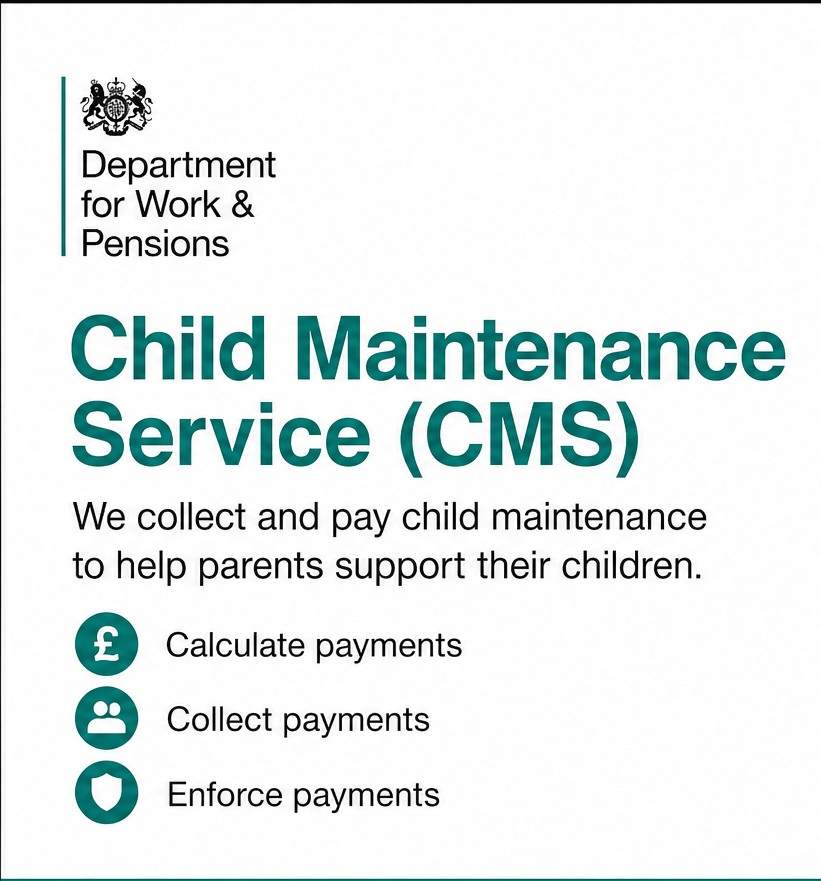
CMS has 3 main jobs:
Calculate
Work out payment amount
Collect
Handle payments if needed
Enforce
Chase unpaid maintenance
Types of Child Maintenance Arrangements
1. Family-Based Arrangement (Private Agreement)
Parents arrange payments themselves.
Advantages
- no CMS fees
- flexible
- less government involvement
Problems
- disagreements
- missed payments
- lack of enforcement
2. Direct Pay
CMS calculates the amount, but parents transfer money directly.
Features
- no collection fees
- CMS still manages calculations
- parents handle payments themselves
3. Collect and Pay
CMS collects money and sends it to the receiving parent.
Usually used when:
- payments are missed
- there is conflict
- domestic abuse concerns exist
Fees
Person
Fee
Paying parent
20% extra
Receiving parent
4% deduction
Example:
- £100 maintenance
- paying parent pays £120
- receiving parent receives £96
How CMS Calculates Payments
CMS mainly uses HMRC income records.
Official guide:
How Child Maintenance Is Worked Out
The 6-Step CMS Formula
Step 1 — Income
CMS checks:
- salary
- self-employment income
- pensions
- benefits
Using HMRC data.
Step 2 — Adjustments
They consider:
- pension contributions
- other children supported
- shared care
- special expenses
Step 3 — Rate Applied
Rates depend on weekly income.
Under £7
Nil
Benefits/£7–£100
Flat (£7/week)
£100–£200
Reduced
£200–£3,000
Basic
Step 4 — Other Children
CMS reduces liability if:
- the paying parent supports other children at home
Step 5 — Weekly Maintenance
CMS calculates final weekly payment.
Step 6 — Shared Care
If children stay overnight regularly with the paying parent:
- payments may reduce
Shared care bands start at:
- 52 nights per year
Calculations Formula
Gross Income *******
Reduction of pension amount
1 child = 12 %
2 = 16%
3 = 19%
Of gross income
- shared care 52 nights+
52 to 103 nights 14.29%
104 to 155 nights 28.57%
156 to 174 nights 42.86%
175 nights or more 50%, plus an extra £7 a week reduction
- other children
The CMS reduces the paying parent's gross income by a percentage based on how many children they have. The percentage reductions are:
One child: 11% reduction
Two children: 14% reduction
Three or more children: 16% reduction
After this (NI) national insurance & TAX taken by HMRC
CMS Enforcement Powers
CMS has strong legal powers if payments are missed.
They can:
Deduction from earnings
Take money from wages
Deduction orders
Take money from bank accounts
Benefit deductions
Take money from benefits
Liability orders
Court-backed debt enforcement
Bailiffs
Seize goods
Driving licence action
Suspend licence
Prison proceedings
In serious cases
CMS and Self-Employed Parents
This is one of the most complained-about areas.
Problems can happen if:
- income appears low on HMRC records
- company directors pay themselves differently
- undeclared income exists
You can ask CMS to investigate:
- hidden income
- assets
- lifestyle inconsistencies
This is called a:
- variation request
Variations (Extra Income Reviews)
CMS can look at:
- rental income
- dividends
- large assets
- unearned income
- company income diversion
Official guidance:
Common CMS Problems
Payment Avoidance
Some parents:
- hide income
- move jobs
- become “self-employed”
- delay payments
Incorrect Calculations
Disputes over:
- shared care
- overnight stays
- earnings
- bonus income
Enforcement Delays
People often complain CMS:
- acts slowly
- misses arrears
- delays action
Communication Problems
Common complaints:
- difficult phone contact
- confusing letters
- inconsistent advice
Domestic Abuse and Safety
CMS has special procedures for domestic abuse cases.
Possible support:
- Collect and Pay
- confidential addresses
- non-geographic bank accounts
If Someone Does Not Pay
CMS may:
- contact the paying parent
- arrange repayment
- enforce deductions
- start legal enforcement
You can report missed payments through your online account.
Challenging CMS Decisions
Mandatory Reconsideration
Ask CMS to review the decision.
Usually within:
- 1 month
Appeal Tribunal
Independent tribunal review if you still disagree.
CMS Arrears
Arrears are unpaid maintenance debt.
CMS can:
- collect old debt
- add enforcement action
- use courts
Even old arrears can still be chased.
CMS and Benefits
Receiving child maintenance:
- usually does NOT reduce benefits
But:
- some council support calculations may differ
CMS Guides and Official Documents
Official CMS Guidance
Step-by-Step Calculation Guide
How CMS Calculates Maintenance
Decision Makers Guidance
Independent Help and Advice
Citizens Advice
Citizens Advice Child Maintenance Help
Child Poverty Action Group
UK Parliament CMS Information
Important Things People Often Miss
CMS Only Deals With Money
It does NOT decide:
- child custody
- visitation/contact
- parenting disputes
Courts handle those issues.
Shared Care Affects Payments
More overnight stays can reduce maintenance.
Income Changes Matter
If income changes significantly:
- tell CMS immediately
Direct Pay Still Requires Proof
Keep:
- bank statements
- screenshots
- payment references
Most Common CMS Complaints
Complaints
Hidden income
Self-employed disputes
Delayed enforcement
Arrears not chased quickly
Shared care disputes
Overnight disagreements
Poor communication
Long phone waits
Wrong calculations
Incorrect HMRC data
Useful FOI Searches About CMS
Search existing requests here:
WhatDoTheyKnow CMS FOI Requests
People often search for:
- CMS complaint numbers
- enforcement statistics
- hidden income investigations
- tribunal overturn rates
- arrears collection data
Key Primary Legislation
- Child Support Act 1991: The foundational legislation that established the legal obligation for maintenance and the statutory framework for assessment, collection, and enforcement.
- Child Maintenance and Other Payments Act 2008: Introduced significant reforms to the system, granting the CMS expanded powers to collect and enforce payments, including deductions directly from earnings or bank accounts.
Core Regulations
- The Child Support Maintenance Calculation Regulations 2012: These regulations govern how the CMS calculates payments. They define the "gross weekly income" thresholds and the different maintenance tiers (e.g., standard, flat, or nil rates).
Child maintenance decision makers' guide
- https://www.gov.uk/government/publications/child-maintenance-decision-makers-guide