
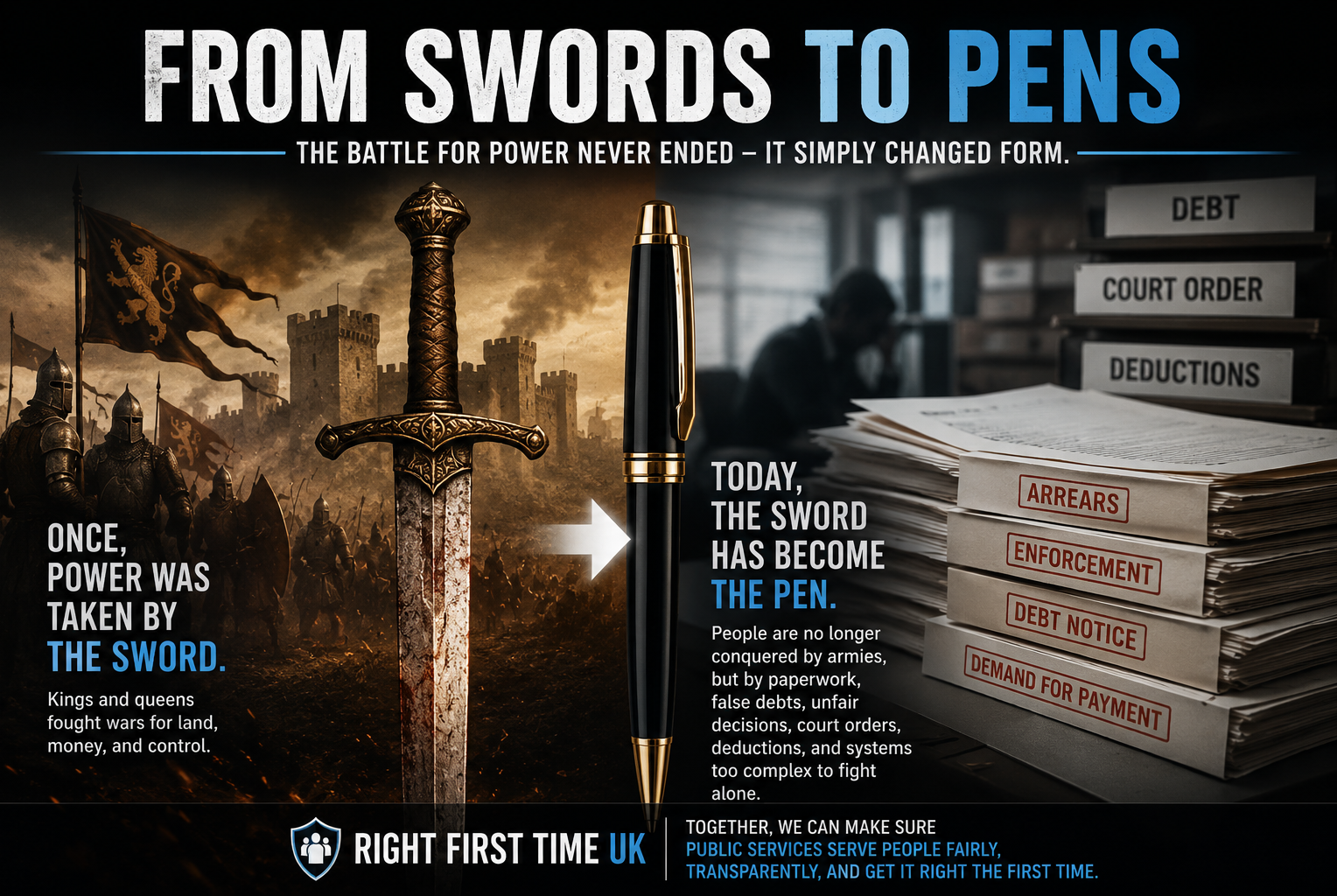
From Swords to Pens
How the Fight for Kings and Queens Became a War of Systems, Paper, and Power
In the earliest ages of humanity, power was simple.
A man with the strongest sword ruled.
A king with the largest army conquered.
A queen with the richest land controlled trade, wealth, and survival.
Wars were fought face to face—steel against steel, blood on the battlefield, castles burning, banners falling.
But history changed.
The sword did not disappear.
It evolved.
The battlefield moved—from open land to offices, from castles to parliaments, from crowns to corporations, from swords to signatures, from armies to institutions.
Today, many of the greatest wars are not fought with blades.
They are fought with laws, taxes, debt, media, paperwork, policy, and control.
The pen became sharper than the sword.
This is that history.
I. The Age of the Sword
Power Was Physical
Thousands of years ago, kingdoms rose through conquest.
Ancient Egypt.
Roman Empire.
Achaemenid Empire.
China.
The Vikings.
The Mongols.
Ottoman Empire.
Medieval Europe.
Land meant survival.
More land meant more food.
More food meant more soldiers.
More soldiers meant more power.
Kings fought kings because land was wealth.
Gold was buried in the earth.
Rivers controlled trade.
Ports controlled empires.
If one ruler wanted more, he marched.
No disguise.
No diplomacy.
Just war.
Swords, shields, horses, siege towers.
Victory belonged to whoever could kill, conquer, and hold.
This was honest brutality.
Everyone knew who the enemy was.
II. The Crown and the Church
Power Became Legitimized
As kingdoms grew, rulers learned something important:
Fear controls people for a while.
Belief controls them for generations.
So kings partnered with religion.
They claimed divine right.
“I do not rule because I am strong.
I rule because God chose me.”
This changed everything.
Now rebellion was not just treason.
It was sin.
The church and the crown became partners.
Taxes were called duty.
War was called holy.
Control was called order.
The sword was still there—
but now it was protected by ideas.
III. Gunpowder Changed the World
The Fall of the Warrior Class
Then came gunpowder.
Cannons destroyed castles.
Muskets killed knights.
Armies became larger, cheaper, and deadlier.
The nobleman with a sword was no longer supreme.
The state became stronger than the individual warrior.
Governments needed:
permanent armies
taxes
bureaucracies
records
administrators
Large wars pushed rulers to build organized bureaucracies and raise taxes to support standing armies.
This is where the modern state was born.
Not from peace—
from war.
As historians often summarize:
War made the state, and the state made war.
Now rulers did not just need swords.
They needed paperwork.
IV. Colonialism
Theft Became International
Europe discovered a new method:
Why fight your neighbor…
when you can conquer the world?
Colonial empires expanded across Africa, Asia, and the Americas.
This was still war—
but disguised as civilization.
Resources were taken.
Labor was exploited.
Cultures were erased.
Gold.
Oil.
Rubber.
Spices.
Cotton.
Human beings.
Kings became empires.
The sword crossed oceans.
But something else grew stronger:
contracts.
Trade companies.
Debt systems.
Legal ownership.
Paper theft.
A signature could now steal more than an army.
V. Industrial War
Nations Replaced Kings
Then came the world wars.
No longer king versus king.
Now nation versus nation.
Factories became weapons.
Banks funded destruction.
Industry decided victory.
Millions died not for a king’s crown—
but for flags, ideologies, and economic survival.
War became mechanized.
The battlefield was no longer only military.
It was economic.
Destroy the supply chain.
Starve the enemy.
Control fuel.
Control steel.
Control finance.
The sword had become a system.
VI. The Cold War
The Invisible Battlefield
After World War II, the strongest nations discovered a terrifying truth:
Direct war could destroy everyone.
Nuclear weapons changed everything.
Now open war between superpowers became too dangerous.
So war moved underground.
Proxy wars.
Coups.
Intelligence agencies.
Economic sabotage.
Propaganda.
Political manipulation.
Debt traps.
War did not end.
It changed clothes.
The battlefield became invisible.
People no longer saw swords.
But they still bled.
VII. Modern Democracy and Hidden Power
The Public Pays the Price
Today many people believe kings are gone.
But power never disappears.
It changes shape.
Now rulers wear suits.
Instead of crowns:
titles.
Instead of kingdoms:
institutions.
Instead of royal armies:
systems of finance, surveillance, and law.
The fight is often no longer over territory.
It is over:
debt
taxation
labour
information
compliance
obedience
Citizens work.
Citizens pay.
Citizens obey.
And many feel robbed without seeing the thief.
Because modern theft rarely looks like robbery.
It looks like policy.
It looks like inflation.
It looks like contracts nobody can escape.
It looks like laws written by those already in power.
The public funds the machine.
And the machine protects itself.
VIII. From Swords to Pens
The New War
This is the true transformation.
Before:
“They came with swords.”
Now:
“They come with signatures.”
Before:
“They burned your village.”
Now:
“They price you out of your home.”
Before:
“They stole your gold.”
Now:
“They control your wages, your debt, your future.”
Before:
“The enemy wore Armor.”
Now:
“The enemy may wear a tie.”
The violence is cleaner.
But often deeper.
Because chains you cannot see are harder to break.
IX. What Fights Does the Public Face Now?
The Daily Battlefield
Today’s public often fights:
not enemy armies—
but systems.
The Fight for Money
Working More, Owning Less
People work full time and still struggle to afford:
rent
food
heating
transport
healthcare
education
raising children
Wages rise slowly.
Prices rise fast.
Debt becomes normal.
People run harder just to stand still.
The Fight for Housing
Shelter Becoming a Luxury
Homes were once security.
Now housing feels like survival.
Rent rises.
Mortgages trap.
Landlords gain power.
People fight not for castles—
but for somewhere safe to sleep.
The Fight for Time
Life Controlled by Survival
Long shifts.
Commuting.
Multiple jobs.
Constant pressure.
Time becomes the richest currency.
People are fighting not only for money—
but for hours of their own life.
The Fight for Truth
Information Wars
News.
Social media.
Politics.
Advertising.
Everyone wants belief.
People ask:
What is real?
Who is lying?
Who benefits?
The Fight for Privacy
Watched Without Seeing It
Phones track.
Apps collect.
Governments monitor.
Companies study behaviour.
Freedom changes when every movement becomes data.
The Fight for Health
Survival Through Systems
Stress becomes normal.
Burnout becomes common.
Mental health declines.
People fight their own bodies while navigating systems that feel cold and distant.
The Fight for Fairness
Rules That Feel Unequal
The poor are punished quickly.
The powerful are protected slowly.
Trust breaks when fairness feels selective.
The Fight for Voice
Being Heard
Many feel ignored by leaders, employers, institutions.
People fight to matter.
To be seen.
To influence the lives they are expected to live.
X. Who Causes This?
Usually not one hidden villain.
Usually:
concentrated power
large institutions
monopolies
political networks
financial systems
historic wealth structures
The issue is often not evil masterminds.
It is that power protects itself.
Systems reward profit before wellbeing.
And people become secondary.
XI. Who Profits in the UK?
Often:
large asset owners
major landlords
investment funds
major banks
energy producers
large corporations
The divide is often not:
rich country vs poor country
but:
asset owners vs income earners
Ownership beats labour.
That is where much of the profit sits.
XII. How Does the Public Fight Back?
The Pen Is Also Resistance
History gives one final truth:
The pen is not only used by rulers.
It is also used by the people.
Laws can oppress.
But words can expose.
Books start revolutions.
Journalism breaks empires.
Ideas destroy tyrants.
Truth terrifies corruption.
The same pen that signs oppression—
can write freedom.
That is why powerful people fear voices.
Not swords.
Voices.
Because once people understand the game—
the game changes.
XIII. Strategic Plan
Now We Know We Have a Plan
1. Expose the System
Follow the money.
Who owns?
Who profits?
Who writes the rules?
Ask:
Who benefits if nothing changes?
2. Build Local Strength
Tenant unions.
Community buying groups.
Mutual aid.
Food co-ops.
Local support systems.
Small structures protect people from large ones.
3. Protect Households First
Debt advice.
Rent advice.
Legal rights.
Energy support.
Financial education.
Survival comes before reform.
4. Demand Fair Rules
Pressure leaders.
Demand:
fair taxation
housing reform
stronger regulation
transparent lobbying laws
anti-monopoly enforcement
public accountability
5. Organize, Not Just Complain
Votes matter.
Unions matter.
Community action matters.
Silence protects power.
Organization challenges it.
6. Protect Truth
Support independent journalism.
Learn history.
Teach critical thinking.
Propaganda survives where memory dies.
Human history is not the story of weapons.
It is the story of power.
From swords to pens,
from kings to governments,
from castles to corporations—
the struggle has always been the same:
Who controls wealth?
Who controls land?
Who controls people?
And who pays the price?
The methods changed.
The hunger did not.
The war never ended.
It only learned how to wear a better suit.
Now we know.
We have a plan.
Donate to us
Your donation helps us support families, challenge injustice, expose failures, and push for real legal reforms
REGISTRATIONS IN PROGRESS
Sign petition
We call on Parliament to request the National Audit Office (NAO) to conduct an audit of all arrears transferred between CSA and CMS (1993–2025), with results made public. Contractor data handling and verification must be transparent, and arrears checks kept active during any upgrades.